3/41
●
●
●
-
-
4/41
●
-
mammal placental carnivore canine dog working dog husky
vehicle craft watercraft sailing vessel sailboat trimaran
Figure 1: A snapshot of two root-to-leaf branches of ImageNet: the top row is from the mammal subtree; the bottom row is from the
vehicle subtree. For each synset, 9 randomly sampled images are presented.
Summary of selected subtrees
Imagenet Cat SubtreeESP Cat Subtree
5/41
●
6/41
Ranjay Krishna et al.
8 Ranjay Kris
Fig. 6: From all of the region descriptions, we extract
all objects mentioned. For example, from the region de-
scription “man jumping over a fire hydrant,” we extract
man and fire hydrant.
Fig. 8: Our dataset also captures the relations
interactions between objects in our images. In
ample, we show the relationship jumping o
tween the objects man and fire hydrant.
over on the object fire hydrant. Each
Ranjay Krishna et al.
7/41
●
-
●
(e.g., how much to reward workers, whether to reject their
work, or impose a reputation penalty) their power is
attenuated due to factors such as lack of direct supervision
and visibility into their work behavior, lack of nuanced and
individualized rewards, and the difficulty of imposing
stringent and lasting sanctions (since workers can leave
Th
w
va
m
be
pa
to
pr
an
st
m
A
w
ea
B
te
cr
sp
ne
fo
th
un
fo
pr
cu
ex
th
ef
cl
in
[6
Figure 2: Proposed framework for future crowd work
processes to support complex and interdependent work.
8/41
●
o
o
●
●
9/41
●
-
●
-
-
Microtasks and Crowdsourcing #chi4good, CHI 2016, San Jose, CA, USA
11/41
●
●
●
FALSE
TRUE
TRUE
TRUE?
FALSE?
12/41
●
TRUE TRUE TRUE
FALSE TRUE TRUE
TRUE FALSE TRUE
?
?
?
13/41
● 𝑗
●
TRUE FALSE
TRUE
FALSE
↵j
1
↵j
0
↵j
1
↵j
0
14/41
●
TRUE TRUE TRUE
FALSE TRUE TRUE
TRUE FALSE TRUE
?
?
?
15/41
●
-
-
●
wj ( , + )
xi [0, + )
Pr [yij = ti] =
1
1 + exp ( wjxi)
16/41
●
●
Pr [yij = 1] =
w>
j xi ⌧j
j
!
xi
wj
17/41
●
-
-
●
(d) ARJ
(b) SRJ
(c) CF
Accurate (28%) Mosty accurate (12%) Outer class biased (29%) Middle class biased (29%)
uth Predicted Truth Predicted Truth Predicted Truth Predicted
Truth PredictedTruth PredictedTruth Predicteduth Predicted
Truth PredictedTruth PredictedTruth Predicted
0 0 0
11
0.5
0
11
0.5
0
11
0
0.5
-1
01
-1
0
1
-1
01 1 0 -1-1
01
1
0 -1
1
0
-1
1 0 -1
-1
01
-1
01
-1
0 1 0 -1-1
01 0 -10 -1
1 0 -1
11 1
0 1 234
0
12 3
34
0 1 234
012 3
34
0 1 234
012 3
34
0.8
0.4
0
0.8
0.4
0
0.8
0.4
0
0.8
Middle class biased (34%)Accurate (28%) Mosty accurate (12%) Outer class biased (29%)
Decisive (5%)Conservative (4%)Calibrated (91%)
18/41
●
●
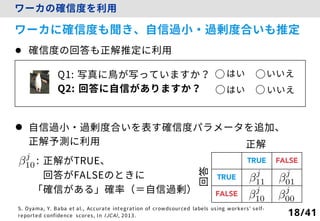
TRUE FALSE
TRUE
FALSE
:
j
10
j
10
j
11
j
01
j
00
19/41
●
●
20/41
●
●
-
860 43 …
43 215 215 860 860
860 860 215 215 215 215
21/41
“A silver tabby
cat is howling
with his mouth
wide open’’
“A sleeping
cat’’
“Dreaming of
becoming a
lion’’
4.7
1.2
2.6
22/41
●
●
●
2.6
“Dreaming
of becoming
a lion’’
23/41
●
-
-
●
-
-
µa
a
r
r
25/41
●
●
-
-
26/41
●
-
●
-
27/41
●
●
-
-
●
-
-
28/41
●
-
-
healthline
Figure 3: Example ad to attract users
time a user clicks on the a
we record a conversion ev
the advertising system. T
the system to optimize th
mizing the number of con
contribution yield, instea
the number of clicks.
Although optimizing fo
Figure 1: Screenshot of the Quizz system.
29/41
●
●
-
-
30/41
31/41
qmw qz qua qb
qM
QqN
TI
K
e
UKu
u
E D P 2
V
qt qJ
'2
V'I
'
E
qmyM
K
Figure 1: Fine Grained Truth Discovery Model for Crowd-
sourced Data Aggregation.
• For the q-th question (q = 1, 2, · · · , Q)
– Draw a topic zq ∼ Multi(θ)
to question q. Le
topical words in qu
ground words, θk
φkw = p(w|k) be
topic k. Then the
times in question q
ity of background
independent, and t
der topic k and wo
p(wq|k, y
where V is the num
V
w=1(nw
q,y=1 + n
dent, and the proba
p(w|θ, φ, φ′
) =
𝑞
𝑞
𝑚
𝑞 𝑢
𝑘 𝑞 𝑢
𝜎 𝑥 = 1/ 1 + exp −𝑥
(⇢kueku bq)
𝑘 𝑢
𝑘
𝑢
𝑞
32/41
●
-
●
●
Q1. “The accident triggered the establishment of the Law for the …”
☐ ☑☑ ☑
● 𝑥0, 𝑦0
● 𝑥0, 𝑦03, 𝑦04, ⋯
●
-
-
34/41
Pr [yi = 1 | xi] =
1
1 + exp ( w>xi)
Pr [yij | yi = 1] =
⇣
↵j
1
⌘yij
⇣
1 ↵j
1
⌘(1 yij )
35/41
●
●
●
Visual Recognition with Humans in the Loop 3
er vision is helpful Computer vision is not helpfuler vision is helpful Computer vision is not helpful
The bird is a 
Black‐footed 
Albatross
Is the belly 
white? yes
Are the eyes 
white? yes
Th bi d i
Is the beak cone‐shaped? yes
Is the upper‐tail brown? yes
Is the breast solid colored? no
Is the breast striped? yes
I h h hi ?The bird is a 
Parakeet Auklet
Is the throat white? yes
The bird is a Henslow’s
Sparrow
amples of the visual 20 questions game on the 200 class Bird dataset.
ponses (shown in red) to questions posed by the computer (shown in blue)
drive up recognition accuracy. In the left image, computer vision algorithms
he bird species correctly without any user interaction. In the middle image,
vision reduces the number of questions to 2. In the right image, computer
ides little help.
YES
YES
NO
36/41
●
-
Crowd-Machine Learning Classifiers
Justin Cheng and Michael S. Bernstein
Stanford University
{jcccf, msb}@cs.stanford.edu
ing classifiers: clas-
en description of a
predictive features
tures using machine
rate and use human-
lassifiers enable fast
that can improve on
judgment, and ac-
extraction is not yet
arning platform, in-
nformative features,
d examples, an ap-
g. The crowd’s ef-
s of the input space
Figure 1. Flock is a hybrid crowd-machine learning platform that capi-
talizes on analogical encoding to guide crowds to nominate effective fea-
37/41
●
-
●
-
-
…
38/41
0.4
0.6
0.8
1.0
Aug 19 Aug 26 Sep 02 Sep 09 Sep 16
提出日
AUC
参加者1
参加者2
参加者3
参加者4
参加者5
参加者6
参加者7
参加者8
参加者9
参加者10
参加者11
参加者12
参加者13
参加者14
参加者15
参加者16
NLDR
LM
統合
AUC=0.982
AUC=0.946
AUC=0.717
39/41
●
-
●
●
40/41
Figure 3. An example analysis microtask shows a single chart (a)
along with chart-reading subtasks (b) an annotation subtask (c) and
a feature-oriented explanation prompt designed to encourage workers
Figure 3. An example analysis microtask shows a single chart (a)
along with chart-reading subtasks (b) an annotation subtask (c) and
a feature-oriented explanation prompt designed to encourage workers
41/41
●
-
●
-
●
-
-
-

群衆の知を引き出すための機械学習(第4回ステアラボ人工知能セミナー)

  • 3.
  • 4.
    4/41 ● - mammal placental carnivorecanine dog working dog husky vehicle craft watercraft sailing vessel sailboat trimaran Figure 1: A snapshot of two root-to-leaf branches of ImageNet: the top row is from the mammal subtree; the bottom row is from the vehicle subtree. For each synset, 9 randomly sampled images are presented. Summary of selected subtrees Imagenet Cat SubtreeESP Cat Subtree
  • 5.
  • 6.
    6/41 Ranjay Krishna etal. 8 Ranjay Kris Fig. 6: From all of the region descriptions, we extract all objects mentioned. For example, from the region de- scription “man jumping over a fire hydrant,” we extract man and fire hydrant. Fig. 8: Our dataset also captures the relations interactions between objects in our images. In ample, we show the relationship jumping o tween the objects man and fire hydrant. over on the object fire hydrant. Each Ranjay Krishna et al.
  • 7.
    7/41 ● - ● (e.g., how muchto reward workers, whether to reject their work, or impose a reputation penalty) their power is attenuated due to factors such as lack of direct supervision and visibility into their work behavior, lack of nuanced and individualized rewards, and the difficulty of imposing stringent and lasting sanctions (since workers can leave Th w va m be pa to pr an st m A w ea B te cr sp ne fo th un fo pr cu ex th ef cl in [6 Figure 2: Proposed framework for future crowd work processes to support complex and interdependent work.
  • 8.
  • 9.
    9/41 ● - ● - - Microtasks and Crowdsourcing#chi4good, CHI 2016, San Jose, CA, USA
  • 11.
  • 12.
    12/41 ● TRUE TRUE TRUE FALSETRUE TRUE TRUE FALSE TRUE ? ? ?
  • 13.
  • 14.
    14/41 ● TRUE TRUE TRUE FALSETRUE TRUE TRUE FALSE TRUE ? ? ?
  • 15.
    15/41 ● - - ● wj ( ,+ ) xi [0, + ) Pr [yij = ti] = 1 1 + exp ( wjxi)
  • 16.
    16/41 ● ● Pr [yij =1] = w> j xi ⌧j j ! xi wj
  • 17.
    17/41 ● - - ● (d) ARJ (b) SRJ (c)CF Accurate (28%) Mosty accurate (12%) Outer class biased (29%) Middle class biased (29%) uth Predicted Truth Predicted Truth Predicted Truth Predicted Truth PredictedTruth PredictedTruth Predicteduth Predicted Truth PredictedTruth PredictedTruth Predicted 0 0 0 11 0.5 0 11 0.5 0 11 0 0.5 -1 01 -1 0 1 -1 01 1 0 -1-1 01 1 0 -1 1 0 -1 1 0 -1 -1 01 -1 01 -1 0 1 0 -1-1 01 0 -10 -1 1 0 -1 11 1 0 1 234 0 12 3 34 0 1 234 012 3 34 0 1 234 012 3 34 0.8 0.4 0 0.8 0.4 0 0.8 0.4 0 0.8 Middle class biased (34%)Accurate (28%) Mosty accurate (12%) Outer class biased (29%) Decisive (5%)Conservative (4%)Calibrated (91%)
  • 18.
  • 19.
  • 20.
    20/41 ● ● - 860 43 … 43215 215 860 860 860 860 215 215 215 215
  • 21.
    21/41 “A silver tabby catis howling with his mouth wide open’’ “A sleeping cat’’ “Dreaming of becoming a lion’’ 4.7 1.2 2.6
  • 22.
  • 23.
  • 25.
  • 26.
  • 27.
  • 28.
    28/41 ● - - healthline Figure 3: Examplead to attract users time a user clicks on the a we record a conversion ev the advertising system. T the system to optimize th mizing the number of con contribution yield, instea the number of clicks. Although optimizing fo Figure 1: Screenshot of the Quizz system.
  • 29.
  • 30.
  • 31.
    31/41 qmw qz quaqb qM QqN TI K e UKu u E D P 2 V qt qJ '2 V'I ' E qmyM K Figure 1: Fine Grained Truth Discovery Model for Crowd- sourced Data Aggregation. • For the q-th question (q = 1, 2, · · · , Q) – Draw a topic zq ∼ Multi(θ) to question q. Le topical words in qu ground words, θk φkw = p(w|k) be topic k. Then the times in question q ity of background independent, and t der topic k and wo p(wq|k, y where V is the num V w=1(nw q,y=1 + n dent, and the proba p(w|θ, φ, φ′ ) = 𝑞 𝑞 𝑚 𝑞 𝑢 𝑘 𝑞 𝑢 𝜎 𝑥 = 1/ 1 + exp −𝑥 (⇢kueku bq) 𝑘 𝑢 𝑘 𝑢 𝑞
  • 32.
    32/41 ● - ● ● Q1. “The accidenttriggered the establishment of the Law for the …” ☐ ☑☑ ☑
  • 34.
    ● 𝑥0, 𝑦0 ●𝑥0, 𝑦03, 𝑦04, ⋯ ● - - 34/41 Pr [yi = 1 | xi] = 1 1 + exp ( w>xi) Pr [yij | yi = 1] = ⇣ ↵j 1 ⌘yij ⇣ 1 ↵j 1 ⌘(1 yij )
  • 35.
    35/41 ● ● ● Visual Recognition withHumans in the Loop 3 er vision is helpful Computer vision is not helpfuler vision is helpful Computer vision is not helpful The bird is a  Black‐footed  Albatross Is the belly  white? yes Are the eyes  white? yes Th bi d i Is the beak cone‐shaped? yes Is the upper‐tail brown? yes Is the breast solid colored? no Is the breast striped? yes I h h hi ?The bird is a  Parakeet Auklet Is the throat white? yes The bird is a Henslow’s Sparrow amples of the visual 20 questions game on the 200 class Bird dataset. ponses (shown in red) to questions posed by the computer (shown in blue) drive up recognition accuracy. In the left image, computer vision algorithms he bird species correctly without any user interaction. In the middle image, vision reduces the number of questions to 2. In the right image, computer ides little help. YES YES NO
  • 36.
    36/41 ● - Crowd-Machine Learning Classifiers JustinCheng and Michael S. Bernstein Stanford University {jcccf, msb}@cs.stanford.edu ing classifiers: clas- en description of a predictive features tures using machine rate and use human- lassifiers enable fast that can improve on judgment, and ac- extraction is not yet arning platform, in- nformative features, d examples, an ap- g. The crowd’s ef- s of the input space Figure 1. Flock is a hybrid crowd-machine learning platform that capi- talizes on analogical encoding to guide crowds to nominate effective fea-
  • 37.
  • 38.
    38/41 0.4 0.6 0.8 1.0 Aug 19 Aug26 Sep 02 Sep 09 Sep 16 提出日 AUC 参加者1 参加者2 参加者3 参加者4 参加者5 参加者6 参加者7 参加者8 参加者9 参加者10 参加者11 参加者12 参加者13 参加者14 参加者15 参加者16 NLDR LM 統合 AUC=0.982 AUC=0.946 AUC=0.717
  • 39.
  • 40.
    40/41 Figure 3. Anexample analysis microtask shows a single chart (a) along with chart-reading subtasks (b) an annotation subtask (c) and a feature-oriented explanation prompt designed to encourage workers Figure 3. An example analysis microtask shows a single chart (a) along with chart-reading subtasks (b) an annotation subtask (c) and a feature-oriented explanation prompt designed to encourage workers
  • 41.