Accuracy and Precision in
analytical procedure
validation
Presented by:
Sampat Choudhary
Department of pharmaceutical
analysis
NIPER Hyderabad
Course code: GE-611
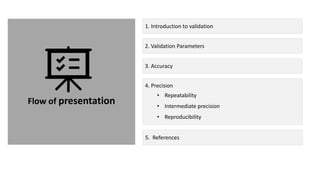
Flow of presentation
1. Introduction to validation
2. Validation Parameters
3. Accuracy
4. Precision
• Repeatability
• Intermediate precision
• Reproducibility
5. References
• A documented act of proving any procedure, process, equipment,
material, activity, or system actually leads to expected results.
Objectives:
• Important element of quality control
• Ensures that procedure is reliable and produce accurate results.
• Regulatory requirement.
Validation
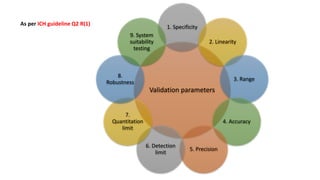
As per ICH guideline Q2 R(1)
Validation parameters
1. Specificity
2. Linearity
3. Range
4. Accuracy
5. Precision
6. Detection
limit
7.
Quantitation
limit
8.
Robustness
9. System
suitability
testing
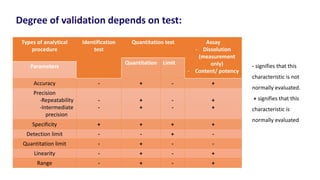
Types of analytical
procedure
Identification
test
Quantitation test Assay
- Dissolution
(measurement
only)
- Content/ potency
Quantitation Limit
Parameters
Accuracy - + - +
Precision
-Repeatability
-Intermediate
precision
-
-
+
+
-
-
+
+
Specificity + + + +
Detection limit - - + -
Quantitation limit - + - -
Linearity - + - +
Range - + - +
- signifies that this
characteristic is not
normally evaluated.
+ signifies that this
characteristic is
normally evaluated
Degree of validation depends on test:
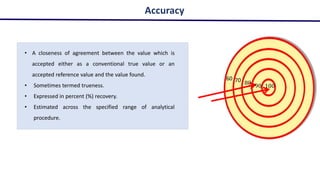
• A closeness of agreement between the value which is
accepted either as a conventional true value or an
accepted reference value and the value found.
• Sometimes termed trueness.
• Expressed in percent (%) recovery.
• Estimated across the specified range of analytical
procedure.
Accuracy
100
90
80
70
60
Methods to determine accuracy
 Direct method:
• Analysing a sample of known concentration and comparing the measured value to
the true value.
 Spiked placebo (Product matrix) recovery method :
• A known amount of pure active constituent is added to formulation blank, Then assayed.
• A sample containing active pharmaceutical ingredient is assayed.
• A results obtained are compared with expected results.
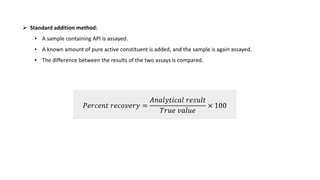
𝑃𝑒𝑟𝑐𝑒𝑛𝑡 𝑟𝑒𝑐𝑜𝑣𝑒𝑟𝑦 =
𝐴𝑛𝑎𝑙𝑦𝑡𝑖𝑐𝑎𝑙 𝑟𝑒𝑠𝑢𝑙𝑡
𝑇𝑟𝑢𝑒 𝑣𝑎𝑙𝑢𝑒
× 100
 Standard addition method:
• A sample containing API is assayed.
• A known amount of pure active constituent is added, and the sample is again assayed.
• The difference between the results of the two assays is compared.
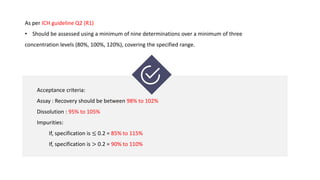
As per ICH guideline Q2 (R1)
• Should be assessed using a minimum of nine determinations over a minimum of three
concentration levels (80%, 100%, 120%), covering the specified range.
Acceptance criteria:
Assay : Recovery should be between 98% to 102%
Dissolution : 95% to 105%
Impurities:
If, specification is ≤ 0.2 = 85% to 115%
If, specification is > 0.2 = 90% to 110%
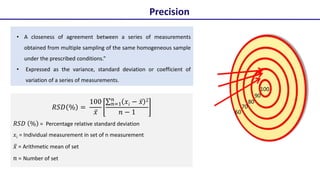
𝑅𝑆𝐷 % =
100
𝑥̅
𝑛=1
𝑛
𝑥̅𝑖 − 𝑥̅ 2
𝑛 − 1
𝑅𝑆𝐷 % = Percentage relative standard deviation
𝑥̅𝑖 = Individual measurement in set of n measurement
𝑥̅ = Arithmetic mean of set
𝑛 = Number of set
• A closeness of agreement between a series of measurements
obtained from multiple sampling of the same homogeneous sample
under the prescribed conditions.”
• Expressed as the variance, standard deviation or coefficient of
variation of a series of measurements.
Precision
100
90
80
70
60
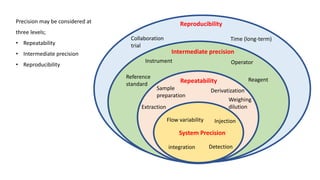
Precision may be considered at
three levels;
• Repeatability
• Intermediate precision
• Reproducibility
System Precision
Repeatability
Intermediate precision
Reproducibility
Flow variability
integration Detection
Injection
Derivatization
Weighing
dilution
Extraction
Sample
preparation
Instrument
Collaboration
trial
Time (long-term)
Operator
Reagent
Reference
standard
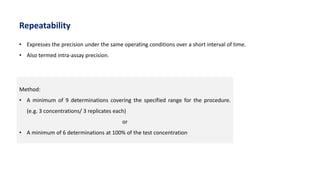
Method:
• A minimum of 9 determinations covering the specified range for the procedure.
(e.g. 3 concentrations/ 3 replicates each)
or
• A minimum of 6 determinations at 100% of the test concentration
• Expresses the precision under the same operating conditions over a short interval of time.
• Also termed intra-assay precision.
Repeatability
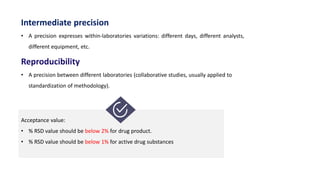
Intermediate precision
• A precision expresses within-laboratories variations: different days, different analysts,
different equipment, etc.
Reproducibility
• A precision between different laboratories (collaborative studies, usually applied to
standardization of methodology).
Acceptance value:
• % RSD value should be below 2% for drug product.
• % RSD value should be below 1% for active drug substances.
1. Guideline, ICH., Validation of analytical procedures: text and
methodology. Q2 (R1), 2005. 1(20): p. 05.
2. Gupta, et al., Method validation of analytical procedures.
PharmaTutor, 2015. 3(1): p. 32-39.
3. Ravichandran, V., et al., Validation of analytical methods–
strategies & importance. International Journal of Pharmacy and
Pharmaceutical Sciences, 2010. 2(3): p. 18-22.
4. Nash, R.A., et al., Pharmaceutical process validation. 2003: Marcel
Dekker New York.
References
Thank you
The astounding difference between accuracy and precision is,
consistency.
- Jaaziel Charishma Ragland

Accuracy and precision presentation

  • 1.
    Accuracy and Precisionin analytical procedure validation Presented by: Sampat Choudhary Department of pharmaceutical analysis NIPER Hyderabad Course code: GE-611
  • 2.
    Flow of presentation 1.Introduction to validation 2. Validation Parameters 3. Accuracy 4. Precision • Repeatability • Intermediate precision • Reproducibility 5. References
  • 3.
    • A documentedact of proving any procedure, process, equipment, material, activity, or system actually leads to expected results. Objectives: • Important element of quality control • Ensures that procedure is reliable and produce accurate results. • Regulatory requirement. Validation
  • 4.
    As per ICHguideline Q2 R(1) Validation parameters 1. Specificity 2. Linearity 3. Range 4. Accuracy 5. Precision 6. Detection limit 7. Quantitation limit 8. Robustness 9. System suitability testing
  • 5.
    Types of analytical procedure Identification test Quantitationtest Assay - Dissolution (measurement only) - Content/ potency Quantitation Limit Parameters Accuracy - + - + Precision -Repeatability -Intermediate precision - - + + - - + + Specificity + + + + Detection limit - - + - Quantitation limit - + - - Linearity - + - + Range - + - + - signifies that this characteristic is not normally evaluated. + signifies that this characteristic is normally evaluated Degree of validation depends on test:
  • 6.
    • A closenessof agreement between the value which is accepted either as a conventional true value or an accepted reference value and the value found. • Sometimes termed trueness. • Expressed in percent (%) recovery. • Estimated across the specified range of analytical procedure. Accuracy 100 90 80 70 60
  • 7.
    Methods to determineaccuracy  Direct method: • Analysing a sample of known concentration and comparing the measured value to the true value.  Spiked placebo (Product matrix) recovery method : • A known amount of pure active constituent is added to formulation blank, Then assayed. • A sample containing active pharmaceutical ingredient is assayed. • A results obtained are compared with expected results.
  • 8.
    𝑃𝑒𝑟𝑐𝑒𝑛𝑡 𝑟𝑒𝑐𝑜𝑣𝑒𝑟𝑦 = 𝐴𝑛𝑎𝑙𝑦𝑡𝑖𝑐𝑎𝑙𝑟𝑒𝑠𝑢𝑙𝑡 𝑇𝑟𝑢𝑒 𝑣𝑎𝑙𝑢𝑒 × 100  Standard addition method: • A sample containing API is assayed. • A known amount of pure active constituent is added, and the sample is again assayed. • The difference between the results of the two assays is compared.
  • 9.
    As per ICHguideline Q2 (R1) • Should be assessed using a minimum of nine determinations over a minimum of three concentration levels (80%, 100%, 120%), covering the specified range. Acceptance criteria: Assay : Recovery should be between 98% to 102% Dissolution : 95% to 105% Impurities: If, specification is ≤ 0.2 = 85% to 115% If, specification is > 0.2 = 90% to 110%
  • 10.
    𝑅𝑆𝐷 % = 100 𝑥̅ 𝑛=1 𝑛 𝑥̅𝑖− 𝑥̅ 2 𝑛 − 1 𝑅𝑆𝐷 % = Percentage relative standard deviation 𝑥̅𝑖 = Individual measurement in set of n measurement 𝑥̅ = Arithmetic mean of set 𝑛 = Number of set • A closeness of agreement between a series of measurements obtained from multiple sampling of the same homogeneous sample under the prescribed conditions.” • Expressed as the variance, standard deviation or coefficient of variation of a series of measurements. Precision 100 90 80 70 60
  • 11.
    Precision may beconsidered at three levels; • Repeatability • Intermediate precision • Reproducibility System Precision Repeatability Intermediate precision Reproducibility Flow variability integration Detection Injection Derivatization Weighing dilution Extraction Sample preparation Instrument Collaboration trial Time (long-term) Operator Reagent Reference standard
  • 12.
    Method: • A minimumof 9 determinations covering the specified range for the procedure. (e.g. 3 concentrations/ 3 replicates each) or • A minimum of 6 determinations at 100% of the test concentration • Expresses the precision under the same operating conditions over a short interval of time. • Also termed intra-assay precision. Repeatability
  • 13.
    Intermediate precision • Aprecision expresses within-laboratories variations: different days, different analysts, different equipment, etc. Reproducibility • A precision between different laboratories (collaborative studies, usually applied to standardization of methodology). Acceptance value: • % RSD value should be below 2% for drug product. • % RSD value should be below 1% for active drug substances.
  • 14.
    1. Guideline, ICH.,Validation of analytical procedures: text and methodology. Q2 (R1), 2005. 1(20): p. 05. 2. Gupta, et al., Method validation of analytical procedures. PharmaTutor, 2015. 3(1): p. 32-39. 3. Ravichandran, V., et al., Validation of analytical methods– strategies & importance. International Journal of Pharmacy and Pharmaceutical Sciences, 2010. 2(3): p. 18-22. 4. Nash, R.A., et al., Pharmaceutical process validation. 2003: Marcel Dekker New York. References
  • 15.
    Thank you The astoundingdifference between accuracy and precision is, consistency. - Jaaziel Charishma Ragland