Future Time Be going to Will Present Continuous Present Simple Summary
Be going to We use  am/is/are going to  to speak about: Intention We use the special  “be going to”  construction when we have the intention to do something before we speak. We have already made a decision before speaking.  Look at these examples: I have won $1,000. I am going to buy a new TV. We're not going to see my mother tomorrow. When are you going to go on holiday? In these examples, we had an intention or plan before speaking. The decision had been made before we started to speak.
Be going to 2.  Prediction We often use  “be going to”  to make a prediction about the future. Our prediction is based on evidence. We are saying what seems sure to happen.  Here are some examples: The sky is very black. It is going to snow. It's 8.30! You're going to miss the train! I crashed the company car. My boss isn't going to be very happy! In these examples, the present situation (black sky/the time/damaged car) gives us a good idea of what is going to happen.
Will One of the most common ways to talk about the future is using “will”, for example: I will call you tonight. We often call this the "future simple tense", but technically there are no future tenses in English. In this construction, the word will is a modal auxiliary verb.
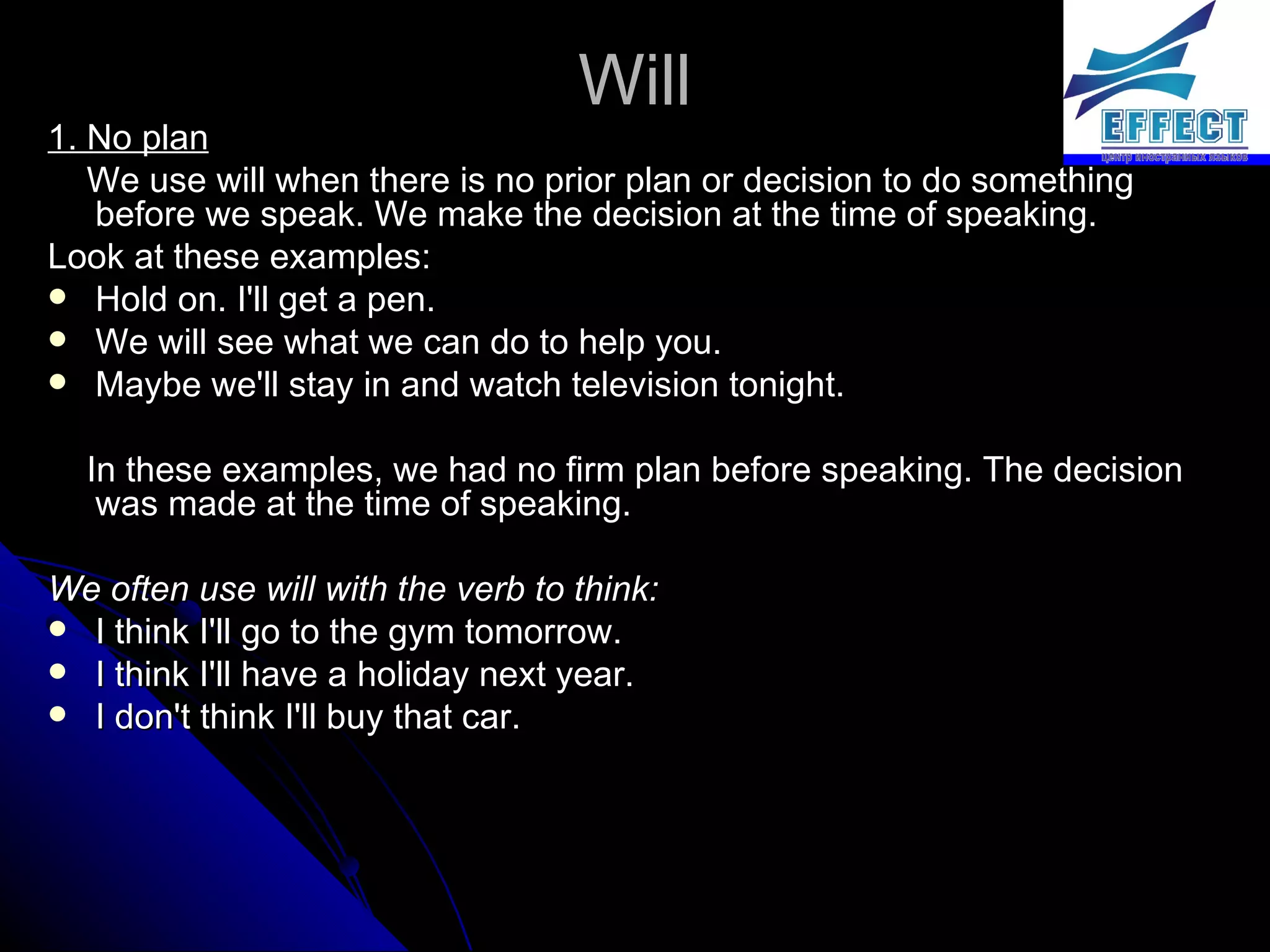
Will 1. No plan We use will when there is no prior plan or decision to do something before we speak. We make the decision at the time of speaking.  Look at these examples: Hold on. I'll get a pen. We will see what we can do to help you. Maybe we'll stay in and watch television tonight. In these examples, we had no firm plan before speaking. The decision was made at the time of speaking. We often use will with the verb to think: I think I'll go to the gym tomorrow. I think I'll have a holiday next year. I don't think I'll buy that car.
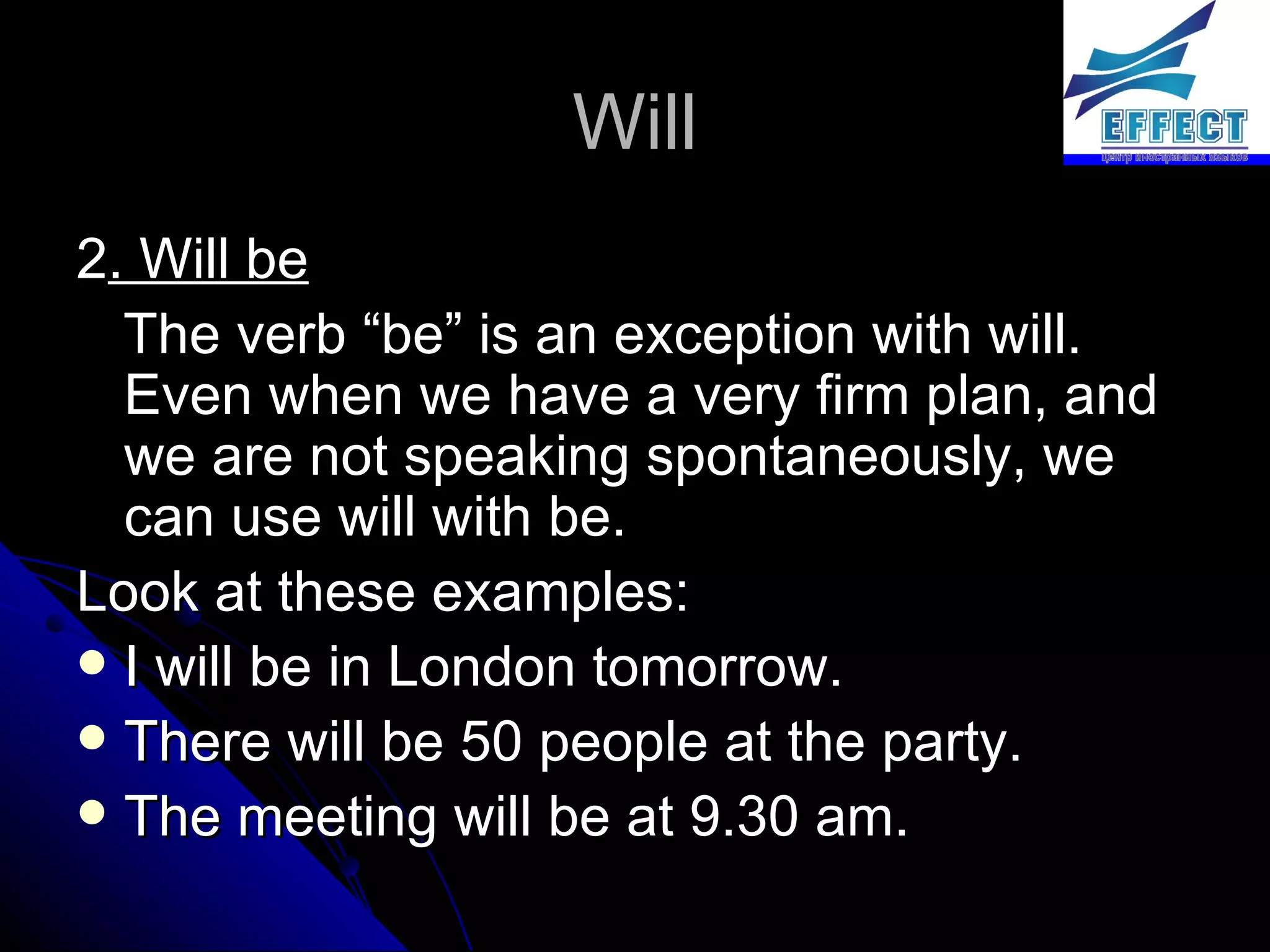
Will 2 . Will be The verb “be” is an exception with will. Even when we have a very firm plan, and we are not speaking spontaneously, we can use will with be.  Look at these examples: I will be in London tomorrow. There will be 50 people at the party. The meeting will be at 9.30 am.
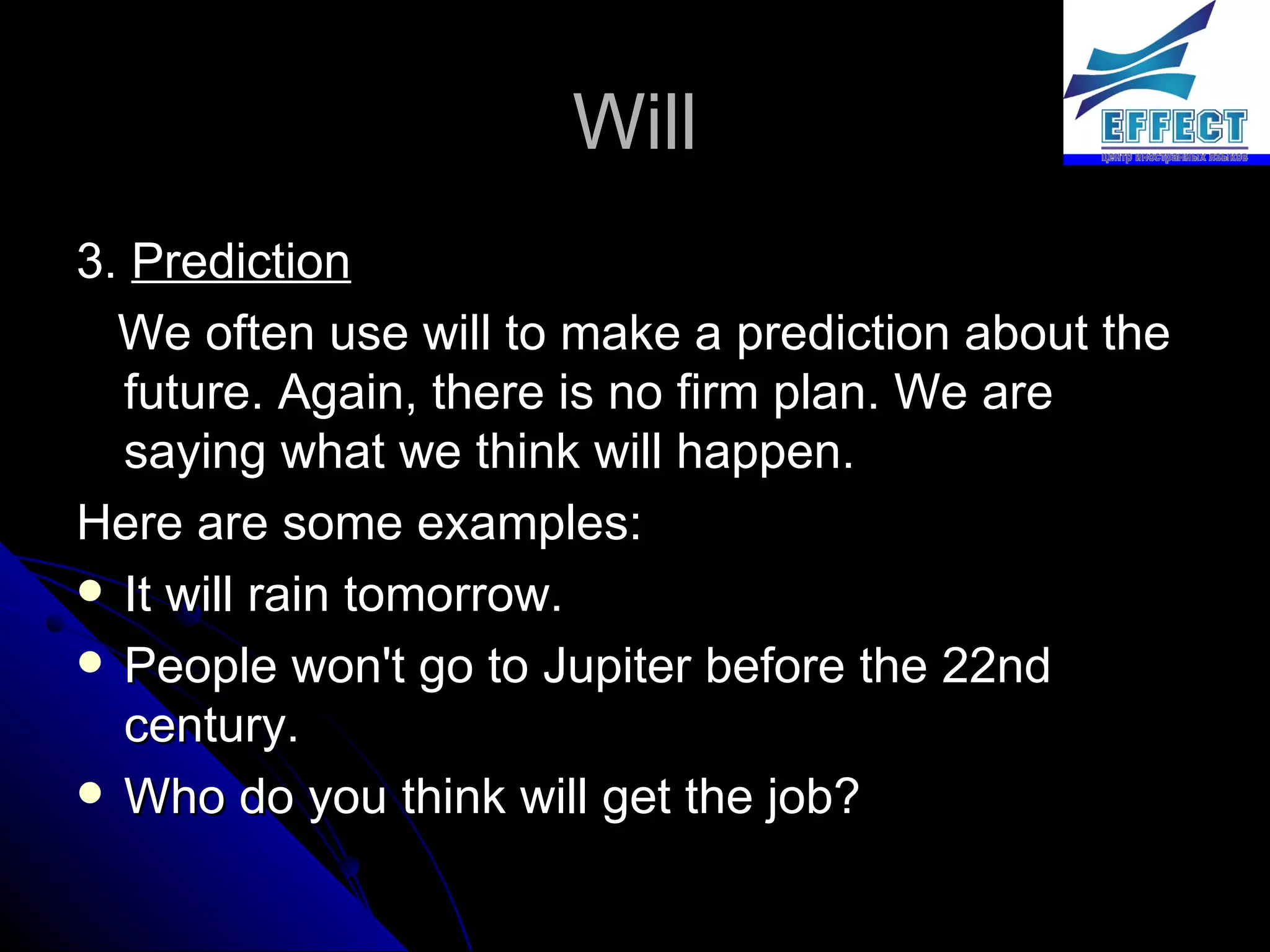
Will 3.  Prediction We often use will to make a prediction about the future. Again, there is no firm plan. We are saying what we think will happen.  Here are some examples: It will rain tomorrow. People won't go to Jupiter before the 22nd century. Who do you think will get the job?
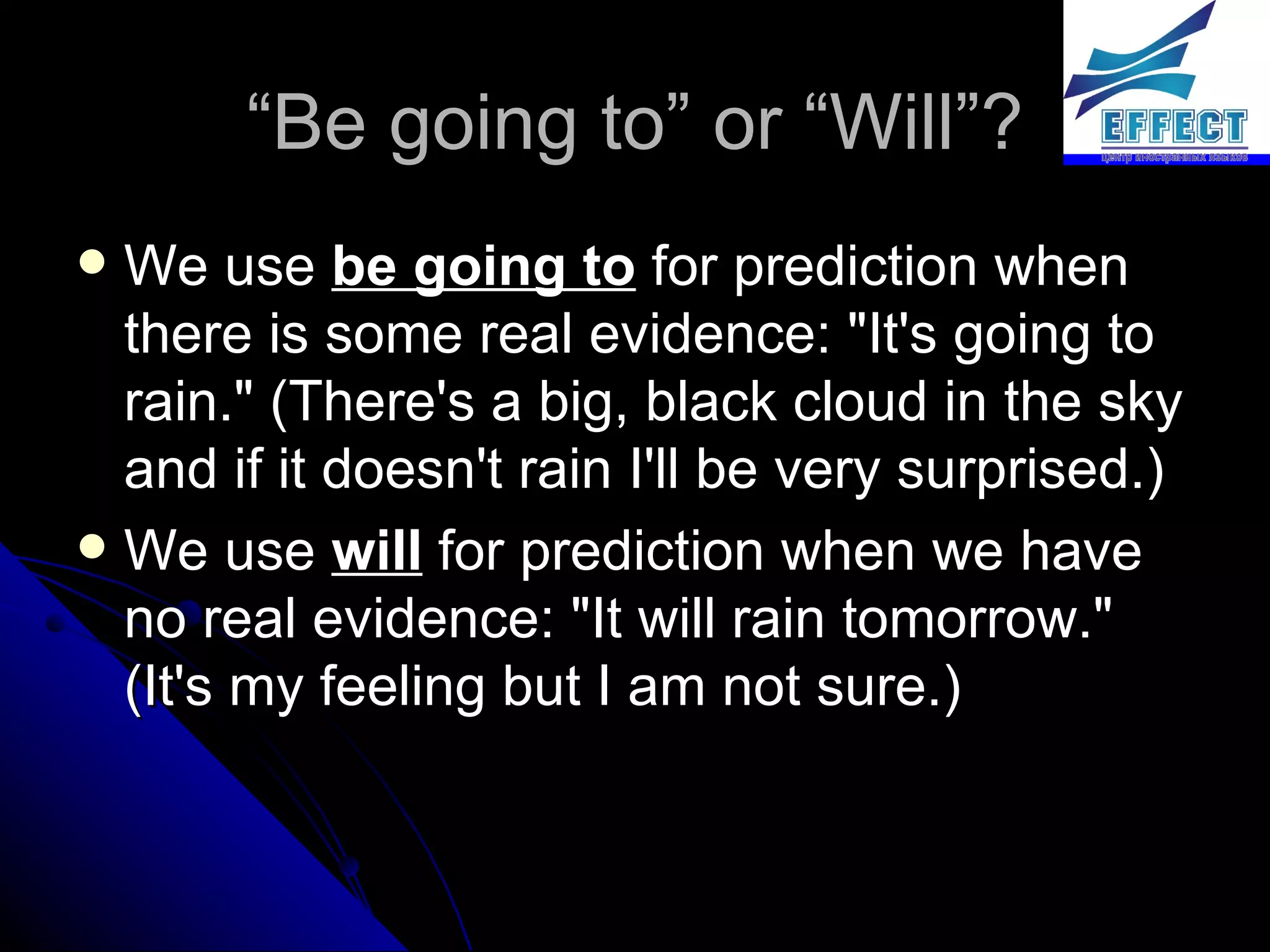
“ Be going to” or “Will”? We use  be going to  for prediction when there is some real evidence: "It's going to rain." (There's a big, black cloud in the sky and if it doesn't rain I'll be very surprised.) We use  will  for prediction when we have no real evidence: "It will rain tomorrow." (It's my feeling but I am not sure.)
Present Continuous 1. Future arrangements The present continuous is used to talk about arrangements for events at a time later than now.  There is a suggestion that more than one person is aware of the event, and that some preparation has already happened.  Look at these examples: I'm meeting Jim at the airport = and both Jim and I have discussed this. I am leaving tomorrow. = and I've already bought my train ticket. We're having a staff meeting next Monday = and all the members of the staff have been told about it.  Note: use the Present Continuous especially with such verbs:  meet, have, arrive and leave
Present Simple Timetable When an event is on a schedule or timetable (for example, the take-off time for a plane), we often use the present simple to express the future. We usually use a future word (expressed or understood) like tomorrow, at 6.30pm, next week. Only a few verbs are used in this way, for example: be, open, close, begin, start, end, finish, arrive, come, leave, return Look at these sentences: The train leaves Detroit at 9pm tonight. John starts work next week. Tomorrow is Thursday. BE CAREFUL! Present Simple is used when a future event is a part of a time-table. Notice the difference between: We're having a staff meeting next Monday.  We have a staff meeting next Monday.(= we have a meeting every Monday, it's on our time-table.)
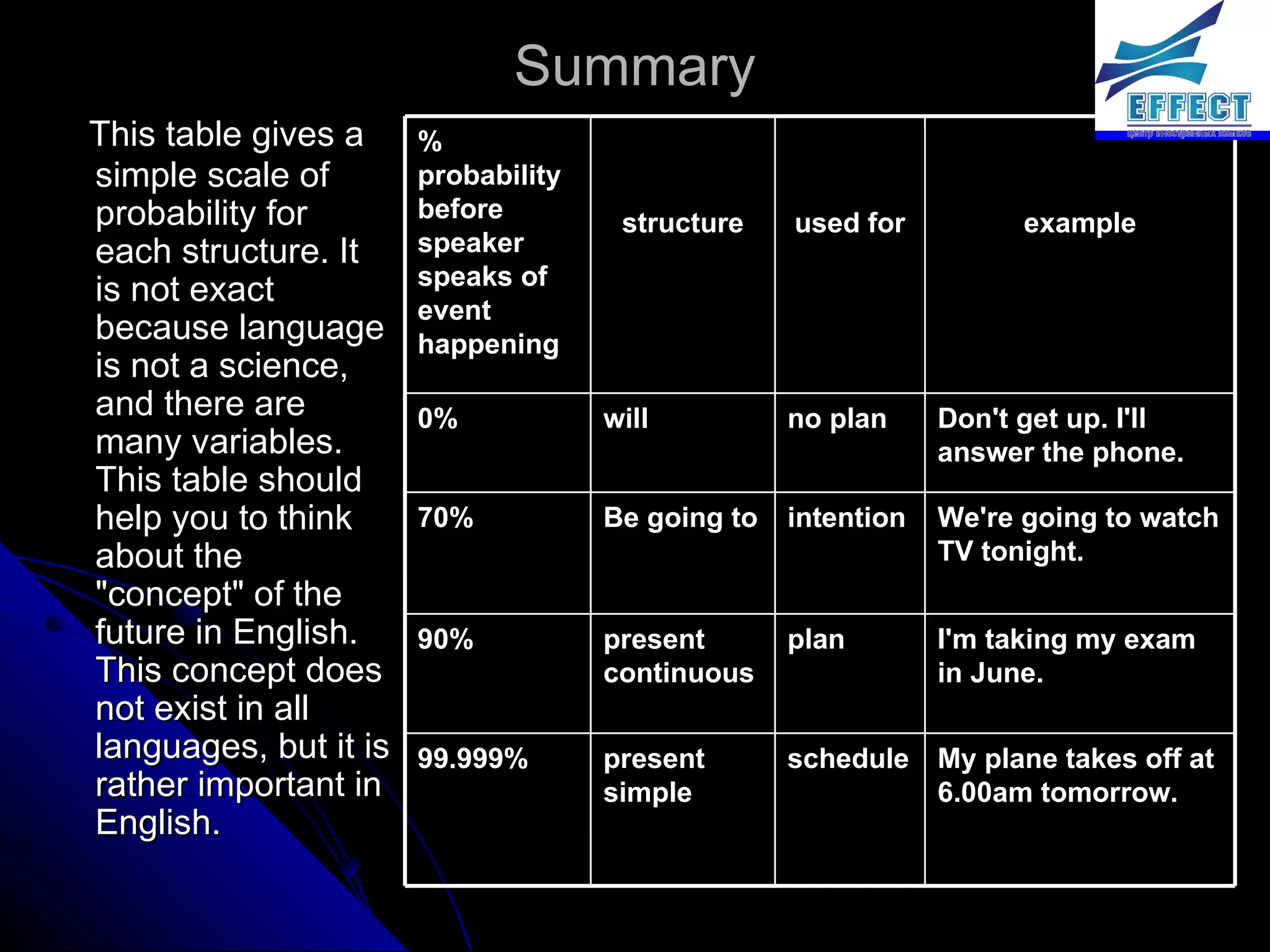
Summary This table gives a simple scale of probability for each structure. It is not exact because language is not a science, and there are many variables. This table should help you to think about the "concept" of the future in English. This concept does not exist in all languages, but it is rather important in English. % probability before speaker speaks of event happening structure used for example 0% will no plan Don't get up. I'll answer the phone. 70% Be  going to intention We're going to watch TV tonight. 90% present continuous plan I'm taking my exam in June. 99.999% present simple schedule My plane takes off at 6.00am tomorrow.

The usage of the future tenses

  • 1.
    Future Time Begoing to Will Present Continuous Present Simple Summary
  • 2.
    Be going toWe use am/is/are going to to speak about: Intention We use the special “be going to” construction when we have the intention to do something before we speak. We have already made a decision before speaking. Look at these examples: I have won $1,000. I am going to buy a new TV. We're not going to see my mother tomorrow. When are you going to go on holiday? In these examples, we had an intention or plan before speaking. The decision had been made before we started to speak.
  • 3.
    Be going to2. Prediction We often use “be going to” to make a prediction about the future. Our prediction is based on evidence. We are saying what seems sure to happen. Here are some examples: The sky is very black. It is going to snow. It's 8.30! You're going to miss the train! I crashed the company car. My boss isn't going to be very happy! In these examples, the present situation (black sky/the time/damaged car) gives us a good idea of what is going to happen.
  • 4.
    Will One ofthe most common ways to talk about the future is using “will”, for example: I will call you tonight. We often call this the "future simple tense", but technically there are no future tenses in English. In this construction, the word will is a modal auxiliary verb.
  • 5.
    Will 1. Noplan We use will when there is no prior plan or decision to do something before we speak. We make the decision at the time of speaking. Look at these examples: Hold on. I'll get a pen. We will see what we can do to help you. Maybe we'll stay in and watch television tonight. In these examples, we had no firm plan before speaking. The decision was made at the time of speaking. We often use will with the verb to think: I think I'll go to the gym tomorrow. I think I'll have a holiday next year. I don't think I'll buy that car.
  • 6.
    Will 2 .Will be The verb “be” is an exception with will. Even when we have a very firm plan, and we are not speaking spontaneously, we can use will with be. Look at these examples: I will be in London tomorrow. There will be 50 people at the party. The meeting will be at 9.30 am.
  • 7.
    Will 3. Prediction We often use will to make a prediction about the future. Again, there is no firm plan. We are saying what we think will happen. Here are some examples: It will rain tomorrow. People won't go to Jupiter before the 22nd century. Who do you think will get the job?
  • 8.
    “ Be goingto” or “Will”? We use be going to for prediction when there is some real evidence: "It's going to rain." (There's a big, black cloud in the sky and if it doesn't rain I'll be very surprised.) We use will for prediction when we have no real evidence: "It will rain tomorrow." (It's my feeling but I am not sure.)
  • 9.
    Present Continuous 1.Future arrangements The present continuous is used to talk about arrangements for events at a time later than now. There is a suggestion that more than one person is aware of the event, and that some preparation has already happened. Look at these examples: I'm meeting Jim at the airport = and both Jim and I have discussed this. I am leaving tomorrow. = and I've already bought my train ticket. We're having a staff meeting next Monday = and all the members of the staff have been told about it. Note: use the Present Continuous especially with such verbs: meet, have, arrive and leave
  • 10.
    Present Simple TimetableWhen an event is on a schedule or timetable (for example, the take-off time for a plane), we often use the present simple to express the future. We usually use a future word (expressed or understood) like tomorrow, at 6.30pm, next week. Only a few verbs are used in this way, for example: be, open, close, begin, start, end, finish, arrive, come, leave, return Look at these sentences: The train leaves Detroit at 9pm tonight. John starts work next week. Tomorrow is Thursday. BE CAREFUL! Present Simple is used when a future event is a part of a time-table. Notice the difference between: We're having a staff meeting next Monday. We have a staff meeting next Monday.(= we have a meeting every Monday, it's on our time-table.)
  • 11.
    Summary This tablegives a simple scale of probability for each structure. It is not exact because language is not a science, and there are many variables. This table should help you to think about the "concept" of the future in English. This concept does not exist in all languages, but it is rather important in English. % probability before speaker speaks of event happening structure used for example 0% will no plan Don't get up. I'll answer the phone. 70% Be going to intention We're going to watch TV tonight. 90% present continuous plan I'm taking my exam in June. 99.999% present simple schedule My plane takes off at 6.00am tomorrow.