Unit 5 Going Places Use of future with going to and will and the use of modals for necessity and suggestion Lic. Selene Rodríguez   Junio 2008 Rev. Ceci
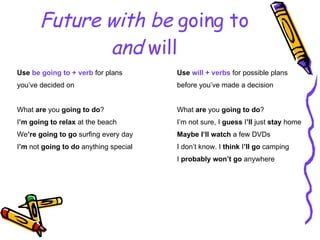
Future with be  going to  and  will Use  be going to + verb  for plans Use  will + verbs  for possible plans you’ve decided on before you’ve made a decision What  are  you  going to do ? What  are  you  going to do ? I ’m   going to relax  at the beach I’m not sure, I  guess  I ’ll  just  stay  home We ’re   going to go  surfing every day Maybe I’ll watch  a few DVDs I ’m  not  going to do  anything special I don’t know. I  think  I ’ll go  camping I  probably won’t go  anywhere
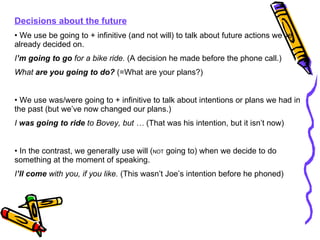
Decisions about the future We use be going to + infinitive (and not will) to talk about future actions we’ve already decided on. I ’m   going to go  for a bike ride.  (A decision he made before the phone call.) What  are you going to do?  (=What are your plans?) We use was/were going to + infinitive to talk about intentions or plans we had in the past (but we’ve now changed our plans.) I  was going to ride  to Bovey, but …  (That was his intention, but it isn’t now) In the contrast, we generally use will ( NOT  going to) when we decide to do something at the moment of speaking. I ’ll come  with you, if you like.  (This wasn’t Joe’s intention before he phoned)
Notice that we use  will  or  won’t  when we make simple predictions about future actions or situations. The hotels  will  be cheaper in October But the weather  won’t  be as good After  I  and  we , we can use will in  affirmative sentences . But we normaly use the short form = I’ll We’ll have to take winter clothes In  negative sentences , after  I  and  we , we can use won’t. We won’t have time to see everything Notice that will/won’t can be use to talk about intentions, that is, when we talk about something we decide to do or not to do at the moment of speaking I’ll sit next to you We use will to make a request Will you hold my bag? Will you take a photo for me? We use won’t when we refuse to do something I won’t come.
Predicting future events:  will  or  going to ? We normally use will / won’t for simple predictions. Rain  will spread  from the west. It  won’t be  much fun. But we use going to (NOT will) for predictions about the future when there’s present evidence of a future event. It ’s   going to  rain. It’ s going to  be very windy. (The weather forecast he’s looking at tells him this)
EXERCISE 1.  Complete the conversation with the appropriate forms of  be going to  or   will .   Have you made any vacation plans? Well, I’ve decided on one thing, I __________ go camping. A.  That’s great! For how long? I __________ be away for a week. I only have five days of vacation. So when are you leaving? I’m not sure. I __________ probably leave around the end of May. A.  And where __________  you __________ go? I haven’t thought about that yet. I guess I __________ go to one of the national parks. That sounds like fun. Yeah. Maybe I __________ go hiking and do some fishing. A.  __________ you __________ rent a camper? I’m not sure. Actually, I probably __________ rent a camper – it’s to expensive. _____ you __________ going with anyone? No. I need some time alone. I __________ travel by myself.
Modals for necessity and suggestion Describing necessity Giving suggestions You  must  have a driver’s license. You ’d   better  avoid the stalls on the streets. You  need to  make a reservation. You  ought to  pack a first -aid kit. You  have to  get a passport. You  should  try some local specialties. You  don’t have   to  get a visa. You  shouldn't  carry a lot of cash
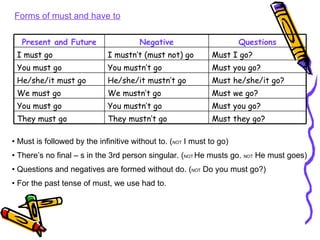
Forms of must and have to Must is followed by the infinitive without to. ( NOT  I must to go) There’s no final – s in the 3rd person singular. ( NOT  He musts go.  NOT  He must goes) Questions and negatives are formed without do. ( NOT  Do you must go?) For the past tense of must, we use had to. Must they go? They mustn’t go They must go Must you go? You mustn’t go You must go Must we go? We mustn’t go We must go Must he/she/it go? He/she/it mustn’t go He/she/it must go Must you go? You mustn’t go You must go Must I go? I mustn’t (must not) go I must go Questions Negative Present and Future
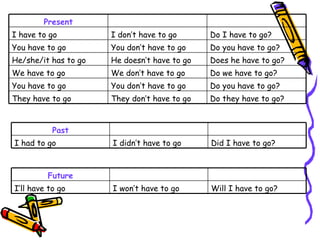
Do they have to go? They don’t have to go They have to go Do you have to go? You don’t have to go You have to go Do we have to go? We don’t have to go We have to go Does he have to go? He doesn’t have to go He/she/it has to go Do you have to go? You don’t have to go You have to go Do I have to go? I don’t have to go I have to go Present Did I have to go? I didn’t have to go I had to go Past Will I have to go? I won’t have to go I’ll have to go Future
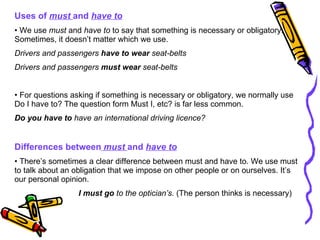
Uses of  must  and   have to We use  must  and  have to  to say that something is necessary or obligatory. Sometimes, it doesn’t matter which we use. Drivers and passengers  have to wear  seat-belts  Drivers and passengers  must wear  seat-belts For questions asking if something is necessary or obligatory, we normally use Do I have to? The question form Must I, etc? is far less common. Do you have to  have an international driving licence? Differences between   must  and  have to There’s sometimes a clear difference between must and have to. We use must to talk about an obligation that we impose on other people or on ourselves. It’s our personal opinion. I must go  to the optician’s . (The person thinks is necessary)
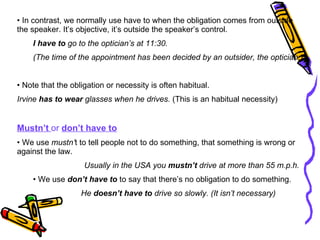
In contrast, we normally use have to when the obligation comes from outside the speaker. It’s objective, it’s outside the speaker’s control. I have to  go to the optician’s at 11:30. (The time of the appointment has been decided by an outsider, the optician.) Note that the obligation or necessity is often habitual. Irvine  has to wear  glasses when he drives.  (This is an habitual necessity) Mustn’t  or  don’t have to We use  mustn’ t to tell people not to do something, that something is wrong or against the law. Usually in the USA you  mustn’t  drive at more than 55 m.p.h. We use  don’t have to  to say that there’s no obligation to do something. He  doesn’t have to  drive so slowly. (It isn’t necessary)
The main use of   should/ought to We use  should  + infinitive  without to or  ought to  + infinitive  when we think something is the right thing to do. People  should pay  to use the roads = People  ought to pay Had better + infinitive without to We use  had better (d’ better)  + infinitive   without to  to say that something is the right thing to do. We use it with I and we to talk about an immediate intention. I’ d   better  go by car We use it with  you  or  he, she, it, they  when we’re giving advice or warning about the present or the immediate future. You’ d better  hurry
EXERCISE 2.   Choose the best advice for someone who is going on vacation. You __________ make hotel reservations in advance. It might be difficult to find a room after you get there. (have to / ‘d better.) You __________ carry identification with you. It’s the law!. (must / should) You __________ buy a round – trip plane tickets because it’s cheaper. (must / should) You __________ pack too many clothes. You won’t have room to bring back any gifts. (don’t have to / shouldn’t) You __________ check out of most hotel rooms by noon if you don’t want to pay for another night. (need to / ought to) You __________ buy a new suitcase because your old one is getting shabby. (have to / ought to)
BIBLIOGRAPHY Richards, Jack C. Interchange Third Edition Cambridge University Press 2005 Bolton, David and Goodey, Noel English Grammar in steps Richmond Publishing 2003

Unit 5 (Level 2) Going Places

  • 1.
    Unit 5 GoingPlaces Use of future with going to and will and the use of modals for necessity and suggestion Lic. Selene Rodríguez Junio 2008 Rev. Ceci
  • 2.
    Future with be going to and will Use be going to + verb for plans Use will + verbs for possible plans you’ve decided on before you’ve made a decision What are you going to do ? What are you going to do ? I ’m going to relax at the beach I’m not sure, I guess I ’ll just stay home We ’re going to go surfing every day Maybe I’ll watch a few DVDs I ’m not going to do anything special I don’t know. I think I ’ll go camping I probably won’t go anywhere
  • 3.
    Decisions about thefuture We use be going to + infinitive (and not will) to talk about future actions we’ve already decided on. I ’m going to go for a bike ride. (A decision he made before the phone call.) What are you going to do? (=What are your plans?) We use was/were going to + infinitive to talk about intentions or plans we had in the past (but we’ve now changed our plans.) I was going to ride to Bovey, but … (That was his intention, but it isn’t now) In the contrast, we generally use will ( NOT going to) when we decide to do something at the moment of speaking. I ’ll come with you, if you like. (This wasn’t Joe’s intention before he phoned)
  • 4.
    Notice that weuse will or won’t when we make simple predictions about future actions or situations. The hotels will be cheaper in October But the weather won’t be as good After I and we , we can use will in affirmative sentences . But we normaly use the short form = I’ll We’ll have to take winter clothes In negative sentences , after I and we , we can use won’t. We won’t have time to see everything Notice that will/won’t can be use to talk about intentions, that is, when we talk about something we decide to do or not to do at the moment of speaking I’ll sit next to you We use will to make a request Will you hold my bag? Will you take a photo for me? We use won’t when we refuse to do something I won’t come.
  • 5.
    Predicting future events: will or going to ? We normally use will / won’t for simple predictions. Rain will spread from the west. It won’t be much fun. But we use going to (NOT will) for predictions about the future when there’s present evidence of a future event. It ’s going to rain. It’ s going to be very windy. (The weather forecast he’s looking at tells him this)
  • 6.
    EXERCISE 1. Complete the conversation with the appropriate forms of be going to or will . Have you made any vacation plans? Well, I’ve decided on one thing, I __________ go camping. A. That’s great! For how long? I __________ be away for a week. I only have five days of vacation. So when are you leaving? I’m not sure. I __________ probably leave around the end of May. A. And where __________ you __________ go? I haven’t thought about that yet. I guess I __________ go to one of the national parks. That sounds like fun. Yeah. Maybe I __________ go hiking and do some fishing. A. __________ you __________ rent a camper? I’m not sure. Actually, I probably __________ rent a camper – it’s to expensive. _____ you __________ going with anyone? No. I need some time alone. I __________ travel by myself.
  • 7.
    Modals for necessityand suggestion Describing necessity Giving suggestions You must have a driver’s license. You ’d better avoid the stalls on the streets. You need to make a reservation. You ought to pack a first -aid kit. You have to get a passport. You should try some local specialties. You don’t have to get a visa. You shouldn't carry a lot of cash
  • 8.
    Forms of mustand have to Must is followed by the infinitive without to. ( NOT I must to go) There’s no final – s in the 3rd person singular. ( NOT He musts go. NOT He must goes) Questions and negatives are formed without do. ( NOT Do you must go?) For the past tense of must, we use had to. Must they go? They mustn’t go They must go Must you go? You mustn’t go You must go Must we go? We mustn’t go We must go Must he/she/it go? He/she/it mustn’t go He/she/it must go Must you go? You mustn’t go You must go Must I go? I mustn’t (must not) go I must go Questions Negative Present and Future
  • 9.
    Do they haveto go? They don’t have to go They have to go Do you have to go? You don’t have to go You have to go Do we have to go? We don’t have to go We have to go Does he have to go? He doesn’t have to go He/she/it has to go Do you have to go? You don’t have to go You have to go Do I have to go? I don’t have to go I have to go Present Did I have to go? I didn’t have to go I had to go Past Will I have to go? I won’t have to go I’ll have to go Future
  • 10.
    Uses of must and have to We use must and have to to say that something is necessary or obligatory. Sometimes, it doesn’t matter which we use. Drivers and passengers have to wear seat-belts Drivers and passengers must wear seat-belts For questions asking if something is necessary or obligatory, we normally use Do I have to? The question form Must I, etc? is far less common. Do you have to have an international driving licence? Differences between must and have to There’s sometimes a clear difference between must and have to. We use must to talk about an obligation that we impose on other people or on ourselves. It’s our personal opinion. I must go to the optician’s . (The person thinks is necessary)
  • 11.
    In contrast, wenormally use have to when the obligation comes from outside the speaker. It’s objective, it’s outside the speaker’s control. I have to go to the optician’s at 11:30. (The time of the appointment has been decided by an outsider, the optician.) Note that the obligation or necessity is often habitual. Irvine has to wear glasses when he drives. (This is an habitual necessity) Mustn’t or don’t have to We use mustn’ t to tell people not to do something, that something is wrong or against the law. Usually in the USA you mustn’t drive at more than 55 m.p.h. We use don’t have to to say that there’s no obligation to do something. He doesn’t have to drive so slowly. (It isn’t necessary)
  • 12.
    The main useof should/ought to We use should + infinitive without to or ought to + infinitive when we think something is the right thing to do. People should pay to use the roads = People ought to pay Had better + infinitive without to We use had better (d’ better) + infinitive without to to say that something is the right thing to do. We use it with I and we to talk about an immediate intention. I’ d better go by car We use it with you or he, she, it, they when we’re giving advice or warning about the present or the immediate future. You’ d better hurry
  • 13.
    EXERCISE 2. Choose the best advice for someone who is going on vacation. You __________ make hotel reservations in advance. It might be difficult to find a room after you get there. (have to / ‘d better.) You __________ carry identification with you. It’s the law!. (must / should) You __________ buy a round – trip plane tickets because it’s cheaper. (must / should) You __________ pack too many clothes. You won’t have room to bring back any gifts. (don’t have to / shouldn’t) You __________ check out of most hotel rooms by noon if you don’t want to pay for another night. (need to / ought to) You __________ buy a new suitcase because your old one is getting shabby. (have to / ought to)
  • 14.
    BIBLIOGRAPHY Richards, JackC. Interchange Third Edition Cambridge University Press 2005 Bolton, David and Goodey, Noel English Grammar in steps Richmond Publishing 2003