RELATIVE PRONOUNS 
RINCON GELVEZ JORGE ANDRES
USE 
 A relative pronoun is a pronoun that introduces a relative 
clause. It is called a "relative" pronoun because it "relates" to 
the word that its relative clause modifies. Here is an example: 
 The person who phoned me last night is my teacher. 
 In the above example, "who": 
 relates to "The person", which "who phoned me last night" 
modifies 
 introduces the relative clause "who phoned me last night" 
 There are five relative pronouns: who, whom, whose, 
which, that* 
 Who (subject) and whom (object) are generally only for 
people. Whose is for possession. Which is for things. That 
can be used for things and people only in defining relative 
clauses (clauses that are essential to the sentence and do 
not simply add extra information
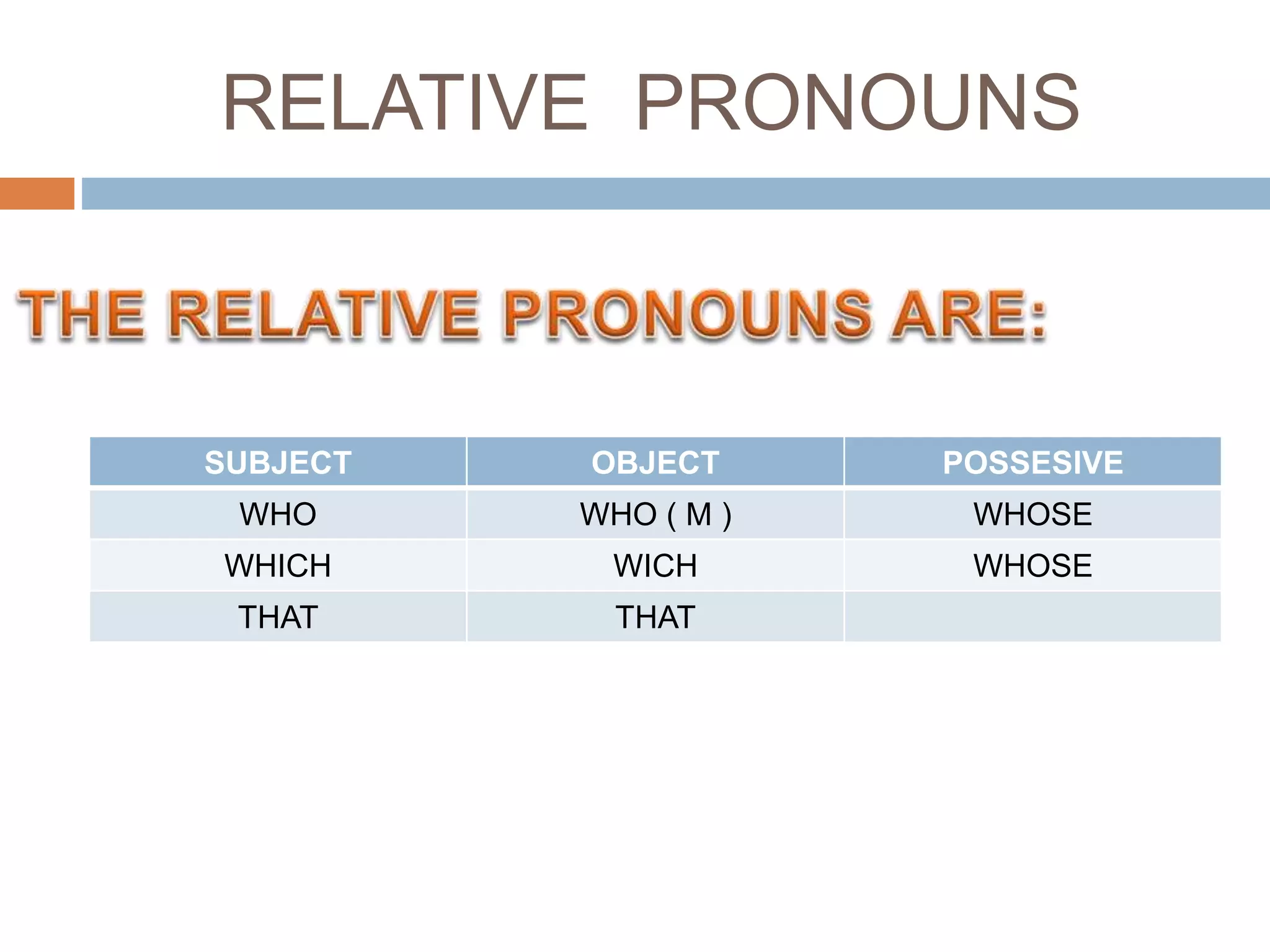
RELATIVE PRONOUNS 
SUBJECT OBJECT POSSESIVE 
WHO WHO ( M ) WHOSE 
WHICH WICH WHOSE 
THAT THAT
EXAMPLES 
 We use whose as the possessive form of who: 
 This is George, whose brother went to school with me. 
 We sometimes use whom as the object of a verb or preposition: 
 This is George, whom you met at our house last year. 
This is George’s brother, with whom I went to school. 
 But nowadays we normally use who: 
 This is George, who you met at our house last year. 
This is George’s brother, who I went to school with. 
 When whom or which have a preposition the preposition can come at the beginning of the 
clause... 
 I had an uncle in Germany, from who[m] I inherited a bit of money. 
We bought a chainsaw, with which we cut up all the wood. 
 … or at the end of the clause: 
 I had an uncle in Germany who[m] I inherited a bit of money from. 
We bought a chainsaw, which we cut all the wood up with. 
 We can use that at the beginning of the clause: 
 I had an uncle in Germany that I inherited a bit of money from. 
We bought a chainsaw that we cut all the wood up with.

Relative pronouns

  • 1.
    RELATIVE PRONOUNS RINCONGELVEZ JORGE ANDRES
  • 2.
    USE  Arelative pronoun is a pronoun that introduces a relative clause. It is called a "relative" pronoun because it "relates" to the word that its relative clause modifies. Here is an example:  The person who phoned me last night is my teacher.  In the above example, "who":  relates to "The person", which "who phoned me last night" modifies  introduces the relative clause "who phoned me last night"  There are five relative pronouns: who, whom, whose, which, that*  Who (subject) and whom (object) are generally only for people. Whose is for possession. Which is for things. That can be used for things and people only in defining relative clauses (clauses that are essential to the sentence and do not simply add extra information
  • 3.
    RELATIVE PRONOUNS SUBJECTOBJECT POSSESIVE WHO WHO ( M ) WHOSE WHICH WICH WHOSE THAT THAT
  • 4.
    EXAMPLES  Weuse whose as the possessive form of who:  This is George, whose brother went to school with me.  We sometimes use whom as the object of a verb or preposition:  This is George, whom you met at our house last year. This is George’s brother, with whom I went to school.  But nowadays we normally use who:  This is George, who you met at our house last year. This is George’s brother, who I went to school with.  When whom or which have a preposition the preposition can come at the beginning of the clause...  I had an uncle in Germany, from who[m] I inherited a bit of money. We bought a chainsaw, with which we cut up all the wood.  … or at the end of the clause:  I had an uncle in Germany who[m] I inherited a bit of money from. We bought a chainsaw, which we cut all the wood up with.  We can use that at the beginning of the clause:  I had an uncle in Germany that I inherited a bit of money from. We bought a chainsaw that we cut all the wood up with.