1
COMMUNITY NUTRITION
PROGRAMMES
Dr. Rizwan S A
Assistant Professor
Dept. of Community Medicine
VMCHRI, Madurai
18.2.2016
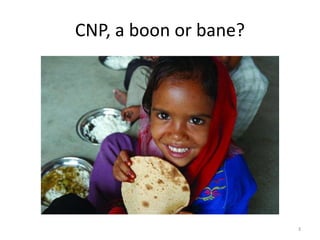
CNP, a boon or bane?
3
Tamilian perspectives
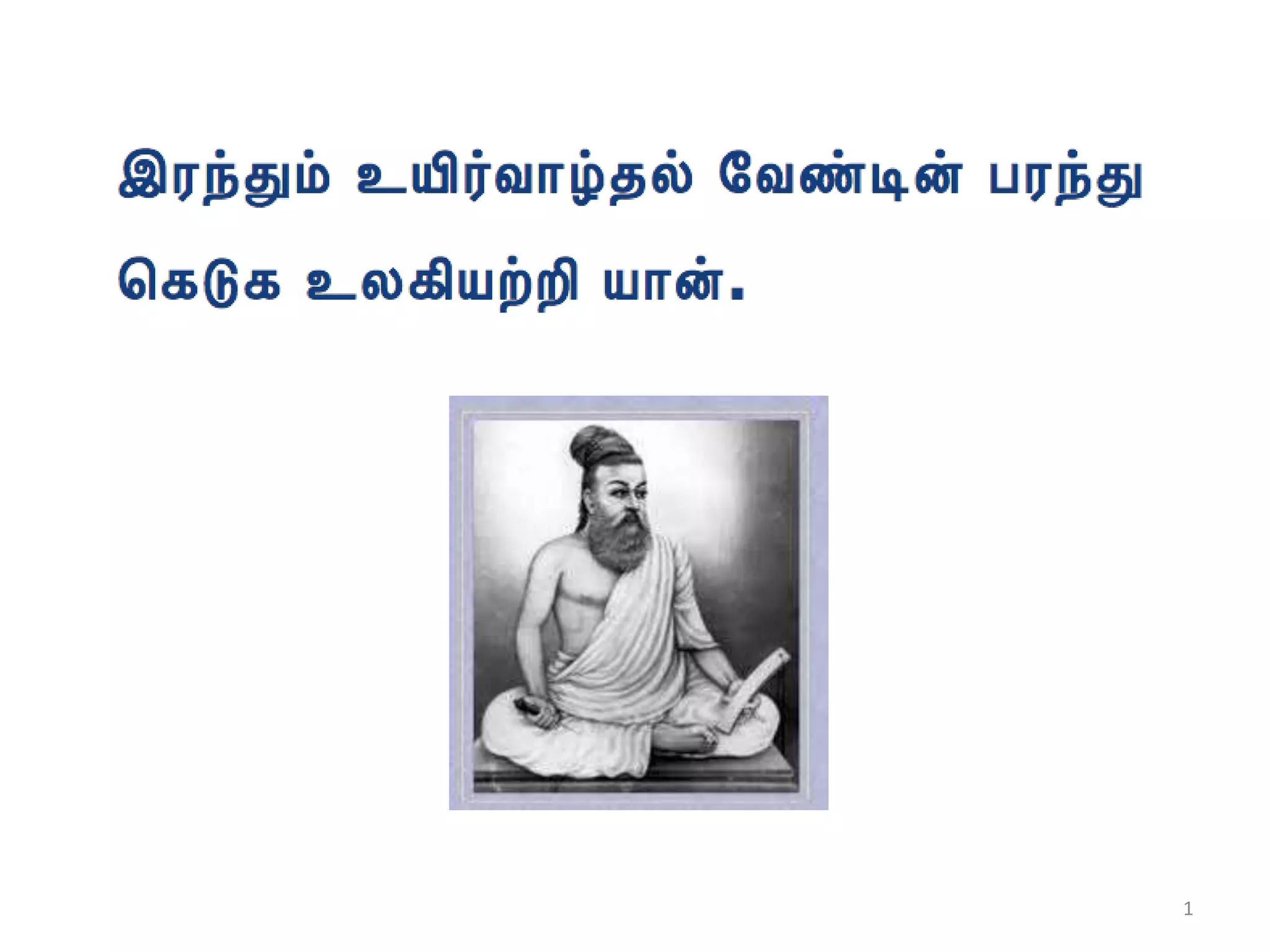
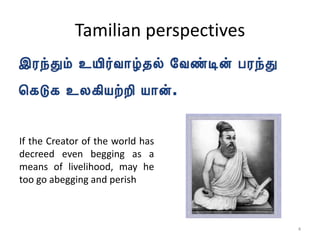
If the Creator of the world has
decreed even begging as a
means of livelihood, may he
too go abegging and perish
4
Tamilian perspectives
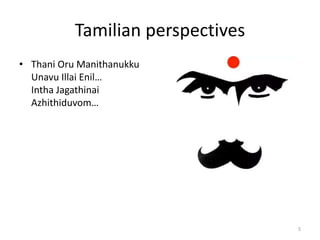
• Thani Oru Manithanukku
Unavu Illai Enil…
Intha Jagathinai
Azhithiduvom…
5
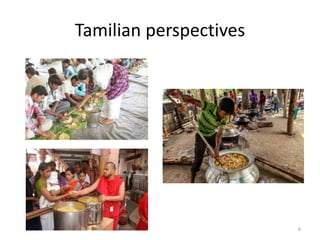
Tamilian perspectives
6
Learning objectives
• At the end of this class you must be able to
– Define the primary objective of CNP
– List out the various CNP in India
– Enlist the objectives and provisions in each CNP
– Develop an opinion on the usefulness of such CNP
7
Recap of goals of the NNP
• Short term interventions
• Long term changes
8
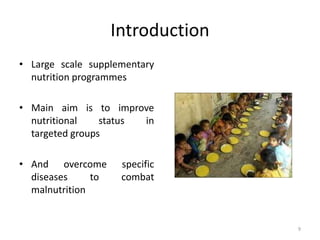
Introduction
• Large scale supplementary
nutrition programmes
• Main aim is to improve
nutritional status in
targeted groups
• And overcome specific
diseases to combat
malnutrition
9
List of CNP
1. Vitamin A prophylaxis programme
2. Prophylaxis against nutritional anaemia
3. Control of iodine deficiency disorders
4. Special nutrition programme
5. Balwadi nutrition programme
6. ICDS programme
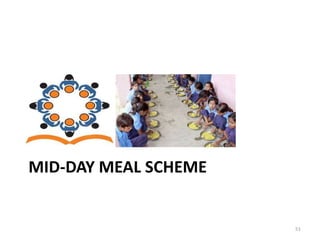
7. Mid-day meal programme
8. Mid-day meal scheme
10
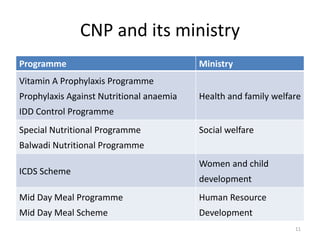
CNP and its ministry
Programme Ministry
Vitamin A Prophylaxis Programme
Prophylaxis Against Nutritional anaemia
IDD Control Programme
Health and family welfare
Special Nutritional Programme
Balwadi Nutritional Programme
Social welfare
ICDS Scheme
Women and child
development
Mid Day Meal Programme
Mid Day Meal Scheme
Human Resource
Development
11
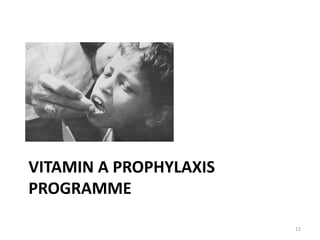
VITAMIN A PROPHYLAXIS
PROGRAMME
12
Vitamin A Prophylaxis Programme
• Initiated in 1970
• Beneficiary: age group 6mo - 5 year
• Objective: Prevent blindness due to VAD
• Implemented by: PHC and subcenter
• A single massive dose of Vitamin A 2 lac IU
(retinol palmitate 110mg) orally every 6
months above 1 year
13
Role of Vitamin A in health
• Prevent respiratory infection
• Maintain GIT epithelium integrity
• Immunity
• Prevent Nutritional blindness
14
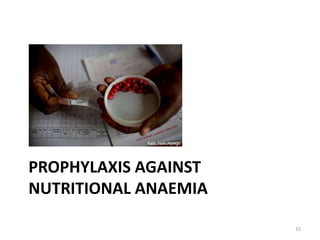
PROPHYLAXIS AGAINST
NUTRITIONAL ANAEMIA
15
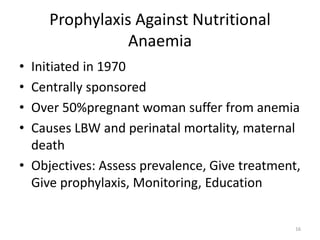
Prophylaxis Against Nutritional
Anaemia
• Initiated in 1970
• Centrally sponsored
• Over 50%pregnant woman suffer from anemia
• Causes LBW and perinatal mortality, maternal
death
• Objectives: Assess prevalence, Give treatment,
Give prophylaxis, Monitoring, Education
16
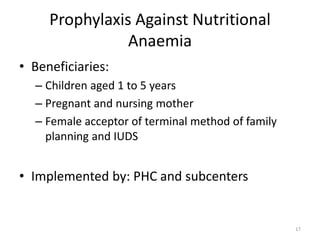
Prophylaxis Against Nutritional
Anaemia
• Beneficiaries:
– Children aged 1 to 5 years
– Pregnant and nursing mother
– Female acceptor of terminal method of family
planning and IUDS
• Implemented by: PHC and subcenters
17
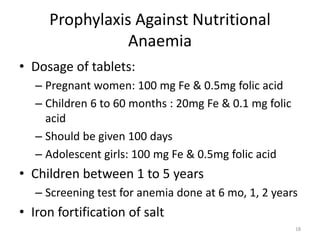
Prophylaxis Against Nutritional
Anaemia
• Dosage of tablets:
– Pregnant women: 100 mg Fe & 0.5mg folic acid
– Children 6 to 60 months : 20mg Fe & 0.1 mg folic
acid
– Should be given 100 days
– Adolescent girls: 100 mg Fe & 0.5mg folic acid
• Children between 1 to 5 years
– Screening test for anemia done at 6 mo, 1, 2 years
• Iron fortification of salt
18
IODINE DEFICIENCY DISORDER
CONTROL PROGRAMME
19
IDD control programme
• National goiter control programme in 1962
• IDD Control Programme
• Replace the entire edible salt by iodide salt
• Fortification of salt with iodine
20
SPECIAL NUTRITIONAL
PROGRAMME
21
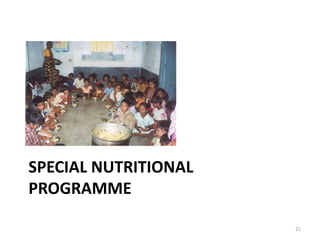
Special Nutritional Programme
• Started in 1970 in urban slums, tribal areas
and backward rural areas
• Main aim is to improve nutritional status in
– children <6 years
– pregnant and lactating women
• Gradually being merged into ICDS
22
APPLIED NUTRITIONAL
PROGRAMME
23
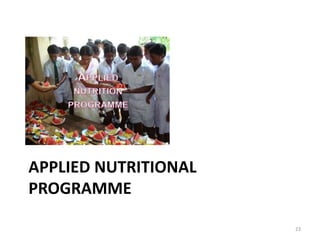
Applied Nutritional Programme
• This project was started in Orissa on 1963
• Later extended to TN and UP
• Objectives:
– Promoting production and of protective food such
vegetables and fruits
– Ensure their consumption by pregnant & lactating
women and children.
• In 1973 extended to all states in INDIA
24
Applied Nutritional Programme
• Major components
– Nutritional Services
– Health services
– Communication
– Monitoring and evaluation
• Later converted into ICDS
25
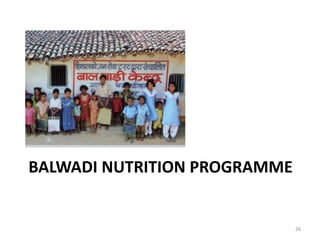
BALWADI NUTRITION PROGRAMME
26
Balwadi Nutrition Programme
• This was started in 1970 by the department of
social welfare
• Beneficiary:
– Preschool children 3-6 years of age
• Activities
– 300 kcal and 10 g protein
– Preschool education
• Phased out because universalization of ICDS
27
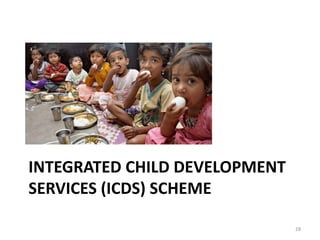
INTEGRATED CHILD DEVELOPMENT
SERVICES (ICDS) SCHEME
28
ICDS
• Launched on 2nd October 1975
• One of the world’s largest and most unique
programmes for early childhood development
• India’s response to the challenge of
– Providing pre-school education on one hand and
– Breaking the vicious cycle of malnutrition, morbidity,
reduced learning capacity and mortality, on the other
• Foremost symbol of India’s commitment to her
children
29
Need for ICDS
• Routine MCH services not reaching target
Population
• Nutritional component not covered by
Health services
• Need for community participation
30
Objectives of ICDS
• Improve the nutritional and health status of
children in the age-group 0-6 years
• Foundation for proper psychological, physical and
social development of the child
• Reduce the incidence of mortality, morbidity,
malnutrition and school dropout
• Co-ordination of departments to promote child
development
• Nutrition and health education to the mother
31
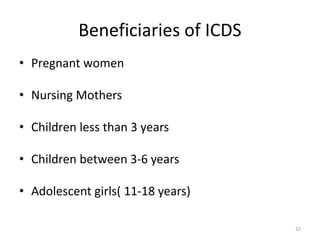
Beneficiaries of ICDS
• Pregnant women
• Nursing Mothers
• Children less than 3 years
• Children between 3-6 years
• Adolescent girls( 11-18 years)
32
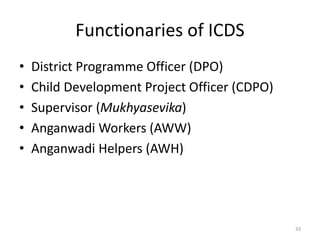
Functionaries of ICDS
• District Programme Officer (DPO)
• Child Development Project Officer (CDPO)
• Supervisor (Mukhyasevika)
• Anganwadi Workers (AWW)
• Anganwadi Helpers (AWH)
33
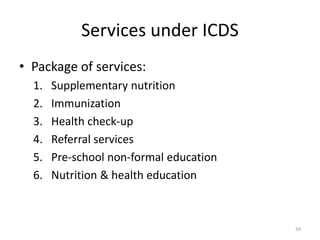
Services under ICDS
• Package of services:
1. Supplementary nutrition
2. Immunization
3. Health check-up
4. Referral services
5. Pre-school non-formal education
6. Nutrition & health education
34
35
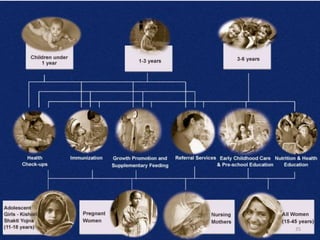
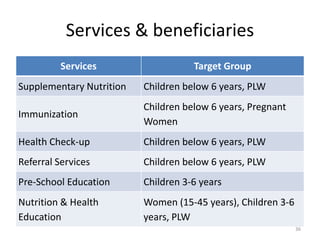
Services & beneficiaries
Services Target Group
Supplementary Nutrition Children below 6 years, PLW
Immunization
Children below 6 years, Pregnant
Women
Health Check-up Children below 6 years, PLW
Referral Services Children below 6 years, PLW
Pre-School Education Children 3-6 years
Nutrition & Health
Education
Women (15-45 years), Children 3-6
years, PLW
36
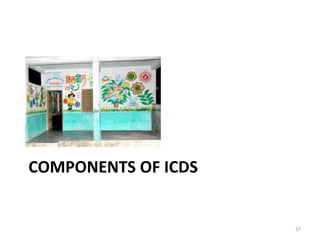
COMPONENTS OF ICDS
37
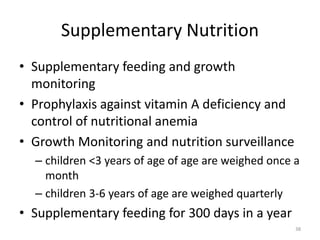
Supplementary Nutrition
• Supplementary feeding and growth
monitoring
• Prophylaxis against vitamin A deficiency and
control of nutritional anemia
• Growth Monitoring and nutrition surveillance
– children <3 years of age of age are weighed once a
month
– children 3-6 years of age are weighed quarterly
• Supplementary feeding for 300 days in a year
38
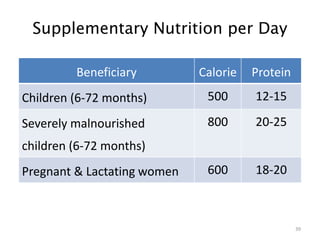
Supplementary Nutrition per Day
Beneficiary Calorie Protein
Children (6-72 months) 500 12-15
Severely malnourished
children (6-72 months)
800 20-25
Pregnant & Lactating women 600 18-20
39
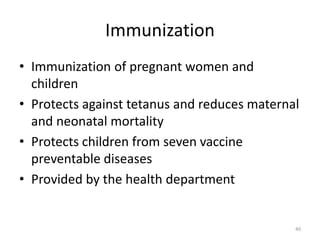
Immunization
• Immunization of pregnant women and
children
• Protects against tetanus and reduces maternal
and neonatal mortality
• Protects children from seven vaccine
preventable diseases
• Provided by the health department
40
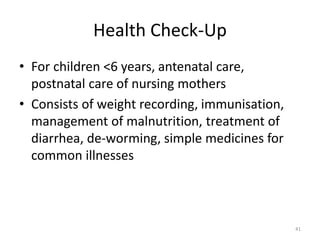
Health Check-Up
• For children <6 years, antenatal care,
postnatal care of nursing mothers
• Consists of weight recording, immunisation,
management of malnutrition, treatment of
diarrhea, de-worming, simple medicines for
common illnesses
41
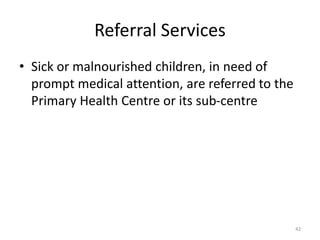
Referral Services
• Sick or malnourished children, in need of
prompt medical attention, are referred to the
Primary Health Centre or its sub-centre
42
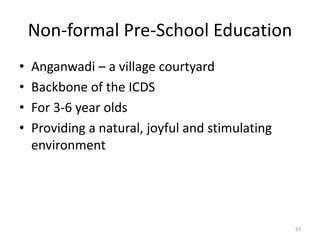
Non-formal Pre-School Education
• Anganwadi – a village courtyard
• Backbone of the ICDS
• For 3-6 year olds
• Providing a natural, joyful and stimulating
environment
43
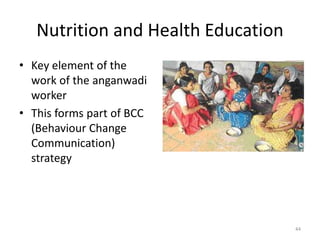
Nutrition and Health Education
• Key element of the
work of the anganwadi
worker
• This forms part of BCC
(Behaviour Change
Communication)
strategy
44
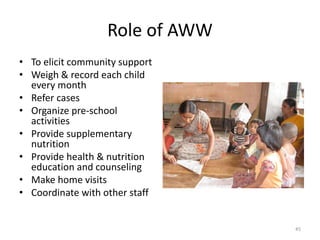
Role of AWW
• To elicit community support
• Weigh & record each child
every month
• Refer cases
• Organize pre-school
activities
• Provide supplementary
nutrition
• Provide health & nutrition
education and counseling
• Make home visits
• Coordinate with other staff
45
Role of AWH
• Cook & serve food
• Clean the Anganwadi premises
• Cleanliness of small children
• Bring small children to Anganwadi
46
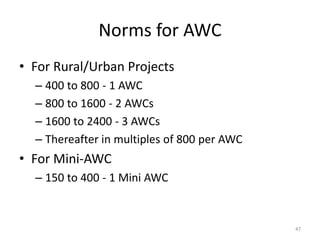
Norms for AWC
• For Rural/Urban Projects
– 400 to 800 - 1 AWC
– 800 to 1600 - 2 AWCs
– 1600 to 2400 - 3 AWCs
– Thereafter in multiples of 800 per AWC
• For Mini-AWC
– 150 to 400 - 1 Mini AWC
47
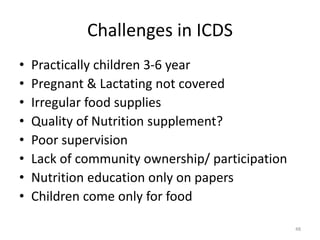
Challenges in ICDS
• Practically children 3-6 year
• Pregnant & Lactating not covered
• Irregular food supplies
• Quality of Nutrition supplement?
• Poor supervision
• Lack of community ownership/ participation
• Nutrition education only on papers
• Children come only for food
48
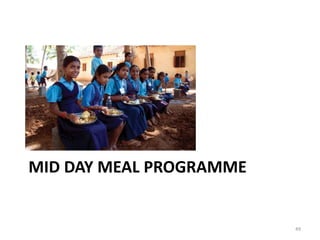
MID DAY MEAL PROGRAMME
49
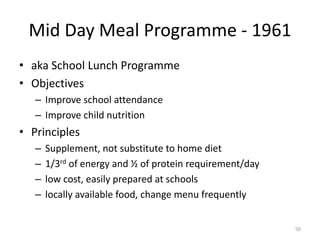
Mid Day Meal Programme - 1961
• aka School Lunch Programme
• Objectives
– Improve school attendance
– Improve child nutrition
• Principles
– Supplement, not substitute to home diet
– 1/3rd of energy and ½ of protein requirement/day
– low cost, easily prepared at schools
– locally available food, change menu frequently
50
MID-DAY MEAL SCHEME
51
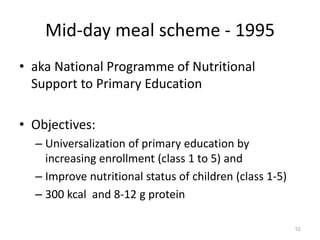
Mid-day meal scheme - 1995
• aka National Programme of Nutritional
Support to Primary Education
• Objectives:
– Universalization of primary education by
increasing enrollment (class 1 to 5) and
– Improve nutritional status of children (class 1-5)
– 300 kcal and 8-12 g protein
52
Challenges to Mid-day meal
programmes
• Good for improving nutrition of the
underprivileged children
• But it requires sustainability
• Repeated incidence of food poisoning in the
mid day meal causing serious threat
53
Review
• Vitamin A supplement administered in
Prevention of nutritional blindness in children
programme contains
1. 25,000 IU/ml
2. 1 lakh IU/ml
3. 3 lakh IU/ml
4. 5 lakh IU/ml
54
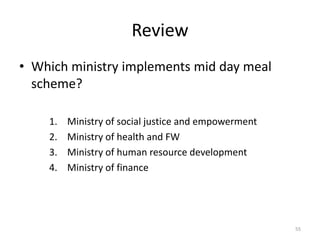
Review
• Which ministry implements mid day meal
scheme?
1. Ministry of social justice and empowerment
2. Ministry of health and FW
3. Ministry of human resource development
4. Ministry of finance
55
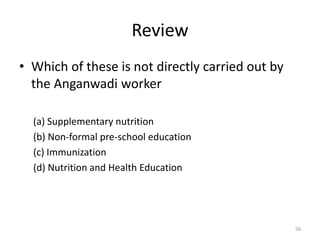
Review
• Which of these is not directly carried out by
the Anganwadi worker
(a) Supplementary nutrition
(b) Non-formal pre-school education
(c) Immunization
(d) Nutrition and Health Education
56
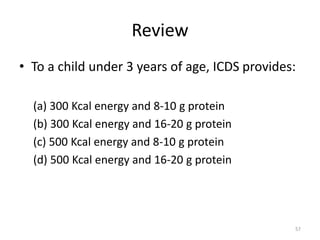
Review
• To a child under 3 years of age, ICDS provides:
(a) 300 Kcal energy and 8-10 g protein
(b) 300 Kcal energy and 16-20 g protein
(c) 500 Kcal energy and 8-10 g protein
(d) 500 Kcal energy and 16-20 g protein
57
THANK YOU
Email your queries to sarizwan1986@outlook.com
58

Community Nutrition Programmes in India

  • 1.
  • 2.
    COMMUNITY NUTRITION PROGRAMMES Dr. RizwanS A Assistant Professor Dept. of Community Medicine VMCHRI, Madurai 18.2.2016
  • 3.
    CNP, a boonor bane? 3
  • 4.
    Tamilian perspectives If theCreator of the world has decreed even begging as a means of livelihood, may he too go abegging and perish 4
  • 5.
    Tamilian perspectives • ThaniOru Manithanukku Unavu Illai Enil… Intha Jagathinai Azhithiduvom… 5
  • 6.
  • 7.
    Learning objectives • Atthe end of this class you must be able to – Define the primary objective of CNP – List out the various CNP in India – Enlist the objectives and provisions in each CNP – Develop an opinion on the usefulness of such CNP 7
  • 8.
    Recap of goalsof the NNP • Short term interventions • Long term changes 8
  • 9.
    Introduction • Large scalesupplementary nutrition programmes • Main aim is to improve nutritional status in targeted groups • And overcome specific diseases to combat malnutrition 9
  • 10.
    List of CNP 1.Vitamin A prophylaxis programme 2. Prophylaxis against nutritional anaemia 3. Control of iodine deficiency disorders 4. Special nutrition programme 5. Balwadi nutrition programme 6. ICDS programme 7. Mid-day meal programme 8. Mid-day meal scheme 10
  • 11.
    CNP and itsministry Programme Ministry Vitamin A Prophylaxis Programme Prophylaxis Against Nutritional anaemia IDD Control Programme Health and family welfare Special Nutritional Programme Balwadi Nutritional Programme Social welfare ICDS Scheme Women and child development Mid Day Meal Programme Mid Day Meal Scheme Human Resource Development 11
  • 12.
  • 13.
    Vitamin A ProphylaxisProgramme • Initiated in 1970 • Beneficiary: age group 6mo - 5 year • Objective: Prevent blindness due to VAD • Implemented by: PHC and subcenter • A single massive dose of Vitamin A 2 lac IU (retinol palmitate 110mg) orally every 6 months above 1 year 13
  • 14.
    Role of VitaminA in health • Prevent respiratory infection • Maintain GIT epithelium integrity • Immunity • Prevent Nutritional blindness 14
  • 15.
  • 16.
    Prophylaxis Against Nutritional Anaemia •Initiated in 1970 • Centrally sponsored • Over 50%pregnant woman suffer from anemia • Causes LBW and perinatal mortality, maternal death • Objectives: Assess prevalence, Give treatment, Give prophylaxis, Monitoring, Education 16
  • 17.
    Prophylaxis Against Nutritional Anaemia •Beneficiaries: – Children aged 1 to 5 years – Pregnant and nursing mother – Female acceptor of terminal method of family planning and IUDS • Implemented by: PHC and subcenters 17
  • 18.
    Prophylaxis Against Nutritional Anaemia •Dosage of tablets: – Pregnant women: 100 mg Fe & 0.5mg folic acid – Children 6 to 60 months : 20mg Fe & 0.1 mg folic acid – Should be given 100 days – Adolescent girls: 100 mg Fe & 0.5mg folic acid • Children between 1 to 5 years – Screening test for anemia done at 6 mo, 1, 2 years • Iron fortification of salt 18
  • 19.
  • 20.
    IDD control programme •National goiter control programme in 1962 • IDD Control Programme • Replace the entire edible salt by iodide salt • Fortification of salt with iodine 20
  • 21.
  • 22.
    Special Nutritional Programme •Started in 1970 in urban slums, tribal areas and backward rural areas • Main aim is to improve nutritional status in – children <6 years – pregnant and lactating women • Gradually being merged into ICDS 22
  • 23.
  • 24.
    Applied Nutritional Programme •This project was started in Orissa on 1963 • Later extended to TN and UP • Objectives: – Promoting production and of protective food such vegetables and fruits – Ensure their consumption by pregnant & lactating women and children. • In 1973 extended to all states in INDIA 24
  • 25.
    Applied Nutritional Programme •Major components – Nutritional Services – Health services – Communication – Monitoring and evaluation • Later converted into ICDS 25
  • 26.
  • 27.
    Balwadi Nutrition Programme •This was started in 1970 by the department of social welfare • Beneficiary: – Preschool children 3-6 years of age • Activities – 300 kcal and 10 g protein – Preschool education • Phased out because universalization of ICDS 27
  • 28.
  • 29.
    ICDS • Launched on2nd October 1975 • One of the world’s largest and most unique programmes for early childhood development • India’s response to the challenge of – Providing pre-school education on one hand and – Breaking the vicious cycle of malnutrition, morbidity, reduced learning capacity and mortality, on the other • Foremost symbol of India’s commitment to her children 29
  • 30.
    Need for ICDS •Routine MCH services not reaching target Population • Nutritional component not covered by Health services • Need for community participation 30
  • 31.
    Objectives of ICDS •Improve the nutritional and health status of children in the age-group 0-6 years • Foundation for proper psychological, physical and social development of the child • Reduce the incidence of mortality, morbidity, malnutrition and school dropout • Co-ordination of departments to promote child development • Nutrition and health education to the mother 31
  • 32.
    Beneficiaries of ICDS •Pregnant women • Nursing Mothers • Children less than 3 years • Children between 3-6 years • Adolescent girls( 11-18 years) 32
  • 33.
    Functionaries of ICDS •District Programme Officer (DPO) • Child Development Project Officer (CDPO) • Supervisor (Mukhyasevika) • Anganwadi Workers (AWW) • Anganwadi Helpers (AWH) 33
  • 34.
    Services under ICDS •Package of services: 1. Supplementary nutrition 2. Immunization 3. Health check-up 4. Referral services 5. Pre-school non-formal education 6. Nutrition & health education 34
  • 35.
  • 36.
    Services & beneficiaries ServicesTarget Group Supplementary Nutrition Children below 6 years, PLW Immunization Children below 6 years, Pregnant Women Health Check-up Children below 6 years, PLW Referral Services Children below 6 years, PLW Pre-School Education Children 3-6 years Nutrition & Health Education Women (15-45 years), Children 3-6 years, PLW 36
  • 37.
  • 38.
    Supplementary Nutrition • Supplementaryfeeding and growth monitoring • Prophylaxis against vitamin A deficiency and control of nutritional anemia • Growth Monitoring and nutrition surveillance – children <3 years of age of age are weighed once a month – children 3-6 years of age are weighed quarterly • Supplementary feeding for 300 days in a year 38
  • 39.
    Supplementary Nutrition perDay Beneficiary Calorie Protein Children (6-72 months) 500 12-15 Severely malnourished children (6-72 months) 800 20-25 Pregnant & Lactating women 600 18-20 39
  • 40.
    Immunization • Immunization ofpregnant women and children • Protects against tetanus and reduces maternal and neonatal mortality • Protects children from seven vaccine preventable diseases • Provided by the health department 40
  • 41.
    Health Check-Up • Forchildren <6 years, antenatal care, postnatal care of nursing mothers • Consists of weight recording, immunisation, management of malnutrition, treatment of diarrhea, de-worming, simple medicines for common illnesses 41
  • 42.
    Referral Services • Sickor malnourished children, in need of prompt medical attention, are referred to the Primary Health Centre or its sub-centre 42
  • 43.
    Non-formal Pre-School Education •Anganwadi – a village courtyard • Backbone of the ICDS • For 3-6 year olds • Providing a natural, joyful and stimulating environment 43
  • 44.
    Nutrition and HealthEducation • Key element of the work of the anganwadi worker • This forms part of BCC (Behaviour Change Communication) strategy 44
  • 45.
    Role of AWW •To elicit community support • Weigh & record each child every month • Refer cases • Organize pre-school activities • Provide supplementary nutrition • Provide health & nutrition education and counseling • Make home visits • Coordinate with other staff 45
  • 46.
    Role of AWH •Cook & serve food • Clean the Anganwadi premises • Cleanliness of small children • Bring small children to Anganwadi 46
  • 47.
    Norms for AWC •For Rural/Urban Projects – 400 to 800 - 1 AWC – 800 to 1600 - 2 AWCs – 1600 to 2400 - 3 AWCs – Thereafter in multiples of 800 per AWC • For Mini-AWC – 150 to 400 - 1 Mini AWC 47
  • 48.
    Challenges in ICDS •Practically children 3-6 year • Pregnant & Lactating not covered • Irregular food supplies • Quality of Nutrition supplement? • Poor supervision • Lack of community ownership/ participation • Nutrition education only on papers • Children come only for food 48
  • 49.
    MID DAY MEALPROGRAMME 49
  • 50.
    Mid Day MealProgramme - 1961 • aka School Lunch Programme • Objectives – Improve school attendance – Improve child nutrition • Principles – Supplement, not substitute to home diet – 1/3rd of energy and ½ of protein requirement/day – low cost, easily prepared at schools – locally available food, change menu frequently 50
  • 51.
  • 52.
    Mid-day meal scheme- 1995 • aka National Programme of Nutritional Support to Primary Education • Objectives: – Universalization of primary education by increasing enrollment (class 1 to 5) and – Improve nutritional status of children (class 1-5) – 300 kcal and 8-12 g protein 52
  • 53.
    Challenges to Mid-daymeal programmes • Good for improving nutrition of the underprivileged children • But it requires sustainability • Repeated incidence of food poisoning in the mid day meal causing serious threat 53
  • 54.
    Review • Vitamin Asupplement administered in Prevention of nutritional blindness in children programme contains 1. 25,000 IU/ml 2. 1 lakh IU/ml 3. 3 lakh IU/ml 4. 5 lakh IU/ml 54
  • 55.
    Review • Which ministryimplements mid day meal scheme? 1. Ministry of social justice and empowerment 2. Ministry of health and FW 3. Ministry of human resource development 4. Ministry of finance 55
  • 56.
    Review • Which ofthese is not directly carried out by the Anganwadi worker (a) Supplementary nutrition (b) Non-formal pre-school education (c) Immunization (d) Nutrition and Health Education 56
  • 57.
    Review • To achild under 3 years of age, ICDS provides: (a) 300 Kcal energy and 8-10 g protein (b) 300 Kcal energy and 16-20 g protein (c) 500 Kcal energy and 8-10 g protein (d) 500 Kcal energy and 16-20 g protein 57
  • 58.
    THANK YOU Email yourqueries to sarizwan1986@outlook.com 58