
National Health
Programmes
Harsha Hirdyani
Assistant Professor
Dept. of Food Technology and
Nutrition
Lovely Professional University
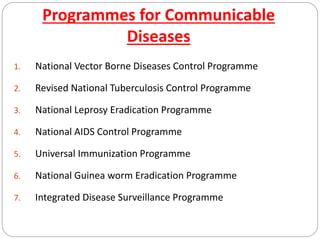
Programmes for Communicable
Diseases
1. National Vector Borne Diseases Control Programme
2. Revised National Tuberculosis Control Programme
3. National Leprosy Eradication Programme
4. National AIDS Control Programme
5. Universal Immunization Programme
6. National Guinea worm Eradication Programme
7. Integrated Disease Surveillance Programme
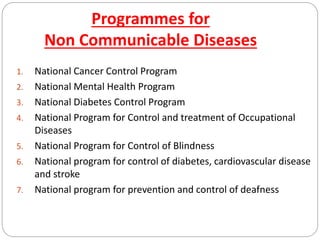
Programmes for
Non Communicable Diseases
1. National Cancer Control Program
2. National Mental Health Program
3. National Diabetes Control Program
4. National Program for Control and treatment of Occupational
Diseases
5. National Program for Control of Blindness
6. National program for control of diabetes, cardiovascular disease
and stroke
7. National program for prevention and control of deafness
National Nutrition Programs
 Integrated Child Development Services Scheme (ICDS)
 Mid-day Meal Programme (MDM)
 Special Nutrition Programme (SNP)
 National Nutritional Anemia Prophylaxis Programme
 National Iodine Deficiency Disorders Control Programme
National Health Policies
 National Health Policy
 National Population Policy
 National AIDS control and Prevention Policy
 National Policy for empowerment of Women
 National Youth Policy
 National Nutrition Policy
National Nutritional
Programmes In India
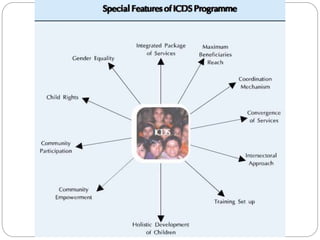
INTEGRATED CHILD DEVELOPMENT
SERVICE (ICDS) SCHEME
• Launched on 2nd October 1975.
• India’s response to the challenge of providing pre-school
education on one hand and breaking the vicious cycle of
malnutrition, morbidity, reduced learning capacity and mortality,
on the other.
• The ICDS national development program is one of the largest in
the world.
• It reaches more than 34 million children aged 0-6 years and 7
million pregnant and lactating mothers
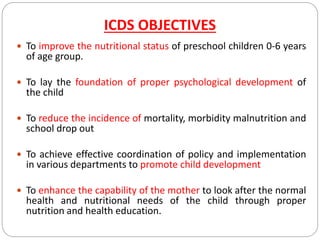
ICDS OBJECTIVES
 To improve the nutritional status of preschool children 0-6 years
of age group.
 To lay the foundation of proper psychological development of
the child
 To reduce the incidence of mortality, morbidity malnutrition and
school drop out
 To achieve effective coordination of policy and implementation
in various departments to promote child development
 To enhance the capability of the mother to look after the normal
health and nutritional needs of the child through proper
nutrition and health education.
Beneficiaries
 Pregnant women
 Nursing Mothers
 Children less than 3 years
 Children between 3-6 years
 Adolescent girls( 11-18 years)
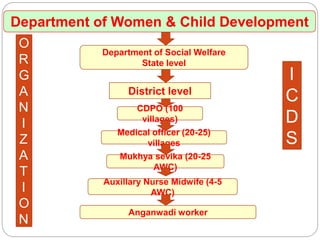
Department of Women & Child Development
Department of Social Welfare
State level
District level
CDPO (100
villages)
Medical officer (20-25)
villages
Mukhya sevika (20-25
AWC)
Auxillary Nurse Midwife (4-5
AWC)
Anganwadi worker
O
R
G
A
N
I
Z
A
T
I
O
N
I
C
D
S
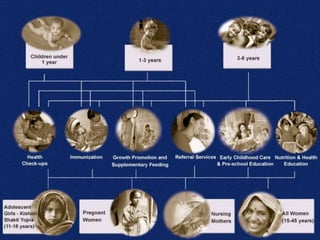
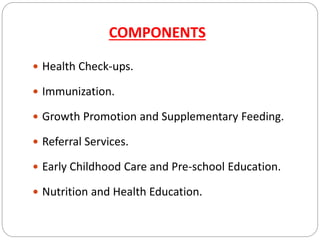
COMPONENTS
 Health Check-ups.
 Immunization.
 Growth Promotion and Supplementary Feeding.
 Referral Services.
 Early Childhood Care and Pre-school Education.
 Nutrition and Health Education.
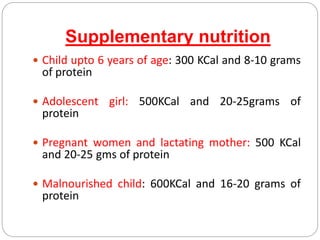
Supplementary nutrition
 Child upto 6 years of age: 300 KCal and 8-10 grams
of protein
 Adolescent girl: 500KCal and 20-25grams of
protein
 Pregnant women and lactating mother: 500 KCal
and 20-25 gms of protein
 Malnourished child: 600KCal and 16-20 grams of
protein
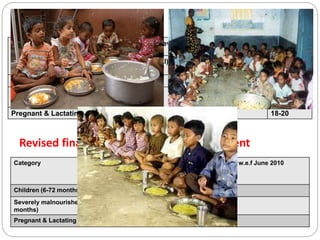
Supplementary nutrition
Revised financial norms for food supplement
Beneficiary Pre-revised Revised w.e.f. Feb. 2009
Calories (KCal) Protein
(G)
Calories
(KCal)
Protein(G)
Children (6-72 months) 300 8-10 500 12-15
Severely malnourished
children (6-72 months)
600 20 800 20-25
Pregnant & Lactating 500 15-20 600 18-20
Category Pre-revised Revised w.e.f June 2010
Children (6-72 months) Rs. 2.00 Rs.4.84
Severely malnourished children (6-72
months)
Rs. 2.70 Rs.5.82
Pregnant & Lactating Rs. 2.30 Rs.6.00
Immunization
 Immunization of pregnant women and infants protects
children from six vaccine preventable diseases-
poliomyelitis, diphtheria, pertussis, tetanus, tuberculosis
and measles.
 These are major preventable causes of child mortality,
disability, morbidity and related malnutrition.
 Immunization of pregnant women against tetanus also
reduces maternal and neonatal mortality
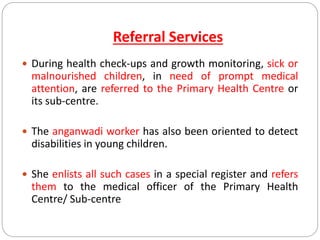
Referral Services
 During health check-ups and growth monitoring, sick or
malnourished children, in need of prompt medical
attention, are referred to the Primary Health Centre or
its sub-centre.
 The anganwadi worker has also been oriented to detect
disabilities in young children.
 She enlists all such cases in a special register and refers
them to the medical officer of the Primary Health
Centre/ Sub-centre
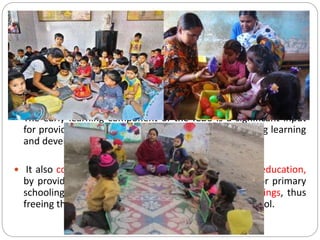
Non-formal Pre-School Education (PSE)
 Its program for the three-to six years old children in the
anganwadi is directed towards providing and ensuring a natural,
joyful and stimulating environment, with emphasis on necessary
inputs for optimal growth and development.
 The early learning component of the ICDS is a significant input
for providing a sound foundation for cumulative lifelong learning
and development.
 It also contributes to the universalization of primary education,
by providing to the child the necessary preparation for primary
schooling and offering substitute care to younger siblings, thus
freeing the older ones – especially girls – to attend school.
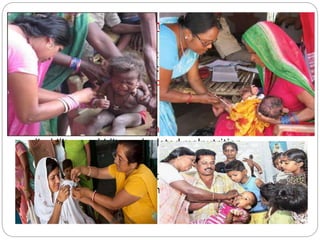
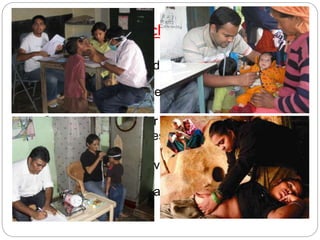
Health check-ups
 Record of weight and height of children at
periodical intervals
 Watch over milestones
 Immunization
 General check up for detection of disease
 Treatment of diseases like diarrhea, ARI
 Deworming
 Prophylaxis against vitamin A deficiency and
anemia
 Referral of serious cases
International partners of ICDS
Government of India partners with the following international
agencies to supplement interventions under the ICDS:
Source: http://wcd.nic.in/icds.htm
 Centrally sponsored programme, launched in 1986.
 Implemented by the Ministry of Women & Child Development
Beneficiaries:
 Children below 6 years of age and expectant /lactating women from
disadvantaged sections
 Implemented through ICDS
Services:
 Implemented through ICDS
 Providing nutritious/ energy food to the beneficiaries
Wheat-based nutrition programme
 First introduced in Tamilnadu.
 Also known as School lunch programme.
 Programme in operation since 1961 under Ministry of Education.
Beneficiaries:
All children of primary and upper primary classes attending:
 Govt. schools
 Govt. aided schools
 Local body schools
 Education guarantee schemes
Mid-day meal scheme
Inexhaustible
Objectives
• Improve the school attendance
• Reduce school drop outs
• Beneficial impact on child’s nutrition
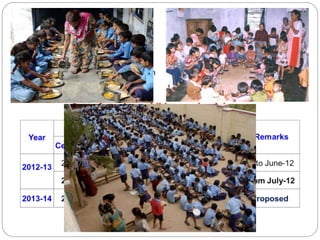
Cost of meal per child per school day
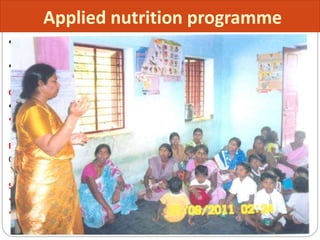
 The Applied Nutrition Programme (ANP) was introduced as a pilot scheme in
Orissa in 1963 which later on extended to Tamil Nadu and Uttar Pradesh.
 In 1973 its extended to all states in INDIA
Objectives:
 Promoting production of protective food such as vegetables and fruits and
 Ensure their consumption by pregnant and nursing mothers and children.
Beneficiaries :
Children between 2-6 years and pregnant and lactating mothers.
Services
 Nutritional education
 Nutrition worth of 25 paise per child per day and 50 paise per woman per day
are provided for 52 days in a year.
Applied nutrition programme
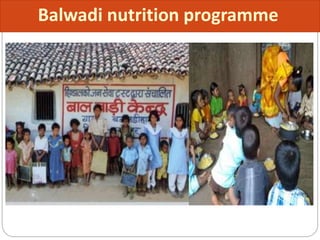
 Initiated in 1970 under the Department of Social Welfare
through voluntary organizations.
 Funded by the Central Government
Beneficiary group
Preschool children 3-5years of age.
Services
 300 Kcal and 10 gm protein per child for 270 days in a year.
 Also provide with pre school education
Balwadi nutrition programme
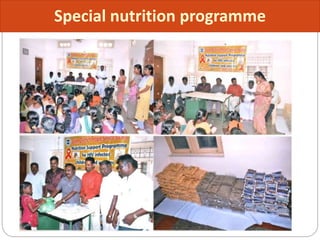
 Initiated in 1970 by Ministry of Social Welfare.
 Operation in urban slums, tribal areas and backward rural areas.
Beneficiary group
 Children below 6 years
 Pregnant and lactating women
Services
 Preschool children : 300kcal and 10-12gm protein
 Pregnant & lactating mothers :500kcal and 25 gm protein
Special nutrition programme
Programme was launched during 4th 5-year plan in 1970 by the
Ministry of Health and Family Welfare
Objective:
Prevention of nutritional anemia in mothers and children
Beneficiaries
 Children 1-5years of age
 Expecting and lactating mothers
 Family planning (IUD) acceptors
National Nutritional Anemia
Prophylaxis Programme
Services:
• Expecting and lactating mothers as well as IUD acceptors -60 mg of
elemental iron + 0.5 mg folate everyday for 100 days.
• Children 1-5 years- 20mg of elemental iron + 0.1 mg folate
everyday for 100 days.
National Vitamin A Prophylaxis
Programme
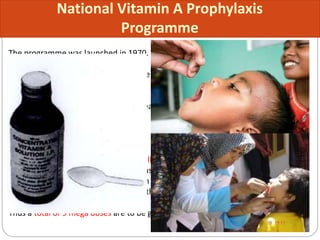
The programme was launched in 1970.
Objectives: To decrease the prevalence of Vitamin A deficiency from current 0.6%
to less than 0.5%.
Beneficiaries: Children 9 months- 5 years
Services:
• Health and nutrition education
• Prophylactic Vitamin A as per the following dosage schedule:
100000 IU at 9 months with measles immunisation
200000 IU at 16-18 months, with DPT booster
200000 IU every 6 moths, up to the age of 5 years.
Thus a total of 9 mega doses are to be given from 9 months of age up to 5 years.
 Launched in 1962, at the end of 2nd 5-year plan by MOHFW,GOI
 Focuses on use of Iodised Salt – Replace of common salt with iodised salt,
 Use of Iodized oil Injection to those suffering from IDD, Oral administration as
prophylaxis in IDD severe areas
Objectives
 Surveys to assess the magnitude of IDD.
 Supply of iodised salt
 Lab monitering of iodised salt and UIE
 Health education.
National Iodine deficiency disorder
control programme
Strategy
• Iodise entire edible salt in the
countryby 1992.
• Ban of non-iodised salt under PFA
act (1954).
People are not potential problems;
they are potential assets.
• If India is to reap the demographic harvest of its young
population, it must ensure that the quality of the population is
good and productive.
• The nutritional status of the population is a measure of the
calibre of the people.
• Therefore, efforts to change the existing nutritional scenario is a
top priority in the years ahead.
Thank you

National nutritional programmes in india

  • 1.
    National Health Programmes Harsha Hirdyani AssistantProfessor Dept. of Food Technology and Nutrition Lovely Professional University
  • 2.
    Programmes for Communicable Diseases 1.National Vector Borne Diseases Control Programme 2. Revised National Tuberculosis Control Programme 3. National Leprosy Eradication Programme 4. National AIDS Control Programme 5. Universal Immunization Programme 6. National Guinea worm Eradication Programme 7. Integrated Disease Surveillance Programme
  • 3.
    Programmes for Non CommunicableDiseases 1. National Cancer Control Program 2. National Mental Health Program 3. National Diabetes Control Program 4. National Program for Control and treatment of Occupational Diseases 5. National Program for Control of Blindness 6. National program for control of diabetes, cardiovascular disease and stroke 7. National program for prevention and control of deafness
  • 4.
    National Nutrition Programs Integrated Child Development Services Scheme (ICDS)  Mid-day Meal Programme (MDM)  Special Nutrition Programme (SNP)  National Nutritional Anemia Prophylaxis Programme  National Iodine Deficiency Disorders Control Programme
  • 5.
    National Health Policies National Health Policy  National Population Policy  National AIDS control and Prevention Policy  National Policy for empowerment of Women  National Youth Policy  National Nutrition Policy
  • 6.
  • 7.
    INTEGRATED CHILD DEVELOPMENT SERVICE(ICDS) SCHEME • Launched on 2nd October 1975. • India’s response to the challenge of providing pre-school education on one hand and breaking the vicious cycle of malnutrition, morbidity, reduced learning capacity and mortality, on the other. • The ICDS national development program is one of the largest in the world. • It reaches more than 34 million children aged 0-6 years and 7 million pregnant and lactating mothers
  • 9.
    ICDS OBJECTIVES  Toimprove the nutritional status of preschool children 0-6 years of age group.  To lay the foundation of proper psychological development of the child  To reduce the incidence of mortality, morbidity malnutrition and school drop out  To achieve effective coordination of policy and implementation in various departments to promote child development  To enhance the capability of the mother to look after the normal health and nutritional needs of the child through proper nutrition and health education.
  • 10.
    Beneficiaries  Pregnant women Nursing Mothers  Children less than 3 years  Children between 3-6 years  Adolescent girls( 11-18 years)
  • 12.
    Department of Women& Child Development Department of Social Welfare State level District level CDPO (100 villages) Medical officer (20-25) villages Mukhya sevika (20-25 AWC) Auxillary Nurse Midwife (4-5 AWC) Anganwadi worker O R G A N I Z A T I O N I C D S
  • 13.
    COMPONENTS  Health Check-ups. Immunization.  Growth Promotion and Supplementary Feeding.  Referral Services.  Early Childhood Care and Pre-school Education.  Nutrition and Health Education.
  • 14.
    Supplementary nutrition  Childupto 6 years of age: 300 KCal and 8-10 grams of protein  Adolescent girl: 500KCal and 20-25grams of protein  Pregnant women and lactating mother: 500 KCal and 20-25 gms of protein  Malnourished child: 600KCal and 16-20 grams of protein
  • 15.
    Supplementary nutrition Revised financialnorms for food supplement Beneficiary Pre-revised Revised w.e.f. Feb. 2009 Calories (KCal) Protein (G) Calories (KCal) Protein(G) Children (6-72 months) 300 8-10 500 12-15 Severely malnourished children (6-72 months) 600 20 800 20-25 Pregnant & Lactating 500 15-20 600 18-20 Category Pre-revised Revised w.e.f June 2010 Children (6-72 months) Rs. 2.00 Rs.4.84 Severely malnourished children (6-72 months) Rs. 2.70 Rs.5.82 Pregnant & Lactating Rs. 2.30 Rs.6.00
  • 16.
    Immunization  Immunization ofpregnant women and infants protects children from six vaccine preventable diseases- poliomyelitis, diphtheria, pertussis, tetanus, tuberculosis and measles.  These are major preventable causes of child mortality, disability, morbidity and related malnutrition.  Immunization of pregnant women against tetanus also reduces maternal and neonatal mortality
  • 17.
    Referral Services  Duringhealth check-ups and growth monitoring, sick or malnourished children, in need of prompt medical attention, are referred to the Primary Health Centre or its sub-centre.  The anganwadi worker has also been oriented to detect disabilities in young children.  She enlists all such cases in a special register and refers them to the medical officer of the Primary Health Centre/ Sub-centre
  • 18.
    Non-formal Pre-School Education(PSE)  Its program for the three-to six years old children in the anganwadi is directed towards providing and ensuring a natural, joyful and stimulating environment, with emphasis on necessary inputs for optimal growth and development.  The early learning component of the ICDS is a significant input for providing a sound foundation for cumulative lifelong learning and development.  It also contributes to the universalization of primary education, by providing to the child the necessary preparation for primary schooling and offering substitute care to younger siblings, thus freeing the older ones – especially girls – to attend school.
  • 19.
    Health check-ups  Recordof weight and height of children at periodical intervals  Watch over milestones  Immunization  General check up for detection of disease  Treatment of diseases like diarrhea, ARI  Deworming  Prophylaxis against vitamin A deficiency and anemia  Referral of serious cases
  • 20.
    International partners ofICDS Government of India partners with the following international agencies to supplement interventions under the ICDS: Source: http://wcd.nic.in/icds.htm
  • 21.
     Centrally sponsoredprogramme, launched in 1986.  Implemented by the Ministry of Women & Child Development Beneficiaries:  Children below 6 years of age and expectant /lactating women from disadvantaged sections  Implemented through ICDS Services:  Implemented through ICDS  Providing nutritious/ energy food to the beneficiaries Wheat-based nutrition programme
  • 22.
     First introducedin Tamilnadu.  Also known as School lunch programme.  Programme in operation since 1961 under Ministry of Education. Beneficiaries: All children of primary and upper primary classes attending:  Govt. schools  Govt. aided schools  Local body schools  Education guarantee schemes Mid-day meal scheme Inexhaustible
  • 23.
    Objectives • Improve theschool attendance • Reduce school drop outs • Beneficial impact on child’s nutrition Cost of meal per child per school day
  • 24.
     The AppliedNutrition Programme (ANP) was introduced as a pilot scheme in Orissa in 1963 which later on extended to Tamil Nadu and Uttar Pradesh.  In 1973 its extended to all states in INDIA Objectives:  Promoting production of protective food such as vegetables and fruits and  Ensure their consumption by pregnant and nursing mothers and children. Beneficiaries : Children between 2-6 years and pregnant and lactating mothers. Services  Nutritional education  Nutrition worth of 25 paise per child per day and 50 paise per woman per day are provided for 52 days in a year. Applied nutrition programme
  • 25.
     Initiated in1970 under the Department of Social Welfare through voluntary organizations.  Funded by the Central Government Beneficiary group Preschool children 3-5years of age. Services  300 Kcal and 10 gm protein per child for 270 days in a year.  Also provide with pre school education Balwadi nutrition programme
  • 26.
     Initiated in1970 by Ministry of Social Welfare.  Operation in urban slums, tribal areas and backward rural areas. Beneficiary group  Children below 6 years  Pregnant and lactating women Services  Preschool children : 300kcal and 10-12gm protein  Pregnant & lactating mothers :500kcal and 25 gm protein Special nutrition programme
  • 27.
    Programme was launchedduring 4th 5-year plan in 1970 by the Ministry of Health and Family Welfare Objective: Prevention of nutritional anemia in mothers and children Beneficiaries  Children 1-5years of age  Expecting and lactating mothers  Family planning (IUD) acceptors National Nutritional Anemia Prophylaxis Programme
  • 28.
    Services: • Expecting andlactating mothers as well as IUD acceptors -60 mg of elemental iron + 0.5 mg folate everyday for 100 days. • Children 1-5 years- 20mg of elemental iron + 0.1 mg folate everyday for 100 days.
  • 29.
    National Vitamin AProphylaxis Programme The programme was launched in 1970. Objectives: To decrease the prevalence of Vitamin A deficiency from current 0.6% to less than 0.5%. Beneficiaries: Children 9 months- 5 years Services: • Health and nutrition education • Prophylactic Vitamin A as per the following dosage schedule: 100000 IU at 9 months with measles immunisation 200000 IU at 16-18 months, with DPT booster 200000 IU every 6 moths, up to the age of 5 years. Thus a total of 9 mega doses are to be given from 9 months of age up to 5 years.
  • 30.
     Launched in1962, at the end of 2nd 5-year plan by MOHFW,GOI  Focuses on use of Iodised Salt – Replace of common salt with iodised salt,  Use of Iodized oil Injection to those suffering from IDD, Oral administration as prophylaxis in IDD severe areas Objectives  Surveys to assess the magnitude of IDD.  Supply of iodised salt  Lab monitering of iodised salt and UIE  Health education. National Iodine deficiency disorder control programme Strategy • Iodise entire edible salt in the countryby 1992. • Ban of non-iodised salt under PFA act (1954).
  • 31.
    People are notpotential problems; they are potential assets. • If India is to reap the demographic harvest of its young population, it must ensure that the quality of the population is good and productive. • The nutritional status of the population is a measure of the calibre of the people. • Therefore, efforts to change the existing nutritional scenario is a top priority in the years ahead.
  • 32.