COMMUNITY NUTRITIONAL
PROGRAMMES
Dr. Harpreet Kaur
1st Year PG student
Community Medicine
Guru Gobind Singh Medical College, Faridkot
Learning objective
◦ To know about nutritional programmes in India and basic
structure of these programmes.
Lesson plan
◦ Introduction
◦ Nutritional programmes for pregnant and lactating mothers
◦ Nutritional programmes for children
◦ Nutritional programmes for adolescents
◦ Other nutritional programmes
Introduction
◦ Under-nutrition prevalent in India is-
-macronutrient deficiency (Protein- energy malnutrition)
-micronutrient deficiency (deficiencies in iron, iodine, vitamin
A and zinc).
◦ Nutrition programs in India are directed against
-general malnutrition and at specific nutritional deficiencies.
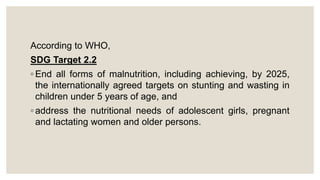
According to WHO,
SDG Target 2.2
◦ End all forms of malnutrition, including achieving, by 2025,
the internationally agreed targets on stunting and wasting in
children under 5 years of age, and
◦ address the nutritional needs of adolescent girls, pregnant
and lactating women and older persons.
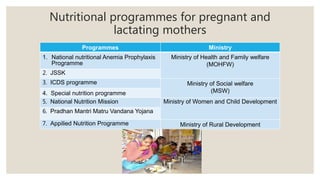
Nutritional programmes for pregnant and
lactating mothers
Programmes Ministry
1. National nutritional Anemia Prophylaxis
Programme
Ministry of Health and Family welfare
(MOHFW)
2. JSSK
3. ICDS programme Ministry of Social welfare
(MSW)
4. Special nutrition programme
5. National Nutrition Mission Ministry of Women and Child Development
6. Pradhan Mantri Matru Vandana Yojana
7. Appilied Nutrition Programme Ministry of Rural Development
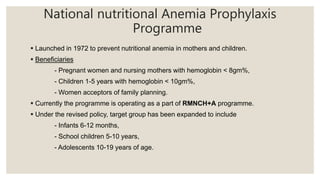
National nutritional Anemia Prophylaxis
Programme
 Launched in 1972 to prevent nutritional anemia in mothers and children.
 Beneficiaries
- Pregnant women and nursing mothers with hemoglobin < 8gm%,
- Children 1-5 years with hemoglobin < 10gm%,
- Women acceptors of family planning.
 Currently the programme is operating as a part of RMNCH+A programme.
 Under the revised policy, target group has been expanded to include
- Infants 6-12 months,
- School children 5-10 years,
- Adolescents 10-19 years of age.
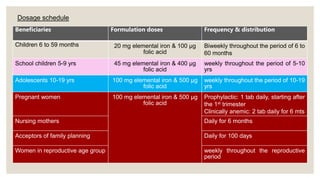
Dosage schedule
Beneficiaries Formulation doses Frequency & distribution
Children 6 to 59 months 20 mg elemental iron & 100 µg
folic acid
Biweekly throughout the period of 6 to
60 months
School children 5-9 yrs 45 mg elemental iron & 400 µg
folic acid
weekly throughout the period of 5-10
yrs
Adolescents 10-19 yrs 100 mg elemental iron & 500 µg
folic acid
weekly throughout the period of 10-19
yrs
Pregnant women 100 mg elemental iron & 500 µg
folic acid
Prophylactic: 1 tab daily, starting after
the 1st trimester
Clinically anemic: 2 tab daily for 6 mts
Nursing mothers Daily for 6 months
Acceptors of family planning Daily for 100 days
Women in reproductive age group weekly throughout the reproductive
period
Strategies under RMNCH+A
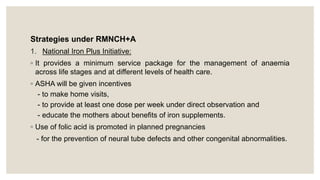
1. National Iron Plus Initiative:
◦ It provides a minimum service package for the management of anaemia
across life stages and at different levels of health care.
◦ ASHA will be given incentives
- to make home visits,
- to provide at least one dose per week under direct observation and
- educate the mothers about benefits of iron supplements.
◦ Use of folic acid is promoted in planned pregnancies
- for the prevention of neural tube defects and other congenital abnormalities.
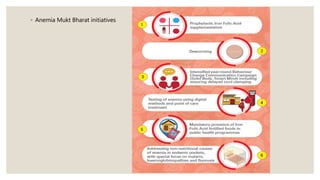
2. Anemia Mukt Bharat
◦ To achieve the targets of World Health Assembly
- 50% reduction of anemia in women of reproductive age by 2025.
- to reduce the prevalence amongst
young children (6-59 months), adolescents and women of reproductive age
groups (15-49 years) by three percent per year.
◦ This has been built upon the existing framework of NIPI.
◦ Anemia Mukt Bharat initiatives
12 by 12 initiative for anemia control
◦ Launched on april 23 ,2007 at AIIMS, New Delhi.
◦ Organized by Department of Obs. & Gynae of AIIMS in collaboration with
WHO, UNICEF and FOGSI.
◦ Objective-
Ensuring every child at least 12 gm% hemoglobin by 12 yrs of age.
◦ Goals-
1. To determine the prevalence of anemia in adolescence to ensure healthy
parenthood.
2. To increase awareness among adolescents regarding anemia & appropriate
nutrition.
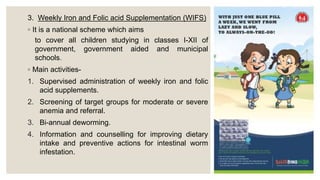
3. Weekly Iron and Folic acid Supplementation (WIFS)
◦ It is a national scheme which aims
to cover all children studying in classes I-XII of
government, government aided and municipal
schools.
◦ Main activities-
1. Supervised administration of weekly iron and folic
acid supplements.
2. Screening of target groups for moderate or severe
anemia and referral.
3. Bi-annual deworming.
4. Information and counselling for improving dietary
intake and preventive actions for intestinal worm
infestation.
ICDS Programme
◦ Integrated Child Development Service, 1975.
◦ There is a strong nutrition component in this programme in the
form
-of supplementary nutrition, vit A prophylaxis and iron and folic
acid distribution.
◦ Currently it is termed as Umbrella ICDS Scheme that comprises
of several subschemes. It includes-
1. Anganwadi Services
2. Scheme for Adolescent Girls
3. National Nutrition Mission
4. Pradhan Mantri Matru Vandana Yojana
5. Child Protection Services
6. National Creche Scheme
Objectives of ICDS
1. To improve the nutritional and health status of children in the age group 0-6
years.
2. To lay the foundations for proper physical, social and psychological
development of the child.
3. To reduce mortality ,morbidity, malnutrition and school drop-outs.
4. To achieve effective co-ordination and implementation of policy among the
various departments working for the promotion of child development.
5. To enhance the capability of the mother and nutritional needs of the child
through proper nutrition and health education.
◦ Beneficiaries-
 pre school children below 6 yrs,
 adolescent girls 11-18 yrs,
 pregnant and lactating mothers.
◦ Anganwadi workers deliver services at village level.
◦ Mahila mandal networks have been built up in ICDS project areas to
help anganwadi workers.
◦ Work of anganwadis is supervised by mukhyasevikas.
◦ Field supervision by Child Development Project Officer(CDPO).
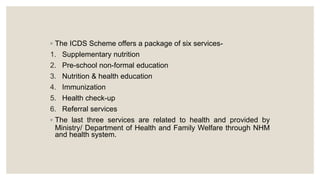
◦ The ICDS Scheme offers a package of six services-
1. Supplementary nutrition
2. Pre-school non-formal education
3. Nutrition & health education
4. Immunization
5. Health check-up
6. Referral services
◦ The last three services are related to health and provided by
Ministry/ Department of Health and Family Welfare through NHM
and health system.
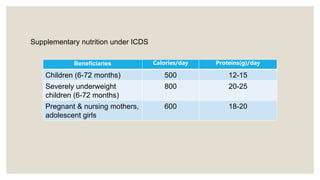
Supplementary nutrition under ICDS
Beneficiaries Calories/day Proteins(g)/day
Children (6-72 months) 500 12-15
Severely underweight
children (6-72 months)
800 20-25
Pregnant & nursing mothers,
adolescent girls
600 18-20
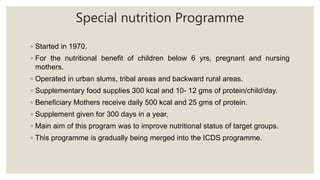
Special nutrition Programme
◦ Started in 1970.
◦ For the nutritional benefit of children below 6 yrs, pregnant and nursing
mothers.
◦ Operated in urban slums, tribal areas and backward rural areas.
◦ Supplementary food supplies 300 kcal and 10- 12 gms of protein/child/day.
◦ Beneficiary Mothers receive daily 500 kcal and 25 gms of protein.
◦ Supplement given for 300 days in a year.
◦ Main aim of this program was to improve nutritional status of target groups.
◦ This programme is gradually being merged into the ICDS programme.
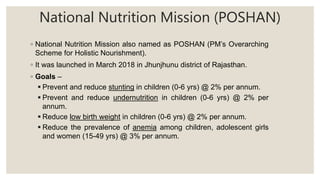
National Nutrition Mission (POSHAN)
◦ National Nutrition Mission also named as POSHAN (PM’s Overarching
Scheme for Holistic Nourishment).
◦ It was launched in March 2018 in Jhunjhunu district of Rajasthan.
◦ Goals –
 Prevent and reduce stunting in children (0-6 yrs) @ 2% per annum.
 Prevent and reduce undernutrition in children (0-6 yrs) @ 2% per
annum.
 Reduce low birth weight in children (0-6 yrs) @ 2% per annum.
 Reduce the prevalence of anemia among children, adolescent girls
and women (15-49 yrs) @ 3% per annum.
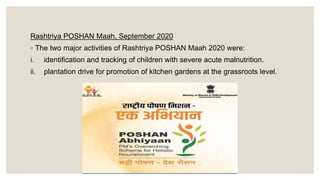
Rashtriya POSHAN Maah, September 2020
◦ The two major activities of Rashtriya POSHAN Maah 2020 were:
i. identification and tracking of children with severe acute malnutrition.
ii. plantation drive for promotion of kitchen gardens at the grassroots level.
Pradhan Mantri Matru Vandana Yojana
◦ Indira Gandhi Matritva Sahyog Yojana which was started in
2010 was renamed as Pradhan Mantri Matru Vandana Yojana
in 2017.
◦ Objectives –
• To provide partial compensation for the wage loss in terms of
cash incentives so that the woman can take adequate rest
before and after delivery of the 1st living child.
• The cash incentive provided would lead to improved health
seeking behaviour amongst the PM & LM.
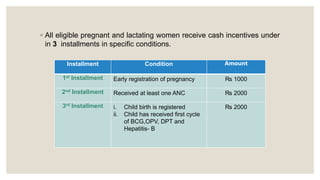
◦ All eligible pregnant and lactating women receive cash incentives under
in 3 installments in specific conditions.
Installment Condition Amount
1st Installment Early registration of pregnancy ₨ 1000
2nd Installment Received at least one ANC ₨ 2000
3rd Installment i. Child birth is registered
ii. Child has received first cycle
of BCG,OPV, DPT and
Hepatitis- B
₨ 2000
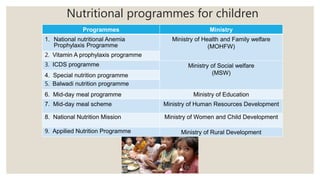
Nutritional programmes for children
Programmes Ministry
1. National nutritional Anemia
Prophylaxis Programme
Ministry of Health and Family welfare
(MOHFW)
2. Vitamin A prophylaxis programme
3. ICDS programme Ministry of Social welfare
(MSW)
4. Special nutrition programme
5. Balwadi nutrition programme
6. Mid-day meal programme Ministry of Education
7. Mid-day meal scheme Ministry of Human Resources Development
8. National Nutrition Mission Ministry of Women and Child Development
9. Appilied Nutrition Programme Ministry of Rural Development
Vitamin A prophylaxis programme
◦ Vitamin A deficiency is one of the major causes of blindness
in children below five years.
◦ The program was started in 1970 with the objective to reduce
the prevalence of vitamin A deficiency disorders from 0.6% to
0.5%.
◦ Beneficiary: age group 6months - 5years
◦ Implemented by: PHC and subcenter
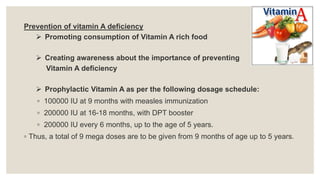
Prevention of vitamin A deficiency
 Promoting consumption of Vitamin A rich food
 Creating awareness about the importance of preventing
Vitamin A deficiency
 Prophylactic Vitamin A as per the following dosage schedule:
◦ 100000 IU at 9 months with measles immunization
◦ 200000 IU at 16-18 months, with DPT booster
◦ 200000 IU every 6 months, up to the age of 5 years.
◦ Thus, a total of 9 mega doses are to be given from 9 months of age up to 5 years.
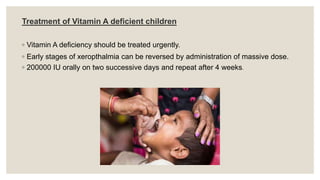
Treatment of Vitamin A deficient children
◦ Vitamin A deficiency should be treated urgently.
◦ Early stages of xeropthalmia can be reversed by administration of massive dose.
◦ 200000 IU orally on two successive days and repeat after 4 weeks.
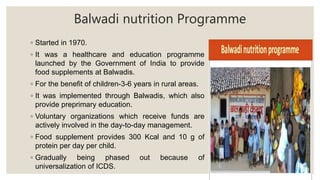
Balwadi nutrition Programme
◦ Started in 1970.
◦ It was a healthcare and education programme
launched by the Government of India to provide
food supplements at Balwadis.
◦ For the benefit of children-3-6 years in rural areas.
◦ It was implemented through Balwadis, which also
provide preprimary education.
◦ Voluntary organizations which receive funds are
actively involved in the day-to-day management.
◦ Food supplement provides 300 Kcal and 10 g of
protein per day per child.
◦ Gradually being phased out because of
universalization of ICDS.
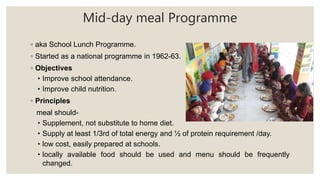
Mid-day meal Programme
◦ aka School Lunch Programme.
◦ Started as a national programme in 1962-63.
◦ Objectives
• Improve school attendance.
• Improve child nutrition.
◦ Principles
meal should-
• Supplement, not substitute to home diet.
• Supply at least 1/3rd of total energy and ½ of protein requirement /day.
• low cost, easily prepared at schools.
• locally available food should be used and menu should be frequently
changed.
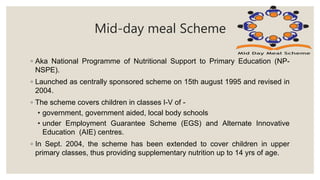
Mid-day meal Scheme
◦ Aka National Programme of Nutritional Support to Primary Education (NP-
NSPE).
◦ Launched as centrally sponsored scheme on 15th august 1995 and revised in
2004.
◦ The scheme covers children in classes I-V of -
• government, government aided, local body schools
• under Employment Guarantee Scheme (EGS) and Alternate Innovative
Education (AIE) centres.
◦ In Sept. 2004, the scheme has been extended to cover children in upper
primary classes, thus providing supplementary nutrition up to 14 yrs of age.
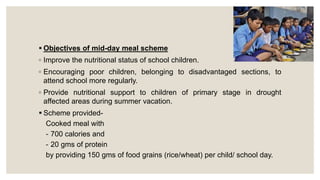
 Objectives of mid-day meal scheme
◦ Improve the nutritional status of school children.
◦ Encouraging poor children, belonging to disadvantaged sections, to
attend school more regularly.
◦ Provide nutritional support to children of primary stage in drought
affected areas during summer vacation.
 Scheme provided-
Cooked meal with
- 700 calories and
- 20 gms of protein
by providing 150 gms of food grains (rice/wheat) per child/ school day.
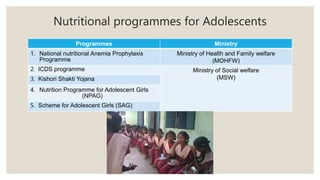
Nutritional programmes for Adolescents
Programmes Ministry
1. National nutritional Anemia Prophylaxis
Programme
Ministry of Health and Family welfare
(MOHFW)
2. ICDS programme Ministry of Social welfare
(MSW)
3. Kishori Shakti Yojana
4. Nutrition Programme for Adolescent Girls
(NPAG)
5. Scheme for Adolescent Girls (SAG)
Kishori Shakti Yojana
(KSY)
◦ This scheme is a redesign of the already existing Adolescent Girls
Scheme being implemented as a component under the centrally
sponsored ICDS Scheme.
◦ Objectives
 To improve the nutritional, health and development status of
adolescent girls.
 Promote awareness of health, hygiene, nutrition and family care.
 Link them to opportunities for learning life skills.
 Help them gain a better understanding of their social environment
and take initiatives to become productive members of the society.
Nutrition Programme for Adolescent Girls
(NPAG)
◦ To address the problem of under-nutrition among adolescent
girls.
◦ Target Group:
 Adolescent girls (11-19 years)
Adolescent girls (11-15 years) (weight <30 Kg)
Adolescent girls (15-19 years ) (weight <35 Kg)
◦ NPAG-Services
• 6 kg of free food-grains (wheat/rice/Maize based on
habitual consumption pattern of the state) /per month per
beneficiary.
• Nutrition and Health Education to the beneficiaries and
their families.
◦ This Programme is operationalised through the
administrative set up of ICDS at the state, district, block and
Anganwadi level.
Scheme for Adolescent Girls
(SAG)
◦ Scheme was launched in 2010 as Rajiv Gandhi Scheme For
Empowerment Of Adolescent Girls (RGSEAG)- SABLA and replaces
KSY and NPAG.
◦ Objectives
• Enable the adolescent girls for self development & empowerment.
• Improve their nutrition and health status.
• Promote awareness about hygiene, ARSH and family & child care.
• Upgrade their life skills & tie up with National Skill Development
Program (NSDP) for vocational skills.
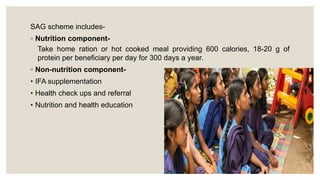
SAG scheme includes-
◦ Nutrition component-
Take home ration or hot cooked meal providing 600 calories, 18-20 g of
protein per beneficiary per day for 300 days a year.
◦ Non-nutrition component-
• IFA supplementation
• Health check ups and referral
• Nutrition and health education
Nutritional programmes for Elderly
Other Programmes
Programmes Ministry
1. Annapurna Scheme Ministry of Agriculture, Consumer
Affairs, Food and Public distribution
Programmes Ministry
1. Iodine deficiency disorders control
programme
Ministry of Health and Family welfare
(MOHFW)
2. National programme for prevention and
control of fluorosis
3. Antyodya Anna Yojana Ministry of Agriculture, Consumer Affairs,
Food and Public distribution
4. Smart Ration Card Scheme
Annapurna Scheme
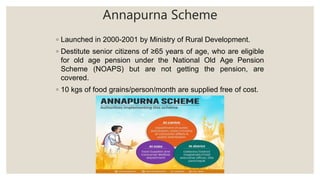
◦ Launched in 2000-2001 by Ministry of Rural Development.
◦ Destitute senior citizens of ≥65 years of age, who are eligible
for old age pension under the National Old Age Pension
Scheme (NOAPS) but are not getting the pension, are
covered.
◦ 10 kgs of food grains/person/month are supplied free of cost.
Iodine deficiency disorders control
Programme
◦ National goiter control programme was launched in 1962.
◦ Renamed in 1992 to address the spectrum of disorders that
are caused by iodine deficiency.
◦ Goal of the program is-
to reduce the prevalence of IDD to below 10% in endemic
districts of the country by 2000. Since this was achieved,
the goal was modified to reduce the prevalence of IDD to
below 5%.
◦ Activities under the program-
 Surveys to assess the magnitude of IDD in districts.
 Supply of iodized salt in place of common salt.
 Resurveys 5yearly to assess impact of iodized salt & IDD.
 Lab monitoring of iodized salt and urinary iodine excretion.
 Health education and publicity.
◦ MoHFW is responsible for the overall functioning of the program.
◦ Salt Commisioner’s office under Ministry of Industry controls monitoring,
production and distribution of iodized salt to the states & Uts.
◦ Common salt is iodized using potassium iodate and the iodine content
should not be <30 ppm at production and 15 ppm at consumption levels
under the Food Safety and Standards Act.
◦ Information, education and communication regarding the importance of
consumption of iodized salt in prevention of IDD is central to the program.
◦ IDD spots containing messages on consequences of iodine deficiency
disorders and benefits of consuming iodized salt are being telecast through
Doordarshan channels daily and IDD messages under Swasth Bharat
Programme.
National program for prevention and
control of fluorosis
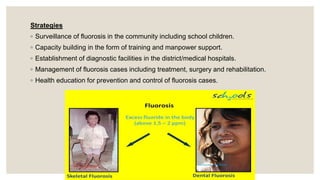
◦ Fluorosis is caused by excess intake of fluorides through drinking water/food
products/industrial pollutants, over a long period, resulting in major health
disorders like dental fluorosis, skeletal fluorosis and nonskeletal fluorosis.
◦ These harmful effects are permanent in nature and irreversible.
◦ The desirable limit of fluoride as per Bureau of Indian Standards (BIS) is 1
ppm.
◦ To combat this problem, this program was launched in 2008-09.
Objectives
◦ To collect, assess and use the baseline survey data of fluorosis of Ministry of
Drinking Water Supply for starting the project.
◦ Comprehensive mgt. of fluorosis in selected areas.
◦ Capacity building for prevention, diagnosis & mgt. of fluorosis cases.
Strategies
◦ Surveillance of fluorosis in the community including school children.
◦ Capacity building in the form of training and manpower support.
◦ Establishment of diagnostic facilities in the district/medical hospitals.
◦ Management of fluorosis cases including treatment, surgery and rehabilitation.
◦ Health education for prevention and control of fluorosis cases.
Antyodya Anna Yojana
◦ Launched in 25th Dec 2000.
◦ Target group –
Poor families who couldn’t afford food grains even at BPL rates
◦ Service –
Families are given food grains at highly subsidized rates.
ex.- wheat @Rs 2/kg & rice @Rs 3/kg, 35 kg being supplied per family per
month.
◦ In 2009, it was extended to include all eligible BPL, and families of HIV +ve
persons in AAY list on priority.
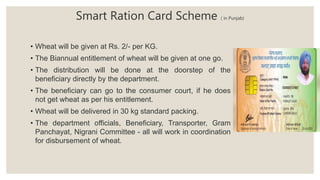
• Wheat will be given at Rs. 2/- per KG.
• The Biannual entitlement of wheat will be given at one go.
• The distribution will be done at the doorstep of the
beneficiary directly by the department.
• The beneficiary can go to the consumer court, if he does
not get wheat as per his entitlement.
• Wheat will be delivered in 30 kg standard packing.
• The department officials, Beneficiary, Transporter, Gram
Panchayat, Nigrani Committee - all will work in coordination
for disbursement of wheat.
Smart Ration Card Scheme ( in Punjab)
Still…
Where are we now ?
INDIA holds 94th Rank among 107
Countries in
Global Hunger Index 2020
References
◦ Park K. Nutrition and Health, Park’s textbook of preventive and social
medicine, 25th ed. Jabalpur: M/s Banarsidas Bhanot Publishers; 2019. p.716-
8.
◦ Banerjee B, National Nutrition Programme, DK Taneja’s Health Policies &
Programmes in India, 16th ed. Jaypee Brothers Medical Publishers (P) Ltd;
2019.p.427-59.
Thank you

Community nutritional programmes

  • 1.
    COMMUNITY NUTRITIONAL PROGRAMMES Dr. HarpreetKaur 1st Year PG student Community Medicine Guru Gobind Singh Medical College, Faridkot
  • 2.
    Learning objective ◦ Toknow about nutritional programmes in India and basic structure of these programmes.
  • 3.
    Lesson plan ◦ Introduction ◦Nutritional programmes for pregnant and lactating mothers ◦ Nutritional programmes for children ◦ Nutritional programmes for adolescents ◦ Other nutritional programmes
  • 4.
    Introduction ◦ Under-nutrition prevalentin India is- -macronutrient deficiency (Protein- energy malnutrition) -micronutrient deficiency (deficiencies in iron, iodine, vitamin A and zinc). ◦ Nutrition programs in India are directed against -general malnutrition and at specific nutritional deficiencies.
  • 5.
    According to WHO, SDGTarget 2.2 ◦ End all forms of malnutrition, including achieving, by 2025, the internationally agreed targets on stunting and wasting in children under 5 years of age, and ◦ address the nutritional needs of adolescent girls, pregnant and lactating women and older persons.
  • 6.
    Nutritional programmes forpregnant and lactating mothers Programmes Ministry 1. National nutritional Anemia Prophylaxis Programme Ministry of Health and Family welfare (MOHFW) 2. JSSK 3. ICDS programme Ministry of Social welfare (MSW) 4. Special nutrition programme 5. National Nutrition Mission Ministry of Women and Child Development 6. Pradhan Mantri Matru Vandana Yojana 7. Appilied Nutrition Programme Ministry of Rural Development
  • 7.
    National nutritional AnemiaProphylaxis Programme  Launched in 1972 to prevent nutritional anemia in mothers and children.  Beneficiaries - Pregnant women and nursing mothers with hemoglobin < 8gm%, - Children 1-5 years with hemoglobin < 10gm%, - Women acceptors of family planning.  Currently the programme is operating as a part of RMNCH+A programme.  Under the revised policy, target group has been expanded to include - Infants 6-12 months, - School children 5-10 years, - Adolescents 10-19 years of age.
  • 8.
    Dosage schedule Beneficiaries Formulationdoses Frequency & distribution Children 6 to 59 months 20 mg elemental iron & 100 µg folic acid Biweekly throughout the period of 6 to 60 months School children 5-9 yrs 45 mg elemental iron & 400 µg folic acid weekly throughout the period of 5-10 yrs Adolescents 10-19 yrs 100 mg elemental iron & 500 µg folic acid weekly throughout the period of 10-19 yrs Pregnant women 100 mg elemental iron & 500 µg folic acid Prophylactic: 1 tab daily, starting after the 1st trimester Clinically anemic: 2 tab daily for 6 mts Nursing mothers Daily for 6 months Acceptors of family planning Daily for 100 days Women in reproductive age group weekly throughout the reproductive period
  • 9.
    Strategies under RMNCH+A 1.National Iron Plus Initiative: ◦ It provides a minimum service package for the management of anaemia across life stages and at different levels of health care. ◦ ASHA will be given incentives - to make home visits, - to provide at least one dose per week under direct observation and - educate the mothers about benefits of iron supplements. ◦ Use of folic acid is promoted in planned pregnancies - for the prevention of neural tube defects and other congenital abnormalities.
  • 10.
    2. Anemia MuktBharat ◦ To achieve the targets of World Health Assembly - 50% reduction of anemia in women of reproductive age by 2025. - to reduce the prevalence amongst young children (6-59 months), adolescents and women of reproductive age groups (15-49 years) by three percent per year. ◦ This has been built upon the existing framework of NIPI.
  • 11.
    ◦ Anemia MuktBharat initiatives
  • 12.
    12 by 12initiative for anemia control ◦ Launched on april 23 ,2007 at AIIMS, New Delhi. ◦ Organized by Department of Obs. & Gynae of AIIMS in collaboration with WHO, UNICEF and FOGSI. ◦ Objective- Ensuring every child at least 12 gm% hemoglobin by 12 yrs of age. ◦ Goals- 1. To determine the prevalence of anemia in adolescence to ensure healthy parenthood. 2. To increase awareness among adolescents regarding anemia & appropriate nutrition.
  • 13.
    3. Weekly Ironand Folic acid Supplementation (WIFS) ◦ It is a national scheme which aims to cover all children studying in classes I-XII of government, government aided and municipal schools. ◦ Main activities- 1. Supervised administration of weekly iron and folic acid supplements. 2. Screening of target groups for moderate or severe anemia and referral. 3. Bi-annual deworming. 4. Information and counselling for improving dietary intake and preventive actions for intestinal worm infestation.
  • 14.
    ICDS Programme ◦ IntegratedChild Development Service, 1975. ◦ There is a strong nutrition component in this programme in the form -of supplementary nutrition, vit A prophylaxis and iron and folic acid distribution. ◦ Currently it is termed as Umbrella ICDS Scheme that comprises of several subschemes. It includes- 1. Anganwadi Services 2. Scheme for Adolescent Girls 3. National Nutrition Mission 4. Pradhan Mantri Matru Vandana Yojana 5. Child Protection Services 6. National Creche Scheme
  • 15.
    Objectives of ICDS 1.To improve the nutritional and health status of children in the age group 0-6 years. 2. To lay the foundations for proper physical, social and psychological development of the child. 3. To reduce mortality ,morbidity, malnutrition and school drop-outs. 4. To achieve effective co-ordination and implementation of policy among the various departments working for the promotion of child development. 5. To enhance the capability of the mother and nutritional needs of the child through proper nutrition and health education.
  • 16.
    ◦ Beneficiaries-  preschool children below 6 yrs,  adolescent girls 11-18 yrs,  pregnant and lactating mothers. ◦ Anganwadi workers deliver services at village level. ◦ Mahila mandal networks have been built up in ICDS project areas to help anganwadi workers. ◦ Work of anganwadis is supervised by mukhyasevikas. ◦ Field supervision by Child Development Project Officer(CDPO).
  • 17.
    ◦ The ICDSScheme offers a package of six services- 1. Supplementary nutrition 2. Pre-school non-formal education 3. Nutrition & health education 4. Immunization 5. Health check-up 6. Referral services ◦ The last three services are related to health and provided by Ministry/ Department of Health and Family Welfare through NHM and health system.
  • 18.
    Supplementary nutrition underICDS Beneficiaries Calories/day Proteins(g)/day Children (6-72 months) 500 12-15 Severely underweight children (6-72 months) 800 20-25 Pregnant & nursing mothers, adolescent girls 600 18-20
  • 19.
    Special nutrition Programme ◦Started in 1970. ◦ For the nutritional benefit of children below 6 yrs, pregnant and nursing mothers. ◦ Operated in urban slums, tribal areas and backward rural areas. ◦ Supplementary food supplies 300 kcal and 10- 12 gms of protein/child/day. ◦ Beneficiary Mothers receive daily 500 kcal and 25 gms of protein. ◦ Supplement given for 300 days in a year. ◦ Main aim of this program was to improve nutritional status of target groups. ◦ This programme is gradually being merged into the ICDS programme.
  • 20.
    National Nutrition Mission(POSHAN) ◦ National Nutrition Mission also named as POSHAN (PM’s Overarching Scheme for Holistic Nourishment). ◦ It was launched in March 2018 in Jhunjhunu district of Rajasthan. ◦ Goals –  Prevent and reduce stunting in children (0-6 yrs) @ 2% per annum.  Prevent and reduce undernutrition in children (0-6 yrs) @ 2% per annum.  Reduce low birth weight in children (0-6 yrs) @ 2% per annum.  Reduce the prevalence of anemia among children, adolescent girls and women (15-49 yrs) @ 3% per annum.
  • 21.
    Rashtriya POSHAN Maah,September 2020 ◦ The two major activities of Rashtriya POSHAN Maah 2020 were: i. identification and tracking of children with severe acute malnutrition. ii. plantation drive for promotion of kitchen gardens at the grassroots level.
  • 22.
    Pradhan Mantri MatruVandana Yojana ◦ Indira Gandhi Matritva Sahyog Yojana which was started in 2010 was renamed as Pradhan Mantri Matru Vandana Yojana in 2017. ◦ Objectives – • To provide partial compensation for the wage loss in terms of cash incentives so that the woman can take adequate rest before and after delivery of the 1st living child. • The cash incentive provided would lead to improved health seeking behaviour amongst the PM & LM.
  • 23.
    ◦ All eligiblepregnant and lactating women receive cash incentives under in 3 installments in specific conditions. Installment Condition Amount 1st Installment Early registration of pregnancy ₨ 1000 2nd Installment Received at least one ANC ₨ 2000 3rd Installment i. Child birth is registered ii. Child has received first cycle of BCG,OPV, DPT and Hepatitis- B ₨ 2000
  • 24.
    Nutritional programmes forchildren Programmes Ministry 1. National nutritional Anemia Prophylaxis Programme Ministry of Health and Family welfare (MOHFW) 2. Vitamin A prophylaxis programme 3. ICDS programme Ministry of Social welfare (MSW) 4. Special nutrition programme 5. Balwadi nutrition programme 6. Mid-day meal programme Ministry of Education 7. Mid-day meal scheme Ministry of Human Resources Development 8. National Nutrition Mission Ministry of Women and Child Development 9. Appilied Nutrition Programme Ministry of Rural Development
  • 25.
    Vitamin A prophylaxisprogramme ◦ Vitamin A deficiency is one of the major causes of blindness in children below five years. ◦ The program was started in 1970 with the objective to reduce the prevalence of vitamin A deficiency disorders from 0.6% to 0.5%. ◦ Beneficiary: age group 6months - 5years ◦ Implemented by: PHC and subcenter
  • 26.
    Prevention of vitaminA deficiency  Promoting consumption of Vitamin A rich food  Creating awareness about the importance of preventing Vitamin A deficiency  Prophylactic Vitamin A as per the following dosage schedule: ◦ 100000 IU at 9 months with measles immunization ◦ 200000 IU at 16-18 months, with DPT booster ◦ 200000 IU every 6 months, up to the age of 5 years. ◦ Thus, a total of 9 mega doses are to be given from 9 months of age up to 5 years.
  • 27.
    Treatment of VitaminA deficient children ◦ Vitamin A deficiency should be treated urgently. ◦ Early stages of xeropthalmia can be reversed by administration of massive dose. ◦ 200000 IU orally on two successive days and repeat after 4 weeks.
  • 28.
    Balwadi nutrition Programme ◦Started in 1970. ◦ It was a healthcare and education programme launched by the Government of India to provide food supplements at Balwadis. ◦ For the benefit of children-3-6 years in rural areas. ◦ It was implemented through Balwadis, which also provide preprimary education. ◦ Voluntary organizations which receive funds are actively involved in the day-to-day management. ◦ Food supplement provides 300 Kcal and 10 g of protein per day per child. ◦ Gradually being phased out because of universalization of ICDS.
  • 29.
    Mid-day meal Programme ◦aka School Lunch Programme. ◦ Started as a national programme in 1962-63. ◦ Objectives • Improve school attendance. • Improve child nutrition. ◦ Principles meal should- • Supplement, not substitute to home diet. • Supply at least 1/3rd of total energy and ½ of protein requirement /day. • low cost, easily prepared at schools. • locally available food should be used and menu should be frequently changed.
  • 30.
    Mid-day meal Scheme ◦Aka National Programme of Nutritional Support to Primary Education (NP- NSPE). ◦ Launched as centrally sponsored scheme on 15th august 1995 and revised in 2004. ◦ The scheme covers children in classes I-V of - • government, government aided, local body schools • under Employment Guarantee Scheme (EGS) and Alternate Innovative Education (AIE) centres. ◦ In Sept. 2004, the scheme has been extended to cover children in upper primary classes, thus providing supplementary nutrition up to 14 yrs of age.
  • 31.
     Objectives ofmid-day meal scheme ◦ Improve the nutritional status of school children. ◦ Encouraging poor children, belonging to disadvantaged sections, to attend school more regularly. ◦ Provide nutritional support to children of primary stage in drought affected areas during summer vacation.  Scheme provided- Cooked meal with - 700 calories and - 20 gms of protein by providing 150 gms of food grains (rice/wheat) per child/ school day.
  • 32.
    Nutritional programmes forAdolescents Programmes Ministry 1. National nutritional Anemia Prophylaxis Programme Ministry of Health and Family welfare (MOHFW) 2. ICDS programme Ministry of Social welfare (MSW) 3. Kishori Shakti Yojana 4. Nutrition Programme for Adolescent Girls (NPAG) 5. Scheme for Adolescent Girls (SAG)
  • 33.
    Kishori Shakti Yojana (KSY) ◦This scheme is a redesign of the already existing Adolescent Girls Scheme being implemented as a component under the centrally sponsored ICDS Scheme. ◦ Objectives  To improve the nutritional, health and development status of adolescent girls.  Promote awareness of health, hygiene, nutrition and family care.  Link them to opportunities for learning life skills.  Help them gain a better understanding of their social environment and take initiatives to become productive members of the society.
  • 34.
    Nutrition Programme forAdolescent Girls (NPAG) ◦ To address the problem of under-nutrition among adolescent girls. ◦ Target Group:  Adolescent girls (11-19 years) Adolescent girls (11-15 years) (weight <30 Kg) Adolescent girls (15-19 years ) (weight <35 Kg)
  • 35.
    ◦ NPAG-Services • 6kg of free food-grains (wheat/rice/Maize based on habitual consumption pattern of the state) /per month per beneficiary. • Nutrition and Health Education to the beneficiaries and their families. ◦ This Programme is operationalised through the administrative set up of ICDS at the state, district, block and Anganwadi level.
  • 36.
    Scheme for AdolescentGirls (SAG) ◦ Scheme was launched in 2010 as Rajiv Gandhi Scheme For Empowerment Of Adolescent Girls (RGSEAG)- SABLA and replaces KSY and NPAG. ◦ Objectives • Enable the adolescent girls for self development & empowerment. • Improve their nutrition and health status. • Promote awareness about hygiene, ARSH and family & child care. • Upgrade their life skills & tie up with National Skill Development Program (NSDP) for vocational skills.
  • 37.
    SAG scheme includes- ◦Nutrition component- Take home ration or hot cooked meal providing 600 calories, 18-20 g of protein per beneficiary per day for 300 days a year. ◦ Non-nutrition component- • IFA supplementation • Health check ups and referral • Nutrition and health education
  • 38.
    Nutritional programmes forElderly Other Programmes Programmes Ministry 1. Annapurna Scheme Ministry of Agriculture, Consumer Affairs, Food and Public distribution Programmes Ministry 1. Iodine deficiency disorders control programme Ministry of Health and Family welfare (MOHFW) 2. National programme for prevention and control of fluorosis 3. Antyodya Anna Yojana Ministry of Agriculture, Consumer Affairs, Food and Public distribution 4. Smart Ration Card Scheme
  • 39.
    Annapurna Scheme ◦ Launchedin 2000-2001 by Ministry of Rural Development. ◦ Destitute senior citizens of ≥65 years of age, who are eligible for old age pension under the National Old Age Pension Scheme (NOAPS) but are not getting the pension, are covered. ◦ 10 kgs of food grains/person/month are supplied free of cost.
  • 40.
    Iodine deficiency disorderscontrol Programme ◦ National goiter control programme was launched in 1962. ◦ Renamed in 1992 to address the spectrum of disorders that are caused by iodine deficiency. ◦ Goal of the program is- to reduce the prevalence of IDD to below 10% in endemic districts of the country by 2000. Since this was achieved, the goal was modified to reduce the prevalence of IDD to below 5%.
  • 41.
    ◦ Activities underthe program-  Surveys to assess the magnitude of IDD in districts.  Supply of iodized salt in place of common salt.  Resurveys 5yearly to assess impact of iodized salt & IDD.  Lab monitoring of iodized salt and urinary iodine excretion.  Health education and publicity. ◦ MoHFW is responsible for the overall functioning of the program. ◦ Salt Commisioner’s office under Ministry of Industry controls monitoring, production and distribution of iodized salt to the states & Uts.
  • 42.
    ◦ Common saltis iodized using potassium iodate and the iodine content should not be <30 ppm at production and 15 ppm at consumption levels under the Food Safety and Standards Act. ◦ Information, education and communication regarding the importance of consumption of iodized salt in prevention of IDD is central to the program. ◦ IDD spots containing messages on consequences of iodine deficiency disorders and benefits of consuming iodized salt are being telecast through Doordarshan channels daily and IDD messages under Swasth Bharat Programme.
  • 43.
    National program forprevention and control of fluorosis ◦ Fluorosis is caused by excess intake of fluorides through drinking water/food products/industrial pollutants, over a long period, resulting in major health disorders like dental fluorosis, skeletal fluorosis and nonskeletal fluorosis. ◦ These harmful effects are permanent in nature and irreversible. ◦ The desirable limit of fluoride as per Bureau of Indian Standards (BIS) is 1 ppm. ◦ To combat this problem, this program was launched in 2008-09.
  • 44.
    Objectives ◦ To collect,assess and use the baseline survey data of fluorosis of Ministry of Drinking Water Supply for starting the project. ◦ Comprehensive mgt. of fluorosis in selected areas. ◦ Capacity building for prevention, diagnosis & mgt. of fluorosis cases.
  • 45.
    Strategies ◦ Surveillance offluorosis in the community including school children. ◦ Capacity building in the form of training and manpower support. ◦ Establishment of diagnostic facilities in the district/medical hospitals. ◦ Management of fluorosis cases including treatment, surgery and rehabilitation. ◦ Health education for prevention and control of fluorosis cases.
  • 46.
    Antyodya Anna Yojana ◦Launched in 25th Dec 2000. ◦ Target group – Poor families who couldn’t afford food grains even at BPL rates ◦ Service – Families are given food grains at highly subsidized rates. ex.- wheat @Rs 2/kg & rice @Rs 3/kg, 35 kg being supplied per family per month. ◦ In 2009, it was extended to include all eligible BPL, and families of HIV +ve persons in AAY list on priority.
  • 47.
    • Wheat willbe given at Rs. 2/- per KG. • The Biannual entitlement of wheat will be given at one go. • The distribution will be done at the doorstep of the beneficiary directly by the department. • The beneficiary can go to the consumer court, if he does not get wheat as per his entitlement. • Wheat will be delivered in 30 kg standard packing. • The department officials, Beneficiary, Transporter, Gram Panchayat, Nigrani Committee - all will work in coordination for disbursement of wheat. Smart Ration Card Scheme ( in Punjab)
  • 48.
    Still… Where are wenow ? INDIA holds 94th Rank among 107 Countries in Global Hunger Index 2020
  • 49.
    References ◦ Park K.Nutrition and Health, Park’s textbook of preventive and social medicine, 25th ed. Jabalpur: M/s Banarsidas Bhanot Publishers; 2019. p.716- 8. ◦ Banerjee B, National Nutrition Programme, DK Taneja’s Health Policies & Programmes in India, 16th ed. Jaypee Brothers Medical Publishers (P) Ltd; 2019.p.427-59.
  • 50.

Editor's Notes