Dr lekshmi M S
 The problems of malnutrition in india has
been recognized since the inception of the
five year plan in 1951 &no of nutritional
programmes have been introduced for
compating this.
 Basic aim of all the nutritional programme is
to provide additional nutrients to target
group to fill the gap between their routine
intake & actual requirement
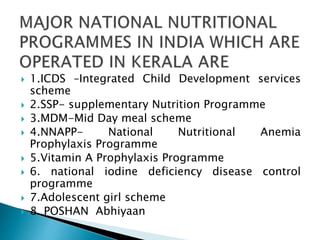
 1.ICDS –Integrated Child Development services
scheme
 2.SSP- supplementary Nutrition Programme
 3.MDM-Mid Day meal scheme
 4.NNAPP- National Nutritional Anemia
Prophylaxis Programme
 5.Vitamin A Prophylaxis Programme
 6. national iodine deficiency disease control
programme
 7.Adolescent girl scheme
 8. POSHAN Abhiyaan
 Launched on October 2nd 1975 under
ministry of social welfare.
One of the world’s largest programme to
provide an integrated package of services for
the entire development of the child.
 It is centrally funded scheme executed by
state govt and union territories.
 Children <3 yrs
 Children 3-6yrs
 Pregnant women and lactating mothers
 Adolescent girls
 Women in reproductive age group 15-45yrs
 The ICDS Scheme offers a package of 6
services
 Supplementary nutrition
 Pre school non formal education
 Nutrition and health education
 Immunization
 Health check up
 Referral services
 1.To improve the nutritional and health status
of children in the age group 0-6yrs
 2.To lay the foundation for proper
psychological, physical and social
development of the child.
 3.To reduce the incidence of mortality,
morbidity, malnutrition and school drop out.
 4 to achieve effective coordination of policy
and implementation among the various
department to promote child development.
 5.To enhances the capability of the mother to
look after the normal health and nutritional
needs of the child through proper nutrition
and health education.
 The services are delivered through
Anganwadi centre-AWC
 1AWC for 400- 800 population
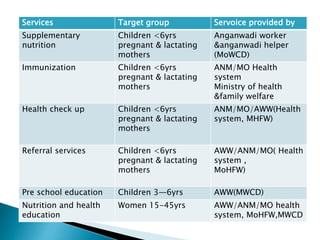
Services Target group Servoice provided by
Supplementary
nutrition
Children <6yrs
pregnant & lactating
mothers
Anganwadi worker
&anganwadi helper
(MoWCD)
Immunization Children <6yrs
pregnant & lactating
mothers
ANM/MO Health
system
Ministry of health
&family welfare
Health check up Children <6yrs
pregnant & lactating
mothers
ANM/MO/AWW(Health
system, MHFW)
Referral services Children <6yrs
pregnant & lactating
mothers
AWW/ANM/MO( Health
system ,
MoHFW)
Pre school education Children 3—6yrs AWW(MWCD)
Nutrition and health
education
Women 15-45yrs AWW/ANM/MO health
system, MoHFW,MWCD
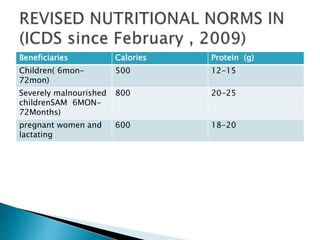
Beneficiaries Calories Protein (g)
Children( 6mon-
72mon)
500 12-15
Severely malnourished
childrenSAM 6MON-
72Months)
800 20-25
pregnant women and
lactating
600 18-20
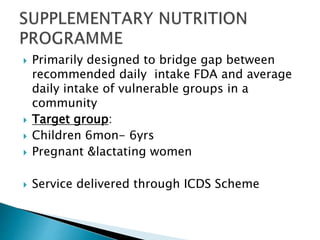
 Primarily designed to bridge gap between
recommended daily intake FDA and average
daily intake of vulnerable groups in a
community
 Target group:
 Children 6mon- 6yrs
 Pregnant &lactating women
 Service delivered through ICDS Scheme
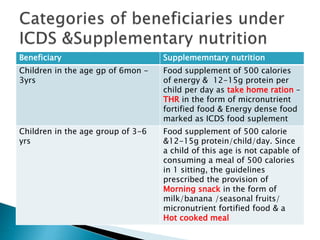
Beneficiary Supplememntary nutrition
Children in the age gp of 6mon -
3yrs
Food supplement of 500 calories
of energy & 12-15g protein per
child per day as take home ration –
THR in the form of micronutrient
fortified food & Energy dense food
marked as ICDS food suplement
Children in the age group of 3-6
yrs
Food supplement of 500 calorie
&12-15g protein/child/day. Since
a child of this age is not capable of
consuming a meal of 500 calories
in 1 sitting, the guidelines
prescribed the provision of
Morning snack in the form of
milk/banana /seasonal fruits/
micronutrient fortified food & a
Hot cooked meal
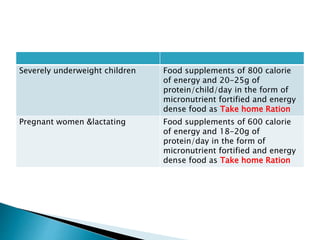
Severely underweight children Food supplements of 800 calorie
of energy and 20-25g of
protein/child/day in the form of
micronutrient fortified and energy
dense food as Take home Ration
Pregnant women &lactating Food supplements of 600 calorie
of energy and 18-20g of
protein/day in the form of
micronutrient fortified and energy
dense food as Take home Ration
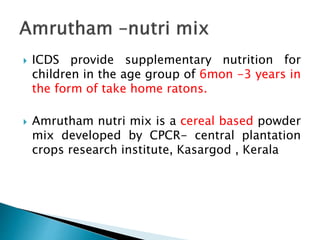
 ICDS provide supplementary nutrition for
children in the age group of 6mon -3 years in
the form of take home ratons.
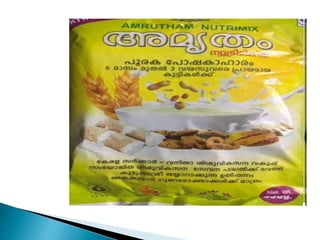
 Amrutham nutri mix is a cereal based powder
mix developed by CPCR- central plantation
crops research institute, Kasargod , Kerala
 From 2006 onwards kudumbasree coloborate
with social welfare dept of kerala for the
supply of THR in the Anganwadies in the
state.
 Fortification of nutrimix under progress with
support of WFP in Wayanaad and need to be
expanded to all district after feasibility
analysis.
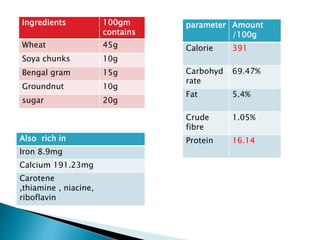
Ingredients 100gm
contains
Wheat 45g
Soya chunks 10g
Bengal gram 15g
Groundnut 10g
sugar 20g
parameter Amount
/100g
Calorie 391
Carbohyd
rate
69.47%
Fat 5.4%
Crude
fibre
1.05%
Protein 16.14
Also rich in
Iron 8.9mg
Calcium 191.23mg
Carotene
,thiamine , niacine,
riboflavin
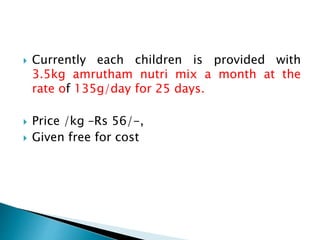
 Currently each children is provided with
3.5kg amrutham nutri mix a month at the
rate of 135g/day for 25 days.
 Price /kg –Rs 56/-,
 Given free for cost
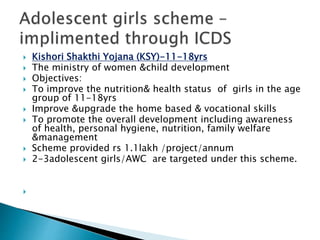
 Kishori Shakthi Yojana (KSY)-11-18yrs
 The ministry of women &child development
 Objectives:
 To improve the nutrition& health status of girls in the age
group of 11-18yrs
 Improve &upgrade the home based & vocational skills
 To promote the overall development including awareness
of health, personal hygiene, nutrition, family welfare
&management
 Scheme provided rs 1.1lakh /project/annum
 2-3adolescent girls/AWC are targeted under this scheme.

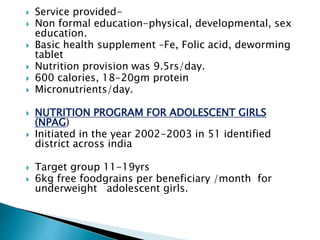
 Service provided-
 Non formal education-physical, developmental, sex
education.
 Basic health supplement –Fe, Folic acid, deworming
tablet
 Nutrition provision was 9.5rs/day.
 600 calories, 18-20gm protein
 Micronutrients/day.
 NUTRITION PROGRAM FOR ADOLESCENT GIRLS
(NPAG)
 Initiated in the year 2002-2003 in 51 identified
district across india
 Target group 11-19yrs
 6kg free foodgrains per beneficiary /month for
underweight adolescent girls.
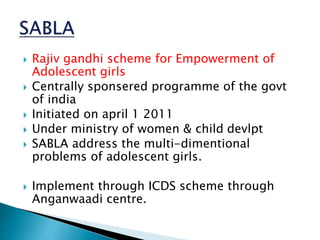
 Rajiv gandhi scheme for Empowerment of
Adolescent girls
 Centrally sponsered programme of the govt
of india
 Initiated on april 1 2011
 Under ministry of women & child devlpt
 SABLA address the multi-dimentional
problems of adolescent girls.
 Implement through ICDS scheme through
Anganwaadi centre.
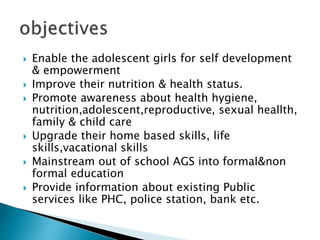
 Enable the adolescent girls for self development
& empowerment
 Improve their nutrition & health status.
 Promote awareness about health hygiene,
nutrition,adolescent,reproductive, sexual heallth,
family & child care
 Upgrade their home based skills, life
skills,vacational skills
 Mainstream out of school AGS into formal&non
formal education
 Provide information about existing Public
services like PHC, police station, bank etc.
 Supplementary nutrition -600 kcal, 18-20g
protein& Micronutrient /day for 300 days in a
year.
 IFA Supplementation,
 Health Check ups& referral services,
 Nutrition & health education,
 Counselling /guidance on family welfare, ARSH,
Child care practices& home management.
 Life skill education & accessing public services
 vocational training.
 SABLA will replace KSY &NPAG in 200 selected
district in india. KSY will continued in
remaining district.
 In kerala district covered under SABLA are
malappuram, palakkad, kollam, idukki.
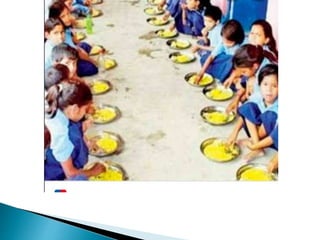
 MDM- Initially Tamil nadu started a mid day
meal programme on 1961 – to provide atleast
one nourishing meal to school going children
per day.
 MDM launched in Kerala in 1984.
 Later Govt of India launched a centrally
sponsored scheme on 15th August 1995 as
MDM scheme.
 It is a national programme to support primary
education class 1-5
 Aim – to increase school enrollment,
retention, and attendance of students and
improves nutrition.
 In 2007 the scheme extended to cover
children in upper primary class 6-8th std
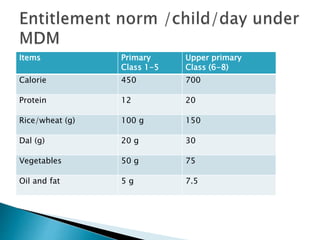
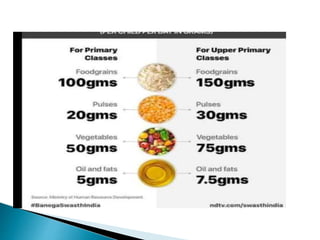
Items Primary
Class 1-5
Upper primary
Class (6-8)
Calorie 450 700
Protein 12 20
Rice/wheat (g) 100 g 150
Dal (g) 20 g 30
Vegetables 50 g 75
Oil and fat 5 g 7.5
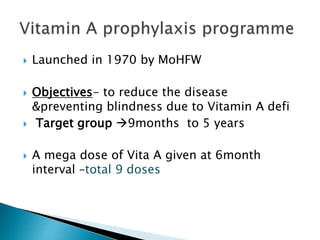
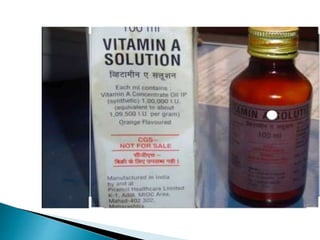
 Launched in 1970 by MoHFW
 Objectives- to reduce the disease
&preventing blindness due to Vitamin A defi
 Target group 9months to 5 years
 A mega dose of Vita A given at 6month
interval –total 9 doses
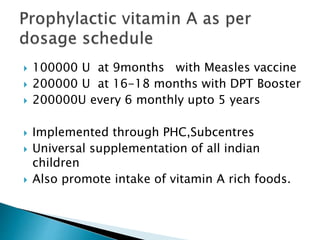
 100000 U at 9months with Measles vaccine
 200000 U at 16-18 months with DPT Booster
 200000U every 6 monthly upto 5 years
 Implemented through PHC,Subcentres
 Universal supplementation of all indian
children
 Also promote intake of vitamin A rich foods.
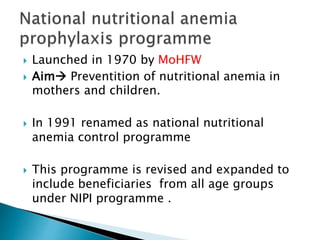
 Launched in 1970 by MoHFW
 Aim Preventition of nutritional anemia in
mothers and children.
 In 1991 renamed as national nutritional
anemia control programme
 This programme is revised and expanded to
include beneficiaries from all age groups
under NIPI programme .
 Infants 6-60 months
 School children 5-10 years
 Adolescent 11-19 years
 Pregnant and lactating women
 Women in reproductive age group 15-45yrs
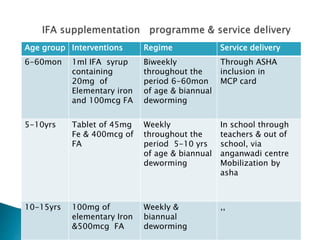
Age group Interventions Regime Service delivery
6-60mon 1ml IFA syrup
containing
20mg of
Elementary iron
and 100mcg FA
Biweekly
throughout the
period 6-60mon
of age & biannual
deworming
Through ASHA
inclusion in
MCP card
5-10yrs Tablet of 45mg
Fe & 400mcg of
FA
Weekly
throughout the
period 5-10 yrs
of age & biannual
deworming
In school through
teachers & out of
school, via
anganwadi centre
Mobilization by
asha
10-15yrs 100mg of
elementary Iron
&500mcg FA
Weekly &
biannual
deworming
,,
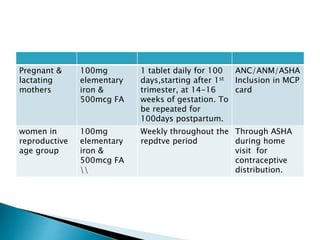
Pregnant &
lactating
mothers
100mg
elementary
iron &
500mcg FA
1 tablet daily for 100
days,starting after 1st
trimester, at 14-16
weeks of gestation. To
be repeated for
100days postpartum.
ANC/ANM/ASHA
Inclusion in MCP
card
women in
reproductive
age group
100mg
elementary
iron &
500mcg FA

Weekly throughout the
repdtve period
Through ASHA
during home
visit for
contraceptive
distribution.
 IFA tablets has been made in 2 colours
 blue & red
 blue called iron ki nili goli for Adolescents
 Red for pregnant & lactating women.
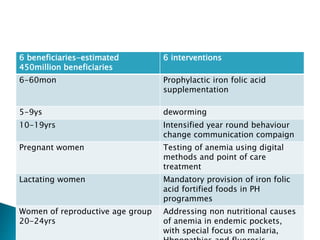
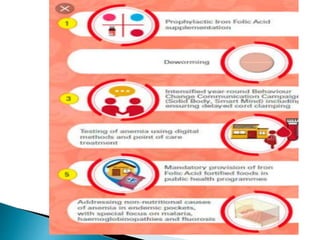
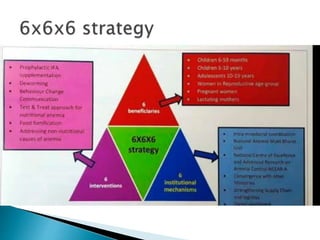
 It focusses on 6 target beneficiaries groups,
through 6 inteventions & 6 institutional
mechanisms to achieve thew envisaged target
under the POSHAN Abhiyan
 Introduced in 2018
6 beneficiaries-estimated
450million beneficiaries
6 interventions
6-60mon Prophylactic iron folic acid
supplementation
5-9ys deworming
10-19yrs Intensified year round behaviour
change communication compaign
Pregnant women Testing of anemia using digital
methods and point of care
treatment
Lactating women Mandatory provision of iron folic
acid fortified foods in PH
programmes
Women of reproductive age group
20-24yrs
Addressing non nutritional causes
of anemia in endemic pockets,
with special focus on malaria,
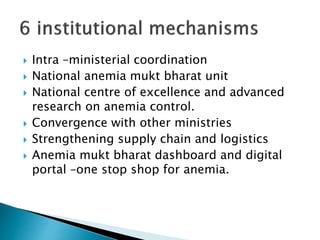
 Intra –ministerial coordination
 National anemia mukt bharat unit
 National centre of excellence and advanced
research on anemia control.
 Convergence with other ministries
 Strengthening supply chain and logistics
 Anemia mukt bharat dashboard and digital
portal –one stop shop for anemia.
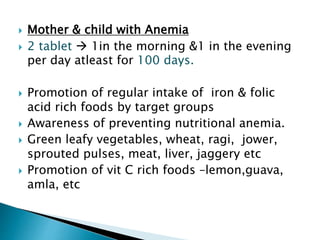
 Mother & child with Anemia
 2 tablet  1in the morning &1 in the evening
per day atleast for 100 days.
 Promotion of regular intake of iron & folic
acid rich foods by target groups
 Awareness of preventing nutritional anemia.
 Green leafy vegetables, wheat, ragi, jower,
sprouted pulses, meat, liver, jaggery etc
 Promotion of vit C rich foods –lemon,guava,
amla, etc
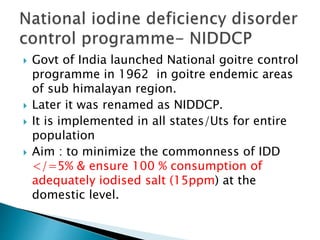
 Govt of India launched National goitre control
programme in 1962 in goitre endemic areas
of sub himalayan region.
 Later it was renamed as NIDDCP.
 It is implemented in all states/Uts for entire
population
 Aim : to minimize the commonness of IDD
</=5% & ensure 100 % consumption of
adequately iodised salt (15ppm) at the
domestic level.
 The prime Minister’s Overarching Scheme for
Holistic Nutrition
 NATIONAL NUTRITION MISSION
 Launched in March 8th , 2018.
 To improve the nutritive status of children
upto 6yrs, adolescent girls, pregnant women&
lactating mothers to achieve specific targets
to reduction in LBW, STUNTING growth,,
undernutrition & prevalence of anemia over
next 3 years.
To reduce the level of stunting, undernutrition,
LBW in children &anemia in adolescent girls,
pregnant women, lactating mother as well as
children by 2%,2%,2%,3% per annum respectively
 Bring down stunting among children in age gp 0-
6yrs from 38.4% to 25% by 2022.
 to ensure a holistic approach all 36 states
&districts are being covered in a phased manner.
4 point strategy or pillars of the misions are:
 Intersectoral convergence for better service
delivery.
 Use of technology( ICT) for the real time
growth monitoring and tracking of women
and children
 Intensified health and nutrition services for
the first 1000 days
 Jan Andolan
 Task of implementation of poshan abhiyaan
is to be carried out through Technical support
unit established at NITI Aayog
 POSHAN Abhiyan is not a programme but a
jan Andolan , Bhagidaari,
 this programme incorporates inclusive
participation of public representatives of local
bodies, govt departments of the state,
 social organizations& the public &private
sector at large.
Key principles
 Aspirations
 Collective identity
 Nudges
 Rewards
 Build recognition across sectors in the country
on impact of malnutrition &call to action for
each sectors contribution to reducing
malnutrition
 Mobilize multiple sectors and communities to
create intent to consume nutrient rich food.
 Build knowledge, attitudes and behavioural
intent to practice optimal breastfeeding,
complementary feeding, maternal nutrition
and adolescent nutrition to prevent
malnutrition including SAM, anemia
 Convergence
 Community engagement
 Advocacy
 Partnerships
 transmedia
 Primary group- mothers, adolescent girls,
pregnant lactating women.
 Secondary group-( those who influence primary
gp) husband, frontline health workers, school
teachers, panchayat representatives etc
 Tertiary group- ( those who create/support ive
/conductive envt to change)
 health facility staff, training institute staff, policy
makers
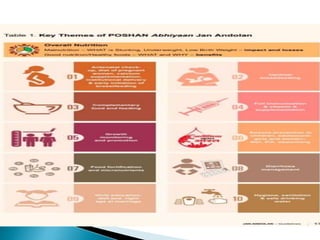
 1 Antenatal check up, diet, of pregnant
women, calcium supplementation,
institutional delivery& early initiation of
breastfeeding
 2 Optimal breastfeeding
 3. Complementary food & feeding
 4. Full immunization & vitamin A
supplementation
 5.Growth monitoring & promotion
6. anemia prevention in children, adolescent
girls and women –diet, IFA, deworming.
 7.Food fortification & micronutrients
 8. diarrhoea management
 9.girls education, diet, &right age at marriage
 10. hygiene, sanitation &safe drinking water
 It is an initiative of Ministry of women & child
development & NITI Aayog to give a push to
POSHAN Abhiyan.
 It focuses on 8 themes:
 1. Antenatal care
 2. Optimal breastfeeding
 3. Complementary feeding
 4. Anemia
 5. Growth monitoring
 6 .Girls education,diet,right age of marriage.
 7. Hygiene and sanitation
 8. Eating healthy food-food fortification.
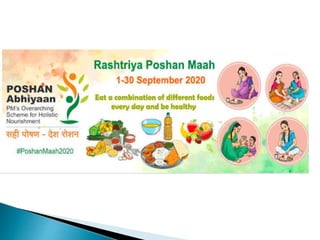
 Month of september is celebrated as
RASHTRIYA poshan Maah across the country.
 Purpose is to take the message of nutrition to
every nook &corner of the country,
 POSHAN Abhiyaan in kerala
 It is under WCD department.
 Aim: to prevent & reduce stunting, under
nutrition, reduce pevalence of anemia &
reduction of LBW.
 TARGET GROUP-
 Children < 6yrs
 Adolescents
 Pregnant & lactating mother.
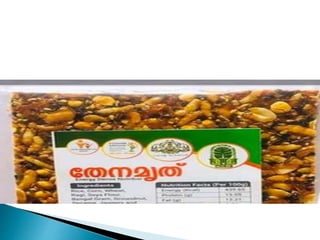
 Recently kerala govt launched a nutritive bar
 Aim to provide supplementary nutrition to
children with severe underweight.
 Made up of 12 ingredients
 Rice, corn,raggi, soya flour, bengal gram,
groundnut, sesame ,jaggery, liquid glucose
 Rich in iron, calcium,protein
 100gm439.65cal+ 15g protein
 Target group- 3-6yrs
 Thank you

Nutritional health programmes in India.pptx

  • 1.
  • 2.
     The problemsof malnutrition in india has been recognized since the inception of the five year plan in 1951 &no of nutritional programmes have been introduced for compating this.  Basic aim of all the nutritional programme is to provide additional nutrients to target group to fill the gap between their routine intake & actual requirement
  • 3.
     1.ICDS –IntegratedChild Development services scheme  2.SSP- supplementary Nutrition Programme  3.MDM-Mid Day meal scheme  4.NNAPP- National Nutritional Anemia Prophylaxis Programme  5.Vitamin A Prophylaxis Programme  6. national iodine deficiency disease control programme  7.Adolescent girl scheme  8. POSHAN Abhiyaan
  • 5.
     Launched onOctober 2nd 1975 under ministry of social welfare. One of the world’s largest programme to provide an integrated package of services for the entire development of the child.  It is centrally funded scheme executed by state govt and union territories.
  • 6.
     Children <3yrs  Children 3-6yrs  Pregnant women and lactating mothers  Adolescent girls  Women in reproductive age group 15-45yrs
  • 7.
     The ICDSScheme offers a package of 6 services  Supplementary nutrition  Pre school non formal education  Nutrition and health education  Immunization  Health check up  Referral services
  • 8.
     1.To improvethe nutritional and health status of children in the age group 0-6yrs  2.To lay the foundation for proper psychological, physical and social development of the child.  3.To reduce the incidence of mortality, morbidity, malnutrition and school drop out.
  • 9.
     4 toachieve effective coordination of policy and implementation among the various department to promote child development.  5.To enhances the capability of the mother to look after the normal health and nutritional needs of the child through proper nutrition and health education.
  • 10.
     The servicesare delivered through Anganwadi centre-AWC  1AWC for 400- 800 population
  • 11.
    Services Target groupServoice provided by Supplementary nutrition Children <6yrs pregnant & lactating mothers Anganwadi worker &anganwadi helper (MoWCD) Immunization Children <6yrs pregnant & lactating mothers ANM/MO Health system Ministry of health &family welfare Health check up Children <6yrs pregnant & lactating mothers ANM/MO/AWW(Health system, MHFW) Referral services Children <6yrs pregnant & lactating mothers AWW/ANM/MO( Health system , MoHFW) Pre school education Children 3—6yrs AWW(MWCD) Nutrition and health education Women 15-45yrs AWW/ANM/MO health system, MoHFW,MWCD
  • 12.
    Beneficiaries Calories Protein(g) Children( 6mon- 72mon) 500 12-15 Severely malnourished childrenSAM 6MON- 72Months) 800 20-25 pregnant women and lactating 600 18-20
  • 13.
     Primarily designedto bridge gap between recommended daily intake FDA and average daily intake of vulnerable groups in a community  Target group:  Children 6mon- 6yrs  Pregnant &lactating women  Service delivered through ICDS Scheme
  • 14.
    Beneficiary Supplememntary nutrition Childrenin the age gp of 6mon - 3yrs Food supplement of 500 calories of energy & 12-15g protein per child per day as take home ration – THR in the form of micronutrient fortified food & Energy dense food marked as ICDS food suplement Children in the age group of 3-6 yrs Food supplement of 500 calorie &12-15g protein/child/day. Since a child of this age is not capable of consuming a meal of 500 calories in 1 sitting, the guidelines prescribed the provision of Morning snack in the form of milk/banana /seasonal fruits/ micronutrient fortified food & a Hot cooked meal
  • 15.
    Severely underweight childrenFood supplements of 800 calorie of energy and 20-25g of protein/child/day in the form of micronutrient fortified and energy dense food as Take home Ration Pregnant women &lactating Food supplements of 600 calorie of energy and 18-20g of protein/day in the form of micronutrient fortified and energy dense food as Take home Ration
  • 16.
     ICDS providesupplementary nutrition for children in the age group of 6mon -3 years in the form of take home ratons.  Amrutham nutri mix is a cereal based powder mix developed by CPCR- central plantation crops research institute, Kasargod , Kerala
  • 17.
     From 2006onwards kudumbasree coloborate with social welfare dept of kerala for the supply of THR in the Anganwadies in the state.  Fortification of nutrimix under progress with support of WFP in Wayanaad and need to be expanded to all district after feasibility analysis.
  • 19.
    Ingredients 100gm contains Wheat 45g Soyachunks 10g Bengal gram 15g Groundnut 10g sugar 20g parameter Amount /100g Calorie 391 Carbohyd rate 69.47% Fat 5.4% Crude fibre 1.05% Protein 16.14 Also rich in Iron 8.9mg Calcium 191.23mg Carotene ,thiamine , niacine, riboflavin
  • 20.
     Currently eachchildren is provided with 3.5kg amrutham nutri mix a month at the rate of 135g/day for 25 days.  Price /kg –Rs 56/-,  Given free for cost
  • 21.
     Kishori ShakthiYojana (KSY)-11-18yrs  The ministry of women &child development  Objectives:  To improve the nutrition& health status of girls in the age group of 11-18yrs  Improve &upgrade the home based & vocational skills  To promote the overall development including awareness of health, personal hygiene, nutrition, family welfare &management  Scheme provided rs 1.1lakh /project/annum  2-3adolescent girls/AWC are targeted under this scheme. 
  • 22.
     Service provided- Non formal education-physical, developmental, sex education.  Basic health supplement –Fe, Folic acid, deworming tablet  Nutrition provision was 9.5rs/day.  600 calories, 18-20gm protein  Micronutrients/day.  NUTRITION PROGRAM FOR ADOLESCENT GIRLS (NPAG)  Initiated in the year 2002-2003 in 51 identified district across india  Target group 11-19yrs  6kg free foodgrains per beneficiary /month for underweight adolescent girls.
  • 23.
     Rajiv gandhischeme for Empowerment of Adolescent girls  Centrally sponsered programme of the govt of india  Initiated on april 1 2011  Under ministry of women & child devlpt  SABLA address the multi-dimentional problems of adolescent girls.  Implement through ICDS scheme through Anganwaadi centre.
  • 24.
     Enable theadolescent girls for self development & empowerment  Improve their nutrition & health status.  Promote awareness about health hygiene, nutrition,adolescent,reproductive, sexual heallth, family & child care  Upgrade their home based skills, life skills,vacational skills  Mainstream out of school AGS into formal&non formal education  Provide information about existing Public services like PHC, police station, bank etc.
  • 25.
     Supplementary nutrition-600 kcal, 18-20g protein& Micronutrient /day for 300 days in a year.  IFA Supplementation,  Health Check ups& referral services,  Nutrition & health education,  Counselling /guidance on family welfare, ARSH, Child care practices& home management.  Life skill education & accessing public services  vocational training.
  • 26.
     SABLA willreplace KSY &NPAG in 200 selected district in india. KSY will continued in remaining district.  In kerala district covered under SABLA are malappuram, palakkad, kollam, idukki.
  • 29.
     MDM- InitiallyTamil nadu started a mid day meal programme on 1961 – to provide atleast one nourishing meal to school going children per day.  MDM launched in Kerala in 1984.  Later Govt of India launched a centrally sponsored scheme on 15th August 1995 as MDM scheme.
  • 30.
     It isa national programme to support primary education class 1-5  Aim – to increase school enrollment, retention, and attendance of students and improves nutrition.  In 2007 the scheme extended to cover children in upper primary class 6-8th std
  • 31.
    Items Primary Class 1-5 Upperprimary Class (6-8) Calorie 450 700 Protein 12 20 Rice/wheat (g) 100 g 150 Dal (g) 20 g 30 Vegetables 50 g 75 Oil and fat 5 g 7.5
  • 33.
     Launched in1970 by MoHFW  Objectives- to reduce the disease &preventing blindness due to Vitamin A defi  Target group 9months to 5 years  A mega dose of Vita A given at 6month interval –total 9 doses
  • 35.
     100000 Uat 9months with Measles vaccine  200000 U at 16-18 months with DPT Booster  200000U every 6 monthly upto 5 years  Implemented through PHC,Subcentres  Universal supplementation of all indian children  Also promote intake of vitamin A rich foods.
  • 36.
     Launched in1970 by MoHFW  Aim Preventition of nutritional anemia in mothers and children.  In 1991 renamed as national nutritional anemia control programme  This programme is revised and expanded to include beneficiaries from all age groups under NIPI programme .
  • 37.
     Infants 6-60months  School children 5-10 years  Adolescent 11-19 years  Pregnant and lactating women  Women in reproductive age group 15-45yrs
  • 38.
    Age group InterventionsRegime Service delivery 6-60mon 1ml IFA syrup containing 20mg of Elementary iron and 100mcg FA Biweekly throughout the period 6-60mon of age & biannual deworming Through ASHA inclusion in MCP card 5-10yrs Tablet of 45mg Fe & 400mcg of FA Weekly throughout the period 5-10 yrs of age & biannual deworming In school through teachers & out of school, via anganwadi centre Mobilization by asha 10-15yrs 100mg of elementary Iron &500mcg FA Weekly & biannual deworming ,,
  • 39.
    Pregnant & lactating mothers 100mg elementary iron & 500mcgFA 1 tablet daily for 100 days,starting after 1st trimester, at 14-16 weeks of gestation. To be repeated for 100days postpartum. ANC/ANM/ASHA Inclusion in MCP card women in reproductive age group 100mg elementary iron & 500mcg FA Weekly throughout the repdtve period Through ASHA during home visit for contraceptive distribution.
  • 40.
     IFA tabletshas been made in 2 colours  blue & red  blue called iron ki nili goli for Adolescents  Red for pregnant & lactating women.
  • 42.
     It focusseson 6 target beneficiaries groups, through 6 inteventions & 6 institutional mechanisms to achieve thew envisaged target under the POSHAN Abhiyan  Introduced in 2018
  • 43.
    6 beneficiaries-estimated 450million beneficiaries 6interventions 6-60mon Prophylactic iron folic acid supplementation 5-9ys deworming 10-19yrs Intensified year round behaviour change communication compaign Pregnant women Testing of anemia using digital methods and point of care treatment Lactating women Mandatory provision of iron folic acid fortified foods in PH programmes Women of reproductive age group 20-24yrs Addressing non nutritional causes of anemia in endemic pockets, with special focus on malaria,
  • 45.
     Intra –ministerialcoordination  National anemia mukt bharat unit  National centre of excellence and advanced research on anemia control.  Convergence with other ministries  Strengthening supply chain and logistics  Anemia mukt bharat dashboard and digital portal –one stop shop for anemia.
  • 47.
     Mother &child with Anemia  2 tablet  1in the morning &1 in the evening per day atleast for 100 days.  Promotion of regular intake of iron & folic acid rich foods by target groups  Awareness of preventing nutritional anemia.  Green leafy vegetables, wheat, ragi, jower, sprouted pulses, meat, liver, jaggery etc  Promotion of vit C rich foods –lemon,guava, amla, etc
  • 48.
     Govt ofIndia launched National goitre control programme in 1962 in goitre endemic areas of sub himalayan region.  Later it was renamed as NIDDCP.  It is implemented in all states/Uts for entire population  Aim : to minimize the commonness of IDD </=5% & ensure 100 % consumption of adequately iodised salt (15ppm) at the domestic level.
  • 51.
     The primeMinister’s Overarching Scheme for Holistic Nutrition  NATIONAL NUTRITION MISSION  Launched in March 8th , 2018.  To improve the nutritive status of children upto 6yrs, adolescent girls, pregnant women& lactating mothers to achieve specific targets to reduction in LBW, STUNTING growth,, undernutrition & prevalence of anemia over next 3 years.
  • 52.
    To reduce thelevel of stunting, undernutrition, LBW in children &anemia in adolescent girls, pregnant women, lactating mother as well as children by 2%,2%,2%,3% per annum respectively  Bring down stunting among children in age gp 0- 6yrs from 38.4% to 25% by 2022.  to ensure a holistic approach all 36 states &districts are being covered in a phased manner.
  • 53.
    4 point strategyor pillars of the misions are:  Intersectoral convergence for better service delivery.  Use of technology( ICT) for the real time growth monitoring and tracking of women and children  Intensified health and nutrition services for the first 1000 days  Jan Andolan
  • 55.
     Task ofimplementation of poshan abhiyaan is to be carried out through Technical support unit established at NITI Aayog
  • 56.
     POSHAN Abhiyanis not a programme but a jan Andolan , Bhagidaari,  this programme incorporates inclusive participation of public representatives of local bodies, govt departments of the state,  social organizations& the public &private sector at large.
  • 57.
    Key principles  Aspirations Collective identity  Nudges  Rewards
  • 58.
     Build recognitionacross sectors in the country on impact of malnutrition &call to action for each sectors contribution to reducing malnutrition  Mobilize multiple sectors and communities to create intent to consume nutrient rich food.  Build knowledge, attitudes and behavioural intent to practice optimal breastfeeding, complementary feeding, maternal nutrition and adolescent nutrition to prevent malnutrition including SAM, anemia
  • 59.
     Convergence  Communityengagement  Advocacy  Partnerships  transmedia
  • 60.
     Primary group-mothers, adolescent girls, pregnant lactating women.  Secondary group-( those who influence primary gp) husband, frontline health workers, school teachers, panchayat representatives etc  Tertiary group- ( those who create/support ive /conductive envt to change)  health facility staff, training institute staff, policy makers
  • 61.
     1 Antenatalcheck up, diet, of pregnant women, calcium supplementation, institutional delivery& early initiation of breastfeeding  2 Optimal breastfeeding  3. Complementary food & feeding  4. Full immunization & vitamin A supplementation  5.Growth monitoring & promotion
  • 62.
    6. anemia preventionin children, adolescent girls and women –diet, IFA, deworming.  7.Food fortification & micronutrients  8. diarrhoea management  9.girls education, diet, &right age at marriage  10. hygiene, sanitation &safe drinking water
  • 64.
     It isan initiative of Ministry of women & child development & NITI Aayog to give a push to POSHAN Abhiyan.  It focuses on 8 themes:  1. Antenatal care  2. Optimal breastfeeding  3. Complementary feeding  4. Anemia  5. Growth monitoring  6 .Girls education,diet,right age of marriage.
  • 66.
     7. Hygieneand sanitation  8. Eating healthy food-food fortification.  Month of september is celebrated as RASHTRIYA poshan Maah across the country.  Purpose is to take the message of nutrition to every nook &corner of the country,
  • 67.
     POSHAN Abhiyaanin kerala  It is under WCD department.  Aim: to prevent & reduce stunting, under nutrition, reduce pevalence of anemia & reduction of LBW.  TARGET GROUP-  Children < 6yrs  Adolescents  Pregnant & lactating mother.
  • 69.
     Recently keralagovt launched a nutritive bar  Aim to provide supplementary nutrition to children with severe underweight.  Made up of 12 ingredients  Rice, corn,raggi, soya flour, bengal gram, groundnut, sesame ,jaggery, liquid glucose  Rich in iron, calcium,protein  100gm439.65cal+ 15g protein  Target group- 3-6yrs
  • 70.