NATIONAL
NUTRITIONAL
POLICY
NATIONAL NUTROTIONAL POLICY
• The adoption of NNP in 1993 by the government under
the department of women and child development has
been one of the significant achievement on nutrition
scene in India.
• NNP recognized that nutrition is a multisectoral issue
and need to be tackled at various level.
• The policy recognized that multifaceted problem of
malnutrition and advocated the multisectoral approach
for controlling the same and identified the series of
actions in various spheres like food production and
distribution, health and family welfare, agriculture,
horticulture, education, etc.
• NNP wanted to achieve an optimum state of
nutrition for all sections of society but with a
special priority to women, mothers, and
children who are vulnerable as well as risk.
GOALS OF NNP
1. To reduce the incidence of moderate and severe
malnutrition and stunned growth among children.
2. Reduction in the incidence of low birth weight baby.
3. Elimination of blindness due to deficiency of vitamin A.
4.reduction of iron deficiency anemia among pregnant
women from 50 to 25%.
5. Universal iodization of salt for reduction of goiter.
6. Special emphasis on geriatric nutrition.
7. Annual production of 250 million tones of food grains.
8. Improving house hold food security through poverty
alleviation programmes.
9. Promoting appropriate diet and healthy life style.
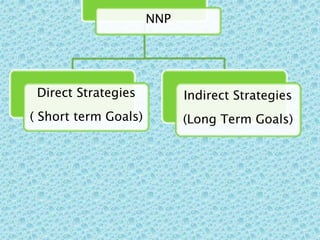
NNP
Direct Strategies
( Short term Goals)
Indirect Strategies
(Long Term Goals)
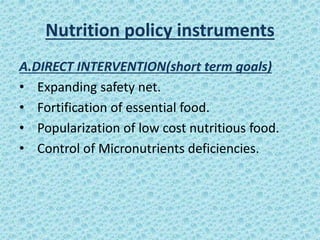
Nutrition policy instruments
A.DIRECT INTERVENTION(short term goals)
• Expanding safety net.
• Fortification of essential food.
• Popularization of low cost nutritious food.
• Control of Micronutrients deficiencies.
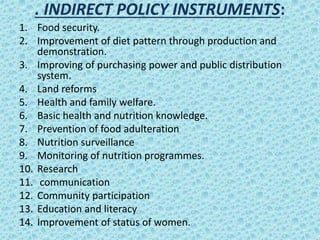
. INDIRECT POLICY INSTRUMENTS:
1. Food security.
2. Improvement of diet pattern through production and
demonstration.
3. Improving of purchasing power and public distribution
system.
4. Land reforms
5. Health and family welfare.
6. Basic health and nutrition knowledge.
7. Prevention of food adulteration
8. Nutrition surveillance
9. Monitoring of nutrition programmes.
10. Research
11. communication
12. Community participation
13. Education and literacy
14. Improvement of status of women.
A. DIRECT INTERVENTIONS
1.Expanding safety net:
1. Ensuring proper nutrition of target groups
(Vulnerable groups): The National Nutritional
Policy has paid special attention towards the
vulnerable groups and implemented many
nutritional programmes to improve the health
status of these target groups like children,
adolescents, pregnant and nursing mothers
etc.
• Expanding the safety net for children – proper
implementation of universal immunization,
oral rehydration and ICDS services have been
expanded to cover all vulnerable children in
the age group 0 to 6 years. Presently ICDS
covers around 15.3 million children from rural
and urban slums. ICDS aims at covering the
remaining 15.46 nutritionally at risk children
by extending ICDS blocks of the country.
• Growth monitoring in 0-3 year age group:
Growth monitoring aims at identification of
malnourished children and provision of
nutritional management for the children
especially 0-3 years of age group. This
includes Provision of adequate nutrition for
the children, health education of mothers,
empowerment of the mother to manage
nutritional needs of her children effectively.
◦ Nutrition of adolescent girls to enable them to
attain safe motherhood:
◦ The policy has expanded the ICDS services for the
adolescent girls to improve their nutritional
status, to prepare them for safe motherhood by
providing basic education about nutrition,
fertility, Iron supplementation etc.
◦ Nutrition of pregnant women to decrease
incidence of low birth weight:
◦ Under the policy the government has taken
measures to improve the nutritional status of the
pregnant mothers right from 1st trimester,
supplementation of iron and folic acid, frequent
health checkups etc.
2. Fortification of food:
Policy recognized that the essential food items shall
be fortified with appropriate nutrients, e.g. salt
with iodine and iron. The distribution of iodized
salt should cover all the population of endemic
areas of the country.
3. Popularization of low cost nutritious food:
Majority of the Indian population belongs to low
socio economic status and they cannot afford for
the expensive food products. So there is a need
to provide low cost and nutritious food products
for the people to maintain and improve the
health of the individual, family and the
community by developing indigenous systems
and with locally available foods.
4. Control of micronutrients
deficiencies:
Among vulnerable groups, deficiency of vitamin
“A” , iron, and folic acid, and iodine among
children, pregnant women and nursing
mothers shall be recognized through
intensified programme. All prophylaxis
programme should be intensified.
•Example Vitamin A prophylaxis programme,
The nutritional anaemia prophylaxis
programme etc.
INDIRECT POLICY INSTRUMENTS
1. Food security:
In order to ensure complete food security, a per capita
availability of 215 kg/ person/ year of food grain is
to be attained. This requires 250 million tones of
food grains / year.
2.Improvement of diet pattern through production
and demonstration:
The dietary pattern of the people should be improved
by promoting the production and increasing the
per capita availability of nutritionally rich foods.
Provision of nutritionally rich foods at affordable
cost. Production of pulses, oilseeds and other food
crops will be increased.
. The production of protective food crops, such
as vegetables, fruits, milk, meat, fish and
poultry shall be augmented
Preference shall be given to green leafy
vegetables and fruits such as guava, papaya
and amla with the help of latest and
improved techniques.
3. Improving the purchasing power and public
distribution system:
Poverty alleviation programmes like the integrated rural
development programme(IRDP) and employment
generation scheme likes Jawahar Rojgar Yojana, Nehru
Rojgar Yjana, need to be re-oriented and restructured
to make a forceful dent on purchasing power.
Secondly, equitable food distribution shall be ensured
through the expansion of the public distribution
system.
4. Land reforms:
Land reforms measures should be implemented so that
the vulnerability of landless and landed poor can be
reduced.
5. Health and family welfare:
Increased health and immunization facilities should
be provided to all. The population in the
reproductive age group should be empowered
through education, that they are responsible for
their own family size.
6.Basic health and nutrition knowledge:
Basic health and nutrition knowledge with special
focus on wholesome infant feeding practices
should be imparted to the people extensively and
effectively. Nutritional and health education
should be integrated in the school curriculum.
7. Prevention of food adulteration:
prevention of food adulteration must be
strengthened by gearing up the enforcement
machinery.
8. Nutrition surveillance:
This is another area which required immediate attention. The
NNMB/ NIN of ICMR need to be strengthened so that
periodical monitoring of the nutritional status of children,
adolescent girls, pregnant and lactating mother can be carried
out.
9. Monitoring of nutritional programmes:
Monitoring of nutritional programmes and nutrition education
and demonstration by food and nutrition board through all its
67 centers and fields should be continued.
10. research:
Research in various aspects in the nutrition both on
consumption side as well as supply side is another essential
aspect of strategy. Research should enable selection of new
varieties of food with high nutritive value which can be in
reach and within the purchasing power of poor.
11. communication:
Communication through established media is one of
the most important strategies to be adopted for the
effective implementation of nutrition policy. Both
mass communication as well as group or
interpersonal communication should be used.
12. Community participation:
The active involvement of community is essential not
only in terms of being aware of the services
available to the community but also for the deriving
the maximum benefit from such services by giving
timely feedback necessary at all levels. Community
participation include:
a. Generating awareness.
b. involving community through panchayats.
c. Promoting schemes related to kitchen garden, food
preservation and weaning food.
13. Education and literacy:
It has been shown that the education and literacy
particularly that of women is a key determinant for
better nutritional status. For example Kerala state
which has the highest literacy rate also has the
best nutrition status.
14. Improvement of the status of women:
The most effective way to implement nutrition is to
focus on improving the status of women, particularly
the economic status. After all, women are the
ultimate provider of the nutrition to households.
Moreover, female education also has a strong
inverse relationship with IMR. Educated women
have greater role in household decision making,
particularly those related to nutrition and feeding
practices.
National nutrotional policy

National nutrotional policy

  • 1.
  • 2.
    NATIONAL NUTROTIONAL POLICY •The adoption of NNP in 1993 by the government under the department of women and child development has been one of the significant achievement on nutrition scene in India. • NNP recognized that nutrition is a multisectoral issue and need to be tackled at various level. • The policy recognized that multifaceted problem of malnutrition and advocated the multisectoral approach for controlling the same and identified the series of actions in various spheres like food production and distribution, health and family welfare, agriculture, horticulture, education, etc.
  • 3.
    • NNP wantedto achieve an optimum state of nutrition for all sections of society but with a special priority to women, mothers, and children who are vulnerable as well as risk.
  • 4.
    GOALS OF NNP 1.To reduce the incidence of moderate and severe malnutrition and stunned growth among children. 2. Reduction in the incidence of low birth weight baby. 3. Elimination of blindness due to deficiency of vitamin A. 4.reduction of iron deficiency anemia among pregnant women from 50 to 25%. 5. Universal iodization of salt for reduction of goiter. 6. Special emphasis on geriatric nutrition. 7. Annual production of 250 million tones of food grains. 8. Improving house hold food security through poverty alleviation programmes. 9. Promoting appropriate diet and healthy life style.
  • 5.
    NNP Direct Strategies ( Shortterm Goals) Indirect Strategies (Long Term Goals)
  • 6.
    Nutrition policy instruments A.DIRECTINTERVENTION(short term goals) • Expanding safety net. • Fortification of essential food. • Popularization of low cost nutritious food. • Control of Micronutrients deficiencies.
  • 7.
    . INDIRECT POLICYINSTRUMENTS: 1. Food security. 2. Improvement of diet pattern through production and demonstration. 3. Improving of purchasing power and public distribution system. 4. Land reforms 5. Health and family welfare. 6. Basic health and nutrition knowledge. 7. Prevention of food adulteration 8. Nutrition surveillance 9. Monitoring of nutrition programmes. 10. Research 11. communication 12. Community participation 13. Education and literacy 14. Improvement of status of women.
  • 8.
    A. DIRECT INTERVENTIONS 1.Expandingsafety net: 1. Ensuring proper nutrition of target groups (Vulnerable groups): The National Nutritional Policy has paid special attention towards the vulnerable groups and implemented many nutritional programmes to improve the health status of these target groups like children, adolescents, pregnant and nursing mothers etc.
  • 9.
    • Expanding thesafety net for children – proper implementation of universal immunization, oral rehydration and ICDS services have been expanded to cover all vulnerable children in the age group 0 to 6 years. Presently ICDS covers around 15.3 million children from rural and urban slums. ICDS aims at covering the remaining 15.46 nutritionally at risk children by extending ICDS blocks of the country.
  • 10.
    • Growth monitoringin 0-3 year age group: Growth monitoring aims at identification of malnourished children and provision of nutritional management for the children especially 0-3 years of age group. This includes Provision of adequate nutrition for the children, health education of mothers, empowerment of the mother to manage nutritional needs of her children effectively.
  • 11.
    ◦ Nutrition ofadolescent girls to enable them to attain safe motherhood: ◦ The policy has expanded the ICDS services for the adolescent girls to improve their nutritional status, to prepare them for safe motherhood by providing basic education about nutrition, fertility, Iron supplementation etc. ◦ Nutrition of pregnant women to decrease incidence of low birth weight: ◦ Under the policy the government has taken measures to improve the nutritional status of the pregnant mothers right from 1st trimester, supplementation of iron and folic acid, frequent health checkups etc.
  • 12.
    2. Fortification offood: Policy recognized that the essential food items shall be fortified with appropriate nutrients, e.g. salt with iodine and iron. The distribution of iodized salt should cover all the population of endemic areas of the country. 3. Popularization of low cost nutritious food: Majority of the Indian population belongs to low socio economic status and they cannot afford for the expensive food products. So there is a need to provide low cost and nutritious food products for the people to maintain and improve the health of the individual, family and the community by developing indigenous systems and with locally available foods.
  • 13.
    4. Control ofmicronutrients deficiencies: Among vulnerable groups, deficiency of vitamin “A” , iron, and folic acid, and iodine among children, pregnant women and nursing mothers shall be recognized through intensified programme. All prophylaxis programme should be intensified. •Example Vitamin A prophylaxis programme, The nutritional anaemia prophylaxis programme etc.
  • 14.
    INDIRECT POLICY INSTRUMENTS 1.Food security: In order to ensure complete food security, a per capita availability of 215 kg/ person/ year of food grain is to be attained. This requires 250 million tones of food grains / year. 2.Improvement of diet pattern through production and demonstration: The dietary pattern of the people should be improved by promoting the production and increasing the per capita availability of nutritionally rich foods. Provision of nutritionally rich foods at affordable cost. Production of pulses, oilseeds and other food crops will be increased.
  • 15.
    . The productionof protective food crops, such as vegetables, fruits, milk, meat, fish and poultry shall be augmented Preference shall be given to green leafy vegetables and fruits such as guava, papaya and amla with the help of latest and improved techniques.
  • 16.
    3. Improving thepurchasing power and public distribution system: Poverty alleviation programmes like the integrated rural development programme(IRDP) and employment generation scheme likes Jawahar Rojgar Yojana, Nehru Rojgar Yjana, need to be re-oriented and restructured to make a forceful dent on purchasing power. Secondly, equitable food distribution shall be ensured through the expansion of the public distribution system. 4. Land reforms: Land reforms measures should be implemented so that the vulnerability of landless and landed poor can be reduced.
  • 17.
    5. Health andfamily welfare: Increased health and immunization facilities should be provided to all. The population in the reproductive age group should be empowered through education, that they are responsible for their own family size. 6.Basic health and nutrition knowledge: Basic health and nutrition knowledge with special focus on wholesome infant feeding practices should be imparted to the people extensively and effectively. Nutritional and health education should be integrated in the school curriculum. 7. Prevention of food adulteration: prevention of food adulteration must be strengthened by gearing up the enforcement machinery.
  • 18.
    8. Nutrition surveillance: Thisis another area which required immediate attention. The NNMB/ NIN of ICMR need to be strengthened so that periodical monitoring of the nutritional status of children, adolescent girls, pregnant and lactating mother can be carried out. 9. Monitoring of nutritional programmes: Monitoring of nutritional programmes and nutrition education and demonstration by food and nutrition board through all its 67 centers and fields should be continued. 10. research: Research in various aspects in the nutrition both on consumption side as well as supply side is another essential aspect of strategy. Research should enable selection of new varieties of food with high nutritive value which can be in reach and within the purchasing power of poor.
  • 19.
    11. communication: Communication throughestablished media is one of the most important strategies to be adopted for the effective implementation of nutrition policy. Both mass communication as well as group or interpersonal communication should be used. 12. Community participation: The active involvement of community is essential not only in terms of being aware of the services available to the community but also for the deriving the maximum benefit from such services by giving timely feedback necessary at all levels. Community participation include: a. Generating awareness. b. involving community through panchayats. c. Promoting schemes related to kitchen garden, food preservation and weaning food.
  • 20.
    13. Education andliteracy: It has been shown that the education and literacy particularly that of women is a key determinant for better nutritional status. For example Kerala state which has the highest literacy rate also has the best nutrition status. 14. Improvement of the status of women: The most effective way to implement nutrition is to focus on improving the status of women, particularly the economic status. After all, women are the ultimate provider of the nutrition to households. Moreover, female education also has a strong inverse relationship with IMR. Educated women have greater role in household decision making, particularly those related to nutrition and feeding practices.