NATIONAL NUTRITIONAL
PROGRAMS
SAMIKSHA KURIYAL
(NURSING TUTOR)
INTRODUCTION
Since India became free, several measures have been undertaken by the National
Government to improve the health of the people. National nutritional programs have been
launched by the central government to control and prevent major nutritional deficiency
diseases like vitamin A deficiency, iodine deficiency, PEM and iron deficiency, etc. some
of the programs are discussed here.
 Integrated Child Development Scheme (ICDS)
 Mid- Day School Meal Program.
 National Program for Control of Blindness or Vitamin A Prophylaxis Program.
 Iodine Deficiency Disorder Program (IDD).
 Prophylaxis Against Nutritional Anemia.
INTEGRATED CHILD DEVELOPMENT SCHEME (ICDS)
ICDS program was started in 1975 by the government of India in the ministry of social and women’s
welfare in pursuance of the national policy for children. It is the most important scheme in the field of
child welfare. ICDS provides an integrated package of early childhood services. These consist of:
 Supplementary nutrition.
 Immunization
 Health check up
 Medical referral services
 Nutrition and health education for women
 Non-formal education for children upto age 6 years and of pregnant and nursing mothers in rural, urban
and tribal areas.
OBJECTIVES OF ICDS
 To improve the nutritional health status of children in the age group of 0 to 6 years.
 To lay the foundation for proper psychological, physical and social development of children.
 To reduce the mortality and morbidity, malnutrition and school dropout.
 To achieve an effective coordination of policy and implementation among various departments
working for the promotion of child development.
 To enhance the capacity of mother and nutritional needs of children through proper nutrition and
health education.
Package of Services
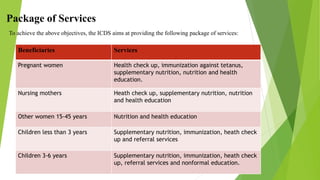
To achieve the above objectives, the ICDS aims at providing the following package of services:
Beneficiaries Services
Pregnant women Health check up, immunization against tetanus,
supplementary nutrition, nutrition and health
education.
Nursing mothers Heath check up, supplementary nutrition, nutrition
and health education
Other women 15-45 years Nutrition and health education
Children less than 3 years Supplementary nutrition, immunization, heath check
up and referral services
Children 3-6 years Supplementary nutrition, immunization, heath check
up, referral services and nonformal education.
Delivery of services
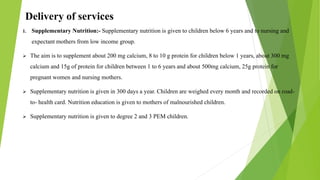
1. Supplementary Nutrition:- Supplementary nutrition is given to children below 6 years and to nursing and
expectant mothers from low income group.
 The aim is to supplement about 200 mg calcium, 8 to 10 g protein for children below 1 years, about 300 mg
calcium and 15g of protein for children between 1 to 6 years and about 500mg calcium, 25g protein for
pregnant women and nursing mothers.
 Supplementary nutrition is given in 300 days a year. Children are weighed every month and recorded on road-
to- health card. Nutrition education is given to mothers of malnourished children.
 Supplementary nutrition is given to degree 2 and 3 PEM children.
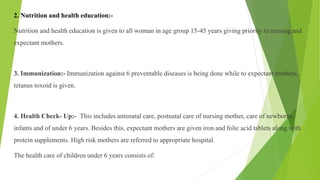
2. Nutrition and health education:-
Nutrition and health education is given to all woman in age group 15-45 years giving priority to nursing and
expectant mothers.
3. Immunization:- Immunization against 6 preventable diseases is being done while to expectant mothers,
tetanus toxoid is given.
4. Health Check- Up:- This includes antenatal care, postnatal care of nursing mother, care of newborns,
infants and of under 6 years. Besides this, expectant mothers are given iron and folic acid tablets along with
protein supplements. High risk mothers are referred to appropriate hospital.
The health care of children under 6 years consists of:
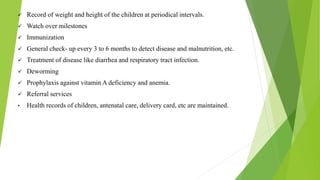
 Record of weight and height of the children at periodical intervals.
 Watch over milestones
 Immunization
 General check- up every 3 to 6 months to detect disease and malnutrition, etc.
 Treatment of disease like diarrhea and respiratory tract infection.
 Deworming
 Prophylaxis against vitamin A deficiency and anemia.
 Referral services
• Health records of children, antenatal care, delivery card, etc are maintained.
5. Nonformal preschool education:-
Children of 3 to 5 years are imparted non formal and pre school education in an Anganwadis. The
objective is to provide opportunities to develop desirable attitude, values, behavior pattern among
children. Locally produced inexpensive toys and materials are used in organizing play and
creative activity.
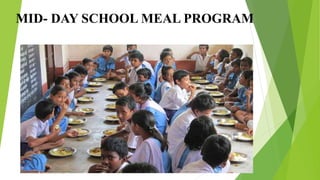
MID- DAY SCHOOL MEAL PROGRAM
INTRODUCTION:-
It was launched as a centrally sponsored scheme on 15 August1995 and revised in 2004.
Accordingly, the Mid- day school meal program was initiated in 1962 to 1963 for providing mid-
day meals to primary school children.
MID- DAY MEAL SCHEME:-
In the schemes central government provides a free supply of food grains from nearest FCI (Food
Corporation of India). To achieve the objective a cooked mid- day meal with minimum 300
calories and 8 to12 gm of protein is provided to all primary class students through this scheme.
AIMS OF MID- DAY SCHOOL MEAL PROGRAM:-
a) To fulfil one third nutritional requirement of school children.
b) To create interest about school and education.
c) To reduce absenteeism in school.
d) To provide relief to parents of poor children.
PRINCIPLES OF MID- DAY SCHOOL MEAL PROGRAM:-
In formulating mid- day meals for school children, the following broad principles should be kept in
mind:
 The meal should supply at least one third of the total energy requirement and half of protein need.
 The meal should be at minimum cost.
 The meal should be prepared easily in schools.
 No complicated cooking process should be involved.
 As far as possible, locally available food should be used in preparing the meal.
 The menu should be frequently changed to avoid monotony.
NATIONALN PROGRAME FOR CONTROL
OF BLINDNESS OR VITAMIN- A
PROPHYLAXIS PROGRAM
INTRODUCTION:-
This program was launched by the Ministry of Health and Family Welfare on the basis of technology
developed at the National Institute of Nutrition (NIN) of Hyderabad. Vitamin A deficiency is
considered a public health problem in India. The prevalence of vitamin A deficiency in children of
age from 6 months to 6 years.
The prevalence rate of 6% in children under 6 year of age was recorded. Vitamin A deficiency
include night blindness, conjunctival xerosis, bitot spots, corneal xerosis and keratomalacia.
PREVENTION AND CONTROL OF VITAMIN- A DEFICIENCY:
 Regular consumption of dark green leaf vegetables or yellow fruits and vegetables prevent vitamin
A deficiency.
 Breastfeeding protects against vitamin A deficiency. Colostrum is rich in vitamin A.
 Oral prophylactic dose of vitamin A:
 1 dose of 1,00,000 IU to infants (6- 11 months)
 Six monthly dose of 2,00,000 IU to children 1 to 5 years of age
 Treatment of vitamin A deficient cases:
 Single oral dose of 2,00,000 IU of vitamin A immediately at diagnosis.
 Follow- up dose of 2,00,000 IU 1- 4 weeks later.
ROLE OF NURSE IN VITAMIN- A PROPHYLAXIS PROGRAM:
A nurse should have complete knowledge of nutrition including vitamin A. she should know the
functions, sources, daily requirement and deficiency disease of vitamin A along with signs and
symptoms.
1. Assessment:- A community health nurse should make assessment of that particular
community for vitamin A deficiency disease. She should assess the children while they come
to attend baby clinic, in Anganwadis and in schools.
2. Implementation:- It is the responsibility of community health nurse to recognize
immunization clinics and camps in which she administers the vitamin A drops as a part of
immunization.
3. Records and Reports:- A community health nurse is a accountable for whole vitamin A
prophylaxis program. It is her prime duty to maintain her record regarding these programs
stock register, immunization cards of children.
4. Health Education:- A nurse is a person who can teach the community to take diet containing vit A.
She should explain the cheap and locally available foods rich vitamin A. She should also make aware
them about deficiency diseases of vitamin A.
5. Evaluation:- Time to time evaluation is very important to watch the progress of the program. If
there is any failure she should inform to the authority.
6. Research and Training:- Community health nurse plays an important role in conducting research
on vitamin A deficiency. She also teaches to students, Anganwadi workers (AWWs) and others health
professionals.
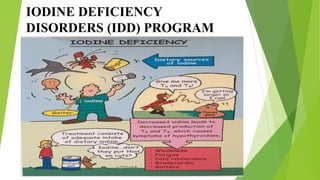
IODINE DEFICIENCY
DISORDERS (IDD) PROGRAM
INTRODUCTION:-
The National Goiter Control Program was launched by the government of India in 1962, in the
conventional goiter belt in the Himalayan region with the objective of identification of the goiter
endemic areas to supply iodized salt in place of common salt and to assess the impact of goiter control
measures over a period of time.
OBJECTIVES:-
Survey to assess the magnitude of the Iodine Deficiency Disorder.
Supply of Iodated salt in place of common salt.
Resurvey after every 5 year to assess the extent of Iodine Deficiency
Disorder and the impact of iodated salt.
Health education & publicity.
Laboratory monitoring of isolated salt and urinary Iodine excretion.
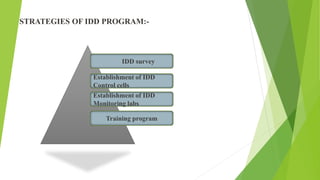
STRATEGIES OF IDD PROGRAM:-
IDD survey
Establishment of IDD
Control cells
Establishment of IDD
Monitoring labs
Training program
ROLE OF NURSE IN IDD PROGRAM:-
1.Assessment
2. Planning and Implementation
3. Iodine Monitoring
4. Record Maintaining
5. Health Education
6. Evaluation
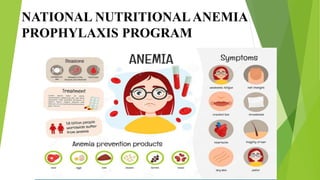
NATIONAL NUTRITIONAL ANEMIA
PROPHYLAXIS PROGRAM
INTRODUCTION
Nutritional anemia is highly prevalent in developing countries. It is found in child bearing aged
women and young children. Program was launched in 1970 during the 4- 5 year plan to prevent
nutritional anemia in mothers and children. The program is based on daily supplementation with
iron and folic acid tablets to prevent anemia.
OBJECTIVE:-
 Prevention of nutritional anemia in mothers and children.
 Minimum 100 tablets to each pregnant women are given.
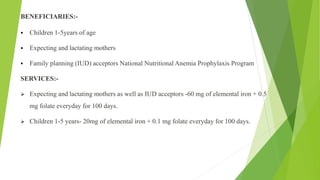
BENEFICIARIES:-
 Children 1-5years of age
 Expecting and lactating mothers
 Family planning (IUD) acceptors National Nutritional Anemia Prophylaxis Program
SERVICES:-
 Expecting and lactating mothers as well as IUD acceptors -60 mg of elemental iron + 0.5
mg folate everyday for 100 days.
 Children 1-5 years- 20mg of elemental iron + 0.1 mg folate everyday for 100 days.

National Nutritional Programs In India

  • 1.
  • 2.
    INTRODUCTION Since India becamefree, several measures have been undertaken by the National Government to improve the health of the people. National nutritional programs have been launched by the central government to control and prevent major nutritional deficiency diseases like vitamin A deficiency, iodine deficiency, PEM and iron deficiency, etc. some of the programs are discussed here.  Integrated Child Development Scheme (ICDS)  Mid- Day School Meal Program.  National Program for Control of Blindness or Vitamin A Prophylaxis Program.  Iodine Deficiency Disorder Program (IDD).  Prophylaxis Against Nutritional Anemia.
  • 3.
    INTEGRATED CHILD DEVELOPMENTSCHEME (ICDS) ICDS program was started in 1975 by the government of India in the ministry of social and women’s welfare in pursuance of the national policy for children. It is the most important scheme in the field of child welfare. ICDS provides an integrated package of early childhood services. These consist of:  Supplementary nutrition.  Immunization  Health check up  Medical referral services  Nutrition and health education for women  Non-formal education for children upto age 6 years and of pregnant and nursing mothers in rural, urban and tribal areas.
  • 4.
    OBJECTIVES OF ICDS To improve the nutritional health status of children in the age group of 0 to 6 years.  To lay the foundation for proper psychological, physical and social development of children.  To reduce the mortality and morbidity, malnutrition and school dropout.  To achieve an effective coordination of policy and implementation among various departments working for the promotion of child development.  To enhance the capacity of mother and nutritional needs of children through proper nutrition and health education.
  • 5.
    Package of Services Toachieve the above objectives, the ICDS aims at providing the following package of services: Beneficiaries Services Pregnant women Health check up, immunization against tetanus, supplementary nutrition, nutrition and health education. Nursing mothers Heath check up, supplementary nutrition, nutrition and health education Other women 15-45 years Nutrition and health education Children less than 3 years Supplementary nutrition, immunization, heath check up and referral services Children 3-6 years Supplementary nutrition, immunization, heath check up, referral services and nonformal education.
  • 6.
    Delivery of services 1.Supplementary Nutrition:- Supplementary nutrition is given to children below 6 years and to nursing and expectant mothers from low income group.  The aim is to supplement about 200 mg calcium, 8 to 10 g protein for children below 1 years, about 300 mg calcium and 15g of protein for children between 1 to 6 years and about 500mg calcium, 25g protein for pregnant women and nursing mothers.  Supplementary nutrition is given in 300 days a year. Children are weighed every month and recorded on road- to- health card. Nutrition education is given to mothers of malnourished children.  Supplementary nutrition is given to degree 2 and 3 PEM children.
  • 7.
    2. Nutrition andhealth education:- Nutrition and health education is given to all woman in age group 15-45 years giving priority to nursing and expectant mothers. 3. Immunization:- Immunization against 6 preventable diseases is being done while to expectant mothers, tetanus toxoid is given. 4. Health Check- Up:- This includes antenatal care, postnatal care of nursing mother, care of newborns, infants and of under 6 years. Besides this, expectant mothers are given iron and folic acid tablets along with protein supplements. High risk mothers are referred to appropriate hospital. The health care of children under 6 years consists of:
  • 8.
     Record ofweight and height of the children at periodical intervals.  Watch over milestones  Immunization  General check- up every 3 to 6 months to detect disease and malnutrition, etc.  Treatment of disease like diarrhea and respiratory tract infection.  Deworming  Prophylaxis against vitamin A deficiency and anemia.  Referral services • Health records of children, antenatal care, delivery card, etc are maintained.
  • 9.
    5. Nonformal preschooleducation:- Children of 3 to 5 years are imparted non formal and pre school education in an Anganwadis. The objective is to provide opportunities to develop desirable attitude, values, behavior pattern among children. Locally produced inexpensive toys and materials are used in organizing play and creative activity.
  • 10.
    MID- DAY SCHOOLMEAL PROGRAM
  • 11.
    INTRODUCTION:- It was launchedas a centrally sponsored scheme on 15 August1995 and revised in 2004. Accordingly, the Mid- day school meal program was initiated in 1962 to 1963 for providing mid- day meals to primary school children. MID- DAY MEAL SCHEME:- In the schemes central government provides a free supply of food grains from nearest FCI (Food Corporation of India). To achieve the objective a cooked mid- day meal with minimum 300 calories and 8 to12 gm of protein is provided to all primary class students through this scheme.
  • 12.
    AIMS OF MID-DAY SCHOOL MEAL PROGRAM:- a) To fulfil one third nutritional requirement of school children. b) To create interest about school and education. c) To reduce absenteeism in school. d) To provide relief to parents of poor children.
  • 13.
    PRINCIPLES OF MID-DAY SCHOOL MEAL PROGRAM:- In formulating mid- day meals for school children, the following broad principles should be kept in mind:  The meal should supply at least one third of the total energy requirement and half of protein need.  The meal should be at minimum cost.  The meal should be prepared easily in schools.  No complicated cooking process should be involved.  As far as possible, locally available food should be used in preparing the meal.  The menu should be frequently changed to avoid monotony.
  • 14.
    NATIONALN PROGRAME FORCONTROL OF BLINDNESS OR VITAMIN- A PROPHYLAXIS PROGRAM
  • 15.
    INTRODUCTION:- This program waslaunched by the Ministry of Health and Family Welfare on the basis of technology developed at the National Institute of Nutrition (NIN) of Hyderabad. Vitamin A deficiency is considered a public health problem in India. The prevalence of vitamin A deficiency in children of age from 6 months to 6 years. The prevalence rate of 6% in children under 6 year of age was recorded. Vitamin A deficiency include night blindness, conjunctival xerosis, bitot spots, corneal xerosis and keratomalacia.
  • 16.
    PREVENTION AND CONTROLOF VITAMIN- A DEFICIENCY:  Regular consumption of dark green leaf vegetables or yellow fruits and vegetables prevent vitamin A deficiency.  Breastfeeding protects against vitamin A deficiency. Colostrum is rich in vitamin A.  Oral prophylactic dose of vitamin A:  1 dose of 1,00,000 IU to infants (6- 11 months)  Six monthly dose of 2,00,000 IU to children 1 to 5 years of age  Treatment of vitamin A deficient cases:  Single oral dose of 2,00,000 IU of vitamin A immediately at diagnosis.  Follow- up dose of 2,00,000 IU 1- 4 weeks later.
  • 17.
    ROLE OF NURSEIN VITAMIN- A PROPHYLAXIS PROGRAM: A nurse should have complete knowledge of nutrition including vitamin A. she should know the functions, sources, daily requirement and deficiency disease of vitamin A along with signs and symptoms. 1. Assessment:- A community health nurse should make assessment of that particular community for vitamin A deficiency disease. She should assess the children while they come to attend baby clinic, in Anganwadis and in schools. 2. Implementation:- It is the responsibility of community health nurse to recognize immunization clinics and camps in which she administers the vitamin A drops as a part of immunization. 3. Records and Reports:- A community health nurse is a accountable for whole vitamin A prophylaxis program. It is her prime duty to maintain her record regarding these programs stock register, immunization cards of children.
  • 18.
    4. Health Education:-A nurse is a person who can teach the community to take diet containing vit A. She should explain the cheap and locally available foods rich vitamin A. She should also make aware them about deficiency diseases of vitamin A. 5. Evaluation:- Time to time evaluation is very important to watch the progress of the program. If there is any failure she should inform to the authority. 6. Research and Training:- Community health nurse plays an important role in conducting research on vitamin A deficiency. She also teaches to students, Anganwadi workers (AWWs) and others health professionals.
  • 19.
  • 20.
    INTRODUCTION:- The National GoiterControl Program was launched by the government of India in 1962, in the conventional goiter belt in the Himalayan region with the objective of identification of the goiter endemic areas to supply iodized salt in place of common salt and to assess the impact of goiter control measures over a period of time. OBJECTIVES:- Survey to assess the magnitude of the Iodine Deficiency Disorder. Supply of Iodated salt in place of common salt. Resurvey after every 5 year to assess the extent of Iodine Deficiency Disorder and the impact of iodated salt. Health education & publicity. Laboratory monitoring of isolated salt and urinary Iodine excretion.
  • 21.
    STRATEGIES OF IDDPROGRAM:- IDD survey Establishment of IDD Control cells Establishment of IDD Monitoring labs Training program
  • 22.
    ROLE OF NURSEIN IDD PROGRAM:- 1.Assessment 2. Planning and Implementation 3. Iodine Monitoring 4. Record Maintaining 5. Health Education 6. Evaluation
  • 23.
  • 24.
    INTRODUCTION Nutritional anemia ishighly prevalent in developing countries. It is found in child bearing aged women and young children. Program was launched in 1970 during the 4- 5 year plan to prevent nutritional anemia in mothers and children. The program is based on daily supplementation with iron and folic acid tablets to prevent anemia. OBJECTIVE:-  Prevention of nutritional anemia in mothers and children.  Minimum 100 tablets to each pregnant women are given.
  • 25.
    BENEFICIARIES:-  Children 1-5yearsof age  Expecting and lactating mothers  Family planning (IUD) acceptors National Nutritional Anemia Prophylaxis Program SERVICES:-  Expecting and lactating mothers as well as IUD acceptors -60 mg of elemental iron + 0.5 mg folate everyday for 100 days.  Children 1-5 years- 20mg of elemental iron + 0.1 mg folate everyday for 100 days.