Health , Nutrition and
Community Intervention
Programmes
Smt Rekha DT MSc FSN , KSET
HOD Clinical Nutrition and Dietetics
Smt V. G Women's Degree College , Kalaburagi
Introduction
 Community may be defined in narrower sense as a group or collection of groups that
inhabit in a limited geographical area and whose members live together in such a way
that they share the basic conditions of a common life .
 A group of people : there is no existence of any community without people whose
interest are based on mutual dependence and co operation .
 Health : is a state of complete physical ,mental and social well being and not merely an
absence of disease and infirmity .
 Nutrition : science of food and its relation to health.
 Its science of nourishing body .
 Community nutrition / public nutrition : is concerned with improving nutrition in
populations in both poor and industrialised countries
Activities of Public Nutrition
 An understanding and raising awareness of the nature , causes
and consequences of nutrition problems in society .
 Epidemiology, including monitoring , surveillance and
evaluation .
 Nutritional requirements and dietary guidelines of the
populations .
 Programmes and interventions : their design , planning ,
management and evaluation .
 Community Nutrition and community based programmes.
 Public education , especially nutrition education for
behavioural change .
 Timely warning and prevention and eradication of or mitigation of emergencies ,
including survival ration distribution .
 Advocacy and linkage with such as population and environmental concerns .
 Public policies and programs relevant to nutrition in several sectors for EX;
Economic development , Health , Agriculture and education etc.
Health Care
 Health care involves much more than just medical care
and can be defined as “multitude of service provided to
individuals or communities by agents of health services
or professions, for purpose of promoting , maintaining,
monitoring or restoring health “
 Primary Health Care
 Secondary Health Care
 Tertiary Health Care
1%
Tertiary Health
Care
(Specialised
hospital
9% Secondary
Health Care(General
hospital service )
90% primary health
care(promotive , preventive
and basic curative services at
health posts, health centres
and satellite clinics )
Role of Public Nutrition in Health Care
Delivery
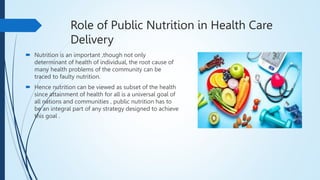
 Nutrition is an important ,though not only
determinant of health of individual, the root cause of
many health problems of the community can be
traced to faulty nutrition.
 Hence nutrition can be viewed as subset of the health
since attainment of health for all is a universal goal of
all nations and communities , public nutrition has to
be an integral part of any strategy designed to achieve
this goal .
Strategies To Combat Community
Nutritional Problems
 Health and Nutrition are most important contributory factors for human
resource development in country like India , the highest populated
country (1.34billion population)has been classified by the World Bank as
country with low income . It ranks 131in rising Human Development Index
out of 188 countries (2017).
 31.2 % residents in urban areas, 68.8 %residents in rural areas 6.7 % of
are Below poverty line .(2019)
 Long term malnutrition leads to increased risk or morbidity, mortality and
reduced work capacity .
 To combat malnutrition Government of India implemented National
Nutritional policies and many intervention programs .
National Nutrition policy
• Department of Woman and Child Development ,GOI.
• Year 1993
• Aim : improvement in Nutritional status of people
• Draw attention to urgent need to reduce malnutrition in
community .
• To highlight the need inter-sectoral coordination to achieve
nutritional goals.
• To identify short term , intermediate and long term
strategies for achieving nutritional goals either through
direct policy changes or indirect institutional for structural
changes .
First Nutrition
Programme
ANP
1963
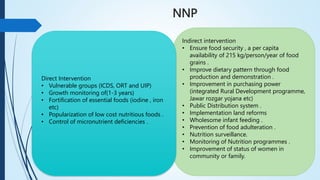
NNP
Indirect intervention
• Ensure food security , a per capita
availability of 215 kg/person/year of food
grains .
• Improve dietary pattern through food
production and demonstration .
• Improvement in purchasing power
(integrated Rural Development programme,
Jawar rozgar yojana etc)
• Public Distribution system .
• Implementation land reforms
• Wholesome infant feeding .
• Prevention of food adulteration .
• Nutrition surveillance.
• Monitoring of Nutrition programmes .
• Improvement of status of women in
community or family.
Direct Intervention
• Vulnerable groups (ICDS, ORT and UIP)
• Growth monitoring of(1-3 years)
• Fortification of essential foods (iodine , iron
etc)
• Popularization of low cost nutritious foods .
• Control of micronutrient deficiencies .
Worlds Unique community based
outreach programme for early
childhood care and development
Nutrient Deficiency control
programmes –Vitamin A , Iron ,
Iodine .
food Supplementation
Programmes like SNP , Balwadi
Feeding Programme, Composite
Nutrition Programme , ANP
Food Security Programmes
PDS , Anna yojana, Annapurna
Scheme , national Food for work
Self Employment wage
Employment Schemes
ICDS
 Pediatric malnutrition has always been a matter of national concern. The various vertical
health programmes initiated by the Government of India (GOI) from time to time did
not reach out to the target community adequately. In 1974, India adopted a well-
defined national policy for children. In pursuance of this policy it was decided to start a
holistic multicentric programme with a compact package of services. The decision led to
the formulation of Integrated Child Development Services (ICDS) scheme – one of the
most prestigious and premier National Human Resource Development programmes of
the GOI.
 The scheme was launched on 2 October 1975 in 33 (4 rural, 18 urban, 11 tribal) blocks.
Over the last 25 years, it was expanded progressively and at present it has 5614 (central
5103, state 511) projects covering over 5300 community development blocks and 300
urban slums; over 60 million children below the age of 6 years and over 10 million
women between 16 and 44 years of age and 2 million lactating mothers . The total
population under ICDS coverage is 70 million, which is approximately 7 percent of the
total population of one billion.
Objectives
• Improvement in the health and nutritional status of children 0–6 years and pregnant and lactating
mothers.
• Reduction in the incidence of their mortality and school drop out
• Provision of a firm foundation for proper psychological, physical and social development of the child.
• Enhancement of the maternal education and capacity to look after her own health and nutrition and
that of her family
• Effective co-ordination of the policy and implementation among various departments and
programmes aimed to promote child development.
BENEFICIARIES and SERVICES
Children 0–6 years of age
Pregnant and lactating mothers
Women 15–44 year of age
Since 1991 adolescent girls upto the age of
18 years for non formal education and
training on health and nutrition
Complementary nutrition
Vitamin A and Iron and folic acid tablets
Immunization and Health check up
Treatment of minor ailments and Referral services
Non-formal education on health and nutrition to women
Preschool education to children 3–6 year old
Convergence of other supportive services like water, sanitation etc.
Mid Day Meal Programme
AIM
•Avoid classroom hunger
•Increase school enrolment
•Increase school attendance
•Improve socialization among castes
•Address malnutrition
•Empower women through employment
In September 2021, the Mid-Day Meal
Scheme was renamed ‘PM POSHAN’ or
Pradhan Mantri Poshan Shakti Nirman. PM
POSHAN will extend the hot cooked meals
to students studying in pre-primary levels
or Bal Vatikas of government and
government-aided primary schools, in
addition to those already covered under
the mid-day scheme.
• Monitor Nutritional Status focus height
, weight and BMI, Hb levels.
• Nutrition garden with active
participation of students .
• Promotion of ethnic cuisine .
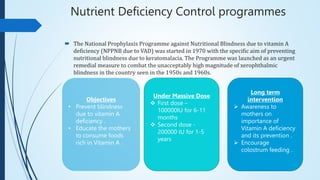
Nutrient Deficiency Control programmes
 The National Prophylaxis Programme against Nutritional Blindness due to vitamin A
deficiency (NPPNB due to VAD) was started in 1970 with the specific aim of preventing
nutritional blindness due to keratomalacia. The Programme was launched as an urgent
remedial measure to combat the unacceptably high magnitude of xerophthalmic
blindness in the country seen in the 1950s and 1960s.
Objectives
• Prevent blindness
due to vitamin A
deficiency .
• Educate the mothers
to consume foods
rich in Vitamin A .
Under Massive Dose
 First dose –
100000IU for 6-11
months
 Second dose -
200000 IU for 1-5
years
Long term
intervention
 Awareness to
mothers on
importance of
Vitamin A deficiency
and its prevention .
 Encourage
colostrum feeding .
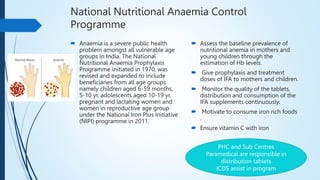
National Nutritional Anaemia Control
Programme
 Anaemia is a severe public health
problem amongst all vulnerable age
groups in India. The National
Nutritional Anaemia Prophylaxis
Programme initiated in 1970, was
revised and expanded to include
beneficiaries from all age groups
namely children aged 6-59 months,
5-10 yr, adolescents aged 10-19 yr,
pregnant and lactating women and
women in reproductive age group
under the National Iron Plus Initiative
(NIPI) programme in 2011.
 Assess the baseline prevalence of
nutritional anemia in mothers and
young children through the
estimation of Hb levels.
 Give prophylaxis and treatment
doses of IFA to mothers and children.
 Monitor the quality of the tablets,
distribution and consumption of the
IFA supplements continuously.
 Motivate to consume iron rich foods
.
 Ensure vitamin C with iron
PHC and Sub Centres
Paramedical are responsible in
distribution tablets
ICDS assist in program
National Iodine Deficiency Disorder
Control Programme
 This programme was introduced by
Direct General of health Service for
endemic Goitre in 1962 mainly
Himalayan and Sub Himalayan belts
in India.
 Objectives
o To identify goitre endemic regions.
o To provide iodized salt to endemic
areas.
o To asses the programme over period
of time .
 In India
 16 million at risk , 54 million have
goitre , 2.2 million have critinism , 6.6
have mild neurological disorder.
Programme Component
• Iodised salt and oil distribution.
• Iodine monitoring and
surveillance .
• Man power training .
• Mass communication .
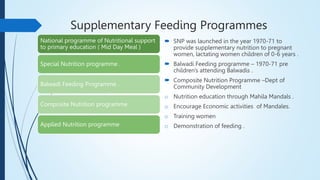
Supplementary Feeding Programmes
National programme of Nutritional support
to primary education ( Mid Day Meal )
Special Nutrition programme .
Balwadi Feeding Programme .
Composite Nutrition programme .
Applied Nutrition programme
 SNP was launched in the year 1970-71 to
provide supplementary nutrition to pregnant
women, lactating women children of 0-6 years .
 Balwadi Feeding programme – 1970-71 pre
children's attending Balwadis .
 Composite Nutrition Programme –Dept of
Community Development
o Nutrition education through Mahila Mandals .
o Encourage Economic activities of Mandales.
o Training women
o Demonstration of feeding .
Food Security Programmes
 Food security refers to access by all people at all
times to enough food for active and healthy life.
1. Increasing purchasing power
2. Supplying food grains at subsidized price .
Public Distribution system
 Important constituent of strategy for poverty
alleviation .
 Major instrument of Government Economic
policy for ensuring food security .
 Poshan Abhiyaan
 Poshan Abhiyaan, also known as the National Nutrition Mission (NNM), was
launched in 2018 (although the programme was being implemented in 2017) by
the Government of India with the aim of tackling malnutrition problem prevalent
in India.
• The chief objective of the mission is to reduce the level of under-nutrition and
also enhance the nutritional status of children in the country.
• The mission is a multi-ministerial initiative and aims at removing malnutrition
from the country by 2022.
• Poshan Abhiyaan is India’s flagship scheme to improve the nutritional outcomes
of adolescents, children, pregnant women and lactating mothers.
• The term ‘Poshan’ in the name of the programme stands for ‘Prime Minister’s
Overarching Scheme for Holistic Nutrition.
• The programme has specific targets for reducing stunting, anemia, under-
nutrition and low birth weight.
• According to ‘Mission 25 by 2020’, the National Nutrition Mission aims to achieve
a reduction in stunting from 38.4% to 25% by 2022.
 One of the major objectives under the POSHAN Abhiyaan is to
leverage technology for monitoring and improving service delivery
for beneficiaries including children (0-6 years), pregnant women
and lactating mothers.
 In this direction, a robust ICT-enabled platform, ‘POSHAN Tracker’,
was developed by the MoWCD and launched on January 13, 2021.
This was done to ensure real-time monitoring of providing
supplementary nutrition and real-time information for prompt
supervision and management of services. Further, for the first time,
Anganwadi workers have been provided with 11.75 lakh
smartphones. Besides, to promote regular growth monitoring,
12.36 lakh Growth Monitoring Devices (Infantometer, Stadiometer,
Weighing Scale for Infants and Weighing Scale for Mother and
Child) have been procured by States/UTs under the Abhiyaan
 Under the POSHAN Abhiyaan, ‘Rashtriya Poshan Maah’ is
celebrated each year in September with the aim to create
awareness about nutrition and healthy food.
 Ministry of Women and Child Development is celebrating the
5th Rashtriya Poshan Maah 2022 across the nation from
September 01 to September 30. The objective is to trigger
Poshan Maah through Gram Panchayats as Poshan
Panchayats with a key focus on “Mahila aur Swasthya” and
“Bacha aur Shiksha”.
 Rashtriya POSHAN Maah
celebrated from September
2018 onwards
 Poshan Maah focused on
Social Behavioural Change
and communication the
broad theme were : antenatal
care , optimal breast feeding
,complementary feeding ,
anaemia , growth monitoring
 The Ministry of Women and Child Development will celebrate the fifth Poshan
Pakhwada from 20th March to 3rd April 2023 with various activities nationwide.
The Pakhwada aims to raise awareness about the importance of nutrition and
promote healthy eating habits through Jan Andolan and Jan Bhagidari.
 Every year, Poshan Pakhwada is celebrated in the month of March for 15 days.
Similarly, the month of September is celebrated as Rashtriya Poshan Maah, across
the country. The Poshan Maah and Pakhwada celebrated so far have witnessed
wide participation and enthusiasm from all States/UTs, frontline functionaries,
converging Ministries as well as public at large. Close to 2.96 crore activities were
held across the country in the last Poshan Pakhwada 2022
The theme of this year’s Poshan Pakhwada 2023 is "Nutrition for All: Together
Towards a Healthy India". With the declaration of 2023 as the International Year
Millets, this year the focus of Poshan Pakhwada will be to popularise ‘Shree Anna’-
the mother of all grains, as a valuable asset to address malnutrition.
Activities of Poshan Pakhwada
 1. Promotion and popularization of Shree Anna
/ Millets for nutritional- well-being through
organization of drives to link Millet-based foods
with supplementary nutrition, Home visits, Diet
consultation camps, etc.
 2. Celebration of Swasth Balak Spardha:
Celebrate and recognize the ‘Swasth Balak’ or
Healthy Child as per defined criteria by generating
a healthy spirit of competition for good nutrition
good health and well being
 3. Popularize Saksham Anganwadis: Campaigns
will be organized to increase awareness and
popularise Saksham Anganwadis with upgraded
infrastructure and facilities as centers of improved
nutrition delivery and early childhood care and
education..
Anaemia Mukth Bharat
 National Family Health Survey
-5 (2019-21)
Age group Anaemia %
Children 6-59
months
67
Adolescent
Girls 15-19
years
59
Adolescent
Boys 15-19
years
31
Women of
reproductive
age
57%
Pregnant
women
52
Interventions
1.Prophylactic Iron and Folic Acid supplementation
2. Deworming
3. Intensified year-round Behaviour Change
Communication Campaign (Solid Body, Smart Mind)
including ensuring delayed cord clamping in
newborns
4. Testing of anemia using digital methods and point
of care treatment . care treatment
5.Mandatory provision of Iron and Folic Acid fortified
foods in government-funded health programmes
6. Addressing non-nutritional causes of anemia in
endemic pockets, with special focus on malaria,
haemoglobinopathies and fluorosis
Conclusion
 Ensuring food security and promoting healthy eating habits , effective
implementation of Nutrition Intervention programmes may combat malnutrition .
 In Urban population we can see imbalance of Nutrients and Micronutrient
deficiencies which are increasing the level of non communicable diseases .
 For Healthy life – modification in life style in need of an hour .
Nutrition Activity
1. Full form of ICDS .
2. Full form of PHC
3. When was ICDS implemented ?
4. RDA of protein for adults .
5. When was Poshan Maah Celebrated ?
Community and nutrition intervention programmes.pptx

Community and nutrition intervention programmes.pptx

  • 1.
    Health , Nutritionand Community Intervention Programmes Smt Rekha DT MSc FSN , KSET HOD Clinical Nutrition and Dietetics Smt V. G Women's Degree College , Kalaburagi
  • 2.
    Introduction  Community maybe defined in narrower sense as a group or collection of groups that inhabit in a limited geographical area and whose members live together in such a way that they share the basic conditions of a common life .  A group of people : there is no existence of any community without people whose interest are based on mutual dependence and co operation .  Health : is a state of complete physical ,mental and social well being and not merely an absence of disease and infirmity .  Nutrition : science of food and its relation to health.  Its science of nourishing body .  Community nutrition / public nutrition : is concerned with improving nutrition in populations in both poor and industrialised countries
  • 3.
    Activities of PublicNutrition  An understanding and raising awareness of the nature , causes and consequences of nutrition problems in society .  Epidemiology, including monitoring , surveillance and evaluation .  Nutritional requirements and dietary guidelines of the populations .  Programmes and interventions : their design , planning , management and evaluation .  Community Nutrition and community based programmes.  Public education , especially nutrition education for behavioural change .
  • 4.
     Timely warningand prevention and eradication of or mitigation of emergencies , including survival ration distribution .  Advocacy and linkage with such as population and environmental concerns .  Public policies and programs relevant to nutrition in several sectors for EX; Economic development , Health , Agriculture and education etc.
  • 5.
    Health Care  Healthcare involves much more than just medical care and can be defined as “multitude of service provided to individuals or communities by agents of health services or professions, for purpose of promoting , maintaining, monitoring or restoring health “  Primary Health Care  Secondary Health Care  Tertiary Health Care 1% Tertiary Health Care (Specialised hospital 9% Secondary Health Care(General hospital service ) 90% primary health care(promotive , preventive and basic curative services at health posts, health centres and satellite clinics )
  • 6.
    Role of PublicNutrition in Health Care Delivery  Nutrition is an important ,though not only determinant of health of individual, the root cause of many health problems of the community can be traced to faulty nutrition.  Hence nutrition can be viewed as subset of the health since attainment of health for all is a universal goal of all nations and communities , public nutrition has to be an integral part of any strategy designed to achieve this goal .
  • 7.
    Strategies To CombatCommunity Nutritional Problems  Health and Nutrition are most important contributory factors for human resource development in country like India , the highest populated country (1.34billion population)has been classified by the World Bank as country with low income . It ranks 131in rising Human Development Index out of 188 countries (2017).  31.2 % residents in urban areas, 68.8 %residents in rural areas 6.7 % of are Below poverty line .(2019)  Long term malnutrition leads to increased risk or morbidity, mortality and reduced work capacity .  To combat malnutrition Government of India implemented National Nutritional policies and many intervention programs .
  • 8.
    National Nutrition policy •Department of Woman and Child Development ,GOI. • Year 1993 • Aim : improvement in Nutritional status of people • Draw attention to urgent need to reduce malnutrition in community . • To highlight the need inter-sectoral coordination to achieve nutritional goals. • To identify short term , intermediate and long term strategies for achieving nutritional goals either through direct policy changes or indirect institutional for structural changes . First Nutrition Programme ANP 1963
  • 9.
    NNP Indirect intervention • Ensurefood security , a per capita availability of 215 kg/person/year of food grains . • Improve dietary pattern through food production and demonstration . • Improvement in purchasing power (integrated Rural Development programme, Jawar rozgar yojana etc) • Public Distribution system . • Implementation land reforms • Wholesome infant feeding . • Prevention of food adulteration . • Nutrition surveillance. • Monitoring of Nutrition programmes . • Improvement of status of women in community or family. Direct Intervention • Vulnerable groups (ICDS, ORT and UIP) • Growth monitoring of(1-3 years) • Fortification of essential foods (iodine , iron etc) • Popularization of low cost nutritious foods . • Control of micronutrient deficiencies .
  • 10.
    Worlds Unique communitybased outreach programme for early childhood care and development Nutrient Deficiency control programmes –Vitamin A , Iron , Iodine . food Supplementation Programmes like SNP , Balwadi Feeding Programme, Composite Nutrition Programme , ANP
  • 11.
    Food Security Programmes PDS, Anna yojana, Annapurna Scheme , national Food for work Self Employment wage Employment Schemes
  • 12.
    ICDS  Pediatric malnutritionhas always been a matter of national concern. The various vertical health programmes initiated by the Government of India (GOI) from time to time did not reach out to the target community adequately. In 1974, India adopted a well- defined national policy for children. In pursuance of this policy it was decided to start a holistic multicentric programme with a compact package of services. The decision led to the formulation of Integrated Child Development Services (ICDS) scheme – one of the most prestigious and premier National Human Resource Development programmes of the GOI.  The scheme was launched on 2 October 1975 in 33 (4 rural, 18 urban, 11 tribal) blocks. Over the last 25 years, it was expanded progressively and at present it has 5614 (central 5103, state 511) projects covering over 5300 community development blocks and 300 urban slums; over 60 million children below the age of 6 years and over 10 million women between 16 and 44 years of age and 2 million lactating mothers . The total population under ICDS coverage is 70 million, which is approximately 7 percent of the total population of one billion.
  • 13.
    Objectives • Improvement inthe health and nutritional status of children 0–6 years and pregnant and lactating mothers. • Reduction in the incidence of their mortality and school drop out • Provision of a firm foundation for proper psychological, physical and social development of the child. • Enhancement of the maternal education and capacity to look after her own health and nutrition and that of her family • Effective co-ordination of the policy and implementation among various departments and programmes aimed to promote child development.
  • 14.
    BENEFICIARIES and SERVICES Children0–6 years of age Pregnant and lactating mothers Women 15–44 year of age Since 1991 adolescent girls upto the age of 18 years for non formal education and training on health and nutrition Complementary nutrition Vitamin A and Iron and folic acid tablets Immunization and Health check up Treatment of minor ailments and Referral services Non-formal education on health and nutrition to women Preschool education to children 3–6 year old Convergence of other supportive services like water, sanitation etc.
  • 15.
    Mid Day MealProgramme AIM •Avoid classroom hunger •Increase school enrolment •Increase school attendance •Improve socialization among castes •Address malnutrition •Empower women through employment In September 2021, the Mid-Day Meal Scheme was renamed ‘PM POSHAN’ or Pradhan Mantri Poshan Shakti Nirman. PM POSHAN will extend the hot cooked meals to students studying in pre-primary levels or Bal Vatikas of government and government-aided primary schools, in addition to those already covered under the mid-day scheme. • Monitor Nutritional Status focus height , weight and BMI, Hb levels. • Nutrition garden with active participation of students . • Promotion of ethnic cuisine .
  • 16.
    Nutrient Deficiency Controlprogrammes  The National Prophylaxis Programme against Nutritional Blindness due to vitamin A deficiency (NPPNB due to VAD) was started in 1970 with the specific aim of preventing nutritional blindness due to keratomalacia. The Programme was launched as an urgent remedial measure to combat the unacceptably high magnitude of xerophthalmic blindness in the country seen in the 1950s and 1960s. Objectives • Prevent blindness due to vitamin A deficiency . • Educate the mothers to consume foods rich in Vitamin A . Under Massive Dose  First dose – 100000IU for 6-11 months  Second dose - 200000 IU for 1-5 years Long term intervention  Awareness to mothers on importance of Vitamin A deficiency and its prevention .  Encourage colostrum feeding .
  • 17.
    National Nutritional AnaemiaControl Programme  Anaemia is a severe public health problem amongst all vulnerable age groups in India. The National Nutritional Anaemia Prophylaxis Programme initiated in 1970, was revised and expanded to include beneficiaries from all age groups namely children aged 6-59 months, 5-10 yr, adolescents aged 10-19 yr, pregnant and lactating women and women in reproductive age group under the National Iron Plus Initiative (NIPI) programme in 2011.  Assess the baseline prevalence of nutritional anemia in mothers and young children through the estimation of Hb levels.  Give prophylaxis and treatment doses of IFA to mothers and children.  Monitor the quality of the tablets, distribution and consumption of the IFA supplements continuously.  Motivate to consume iron rich foods .  Ensure vitamin C with iron PHC and Sub Centres Paramedical are responsible in distribution tablets ICDS assist in program
  • 18.
    National Iodine DeficiencyDisorder Control Programme  This programme was introduced by Direct General of health Service for endemic Goitre in 1962 mainly Himalayan and Sub Himalayan belts in India.  Objectives o To identify goitre endemic regions. o To provide iodized salt to endemic areas. o To asses the programme over period of time .  In India  16 million at risk , 54 million have goitre , 2.2 million have critinism , 6.6 have mild neurological disorder. Programme Component • Iodised salt and oil distribution. • Iodine monitoring and surveillance . • Man power training . • Mass communication .
  • 19.
    Supplementary Feeding Programmes Nationalprogramme of Nutritional support to primary education ( Mid Day Meal ) Special Nutrition programme . Balwadi Feeding Programme . Composite Nutrition programme . Applied Nutrition programme  SNP was launched in the year 1970-71 to provide supplementary nutrition to pregnant women, lactating women children of 0-6 years .  Balwadi Feeding programme – 1970-71 pre children's attending Balwadis .  Composite Nutrition Programme –Dept of Community Development o Nutrition education through Mahila Mandals . o Encourage Economic activities of Mandales. o Training women o Demonstration of feeding .
  • 20.
    Food Security Programmes Food security refers to access by all people at all times to enough food for active and healthy life. 1. Increasing purchasing power 2. Supplying food grains at subsidized price . Public Distribution system  Important constituent of strategy for poverty alleviation .  Major instrument of Government Economic policy for ensuring food security .  Poshan Abhiyaan  Poshan Abhiyaan, also known as the National Nutrition Mission (NNM), was launched in 2018 (although the programme was being implemented in 2017) by the Government of India with the aim of tackling malnutrition problem prevalent in India. • The chief objective of the mission is to reduce the level of under-nutrition and also enhance the nutritional status of children in the country. • The mission is a multi-ministerial initiative and aims at removing malnutrition from the country by 2022. • Poshan Abhiyaan is India’s flagship scheme to improve the nutritional outcomes of adolescents, children, pregnant women and lactating mothers. • The term ‘Poshan’ in the name of the programme stands for ‘Prime Minister’s Overarching Scheme for Holistic Nutrition. • The programme has specific targets for reducing stunting, anemia, under- nutrition and low birth weight. • According to ‘Mission 25 by 2020’, the National Nutrition Mission aims to achieve a reduction in stunting from 38.4% to 25% by 2022.
  • 21.
     One ofthe major objectives under the POSHAN Abhiyaan is to leverage technology for monitoring and improving service delivery for beneficiaries including children (0-6 years), pregnant women and lactating mothers.  In this direction, a robust ICT-enabled platform, ‘POSHAN Tracker’, was developed by the MoWCD and launched on January 13, 2021. This was done to ensure real-time monitoring of providing supplementary nutrition and real-time information for prompt supervision and management of services. Further, for the first time, Anganwadi workers have been provided with 11.75 lakh smartphones. Besides, to promote regular growth monitoring, 12.36 lakh Growth Monitoring Devices (Infantometer, Stadiometer, Weighing Scale for Infants and Weighing Scale for Mother and Child) have been procured by States/UTs under the Abhiyaan
  • 22.
     Under thePOSHAN Abhiyaan, ‘Rashtriya Poshan Maah’ is celebrated each year in September with the aim to create awareness about nutrition and healthy food.  Ministry of Women and Child Development is celebrating the 5th Rashtriya Poshan Maah 2022 across the nation from September 01 to September 30. The objective is to trigger Poshan Maah through Gram Panchayats as Poshan Panchayats with a key focus on “Mahila aur Swasthya” and “Bacha aur Shiksha”.  Rashtriya POSHAN Maah celebrated from September 2018 onwards  Poshan Maah focused on Social Behavioural Change and communication the broad theme were : antenatal care , optimal breast feeding ,complementary feeding , anaemia , growth monitoring
  • 23.
     The Ministryof Women and Child Development will celebrate the fifth Poshan Pakhwada from 20th March to 3rd April 2023 with various activities nationwide. The Pakhwada aims to raise awareness about the importance of nutrition and promote healthy eating habits through Jan Andolan and Jan Bhagidari.  Every year, Poshan Pakhwada is celebrated in the month of March for 15 days. Similarly, the month of September is celebrated as Rashtriya Poshan Maah, across the country. The Poshan Maah and Pakhwada celebrated so far have witnessed wide participation and enthusiasm from all States/UTs, frontline functionaries, converging Ministries as well as public at large. Close to 2.96 crore activities were held across the country in the last Poshan Pakhwada 2022 The theme of this year’s Poshan Pakhwada 2023 is "Nutrition for All: Together Towards a Healthy India". With the declaration of 2023 as the International Year Millets, this year the focus of Poshan Pakhwada will be to popularise ‘Shree Anna’- the mother of all grains, as a valuable asset to address malnutrition.
  • 24.
    Activities of PoshanPakhwada  1. Promotion and popularization of Shree Anna / Millets for nutritional- well-being through organization of drives to link Millet-based foods with supplementary nutrition, Home visits, Diet consultation camps, etc.  2. Celebration of Swasth Balak Spardha: Celebrate and recognize the ‘Swasth Balak’ or Healthy Child as per defined criteria by generating a healthy spirit of competition for good nutrition good health and well being  3. Popularize Saksham Anganwadis: Campaigns will be organized to increase awareness and popularise Saksham Anganwadis with upgraded infrastructure and facilities as centers of improved nutrition delivery and early childhood care and education..
  • 25.
    Anaemia Mukth Bharat National Family Health Survey -5 (2019-21) Age group Anaemia % Children 6-59 months 67 Adolescent Girls 15-19 years 59 Adolescent Boys 15-19 years 31 Women of reproductive age 57% Pregnant women 52 Interventions 1.Prophylactic Iron and Folic Acid supplementation 2. Deworming 3. Intensified year-round Behaviour Change Communication Campaign (Solid Body, Smart Mind) including ensuring delayed cord clamping in newborns 4. Testing of anemia using digital methods and point of care treatment . care treatment 5.Mandatory provision of Iron and Folic Acid fortified foods in government-funded health programmes 6. Addressing non-nutritional causes of anemia in endemic pockets, with special focus on malaria, haemoglobinopathies and fluorosis
  • 26.
    Conclusion  Ensuring foodsecurity and promoting healthy eating habits , effective implementation of Nutrition Intervention programmes may combat malnutrition .  In Urban population we can see imbalance of Nutrients and Micronutrient deficiencies which are increasing the level of non communicable diseases .  For Healthy life – modification in life style in need of an hour .
  • 27.
    Nutrition Activity 1. Fullform of ICDS . 2. Full form of PHC 3. When was ICDS implemented ? 4. RDA of protein for adults . 5. When was Poshan Maah Celebrated ?