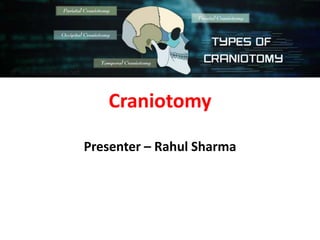
Craniotomy
Presenter – Rahul Sharma
Learning Objectives
• What is Craniotomy?
• What are the Indications for Craniotomy?
• What are the Types of Craniotomy?
• Equipment used in craniotomy?
• What happen to the Bone flap?
• What are the Tests Done Prior to Craniotomy?
• What happens during surgery?
• What are the risks?
• References
Historical context and Perspective
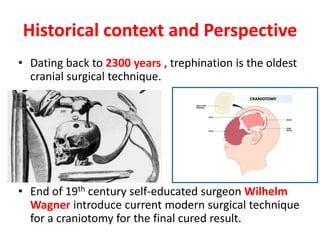
• Dating back to 2300 years , trephination is the oldest
cranial surgical technique.
• End of 19th century self-educated surgeon Wilhelm
Wagner introduce current modern surgical technique
for a craniotomy for the final cured result.
What is Craniotomy?
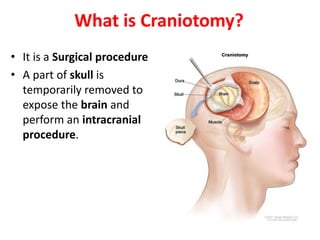
• It is a Surgical procedure
• A part of skull is
temporarily removed to
expose the brain and
perform an intracranial
procedure.
Indications
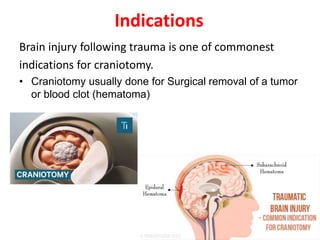
Brain injury following trauma is one of commonest
indications for craniotomy.
• Craniotomy usually done for Surgical removal of a tumor
or blood clot (hematoma)
Clipping of an aneurysm
• Clipping of aneurysm reduces blood flow through it
and therefore decreases its size and its potential to
burst.
Removal of an Arteriovenous Malformation
• Abnormal communication
between an artery and a
vein
• Bleeding can result in
grave consequences.
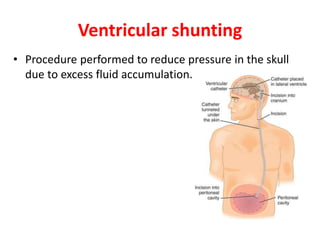
Ventricular shunting
• Procedure performed to reduce pressure in the skull
due to excess fluid accumulation.
Other indication can be:-
1. Decompressive by draining abscess
2. Lobectomy
3. Epilepsy surgery
4. Craniosynostosis
5. Cerebrospinal fluid leak repair
6. Other procedures like inserting deep brain
stimulators for the treatment of conditions
Parkinson’s disease, essential tremor and dystonia
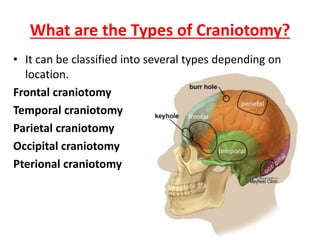
What are the Types of Craniotomy?
• It can be classified into several types depending on
location.
Frontal craniotomy
Temporal craniotomy
Parietal craniotomy
Occipital craniotomy
Pterional craniotomy
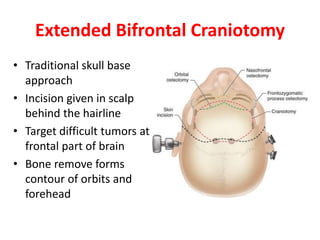
Extended Bifrontal Craniotomy
• Traditional skull base
approach
• Incision given in scalp
behind the hairline
• Target difficult tumors at
frontal part of brain
• Bone remove forms
contour of orbits and
forehead
Principle behind bifrontal craniotomy
• Allows surgeons to work in space between and right
behind eyes without having to unnecessarily
manipulate the brain
Indication
Mainly those tumors not exposed by minimal invasive
approaches including,
• Meningiomas
• Esthesioneuroblastomas
• Malignant skull base tumors
Minimally Invasive Supra-Orbital “
eyebrow” Craniotomy
• Small incision made within
eyebrow
Helps to access
• Tumors in front of brain
• Pituitary gland tumor
• Tumors deeper in brain behind
nose and eyes
• Approach used instead of
endonasal endoscopic surgery
if tumor size is large or close to
optic nerve or vital arteries
it is a minimally invasive procedure, supra-orbital
“eyebrow” craniotomy may offer
• Less pain than open craniotomy
• Faster recovery than open craniotomy
• Minimal scarring
Mainly used for
1. Rathke’s cleft cysts
2. Skull base tumors
3. Pituitary tumors
Retro-Sigmoid “Keyhole” Craniotomy
• Minimally -invasive surgical
procedure
• A small incision behind the ear
• Providing access to cerebellum
and brainstem
• Approach used to reach acoustic
neuromas (vestibular
schwannomas)
Translabyrinthine Craniotomy
• Incision in scalp behind the
ear
• Mastoid bone and some of
the inner ear bone remove
• Considered for removal of
acoustic neuromas
• Semicircular canals of ear are
removed in order to access
tumor
• Removal of semicircular canal
reduced risk of facial nerve
injury
Orbitozygomatic Craniotomy
• Traditional skull base approach
used to target difficult tumors
and aneurysms
• Incision make at scalp behind
the hairline
• bone remove that forms the
contour of orbit and cheek
• Brain tumors that treated through Orbitozygomatic
Craniotomy includes
1. Craniopharyngiomas
2. Pituitary tumors
3. Meningiomas
Supratentorial craniotomy
• Supratentorial craniotomy means the exposure of
any part of a cerebral hemisphere over the basal line
joining the nasion to the inion.
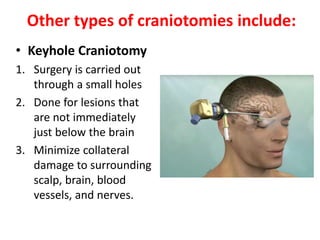
Other types of craniotomies include:
• Keyhole Craniotomy
1. Surgery is carried out
through a small holes
2. Done for lesions that
are not immediately
just below the brain
3. Minimize collateral
damage to surrounding
scalp, brain, blood
vessels, and nerves.
Potential advantages of keyhole brain
• Smaller incisions and bony openings (or no incision
is performed through the nostrils – endonasal)
• Less exposure to normal brain structures
• No use of brain retraction with less manipulation of
the brain itself
• Less pain and lower need for narcotics
• Rapid recovery, mobilization, and return to normal
activities
• Discharge from hospital typically within 1 to 2 days
post-surgery
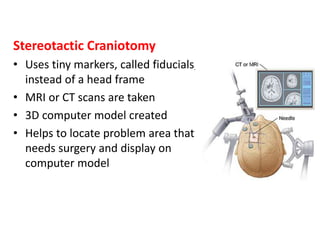
Stereotactic Craniotomy
• Uses tiny markers, called fiducials,
instead of a head frame
• MRI or CT scans are taken
• 3D computer model created
• Helps to locate problem area that
needs surgery and display on
computer model
Awake Craniotomy
• Patient can be woken up during surgery
• Commonly done for epilepsy surgeries
• lesion is close to a critical area of brain
Indications
• Mass lesion residing motor
and language cortex
• Cortex responsible for other
functions
Benefits
Maximize tumor resection while preserving neurological
function.
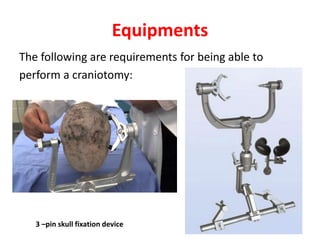
Equipments
The following are requirements for being able to
perform a craniotomy:
3 –pin skull fixation device
High-speed pneumatic cranial drill
(craniotome)
Hudson brace handheld manual drill
Cranial plate fixation tray
• What happen to the Bone flap?
In some cases, depending on etiology and indication for
the procedure,
• Bone can be discarded
• Stored in the abdominal subcutaneous space
• Cryopreserved under cold storage conditions
Craniectomy
• Bone flap is discarded or not
placed back into the skull
during same operation
• It is usually performed after
a traumatic brain injury.
• Decreases intracranial
pressure (ICP),
• Intracranial
hypertension (ICHT)
• Heavy bleeding (also
called haemorrhaging)
inside skull
INDICATION
Cranioplasty
• Surgical procedure to
reconstruct and place the
bone flap back into the
skull during a second
intervention
What are the Tests Done Prior to
Craniotomy?
• Tests is required to diagnose the pathology
• Helps to locate precisely within the skull
• Routine tests done before any surgery
1. Imaging Tests
CT scan (most common)
MRI
Angiography
Routine Tests which are done before any surgery
include:
• Blood tests like hemoglobin levels, blood group
• Liver and kidney function tests
• Blood coagulation test ( Prothromibin time test)
• Urine tests
• ECG
Consent form and complete paperwork
• Helps to give medical history
• Inform about any allergies, medicine going on,
previous surgeries
What things patient should take care ?
• Discontinue all NSAIDS(Naproxin, Advil etc)
• Blood thinners ( coumadin, aspirin, etc) 1 week
before surgery
• Stop smoking, chewing tobacco and drinking alcohol
1 week before surgery and 2 week after surgery
What happens during Surgery?
• 6 main steps during craniotomy
1. Preparing patient
2. Make a skin incision
3. Perform a craniotomy
4. Expose the brain
5. Correct the problem
6. Close the craniotomy
Preparing patient
• No drink & food is allowed
past midnight before surgery
• General anaesthesia
administered
• Head is shaved
• Head is placed in 3 –pin skull
fixation device
• Lumbar drain to remove CSF
fluid
Make a skin incision
• Skin is prepared with
antiseptic
• Skin incision marked
• Entire incision area may be
shaved
• Either, Hair –sparing
technique used
Perform a craniotomy
• Skin and muscle lifted off and
folded back
• One or more small burr holes
made with drill
• Craniotome to cut outline of
bone flap
• Bone flap lifted and dura mater
exposed
Expose the brain
• Opening dura with surgical
scissors
• Folds it back to expose brain
• Retractors placed on brain
• Gently open a corridor to
area needing repair or
removal
Correct the problem
• Neurosurgeons use special
magnification glasses called
loupes
• Neurosurgeon used variety of
small tools to cut open and
repair brain tissue
• Some time computer image
guidance system is used
• Used evoked potential
monitoring used to stimulate
specific cranial nerves
Close the craniotomy
• Problem removed or repaired
• Retractors holding the brain
are removed
• Dura is closed with sutures
• Bone flap is replaced back by
titanium screws and plates
What are the risks?
General complication
1. Bleeding
2. Infection
3. Blood clots
4. Reactions to anesthesia
Specific complications
1. Stroke
2. Seizures
3. swelling of brain, which
may require a second
craniotomy
4. Nerve damage result in
muscle paralysis or
weakness
5. CSF leak
6. Loss of mental functions
7. Permanent brain damage
with associated disabilities
No surgery is without risks
Summary
• Craniotomy is a cut that opens the cranium
• A craniotomy may be small or large depending on the
problem.
Indication
• Various neurological diseases
• injuries or conditions such as brain tumors
• Hematomas (blood clots)
• Aneurysms or AVMs
• Skull fractures
• Other reasons for a craniotomy may include foreign
objects (bullets), swelling of the brain, or infection.
References
• https://www.iowaclinic.com/webres/File/cran
iotomy.pdf
• Fernández-de Thomas RJ, De Jesus O. Craniotomy.
[Updated 2022 Apr 9]. In: StatPearls [Internet].
Treasure Island (FL): StatPearls Publishing; 2022 Jan-
• https://mayfieldclinic.com/pe-craniotomy.htm
Thank You

Craniotomy.pptx

  • 1.
  • 2.
    Learning Objectives • Whatis Craniotomy? • What are the Indications for Craniotomy? • What are the Types of Craniotomy? • Equipment used in craniotomy? • What happen to the Bone flap? • What are the Tests Done Prior to Craniotomy? • What happens during surgery? • What are the risks? • References
  • 3.
    Historical context andPerspective • Dating back to 2300 years , trephination is the oldest cranial surgical technique. • End of 19th century self-educated surgeon Wilhelm Wagner introduce current modern surgical technique for a craniotomy for the final cured result.
  • 4.
    What is Craniotomy? •It is a Surgical procedure • A part of skull is temporarily removed to expose the brain and perform an intracranial procedure.
  • 5.
    Indications Brain injury followingtrauma is one of commonest indications for craniotomy. • Craniotomy usually done for Surgical removal of a tumor or blood clot (hematoma)
  • 6.
    Clipping of ananeurysm • Clipping of aneurysm reduces blood flow through it and therefore decreases its size and its potential to burst.
  • 7.
    Removal of anArteriovenous Malformation • Abnormal communication between an artery and a vein • Bleeding can result in grave consequences.
  • 8.
    Ventricular shunting • Procedureperformed to reduce pressure in the skull due to excess fluid accumulation.
  • 9.
    Other indication canbe:- 1. Decompressive by draining abscess 2. Lobectomy 3. Epilepsy surgery 4. Craniosynostosis 5. Cerebrospinal fluid leak repair 6. Other procedures like inserting deep brain stimulators for the treatment of conditions Parkinson’s disease, essential tremor and dystonia
  • 10.
    What are theTypes of Craniotomy? • It can be classified into several types depending on location. Frontal craniotomy Temporal craniotomy Parietal craniotomy Occipital craniotomy Pterional craniotomy
  • 11.
    Extended Bifrontal Craniotomy •Traditional skull base approach • Incision given in scalp behind the hairline • Target difficult tumors at frontal part of brain • Bone remove forms contour of orbits and forehead
  • 12.
    Principle behind bifrontalcraniotomy • Allows surgeons to work in space between and right behind eyes without having to unnecessarily manipulate the brain Indication Mainly those tumors not exposed by minimal invasive approaches including, • Meningiomas • Esthesioneuroblastomas • Malignant skull base tumors
  • 13.
    Minimally Invasive Supra-Orbital“ eyebrow” Craniotomy • Small incision made within eyebrow Helps to access • Tumors in front of brain • Pituitary gland tumor • Tumors deeper in brain behind nose and eyes • Approach used instead of endonasal endoscopic surgery if tumor size is large or close to optic nerve or vital arteries
  • 14.
    it is aminimally invasive procedure, supra-orbital “eyebrow” craniotomy may offer • Less pain than open craniotomy • Faster recovery than open craniotomy • Minimal scarring Mainly used for 1. Rathke’s cleft cysts 2. Skull base tumors 3. Pituitary tumors
  • 15.
    Retro-Sigmoid “Keyhole” Craniotomy •Minimally -invasive surgical procedure • A small incision behind the ear • Providing access to cerebellum and brainstem • Approach used to reach acoustic neuromas (vestibular schwannomas)
  • 16.
    Translabyrinthine Craniotomy • Incisionin scalp behind the ear • Mastoid bone and some of the inner ear bone remove • Considered for removal of acoustic neuromas • Semicircular canals of ear are removed in order to access tumor • Removal of semicircular canal reduced risk of facial nerve injury
  • 17.
    Orbitozygomatic Craniotomy • Traditionalskull base approach used to target difficult tumors and aneurysms • Incision make at scalp behind the hairline • bone remove that forms the contour of orbit and cheek
  • 18.
    • Brain tumorsthat treated through Orbitozygomatic Craniotomy includes 1. Craniopharyngiomas 2. Pituitary tumors 3. Meningiomas
  • 19.
    Supratentorial craniotomy • Supratentorialcraniotomy means the exposure of any part of a cerebral hemisphere over the basal line joining the nasion to the inion.
  • 20.
    Other types ofcraniotomies include: • Keyhole Craniotomy 1. Surgery is carried out through a small holes 2. Done for lesions that are not immediately just below the brain 3. Minimize collateral damage to surrounding scalp, brain, blood vessels, and nerves.
  • 21.
    Potential advantages ofkeyhole brain • Smaller incisions and bony openings (or no incision is performed through the nostrils – endonasal) • Less exposure to normal brain structures • No use of brain retraction with less manipulation of the brain itself • Less pain and lower need for narcotics • Rapid recovery, mobilization, and return to normal activities • Discharge from hospital typically within 1 to 2 days post-surgery
  • 22.
    Stereotactic Craniotomy • Usestiny markers, called fiducials, instead of a head frame • MRI or CT scans are taken • 3D computer model created • Helps to locate problem area that needs surgery and display on computer model
  • 23.
    Awake Craniotomy • Patientcan be woken up during surgery • Commonly done for epilepsy surgeries • lesion is close to a critical area of brain Indications • Mass lesion residing motor and language cortex • Cortex responsible for other functions Benefits Maximize tumor resection while preserving neurological function.
  • 24.
    Equipments The following arerequirements for being able to perform a craniotomy: 3 –pin skull fixation device
  • 25.
    High-speed pneumatic cranialdrill (craniotome) Hudson brace handheld manual drill Cranial plate fixation tray
  • 26.
    • What happento the Bone flap? In some cases, depending on etiology and indication for the procedure, • Bone can be discarded • Stored in the abdominal subcutaneous space • Cryopreserved under cold storage conditions
  • 27.
    Craniectomy • Bone flapis discarded or not placed back into the skull during same operation • It is usually performed after a traumatic brain injury.
  • 28.
    • Decreases intracranial pressure(ICP), • Intracranial hypertension (ICHT) • Heavy bleeding (also called haemorrhaging) inside skull INDICATION
  • 29.
    Cranioplasty • Surgical procedureto reconstruct and place the bone flap back into the skull during a second intervention
  • 30.
    What are theTests Done Prior to Craniotomy? • Tests is required to diagnose the pathology • Helps to locate precisely within the skull • Routine tests done before any surgery 1. Imaging Tests CT scan (most common) MRI Angiography
  • 31.
    Routine Tests whichare done before any surgery include: • Blood tests like hemoglobin levels, blood group • Liver and kidney function tests • Blood coagulation test ( Prothromibin time test) • Urine tests • ECG
  • 32.
    Consent form andcomplete paperwork • Helps to give medical history • Inform about any allergies, medicine going on, previous surgeries What things patient should take care ? • Discontinue all NSAIDS(Naproxin, Advil etc) • Blood thinners ( coumadin, aspirin, etc) 1 week before surgery • Stop smoking, chewing tobacco and drinking alcohol 1 week before surgery and 2 week after surgery
  • 33.
    What happens duringSurgery? • 6 main steps during craniotomy 1. Preparing patient 2. Make a skin incision 3. Perform a craniotomy 4. Expose the brain 5. Correct the problem 6. Close the craniotomy
  • 34.
    Preparing patient • Nodrink & food is allowed past midnight before surgery • General anaesthesia administered • Head is shaved • Head is placed in 3 –pin skull fixation device • Lumbar drain to remove CSF fluid
  • 35.
    Make a skinincision • Skin is prepared with antiseptic • Skin incision marked • Entire incision area may be shaved • Either, Hair –sparing technique used
  • 36.
    Perform a craniotomy •Skin and muscle lifted off and folded back • One or more small burr holes made with drill • Craniotome to cut outline of bone flap • Bone flap lifted and dura mater exposed
  • 37.
    Expose the brain •Opening dura with surgical scissors • Folds it back to expose brain • Retractors placed on brain • Gently open a corridor to area needing repair or removal
  • 38.
    Correct the problem •Neurosurgeons use special magnification glasses called loupes • Neurosurgeon used variety of small tools to cut open and repair brain tissue • Some time computer image guidance system is used • Used evoked potential monitoring used to stimulate specific cranial nerves
  • 39.
    Close the craniotomy •Problem removed or repaired • Retractors holding the brain are removed • Dura is closed with sutures • Bone flap is replaced back by titanium screws and plates
  • 40.
    What are therisks? General complication 1. Bleeding 2. Infection 3. Blood clots 4. Reactions to anesthesia Specific complications 1. Stroke 2. Seizures 3. swelling of brain, which may require a second craniotomy 4. Nerve damage result in muscle paralysis or weakness 5. CSF leak 6. Loss of mental functions 7. Permanent brain damage with associated disabilities No surgery is without risks
  • 41.
    Summary • Craniotomy isa cut that opens the cranium • A craniotomy may be small or large depending on the problem. Indication • Various neurological diseases • injuries or conditions such as brain tumors • Hematomas (blood clots) • Aneurysms or AVMs • Skull fractures • Other reasons for a craniotomy may include foreign objects (bullets), swelling of the brain, or infection.
  • 42.
    References • https://www.iowaclinic.com/webres/File/cran iotomy.pdf • Fernández-deThomas RJ, De Jesus O. Craniotomy. [Updated 2022 Apr 9]. In: StatPearls [Internet]. Treasure Island (FL): StatPearls Publishing; 2022 Jan- • https://mayfieldclinic.com/pe-craniotomy.htm
  • 43.