REHABILITATION OF PATIENT
WITH PARAPLEGIAAND
QUADRIPLEGIA
MS.JOSE AMALA ANILDA S
NURSING TUTOR
BCON
LEARNING OBJECTIVES
• Helps to understand the terminologies
• Helps to know the risk factors, pathophysiology,
causes, signs and symptoms, diagnosis of the
paraplegia and quadriplegia
• Helps to understand the rehabilitation measures for
paraplegia and quadriplegia
• Helps to know the rehabilitation team involved in
patient`s care.
INTRODUCTION
• Tertiary prevention means disability limitation and
rehabilitation. Tertiary prevention begins early in the
period of recovery from illness. It consists of such
activities as consistent and appropriate administration
of medications to optimize therapeutic effects moving
and positioning the patient to prevent complications of
immobility and active and passive exercises to prevent
disability, minimizing residual disability and helping
the client learn to live productively with limitations.
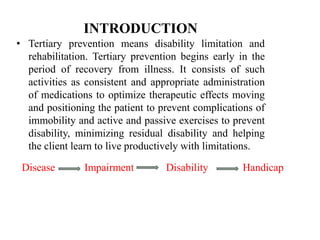
Disease Impairment Disability Handicap
TERMINOLOGIES
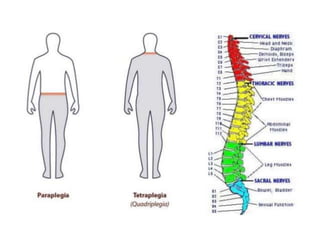
QUADRIPLEGIA/TETRAPLEGIA (quad = 4)
–Tetraplegia results in impairment of function in
the arms as well as typically in the trunk, legs
and pelvic organs, i.e., including the four
extremities.
PARAPLEGIA
- Paraplegia refers to the loss of movement and
sensation in both legs and, sometimes, part of
the lower abdomen.
REHABILITATION
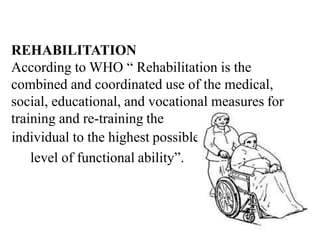
According to WHO “ Rehabilitation is the
combined and coordinated use of the medical,
social, educational, and vocational measures for
training and re-training the
individual to the highest possible
level of functional ability”.
RISK FACTORS
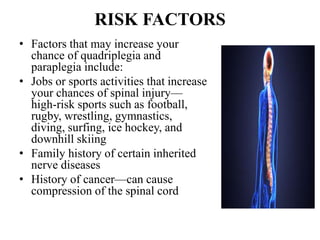
• Factors that may increase your
chance of quadriplegia and
paraplegia include:
• Jobs or sports activities that increase
your chances of spinal injury—
high-risk sports such as football,
rugby, wrestling, gymnastics,
diving, surfing, ice hockey, and
downhill skiing
• Family history of certain inherited
nerve diseases
• History of cancer—can cause
compression of the spinal cord
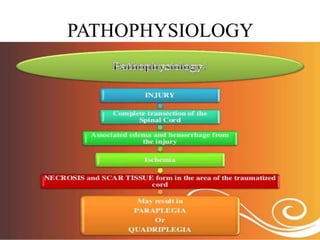
PATHOPHYSIOLOGY
CAUSES
• Quadriplegia and paraplegia are most often
caused by spinal cord injuries. But, they can also
be caused by diseases, such as:
• Multiple sclerosis
• Amyotrophic lateral sclerosis (ALS), also known
as Lou Gehrig disease
• Most spinal cord injuries are caused by accidents,
such as car crashes, falls, and sports injuries.
• Whether it is paraplegia or quadriplegia depends
on the location along the spine where the injury
occurs:
• Paraplegia—damage below the neck
• Quadriplegia—damage to the spinal cord at the
base of the skull or neck
SYMPTOMS
• Paralysis due to spinal cord injuries may be
total or partial. This depends on how much of
the spinal cord is damaged. In addition to
paralysis of the arms and/or legs, you may also
suffer from:
• Incontinence —bladder or bowel
• Sexual dysfunction— male or female
• Trouble breathing
• Difficulty sitting upright depending on the
level of the damage
CONT.D
Inactivity due to paraplegia and quadriplegia can cause
additional problems, like:
• Bed sores
• Spastic limbs
• Pneumonia
• Urinary tract infection
• Weakened bones
• Chronic pain
People with paraplegia and quadriplegia may also become
depressed because of:
• Social isolation
• Lack of emotional support
• Increased dependence on others
DIAGNOSIS
Diagnosis involves finding out where and how badly the brain
and spinal cord are damaged. To do this, doctors will likely
do the following tests:
• Imaging tests evaluate the spine and other structures. These
may include:
• CT scan
• MRI scan
• Myelography (rarely used)
• Your nerve function may be tested with:
• Nerve conduction study
• Somatosensory evoked potentials (SSEPs) (rarely used)
• Your bodily fluids may be tested. This can be done with a
lumbar puncture if some specific neurologic diseases are
suspected.
TREATMENT
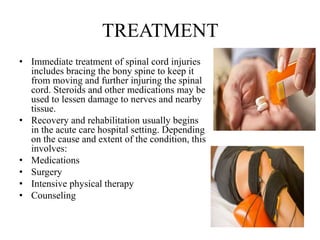
• Immediate treatment of spinal cord injuries
includes bracing the bony spine to keep it
from moving and further injuring the spinal
cord. Steroids and other medications may be
used to lessen damage to nerves and nearby
tissue.
• Recovery and rehabilitation usually begins
in the acute care hospital setting. Depending
on the cause and extent of the condition, this
involves:
• Medications
• Surgery
• Intensive physical therapy
• Counseling
PREVENTION
• The following measures are advised to reduce your chance of getting a spinal cord
injury:
• Drive safely. Motor vehicle accidents are the leading cause of spinal cord injuries.
Wear a seat belt every time you drive. Make sure your children wear seat belts or
are in child safety seats. Don't drive if you have been drinking or using drugs.
• Be safe with firearms. Lock guns and ammunition in a safe place. Store them
separately in locked containers.
• Take measures to avoid falls. Use a stool or stepladder to reach high places. Add
handrails along stairways. Place nonslip mats in your bathroom, shower, and under
carpets. To keep children safe, use safety gates to block stairs. Install window
guards.
• Always wear safety gear when playing sports. Avoid head-first moves, such as:
– Diving into shallow water
– Spear tackling in football
– Sliding headfirst in baseball
– Skating headfirst into the boards in ice hockey
• Use a spotter in gymnastics. Do not jump from very high places
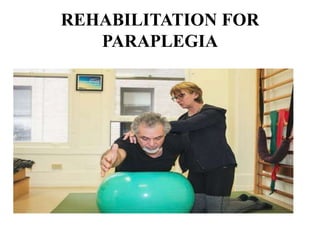
REHABILITATION FOR
PARAPLEGIA
I. General Management
• Frequent change of the patient’s posture to
guard against bedsores.
• Care of the skin by frequent washing with
alcohol followed by talc powder. In case of
urinary incontinence, frequent change of bed-
sheets.
• Care of the bladder: If there is retention, use
parasympathomimetic drugs. If this fails, use a
catheter to evacuate the bladder.
Cont.d
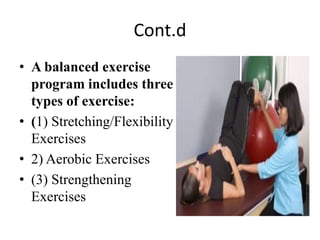
• A balanced exercise
program includes three
types of exercise:
• (1) Stretching/Flexibility
Exercises
• 2) Aerobic Exercises
• (3) Strengthening
Exercises
1) Stretching/Flexibility Exercises
• slow, sustained lengthening of the muscle
• Stretching is the most important exercise you can do.
• Stretching improves flexibility – the ability to move the parts of
your body through their full range of motion.
• Stretching also can reduce muscle spasticity and cramps and may
also reduce problems such as tendonitis and bursitis.
• To be effective, stretching routines must be done regularly, usually
once or twice a day.
• Stretch as far as you can and hold the stretch for 10 seconds and
then ease back.
• Each stretch should be performed slowly, with no sudden jerking or
bouncing.
• Stretching also should be done before and after other exercises to
prevent muscle strain and soreness and to help avoid injuries.
Aerobic Exercises
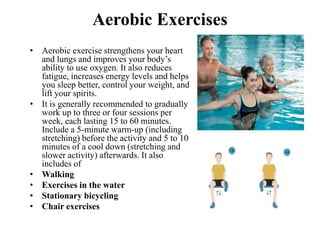
• Aerobic exercise strengthens your heart
and lungs and improves your body’s
ability to use oxygen. It also reduces
fatigue, increases energy levels and helps
you sleep better, control your weight, and
lift your spirits.
• It is generally recommended to gradually
work up to three or four sessions per
week, each lasting 15 to 60 minutes.
Include a 5-minute warm-up (including
stretching) before the activity and 5 to 10
minutes of a cool down (stretching and
slower activity) afterwards. It also
includes of
• Walking
• Exercises in the water
• Stationary bicycling
• Chair exercises
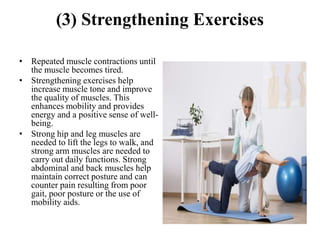
(3) Strengthening Exercises
• Repeated muscle contractions until
the muscle becomes tired.
• Strengthening exercises help
increase muscle tone and improve
the quality of muscles. This
enhances mobility and provides
energy and a positive sense of well-
being.
• Strong hip and leg muscles are
needed to lift the legs to walk, and
strong arm muscles are needed to
carry out daily functions. Strong
abdominal and back muscles help
maintain correct posture and can
counter pain resulting from poor
gait, poor posture or the use of
mobility aids.
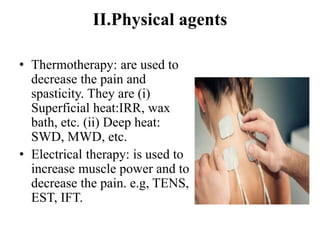
II.Physical agents
• Thermotherapy: are used to
decrease the pain and
spasticity. They are (i)
Superficial heat:IRR, wax
bath, etc. (ii) Deep heat:
SWD, MWD, etc.
• Electrical therapy: is used to
increase muscle power and to
decrease the pain. e.g, TENS,
EST, IFT.
III. Symptomatic Treatment
• Analgesics and sedatives for
pain.
• Muscle relaxants for the
spasticity.
• Vitamins and tonics
IV. Orthotics
• Various orthotics are
used to assist patient
with paraplegia.
• These are: crutch,
walker, cane, brace and
wheelchair.
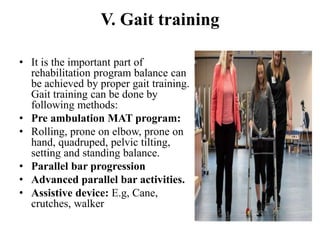
V. Gait training
• It is the important part of
rehabilitation program balance can
be achieved by proper gait training.
Gait training can be done by
following methods:
• Pre ambulation MAT program:
• Rolling, prone on elbow, prone on
hand, quadruped, pelvic tilting,
setting and standing balance.
• Parallel bar progression
• Advanced parallel bar activities.
• Assistive device: E.g, Cane,
crutches, walker
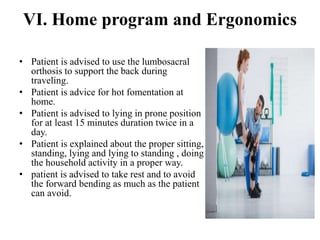
VI. Home program and Ergonomics
• Patient is advised to use the lumbosacral
orthosis to support the back during
traveling.
• Patient is advice for hot fomentation at
home.
• Patient is advised to lying in prone position
for at least 15 minutes duration twice in a
day.
• Patient is explained about the proper sitting,
standing, lying and lying to standing , doing
the household activity in a proper way.
• patient is advised to take rest and to avoid
the forward bending as much as the patient
can avoid.
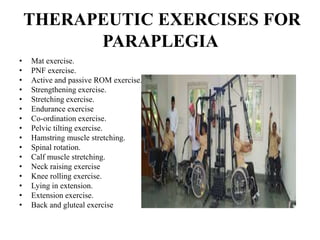
THERAPEUTIC EXERCISES FOR
PARAPLEGIA
• Mat exercise.
• PNF exercise.
• Active and passive ROM exercise.
• Strengthening exercise.
• Stretching exercise.
• Endurance exercise
• Co-ordination exercise.
• Pelvic tilting exercise.
• Hamstring muscle stretching.
• Spinal rotation.
• Calf muscle stretching.
• Neck raising exercise
• Knee rolling exercise.
• Lying in extension.
• Extension exercise.
• Back and gluteal exercise
REHABILITATION FOR
QUADRIPLEGIA
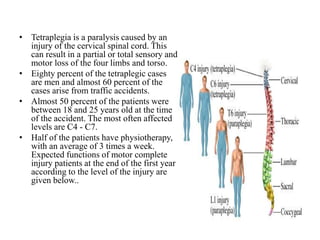
• Tetraplegia is a paralysis caused by an
injury of the cervical spinal cord. This
can result in a partial or total sensory and
motor loss of the four limbs and torso.
• Eighty percent of the tetraplegic cases
are men and almost 60 percent of the
cases arise from traffic accidents.
• Almost 50 percent of the patients were
between 18 and 25 years old at the time
of the accident. The most often affected
levels are C4 - C7.
• Half of the patients have physiotherapy,
with an average of 3 times a week.
Expected functions of motor complete
injury patients at the end of the first year
according to the level of the injury are
given below..
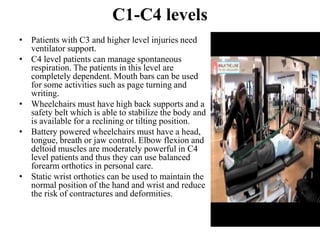
C1-C4 levels
• Patients with C3 and higher level injuries need
ventilator support.
• C4 level patients can manage spontaneous
respiration. The patients in this level are
completely dependent. Mouth bars can be used
for some activities such as page turning and
writing.
• Wheelchairs must have high back supports and a
safety belt which is able to stabilize the body and
is available for a reclining or tilting position.
• Battery powered wheelchairs must have a head,
tongue, breath or jaw control. Elbow flexion and
deltoid muscles are moderately powerful in C4
level patients and thus they can use balanced
forearm orthotics in personal care.
• Static wrist orthotics can be used to maintain the
normal position of the hand and wrist and reduce
the risk of contractures and deformities.
C5 level
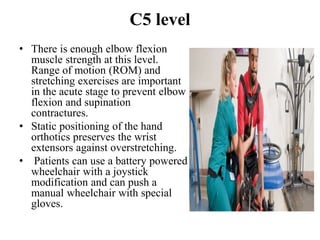
• There is enough elbow flexion
muscle strength at this level.
Range of motion (ROM) and
stretching exercises are important
in the acute stage to prevent elbow
flexion and supination
contractures.
• Static positioning of the hand
orthotics preserves the wrist
extensors against overstretching.
• Patients can use a battery powered
wheelchair with a joystick
modification and can push a
manual wheelchair with special
gloves.
C6 level
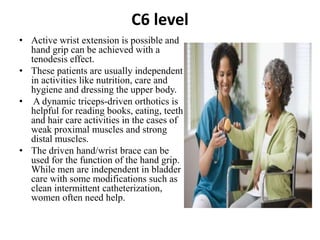
• Active wrist extension is possible and
hand grip can be achieved with a
tenodesis effect.
• These patients are usually independent
in activities like nutrition, care and
hygiene and dressing the upper body.
• A dynamic triceps-driven orthotics is
helpful for reading books, eating, teeth
and hair care activities in the cases of
weak proximal muscles and strong
distal muscles.
• The driven hand/wrist brace can be
used for the function of the hand grip.
While men are independent in bladder
care with some modifications such as
clean intermittent catheterization,
women often need help.
C7-C8 levels
• The elbow extension in C7 level
and finger flexor muscle
strength in C8 level is sufficient.
Patients are independent in most
daily living activities and
transfers.
• They may need some help in
lower extremity dressing. A
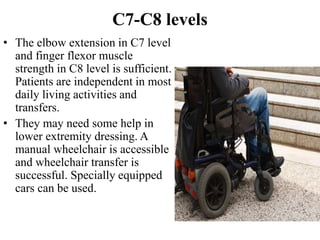
manual wheelchair is accessible
and wheelchair transfer is
successful. Specially equipped
cars can be used.
T11-T12 levels
• Patients are independent in daily living
activities, bowel-bladder care, using a manual
wheelchair and transferring.
• The target is therapeutic ambulation in upper
thoracic injury patients. They can not socially
ambulate. Body control is present in lower
thoracic injury patients and they may be
ambulant at home with lower extremity
orthotics and a walker.
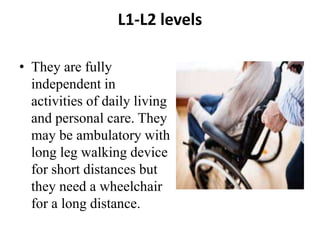
L1-L2 levels
• They are fully
independent in
activities of daily living
and personal care. They
may be ambulatory with
long leg walking device
for short distances but
they need a wheelchair
for a long distance.
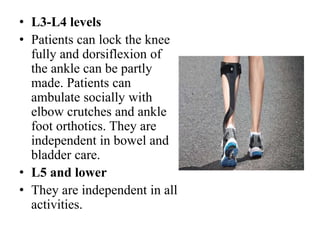
• L3-L4 levels
• Patients can lock the knee
fully and dorsiflexion of
the ankle can be partly
made. Patients can
ambulate socially with
elbow crutches and ankle
foot orthotics. They are
independent in bowel and
bladder care.
• L5 and lower
• They are independent in all
activities.
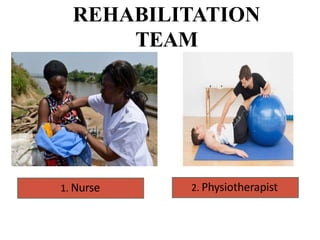
REHABILITATION
TEAM
1. Nurse 2. Physiotherapist
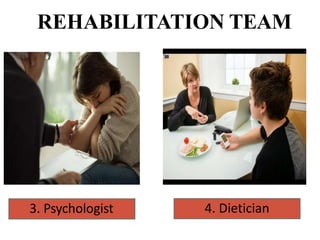
REHABILITATION TEAM
3. Psychologist 4. Dietician
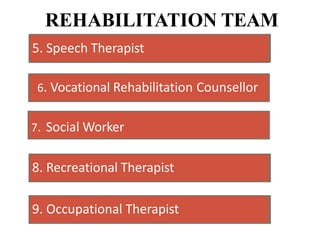
5. Speech Therapist
8. Recreational Therapist
7. Social Worker
6. Vocational Rehabilitation Counsellor
9. Occupational Therapist
REHABILITATION TEAM
5. Speech Therapist
8. Recreational Therapist
7. Social Worker
6. Vocational Rehabilitation Counsellor
9. Occupational Therapist
CONCLUSION
• Paraplegia refers to the loss of movement
and sensation in both legs and, sometimes,
part of the lower abdomen. Quadriplegia
affects all four limbs and, sometimes, parts
of the chest, abdomen, and back.
• Both are forms of paralysis that often result
from injury to the spinal cord. The cause
may be trauma — sustained during a car
accident, for example — or a health
problem, such as a stroke.
• Paralysis can have lasting, wide ranging
effects on a person’s physical health and
overall quality of life.
• It is not curable, but by using a range of
treatments and management strategies, it
may be possible for some people to regain
partial or complete control over the affected
areas.
REFERENCES
• Binard JE. Care and treatment of spinal cord injury patients. J Am
Paraplegia Soc. 1992;15(4):235-249.
• Lukas RV, Chmura S, et al. Management of central nervous system
metastases from renal cancer. Emerging Cancer Therapeutics.
2011;2(1):157-168.
• Shakur S, Takagi I, et al. Ocular melanoma metastasis to the cervical spine:
a case report. J Clin Neurosci. 2012;19(4):610-611.
• Spinal cord injury—acute management. EBSCO DynaMed Plus website.
Available at: http://www.dynamed.com/topics/dmp~AN~T114275/Spinal-
cord-injury-acute-management . Updated June 15, 2017. Accessed
November 8, 2017.
• Spinal cord injury—chronic management. EBSCO DynaMed Plus website.
Available at: http://www.dynamed.com/topics/dmp~AN~T566521/Spinal-
cord-injury-chronic-management . Updated September 7, 2017. Accessed
November 8, 2017
• https://www.ncbi.nlm.nih.gov/pmc/articles/PMC4303793/
• https://physio-pedia.com/Tetraplegia
thank you