Swipe
Basic Probability Theory and
Statistics
These are some very fundamental terms/concepts
related to probability and statistics that often
come across any literature related to Machine
Learning and AI.
Random Experiment
Sample Space
Random Variables
Probability
Conditional Probability
Variance
Probability Distribution
Joint Probability Distribution
Conditional Probability Distribution (CPD)
Factor
Basic Probability Theory and Statistics
A random experiment is a physical situation
whose outcome cannot be predicted until it is
observed.
Random Experiment
A sample space, is a set of all possible outcomes of
a random experiment.
Sample Space
A random variable, is a variable whose possible
values are numerical outcomes of a random
experiment. There are two types of random
variables.
Discrete Random Variable is one which may
take on only a countable number of distinct
values such as 0,1,2,3,4,…….. Discrete random
variables are usually (but not necessarily)
counts.
Continuous Random Variable is one which
takes an infinite number of possible values.
Continuous random variables are usually
measurements.
Random Variables
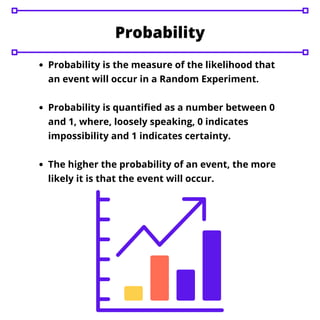
Probability is the measure of the likelihood that
an event will occur in a Random Experiment.
Probability is quantified as a number between 0
and 1, where, loosely speaking, 0 indicates
impossibility and 1 indicates certainty.
The higher the probability of an event, the more
likely it is that the event will occur.
Probability
Conditional Probability is a measure of the
probability of an event given that (by assumption,
presumption, assertion or evidence) another
event has already occurred.
If the event of interest is A and the event B is
known or assumed to have occurred, “the
conditional probability of A given B”, is usually
written as P(A|B).
Conditional Probability
The variance of a random variable X is a measure
of how concentrated the distribution of a random
variable X is around its mean.
Variance
Is a mathematical function that maps the all
possible outcomes of an random experiment with
it’s associated probability. It depends on the
Random Variable X , whether it’s discrete or
continues.
Discrete Probability Distribution: The
mathematical definition of a discrete
probability function, p(x), is a function that
satisfies the following properties. This is
referred as Probability Mass Function.
Continuous Probability Distribution: The
mathematical definition of a continuous
probability function, f(x), is a function that
satisfies the following properties. This is
referred as Probability Density Function.
Probability Distribution
If X and Y are two random variables, the
probability distribution that defines their
simultaneous behaviour during outcomes of a
random experiment is called a joint probability
distribution.
Joint Probability Distribution
If Z is random variable who is dependent on other
variables X and Y, then the distribution of P(Z|X,Y)
is called CPD of Z w.r.t X and Y.
It means for every possible combination of
random variables X, Y we represent a probability
distribution over Z.
There are a number of operations that one can
perform over any probability distribution to get
interesting results. Some of the important
operations are :-
Conditioning/Reduction
Marginalisation
Conditional Probability Distribution (CPD)
If we have a probability distribution of n random
variables X1, X2 … Xn and we make an observation
about k variables that they acquired certain
values a1, a2, …, ak.
It means we already know their assignment. Then
the rows in the JD which are not consistent with
the observation is simply can removed and that
leave us with lesser number of rows.
This operation is known as Reduction.
Conditioning/Reduction
This operation takes a probability distribution
over a large set random variables and produces a
probability distribution over a smaller subset of
the variables.
This operation is known as marginalising a subset
of random variables.
This operation is very useful when we have large
set of random variables as features and we are
interested in a smaller set of variables, and how it
affects output.
Marginalisation
R-programming
Data security
Business analytics
Stay Tuned with
Topics for next Post

Basic probability theory and statistics

  • 1.
  • 2.
    These are somevery fundamental terms/concepts related to probability and statistics that often come across any literature related to Machine Learning and AI. Random Experiment Sample Space Random Variables Probability Conditional Probability Variance Probability Distribution Joint Probability Distribution Conditional Probability Distribution (CPD) Factor Basic Probability Theory and Statistics
  • 3.
    A random experimentis a physical situation whose outcome cannot be predicted until it is observed. Random Experiment
  • 4.
    A sample space,is a set of all possible outcomes of a random experiment. Sample Space
  • 5.
    A random variable,is a variable whose possible values are numerical outcomes of a random experiment. There are two types of random variables. Discrete Random Variable is one which may take on only a countable number of distinct values such as 0,1,2,3,4,…….. Discrete random variables are usually (but not necessarily) counts. Continuous Random Variable is one which takes an infinite number of possible values. Continuous random variables are usually measurements. Random Variables
  • 6.
    Probability is themeasure of the likelihood that an event will occur in a Random Experiment. Probability is quantified as a number between 0 and 1, where, loosely speaking, 0 indicates impossibility and 1 indicates certainty. The higher the probability of an event, the more likely it is that the event will occur. Probability
  • 7.
    Conditional Probability isa measure of the probability of an event given that (by assumption, presumption, assertion or evidence) another event has already occurred. If the event of interest is A and the event B is known or assumed to have occurred, “the conditional probability of A given B”, is usually written as P(A|B). Conditional Probability
  • 8.
    The variance ofa random variable X is a measure of how concentrated the distribution of a random variable X is around its mean. Variance
  • 9.
    Is a mathematicalfunction that maps the all possible outcomes of an random experiment with it’s associated probability. It depends on the Random Variable X , whether it’s discrete or continues. Discrete Probability Distribution: The mathematical definition of a discrete probability function, p(x), is a function that satisfies the following properties. This is referred as Probability Mass Function. Continuous Probability Distribution: The mathematical definition of a continuous probability function, f(x), is a function that satisfies the following properties. This is referred as Probability Density Function. Probability Distribution
  • 10.
    If X andY are two random variables, the probability distribution that defines their simultaneous behaviour during outcomes of a random experiment is called a joint probability distribution. Joint Probability Distribution
  • 11.
    If Z israndom variable who is dependent on other variables X and Y, then the distribution of P(Z|X,Y) is called CPD of Z w.r.t X and Y. It means for every possible combination of random variables X, Y we represent a probability distribution over Z. There are a number of operations that one can perform over any probability distribution to get interesting results. Some of the important operations are :- Conditioning/Reduction Marginalisation Conditional Probability Distribution (CPD)
  • 12.
    If we havea probability distribution of n random variables X1, X2 … Xn and we make an observation about k variables that they acquired certain values a1, a2, …, ak. It means we already know their assignment. Then the rows in the JD which are not consistent with the observation is simply can removed and that leave us with lesser number of rows. This operation is known as Reduction. Conditioning/Reduction
  • 13.
    This operation takesa probability distribution over a large set random variables and produces a probability distribution over a smaller subset of the variables. This operation is known as marginalising a subset of random variables. This operation is very useful when we have large set of random variables as features and we are interested in a smaller set of variables, and how it affects output. Marginalisation
  • 14.