1Transfection
TRANSFECTION TECHNIQUES
Overview and Technical Tips
www.ptglab.com
2Transfection
CONTENTS
Introduction
Transfection Techniques
Cationic-lipid mediated transfection
Calcium phosphate transfection
Viral transfection
Electroporation
FAQs and Troubleshooting
Contact Us
3–7
8–14
www.ptglab.com
15–16
17
3Transfection
–– A transfection is a process that forces nucleic acids into a cell.
–– Different methods are used for a transfection (chemical, physical 	
	 or biological method).
–– The tranfected nucleic acids may stay transient or stable in the 	
	 cell, dependent on the method of transfection.
www.ptglab.com
Transfection:
–– Nucleic acid transfer into eukaryotic cells.
Transformation:
–– Non-viral DNA transfer into non eukaryotc cells, bacteria, plants.
Transduction:
–– DNA transfer mediated by a virus.
INTRODUCTION
4Transfection
www.ptglab.com
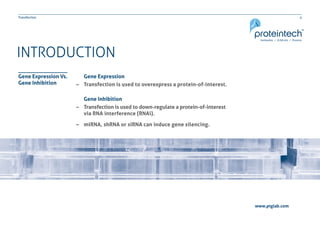
Gene Expression Vs.
Gene Inhibition
Gene Expression
–– Transfection is used to overexpress a protein-of-interest.
Gene Inhibition
–– Transfection is used to down-regulate a protein-of-interest
	 via RNA interference (RNAi).
–– miRNA, shRNA or siRNA can induce gene silencing.
INTRODUCTION
5Transfection
www.ptglab.com
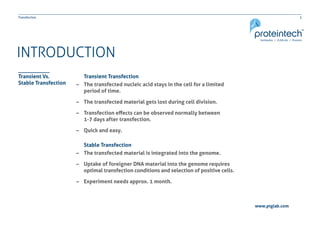
Transient Vs.
Stable Transfection
Transient Transfection
–– The transfected nucleic acid stays in the cell for a limited 		
	 period of time.
–– The transfected material gets lost during cell division.
–– Transfection effects can be observed normally between
	 1-7 days after transfection.
–– Quick and easy.
Stable Transfection
–– The transfected material is integrated into the genome.
–– Uptake of foreigner DNA material into the genome requires 		
	 optimal transfection conditions and selection of positive cells.
–– Experiment needs approx. 1 month.
INTRODUCTION
6Transfection
www.ptglab.com
INTRODUCTION
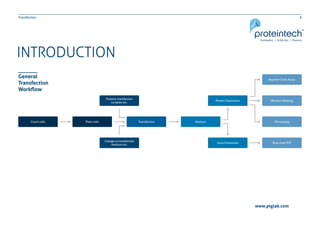
General
Transfection
Workflow
7Transfection
www.ptglab.com
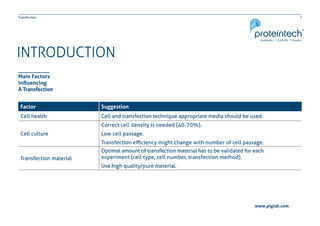
Main Factors
Influencing
A Transfection
Factor Suggestion
Cell health Cell and transfection technique appropriate media should be used.
Cell culture
Correct cell density is needed (40-70%).
Low cell passage.
Transfection efficiency might change with number of cell passage.
Transfection material
Optimal amount of transfection material has to be validated for each
experiment (cell type, cell number, transfection method).
Use high quality/pure material.
INTRODUCTION
8Transfection
TRANSFECTION TECHNIQUES
www.ptglab.com
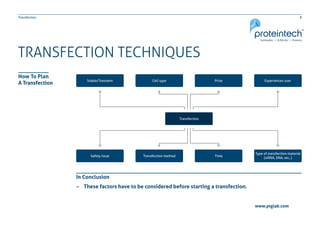
How To Plan
A Transfection
In Conclusion
–– These factors have to be considered before starting a transfection.
9Transfection
www.ptglab.com
TRANSFECTION TECHNIQUES
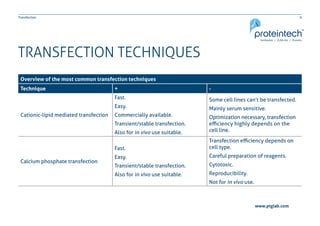
Overview of the most common transfection techniques
Technique + -
Cationic-lipid mediated transfection
Fast.
Easy.
Commercially available.
Transient/stable transfection.
Also for in vivo use suitable.
Some cell lines can’t be transfected.
Mainly serum sensitive.
Optimization necessary, transfection
efficiency highly depends on the
cell line.
Calcium phosphate transfection
Fast.
Easy.
Transient/stable transfection.
Also for in vivo use suitable.
Transfection efficiency depends on
cell type.
Careful preparation of reagents.
Cytotoxic.
Reproducibility.
Not for in vivo use.
10Transfection
www.ptglab.com
TRANSFECTION TECHNIQUES
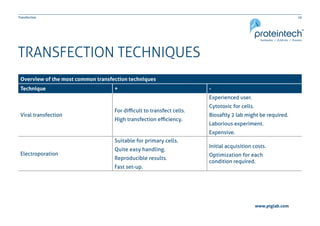
Overview of the most common transfection techniques
Technique + -
Viral transfection
For difficult to transfect cells.
High transfection efficiency.
Experienced user.
Cytotoxic for cells.
Biosaftly 2 lab might be required.
Laborious experiment.
Expensive.
Electroporation
Suitable for primary cells.
Quite easy handling.
Reproducible results.
Fast set-up.
Initial acquisition costs.
Optimization for each
condition required.
11Transfection
Cationic-lipid
Mediated
Transfection
www.ptglab.com
TRANSFECTION TECHNIQUES
The method relies on the formation of a
complex between the DNA and a cationic
lipid-based reagent.
The complex is taken up by the cell
via endocytosis.
–– Fast and easy.
–– Prize range of transfection
	 reagents varies.
–– Not working in all cell types.
–– Transfection results may vary.
–– Transfection success depends
	 on quality of transfection reagent.
12Transfection
www.ptglab.com
Calcium
Phosphate
Transfection
TRANSFECTION TECHNIQUES
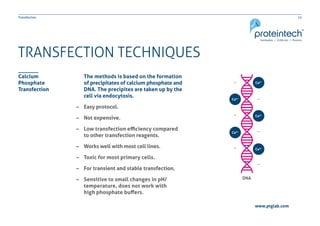
The methods is based on the formation
of precipitates of calcium phosphate and
DNA. The precipites are taken up by the
cell via endocytosis.
–– Easy protocol.
–– Not expensive.
–– Low transfection efficiency compared
	 to other transfection reagents.
–– Works well with most cell lines.
–– Toxic for most primary cells.
–– For transient and stable transfection.
–– Sensitive to small changes in pH/		
	 temperature, does not work with
	 high phosphate buffers.
13Transfection
www.ptglab.com
Viral Mediated
Transfection
(Transduction)
TRANSFECTION TECHNIQUES
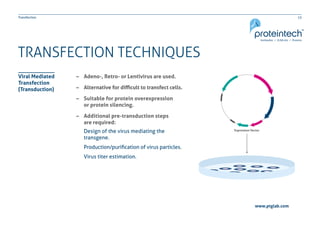
–– Adeno-, Retro- or Lentivirus are used.
–– Alternative for difficult to transfect cells.
–– Suitable for protein overexpression
	 or protein silencing.
–– Additional pre-transduction steps
	 are required:
Design of the virus mediating the
transgene.
Production/purification of virus particles.
Virus titer estimation.
14Transfection
www.ptglab.com
Electroporation
TRANSFECTION TECHNIQUES
The method uses an electric
field that transiently permeabilizates
the membrane. During this period the
foreigner material can enter the cell.
–– Works well with almost all cell types.
–– High transfection efficiency.
–– Requires optimization as cell 		
	 permeability can lead to cell damage.
–– Experienced user needed.
–– Quite expensive method.
15Transfection
www.ptglab.com
FAQS AND TROUBLESHOOTING
How To Plan
A Transfection
In Conclusion
–– These factors have to be considered before starting a transfection.
16Transfection
www.ptglab.com
FAQS AND TROUBLESHOOTING
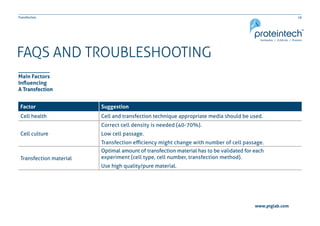
Main Factors
Influencing
A Transfection
Factor Suggestion
Cell health Cell and transfection technique appropriate media should be used.
Cell culture
Correct cell density is needed (40-70%).
Low cell passage.
Transfection efficiency might change with number of cell passage.
Transfection material
Optimal amount of transfection material has to be validated for each
experiment (cell type, cell number, transfection method).
Use high quality/pure material.
17Transfection
CONTACT US
proteintech@ptglab.com
europe@ptglab.com
service@ptglab.com
Available 24 hours via Live Chat and 9–5
(CDT) via phone.
Proteintech Group
Proteintech Europe
Proteintech
Support
US Head Office
United Kingdom
China Office
Please visit us at www.ptglab.com for
more information about our antibodies
and technical tips.
www.ptglab.com

Transfection Techniques - Overview and Technical Tips

  • 1.
  • 2.
    2Transfection CONTENTS Introduction Transfection Techniques Cationic-lipid mediatedtransfection Calcium phosphate transfection Viral transfection Electroporation FAQs and Troubleshooting Contact Us 3–7 8–14 www.ptglab.com 15–16 17
  • 3.
    3Transfection –– A transfectionis a process that forces nucleic acids into a cell. –– Different methods are used for a transfection (chemical, physical or biological method). –– The tranfected nucleic acids may stay transient or stable in the cell, dependent on the method of transfection. www.ptglab.com Transfection: –– Nucleic acid transfer into eukaryotic cells. Transformation: –– Non-viral DNA transfer into non eukaryotc cells, bacteria, plants. Transduction: –– DNA transfer mediated by a virus. INTRODUCTION
  • 4.
    4Transfection www.ptglab.com Gene Expression Vs. GeneInhibition Gene Expression –– Transfection is used to overexpress a protein-of-interest. Gene Inhibition –– Transfection is used to down-regulate a protein-of-interest via RNA interference (RNAi). –– miRNA, shRNA or siRNA can induce gene silencing. INTRODUCTION
  • 5.
    5Transfection www.ptglab.com Transient Vs. Stable Transfection TransientTransfection –– The transfected nucleic acid stays in the cell for a limited period of time. –– The transfected material gets lost during cell division. –– Transfection effects can be observed normally between 1-7 days after transfection. –– Quick and easy. Stable Transfection –– The transfected material is integrated into the genome. –– Uptake of foreigner DNA material into the genome requires optimal transfection conditions and selection of positive cells. –– Experiment needs approx. 1 month. INTRODUCTION
  • 6.
  • 7.
    7Transfection www.ptglab.com Main Factors Influencing A Transfection FactorSuggestion Cell health Cell and transfection technique appropriate media should be used. Cell culture Correct cell density is needed (40-70%). Low cell passage. Transfection efficiency might change with number of cell passage. Transfection material Optimal amount of transfection material has to be validated for each experiment (cell type, cell number, transfection method). Use high quality/pure material. INTRODUCTION
  • 8.
    8Transfection TRANSFECTION TECHNIQUES www.ptglab.com How ToPlan A Transfection In Conclusion –– These factors have to be considered before starting a transfection.
  • 9.
    9Transfection www.ptglab.com TRANSFECTION TECHNIQUES Overview ofthe most common transfection techniques Technique + - Cationic-lipid mediated transfection Fast. Easy. Commercially available. Transient/stable transfection. Also for in vivo use suitable. Some cell lines can’t be transfected. Mainly serum sensitive. Optimization necessary, transfection efficiency highly depends on the cell line. Calcium phosphate transfection Fast. Easy. Transient/stable transfection. Also for in vivo use suitable. Transfection efficiency depends on cell type. Careful preparation of reagents. Cytotoxic. Reproducibility. Not for in vivo use.
  • 10.
    10Transfection www.ptglab.com TRANSFECTION TECHNIQUES Overview ofthe most common transfection techniques Technique + - Viral transfection For difficult to transfect cells. High transfection efficiency. Experienced user. Cytotoxic for cells. Biosaftly 2 lab might be required. Laborious experiment. Expensive. Electroporation Suitable for primary cells. Quite easy handling. Reproducible results. Fast set-up. Initial acquisition costs. Optimization for each condition required.
  • 11.
    11Transfection Cationic-lipid Mediated Transfection www.ptglab.com TRANSFECTION TECHNIQUES The methodrelies on the formation of a complex between the DNA and a cationic lipid-based reagent. The complex is taken up by the cell via endocytosis. –– Fast and easy. –– Prize range of transfection reagents varies. –– Not working in all cell types. –– Transfection results may vary. –– Transfection success depends on quality of transfection reagent.
  • 12.
    12Transfection www.ptglab.com Calcium Phosphate Transfection TRANSFECTION TECHNIQUES The methodsis based on the formation of precipitates of calcium phosphate and DNA. The precipites are taken up by the cell via endocytosis. –– Easy protocol. –– Not expensive. –– Low transfection efficiency compared to other transfection reagents. –– Works well with most cell lines. –– Toxic for most primary cells. –– For transient and stable transfection. –– Sensitive to small changes in pH/ temperature, does not work with high phosphate buffers.
  • 13.
    13Transfection www.ptglab.com Viral Mediated Transfection (Transduction) TRANSFECTION TECHNIQUES ––Adeno-, Retro- or Lentivirus are used. –– Alternative for difficult to transfect cells. –– Suitable for protein overexpression or protein silencing. –– Additional pre-transduction steps are required: Design of the virus mediating the transgene. Production/purification of virus particles. Virus titer estimation.
  • 14.
    14Transfection www.ptglab.com Electroporation TRANSFECTION TECHNIQUES The methoduses an electric field that transiently permeabilizates the membrane. During this period the foreigner material can enter the cell. –– Works well with almost all cell types. –– High transfection efficiency. –– Requires optimization as cell permeability can lead to cell damage. –– Experienced user needed. –– Quite expensive method.
  • 15.
    15Transfection www.ptglab.com FAQS AND TROUBLESHOOTING HowTo Plan A Transfection In Conclusion –– These factors have to be considered before starting a transfection.
  • 16.
    16Transfection www.ptglab.com FAQS AND TROUBLESHOOTING MainFactors Influencing A Transfection Factor Suggestion Cell health Cell and transfection technique appropriate media should be used. Cell culture Correct cell density is needed (40-70%). Low cell passage. Transfection efficiency might change with number of cell passage. Transfection material Optimal amount of transfection material has to be validated for each experiment (cell type, cell number, transfection method). Use high quality/pure material.
  • 17.
    17Transfection CONTACT US proteintech@ptglab.com europe@ptglab.com service@ptglab.com Available 24hours via Live Chat and 9–5 (CDT) via phone. Proteintech Group Proteintech Europe Proteintech Support US Head Office United Kingdom China Office Please visit us at www.ptglab.com for more information about our antibodies and technical tips. www.ptglab.com