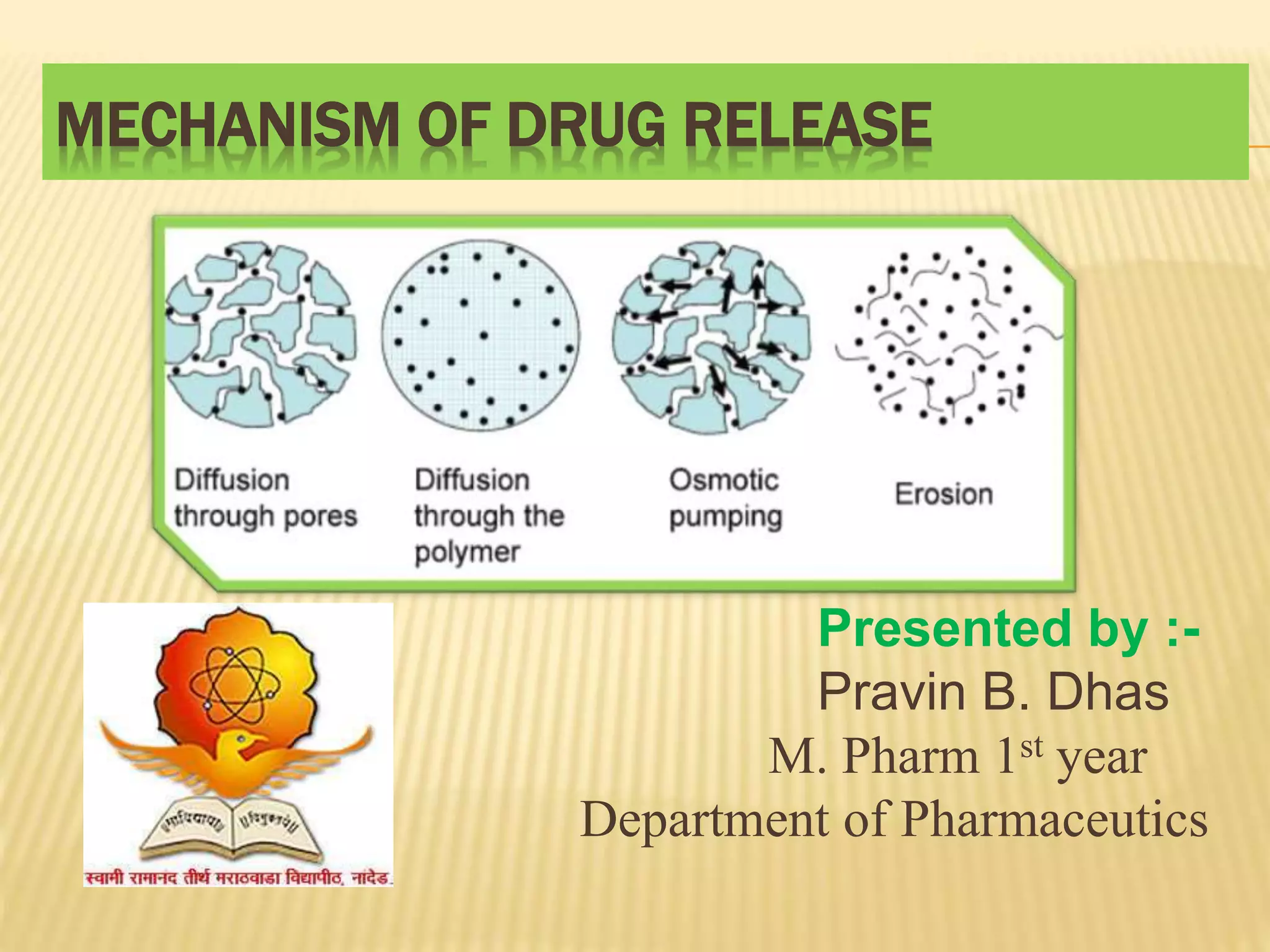
MECHANISM OF DRUG RELEASE
Presented by :-
Pravin B. Dhas
M. Pharm 1st year
Department of Pharmaceutics
 Introduction to Drug Release
 Types of delivery systems
 Types of Mechanism
Dissolution controlled system
Diffusion controlled system
Dissolution & diffusion controlled
system
Drug release refers to the process by which the drug loaded
in or released in the body through diffusion or dissolution
OR after biodegredation of DRUG DELIVERY DEVICE.
Controlled Release Mechanisms
These are developed
1-To improve the temporal and spatial presentation of
drug in the body
2-To protect drug from physiological degradation or
elimination
3-To improve patient compliance and to enhance
quality control in manufacturing of drug products.
 On basis of technical sophistication
Rate programmed DDS
1-Dissolution controlled DDS
2-Diffusion controlled DDS
3-Disso. & diffusion controlled DDS
Stimuli-activated DDS
Site targated DDS
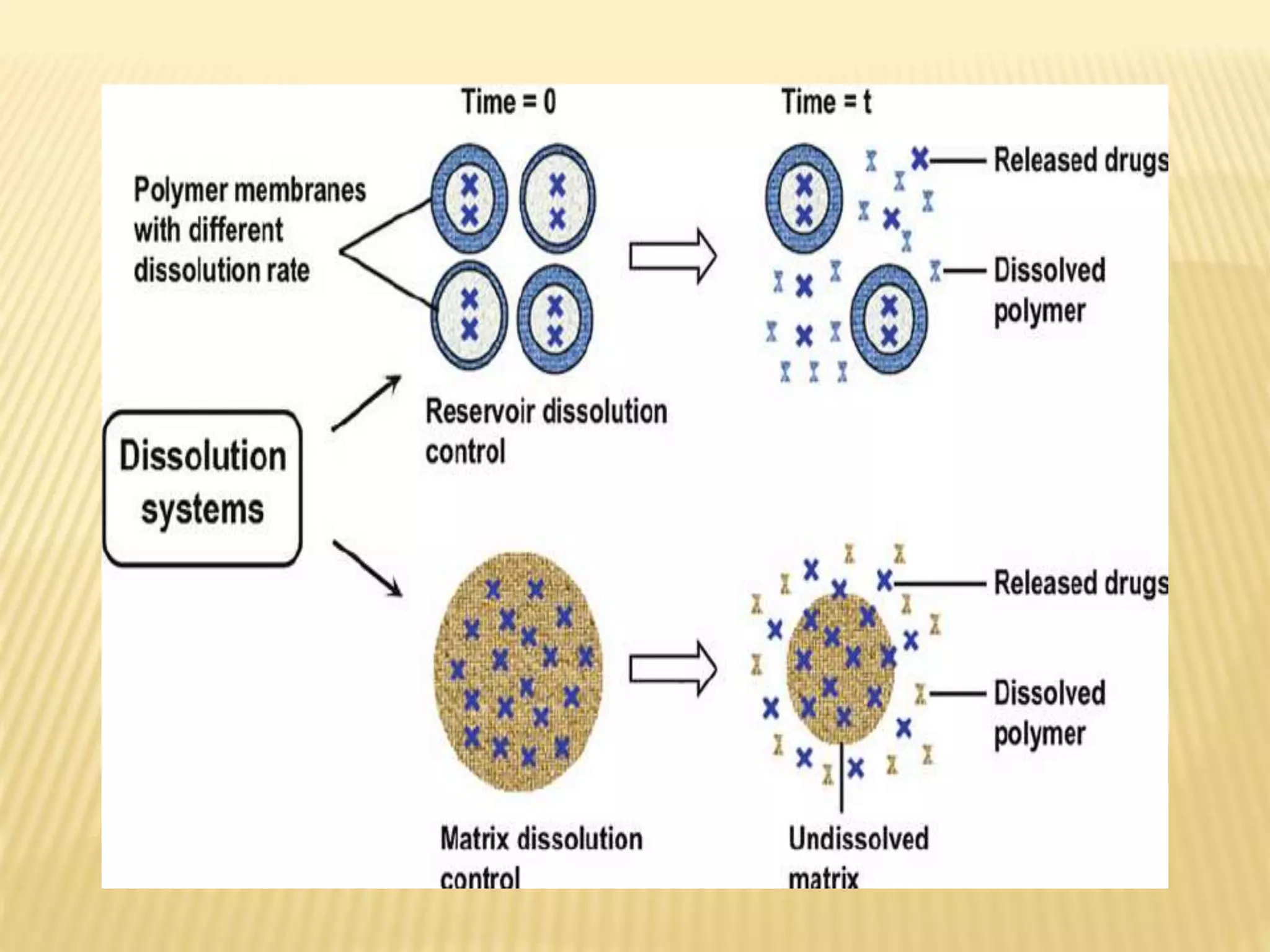
1-Reservoir
2-Matrix
1-
Encapsulation
2-Matrix
A-DISSOLUTION CONTROLLED
SYSTEMS
The rate controlling step is dissolution.
The drug is embedment in slowly
dissolving or erodible matrix or by coating
with slowly dissolving substances.
It is of two types:-
1 Encapsulation dissolution controlled
system
2-Matrix dissolution controlled system
The drug particles are coated or encapsulated by
microencapsulation techniques with slowly
dissolving materials (
like cellulose, polyethylene glycols,
polymethacrylates, waxes etc.
The dissolution rate of coat depends upon the
solubility
and thickness of the coating.
1-ENCAPSULATION DISSOLUTION
CONTROLLED SYSTEMS :-
2-MATRIX DISSOLUTION CONTROLLED
SYSTEMS :-
Matrix systems are also called as monoliths since
the drug is homogeneously dispersed throughout a
rate controlling medium.
They employ waxes such as beeswax, carnauba
wax, hydrogenated castor oil etc which control drug
dissolution by controlling the rate of dissolution fluid
penetration into the matrix by altering the porosity of
rate.
The wax embedded drug is generally prepared by
dispersing the drug in molten wax and congealing
and
B-DIFFUSION
CONTROLLED RELEASE
SYSTEMS:-Diffusion systems are characterized by release rate of
drug is dependant on its diffusion through inert water
insoluble membrane barrier.
These are of two types:-
a) Porous matrix-controlled system
b) Porous-membrane controlled
system
C-DISSOLUTION AND DIFFUSION
CONTROLLED RELEASE SYSTEMS
The drug core is encased in a partially soluble
membrane. Pores are thus created due to dissolution
of parts of the membrane which
1- Permit entry of aqueous medium into the core
and hence drug dissolution occurs
2- Allow diffusion of dissolved drug out of the
system
REFERANCES:-
 Brahmankar. Biopharmaceutics and pharmacokinetics .
fifth edition, pg: 350-25
 Edith Mathiowitz. Encyclopedia of controlled drug
delivery.
1sted, Vol.II, pg: 698-29.
 Wise DL. Hand book of pharmaceutical controlled release
technology. First edition, pg: 183-24.
 Tamizharasi S, Rathi JC, Rathi V. Formulation and
evaluation of Pentoxifylline-loaded Poly(ἑ-caprolactone)
microspheres . Ind J of Pharm Sci, 2008may; 70(3):333-5.
Mechanism of drug release by pd

Mechanism of drug release by pd

  • 1.
    MECHANISM OF DRUGRELEASE Presented by :- Pravin B. Dhas M. Pharm 1st year Department of Pharmaceutics
  • 2.
     Introduction toDrug Release  Types of delivery systems  Types of Mechanism Dissolution controlled system Diffusion controlled system Dissolution & diffusion controlled system
  • 3.
    Drug release refersto the process by which the drug loaded in or released in the body through diffusion or dissolution OR after biodegredation of DRUG DELIVERY DEVICE. Controlled Release Mechanisms These are developed 1-To improve the temporal and spatial presentation of drug in the body 2-To protect drug from physiological degradation or elimination 3-To improve patient compliance and to enhance quality control in manufacturing of drug products.
  • 4.
     On basisof technical sophistication Rate programmed DDS 1-Dissolution controlled DDS 2-Diffusion controlled DDS 3-Disso. & diffusion controlled DDS Stimuli-activated DDS Site targated DDS
  • 5.
  • 6.
    A-DISSOLUTION CONTROLLED SYSTEMS The ratecontrolling step is dissolution. The drug is embedment in slowly dissolving or erodible matrix or by coating with slowly dissolving substances. It is of two types:- 1 Encapsulation dissolution controlled system 2-Matrix dissolution controlled system
  • 7.
    The drug particlesare coated or encapsulated by microencapsulation techniques with slowly dissolving materials ( like cellulose, polyethylene glycols, polymethacrylates, waxes etc. The dissolution rate of coat depends upon the solubility and thickness of the coating. 1-ENCAPSULATION DISSOLUTION CONTROLLED SYSTEMS :-
  • 8.
    2-MATRIX DISSOLUTION CONTROLLED SYSTEMS:- Matrix systems are also called as monoliths since the drug is homogeneously dispersed throughout a rate controlling medium. They employ waxes such as beeswax, carnauba wax, hydrogenated castor oil etc which control drug dissolution by controlling the rate of dissolution fluid penetration into the matrix by altering the porosity of rate. The wax embedded drug is generally prepared by dispersing the drug in molten wax and congealing and
  • 10.
    B-DIFFUSION CONTROLLED RELEASE SYSTEMS:-Diffusion systemsare characterized by release rate of drug is dependant on its diffusion through inert water insoluble membrane barrier. These are of two types:- a) Porous matrix-controlled system b) Porous-membrane controlled system
  • 12.
    C-DISSOLUTION AND DIFFUSION CONTROLLEDRELEASE SYSTEMS The drug core is encased in a partially soluble membrane. Pores are thus created due to dissolution of parts of the membrane which 1- Permit entry of aqueous medium into the core and hence drug dissolution occurs 2- Allow diffusion of dissolved drug out of the system
  • 14.
    REFERANCES:-  Brahmankar. Biopharmaceuticsand pharmacokinetics . fifth edition, pg: 350-25  Edith Mathiowitz. Encyclopedia of controlled drug delivery. 1sted, Vol.II, pg: 698-29.  Wise DL. Hand book of pharmaceutical controlled release technology. First edition, pg: 183-24.  Tamizharasi S, Rathi JC, Rathi V. Formulation and evaluation of Pentoxifylline-loaded Poly(ἑ-caprolactone) microspheres . Ind J of Pharm Sci, 2008may; 70(3):333-5.