Unit I
NOVEL DRUG DELIVERY SYSTEM
BY
DR. SWATI S. GAIKWAD
Controlled drug delivery is one which delivers the drug at a predetermined
rate, for locally or systemically, for a specified period of time.
Sustained Drug Release. Sustained release allows delivery of a specific drug at
a programmed rate that leads to drug delivery for a prolonged period of time.
Prolonged-release products release the active ingredients slowly and work for
a longer time.
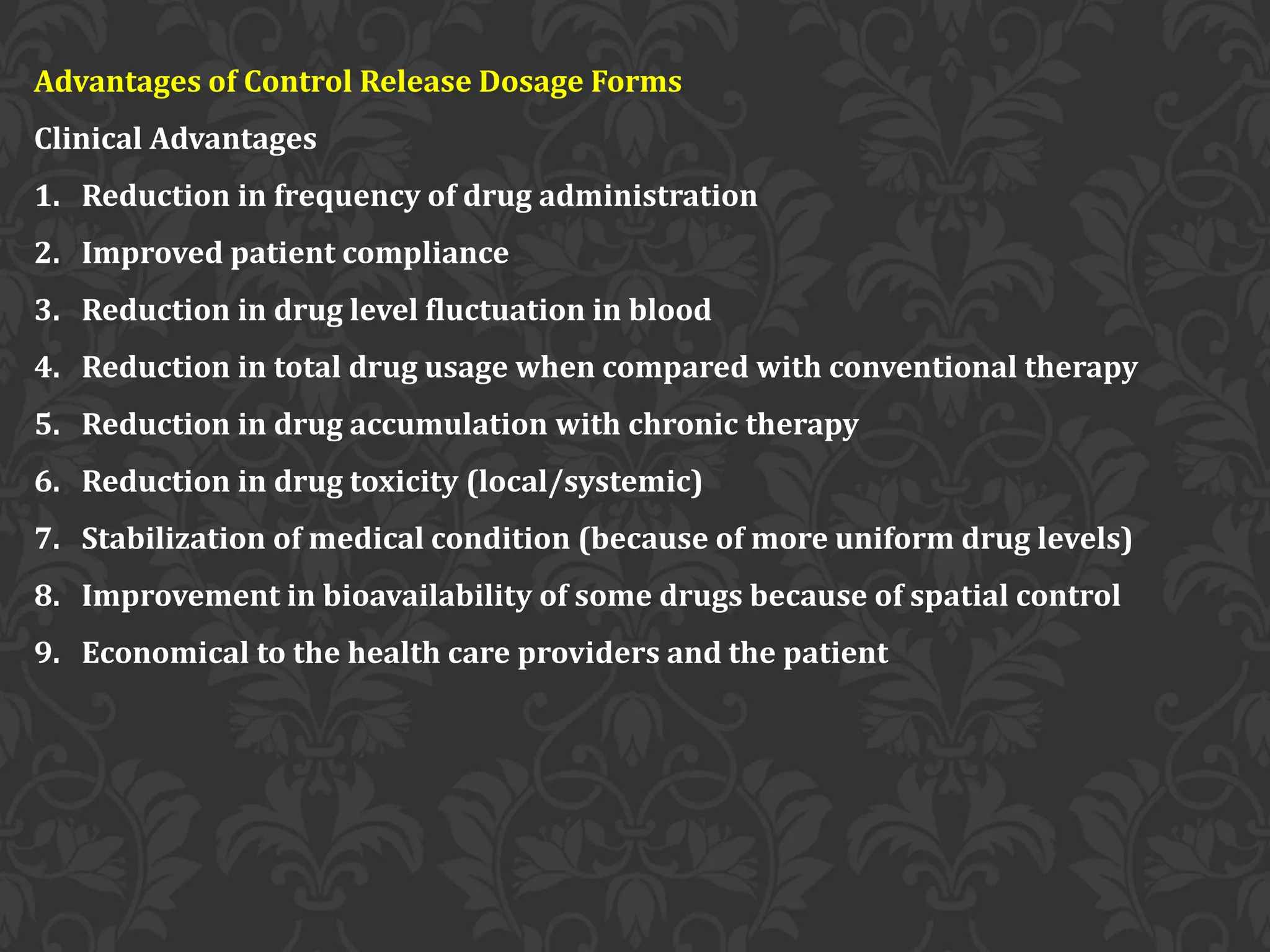
Advantages of Control Release Dosage Forms
Clinical Advantages
1. Reduction in frequency of drug administration
2. Improved patient compliance
3. Reduction in drug level fluctuation in blood
4. Reduction in total drug usage when compared with conventional therapy
5. Reduction in drug accumulation with chronic therapy
6. Reduction in drug toxicity (local/systemic)
7. Stabilization of medical condition (because of more uniform drug levels)
8. Improvement in bioavailability of some drugs because of spatial control
9. Economical to the health care providers and the patient
Commercial / Industrial Advantages
Illustration of innovative/technological leadership
Product life-cycle extension
Product differentiation
Market expansion
Patent extension
Disadvantages of CRDDS
Delay in onset of drug action
Possibility of dose dumping in the case of a poor formulation strategy
Increased potential for first pass metabolism
Greater dependence on GI residence time of dosage form
Possibility of less accurate dose adjustment in some cases
Cost per unit dose is higher when compared with conventional doses
Not all drugs are suitable for formulating into ER dosage form
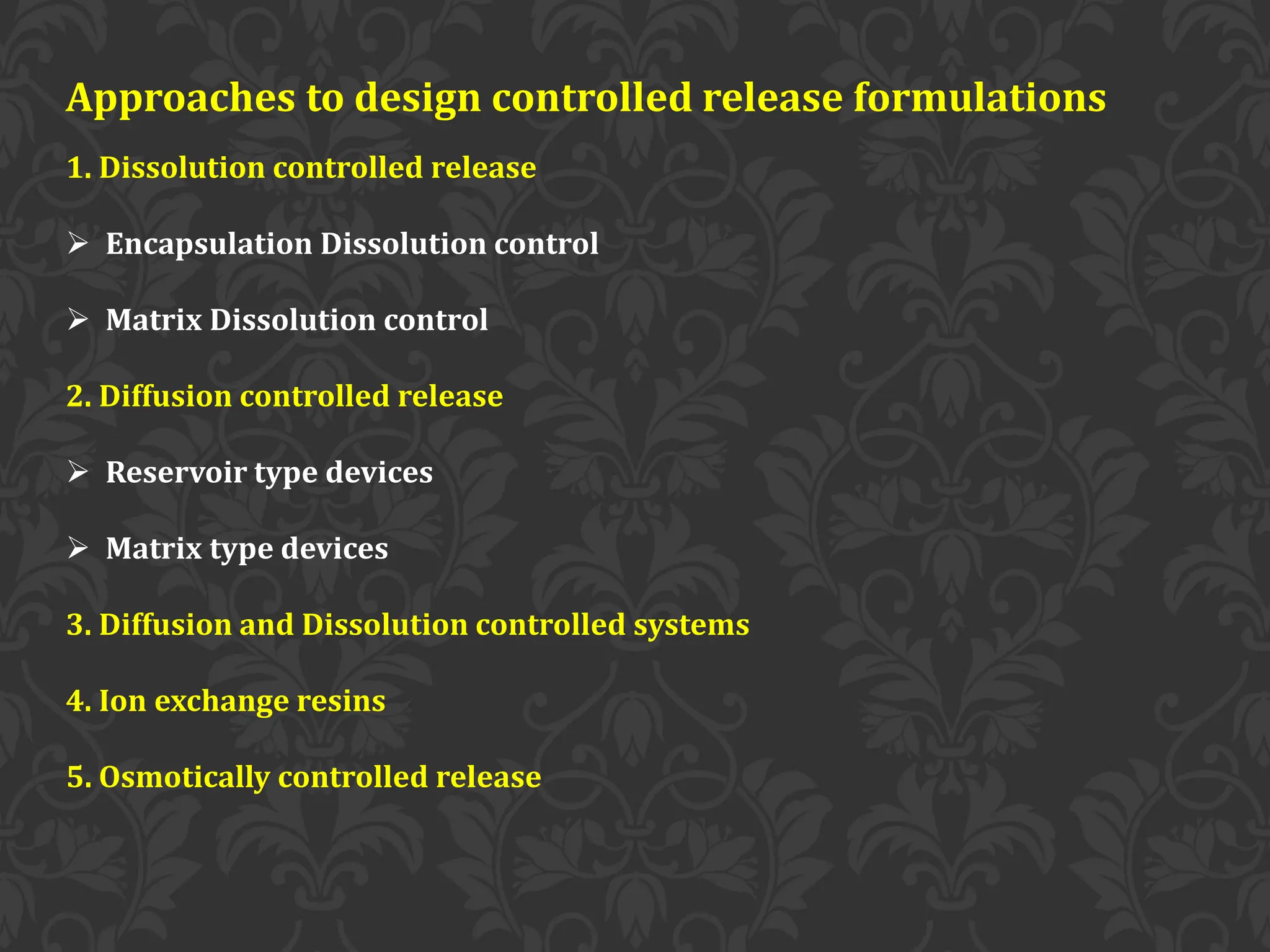
Approaches to design controlled release formulations
1. Dissolution controlled release
 Encapsulation Dissolution control
 Matrix Dissolution control
2. Diffusion controlled release
 Reservoir type devices
 Matrix type devices
3. Diffusion and Dissolution controlled systems
4. Ion exchange resins
5. Osmotically controlled release
MECHANISTIC ASPECTS FOR ORAL CONTROLLED RELEASE DRUG
DELIVERY
FORMULATION
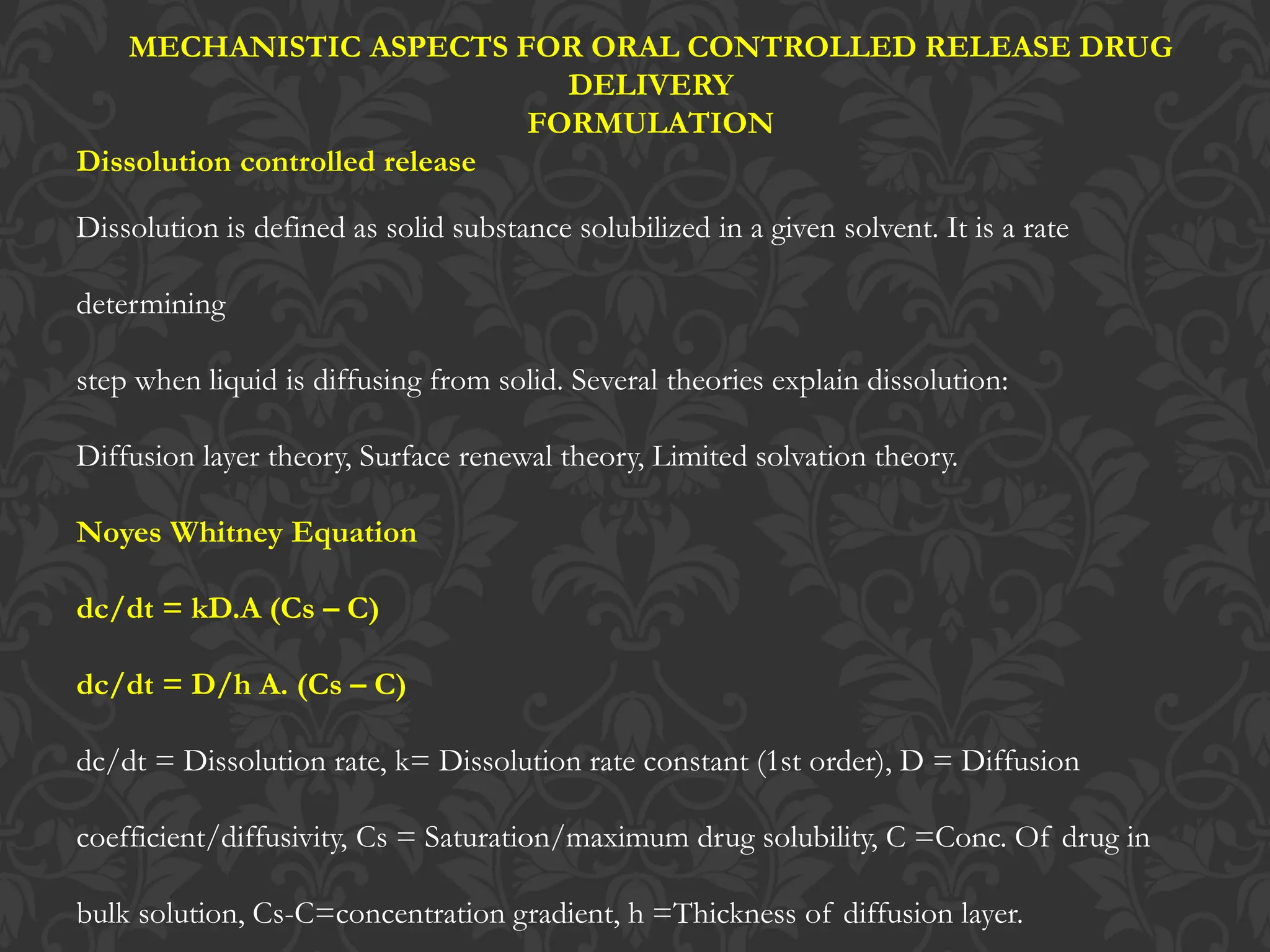
Dissolution controlled release
Dissolution is defined as solid substance solubilized in a given solvent. It is a rate
determining
step when liquid is diffusing from solid. Several theories explain dissolution:
Diffusion layer theory, Surface renewal theory, Limited solvation theory.
Noyes Whitney Equation
dc/dt = kD.A (Cs – C)
dc/dt = D/h A. (Cs – C)
dc/dt = Dissolution rate, k= Dissolution rate constant (1st order), D = Diffusion
coefficient/diffusivity, Cs = Saturation/maximum drug solubility, C =Conc. Of drug in
bulk solution, Cs-C=concentration gradient, h =Thickness of diffusion layer.
Two common formulation system rely on dissolution to determine release
rate of drugs are:
(i)Encapsulated dissolution system
(ii) Matrix dissolution system
Encapsulated dissolution system
This is also known as Coating dissolution controlled system.
Dissolution rate of coat depends upon solubility & thickness of coating.
It masks color, odor, taste and minimize GI irritation.
Controlled release products by decreasing the dissolution rate of drugs which
are highly water soluble can be formulated by preparing appropriate salt or
derivatives, by coating the drug with a slowly dissolving material, or by
incorporating the drug into a slowly dissolving carrier.
Examples: Ornade spansules, Chlortrimeto Repetabs.
Matrix dissolution system
 It is also known as monolithic dissolution controlled system.
 In this dissolution is controlled by: Altering porosity of tablet, decreasing
its wet ability, dissolving at slower rate.
 It follows first order drug release.
 The drug release can be determined by dissolution rate of polymer.
 Examples: Demeaned extencaps, Dimetapp extentabs
Diffusion controlled system
It is a major process for absorption in which no energy required. In this drug
molecules diffuse from a region of higher concentration to lower
concentration until equilibrium is attained and it is directly proportional to
the concentration gradient across the membrane.
In this system release rate is determined by its diffusion through a water-
insoluble polymer.
There are two types of diffusion devices:
- Reservoir diffusion system
- Matrix diffusion system
Reservoir diffusion system
 It is also called as laminated matrix device.
 It is a hollow system containing an inner core surrounded by water
insoluble membrane and polymer can be applied by coating or micro
encapsulation.
 The Rate controlling mechanism is that drug will partition into membrane
and exchange with the fluid surrounding the drug by diffusion.
 Commonly used polymers are HPC, ethyl cellulose & polyvinyl acetate.
 Examples: Nico-400, Nitro-Bid.
 Rate controlling steps: Polymeric content in coating, thickness of coating,
hardness of microcapsule.
Matrix dissolution system
(a) Rigid Matrix Diffusion: Materials used are insoluble plastics such as PVP &
fatty acids.
(b) Swellable Matrix Diffusion: it is also called as Glassy hydro gels and popular
for sustaining the release of highly water soluble drugs. Materials used are
hydrophilic gums
06Examples:
Natural- Guar gum, Tragacanth.
Semi synthetic -HPMC, CMC, Xanthum gum. Synthetic -Polyacrilamides. Examples:
Glucotrol
XL, Procardia XL
The Higuchi Equation describing the drug release from this system [1]
: Q = [DƐ/T (2A-Ɛ Cs.t)] 1/2 Where Q=amt of drug release per unit surface area at
time t,
D=diffusion coefficient of drug in the release medium, Ɛ=porosity of the matrix,
Cs=solubility of
drug in release medium, T=tortuosity of matrix, A=concentration of drug present
in matrix per
unit volume.
Rate controlling step: Diffusion of dissolved drug in matrix.
Dissolution & Diffusion Controlled Release system
In this drug is encased in a partially soluble membrane and pores are
created due to dissolution of parts of membrane.
It permits entry of aqueous medium into core & drug is dissolved or
diffused out of the system.
Ex- Ethyl cellulose & PVP mixture dissolves in water & creates pores of
insoluble ethyl cellulose
Ion exchange resins controlled release system
 Ion exchange resins are cross-linked water insoluble polymers carrying ionizable functional
groups.
 These resins are used for taste masking and controlled release system.
 The formulations are developed by embedding the drug molecules in the ion-exchange resin
matrix and this core is then coated with a semi permeable coating material such as Ethyl
Cellulose.
 This system reduced the degradation of drug in GIT. The most widely used and safe ion-
exchange resin is divinylbenzene sulphonate.
 In tablet formulations ion-exchange resins have been used as disintegrant.
Principle:
Is based on preparation of totally insoluble ionic material
• Resins are insoluble in acidic and alkaline media
•They contain ionizable groups which can be exchanged for drug molecules IER are
capable of exchanging positively or negatively charged drug molecules to form
insoluble poly salt resinates.
Types:
There are two types of IER
Cationic Exchange resins - RSO3-H+ Resins functional groups
Anionic Exchange resins – RNH3+ OH
Mechanism of action
IER combine with drug to form insoluble ion complexes
1. R-SO3– H+ + H2N – A R-SO3 – NH3 + - A
R-NH3+ OH- + HOOC – B RNH3+ -OOC-B + H2O
Where A- NH2 is basic drug
B-COOH is acidic drug
These resinates are administered orally 2 hrs in stomach in contact with acidic fluid
at pH 1.2
Intestinal fluid, remain in contact with slightly basic pH for 6hrs.
Drug can be slowly liberated by exchange with ions present in G.I.T
In the stomach
®- SO3 - NH3 + - A + HCl ®-SO3 - H+ + A-NH3 + Cl-
®-NH3 +Cl- + HOOC-B ®-NH3 +Cl- + HOOC-B Un dissociated
Thus carboxylic acid will be poorly dissociated in stomach and thus absorbed.
In the Intestine
® - - SO3 - NH3 + - A + NaCl ®- -SO3 - Na+ + A-NH3 + Cl-
Basic pH un dissociated
®-NH3 + -OOC – B + NaCl ®-NH3 +Cl- + Na+ -OOCB Sodium salt of acid
(dissociation of acid salt unabsorbed)
Amine salt will be poorly dissociated in intestine and thus absorbed.

CONTROLLED RELEASE DRUG DELIVERY SYSTEM I

  • 1.
    Unit I NOVEL DRUGDELIVERY SYSTEM BY DR. SWATI S. GAIKWAD
  • 2.
    Controlled drug deliveryis one which delivers the drug at a predetermined rate, for locally or systemically, for a specified period of time. Sustained Drug Release. Sustained release allows delivery of a specific drug at a programmed rate that leads to drug delivery for a prolonged period of time. Prolonged-release products release the active ingredients slowly and work for a longer time.
  • 3.
    Advantages of ControlRelease Dosage Forms Clinical Advantages 1. Reduction in frequency of drug administration 2. Improved patient compliance 3. Reduction in drug level fluctuation in blood 4. Reduction in total drug usage when compared with conventional therapy 5. Reduction in drug accumulation with chronic therapy 6. Reduction in drug toxicity (local/systemic) 7. Stabilization of medical condition (because of more uniform drug levels) 8. Improvement in bioavailability of some drugs because of spatial control 9. Economical to the health care providers and the patient
  • 4.
    Commercial / IndustrialAdvantages Illustration of innovative/technological leadership Product life-cycle extension Product differentiation Market expansion Patent extension Disadvantages of CRDDS Delay in onset of drug action Possibility of dose dumping in the case of a poor formulation strategy Increased potential for first pass metabolism Greater dependence on GI residence time of dosage form Possibility of less accurate dose adjustment in some cases Cost per unit dose is higher when compared with conventional doses Not all drugs are suitable for formulating into ER dosage form
  • 5.
    Approaches to designcontrolled release formulations 1. Dissolution controlled release  Encapsulation Dissolution control  Matrix Dissolution control 2. Diffusion controlled release  Reservoir type devices  Matrix type devices 3. Diffusion and Dissolution controlled systems 4. Ion exchange resins 5. Osmotically controlled release
  • 6.
    MECHANISTIC ASPECTS FORORAL CONTROLLED RELEASE DRUG DELIVERY FORMULATION Dissolution controlled release Dissolution is defined as solid substance solubilized in a given solvent. It is a rate determining step when liquid is diffusing from solid. Several theories explain dissolution: Diffusion layer theory, Surface renewal theory, Limited solvation theory. Noyes Whitney Equation dc/dt = kD.A (Cs – C) dc/dt = D/h A. (Cs – C) dc/dt = Dissolution rate, k= Dissolution rate constant (1st order), D = Diffusion coefficient/diffusivity, Cs = Saturation/maximum drug solubility, C =Conc. Of drug in bulk solution, Cs-C=concentration gradient, h =Thickness of diffusion layer.
  • 7.
    Two common formulationsystem rely on dissolution to determine release rate of drugs are: (i)Encapsulated dissolution system (ii) Matrix dissolution system Encapsulated dissolution system This is also known as Coating dissolution controlled system. Dissolution rate of coat depends upon solubility & thickness of coating. It masks color, odor, taste and minimize GI irritation. Controlled release products by decreasing the dissolution rate of drugs which are highly water soluble can be formulated by preparing appropriate salt or derivatives, by coating the drug with a slowly dissolving material, or by incorporating the drug into a slowly dissolving carrier. Examples: Ornade spansules, Chlortrimeto Repetabs.
  • 8.
    Matrix dissolution system It is also known as monolithic dissolution controlled system.  In this dissolution is controlled by: Altering porosity of tablet, decreasing its wet ability, dissolving at slower rate.  It follows first order drug release.  The drug release can be determined by dissolution rate of polymer.  Examples: Demeaned extencaps, Dimetapp extentabs
  • 9.
    Diffusion controlled system Itis a major process for absorption in which no energy required. In this drug molecules diffuse from a region of higher concentration to lower concentration until equilibrium is attained and it is directly proportional to the concentration gradient across the membrane. In this system release rate is determined by its diffusion through a water- insoluble polymer. There are two types of diffusion devices: - Reservoir diffusion system - Matrix diffusion system
  • 10.
    Reservoir diffusion system It is also called as laminated matrix device.  It is a hollow system containing an inner core surrounded by water insoluble membrane and polymer can be applied by coating or micro encapsulation.  The Rate controlling mechanism is that drug will partition into membrane and exchange with the fluid surrounding the drug by diffusion.  Commonly used polymers are HPC, ethyl cellulose & polyvinyl acetate.  Examples: Nico-400, Nitro-Bid.  Rate controlling steps: Polymeric content in coating, thickness of coating, hardness of microcapsule.
  • 11.
    Matrix dissolution system (a)Rigid Matrix Diffusion: Materials used are insoluble plastics such as PVP & fatty acids. (b) Swellable Matrix Diffusion: it is also called as Glassy hydro gels and popular for sustaining the release of highly water soluble drugs. Materials used are hydrophilic gums 06Examples: Natural- Guar gum, Tragacanth. Semi synthetic -HPMC, CMC, Xanthum gum. Synthetic -Polyacrilamides. Examples: Glucotrol XL, Procardia XL The Higuchi Equation describing the drug release from this system [1] : Q = [DƐ/T (2A-Ɛ Cs.t)] 1/2 Where Q=amt of drug release per unit surface area at time t, D=diffusion coefficient of drug in the release medium, Ɛ=porosity of the matrix, Cs=solubility of drug in release medium, T=tortuosity of matrix, A=concentration of drug present in matrix per unit volume. Rate controlling step: Diffusion of dissolved drug in matrix.
  • 12.
    Dissolution & DiffusionControlled Release system In this drug is encased in a partially soluble membrane and pores are created due to dissolution of parts of membrane. It permits entry of aqueous medium into core & drug is dissolved or diffused out of the system. Ex- Ethyl cellulose & PVP mixture dissolves in water & creates pores of insoluble ethyl cellulose
  • 13.
    Ion exchange resinscontrolled release system  Ion exchange resins are cross-linked water insoluble polymers carrying ionizable functional groups.  These resins are used for taste masking and controlled release system.  The formulations are developed by embedding the drug molecules in the ion-exchange resin matrix and this core is then coated with a semi permeable coating material such as Ethyl Cellulose.  This system reduced the degradation of drug in GIT. The most widely used and safe ion- exchange resin is divinylbenzene sulphonate.  In tablet formulations ion-exchange resins have been used as disintegrant.
  • 14.
    Principle: Is based onpreparation of totally insoluble ionic material • Resins are insoluble in acidic and alkaline media •They contain ionizable groups which can be exchanged for drug molecules IER are capable of exchanging positively or negatively charged drug molecules to form insoluble poly salt resinates. Types: There are two types of IER Cationic Exchange resins - RSO3-H+ Resins functional groups Anionic Exchange resins – RNH3+ OH
  • 15.
    Mechanism of action IERcombine with drug to form insoluble ion complexes 1. R-SO3– H+ + H2N – A R-SO3 – NH3 + - A R-NH3+ OH- + HOOC – B RNH3+ -OOC-B + H2O Where A- NH2 is basic drug B-COOH is acidic drug
  • 16.
    These resinates areadministered orally 2 hrs in stomach in contact with acidic fluid at pH 1.2 Intestinal fluid, remain in contact with slightly basic pH for 6hrs. Drug can be slowly liberated by exchange with ions present in G.I.T In the stomach ®- SO3 - NH3 + - A + HCl ®-SO3 - H+ + A-NH3 + Cl- ®-NH3 +Cl- + HOOC-B ®-NH3 +Cl- + HOOC-B Un dissociated Thus carboxylic acid will be poorly dissociated in stomach and thus absorbed. In the Intestine ® - - SO3 - NH3 + - A + NaCl ®- -SO3 - Na+ + A-NH3 + Cl- Basic pH un dissociated ®-NH3 + -OOC – B + NaCl ®-NH3 +Cl- + Na+ -OOCB Sodium salt of acid (dissociation of acid salt unabsorbed) Amine salt will be poorly dissociated in intestine and thus absorbed.