SUBJECT:MODIFIED RELEASE DRUG DELIVERY SYSTEM
PRESENTED BY: PAWAN DHAMALA
1ST YEAR MPHARM
Modified Release drug Delivery System
What are sustained relaese drug formulation?
 Sustained release dosage forms are designed to relese at a
predetermined rate in order to maintain a consistant drug concentration
for specific period of time with minimum side effects.
What are the controlled release drug formulation?
• Controlled drug delivery is one which delivers the drug at a
predetermined rate, for locally or systemically, for a specified period of
time. Controlled drug delivery systems can include the maintenance of
drug levels within a desired range.
Advantages
• Improve patient compliance
• Reduction in fluctuation in steady state level
• Increase the safety margin of high potency
drug
• Reduction in total health care cost
Disadvantages
• Decrease systemic availability
• Poor invitro-invivo concentration
• Increased risk of toxicity
• Retrival of drug is difficult in case of toxicity,
poisining or hyper sensitvity rection
Factors Affecting Oral Sustain Release
Dosage Form
A} Pharmacokinetic and Pharmacodynamic
factor
• Biological half-life
• Absorption
• Distribution
• Metabolism
B} Drug properties relevant to sustain release
formulation
• Dose size
• Ionization, pka and aqueous solubility
• Partition coefficient
• Drug stability
Approaches to Sustain Release Drug
Delievry System
1. Dissolution controlled release systems
These systems are easy to formulate. Drug
which are formulated using have slow
dissolution rate, produced slow dissolving
forms with gastric intestinal fluids and the
drugs which are having aqueous solubility
and dissolution rate.It is further classified
into:
A} Matrix dissolution controlled release system
Matrix dissolution system is known as
monolithic because the drug present in the
matrix is completely dissolve in the medium
which controls the drug release. They are
mostly made of beeswax, carnauba wax,
hydrogenated castor oil etc. and play important
role to control the drug release rate by
controlling the rate of dissolution fluid
penetration into the matrix by altering the
porosity of tablet.
B} Reservior dissolution controlled
release system
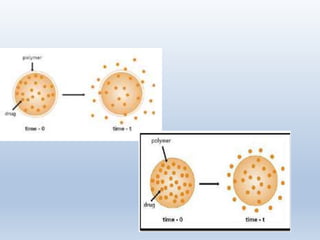
• In reservoir system, the drug particles are
coated or encapsulated with one of the several
microencapsulation techniques using slowly
dissolving materials like cellulose,
polyethylene glycol and waxes. This unit can
be encapsulated in capsules or may be
compressed into tablets Solubility and
thickness of the coating play important role in
dissolution rate of drug.
2} Diffusion controlled release systems
• In diffusion release models, the diffusion of dissolved
drug through a polymeric membrane is a rate limiting
step. In this system, the drug release rate never follows
zero-order kinetics, because the diffusion path length
increases with time as the insoluble matrix is drug
depleted. The mechanism of diffusion process shows
the movement of drug molecules from a region of a
higher concentration to region of lower concentration.
• The flux of the drug J (in amount / area -time), across a
membrane in the direction of decreasing concentration
is given by Fick’s law.
• J = -D dc/dx where,
• J = flux of the drug across a membrane in the direction
of decreasing conc.,
• D = Diffusion coefficient of the drug,
• and dc /dx = Change in the concentration of the drug in
the membrane
3} Dissolution and diffusion controlled
release systems
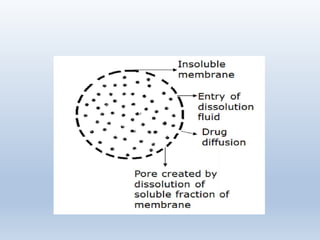
In this kind of systems, the drug is enclosed in
a membrane which is partially water soluble.
The dissolution of the membrane take place
due to which pores are formed and these
pores allows aqueous medium to enter in the
membrane. This results in the dissoultion of
the drug in membrane followed by the
diffusion of the dissolved drug from the
system e.g. combination of ethyl cellulose
with pvp or methyl cellulose.
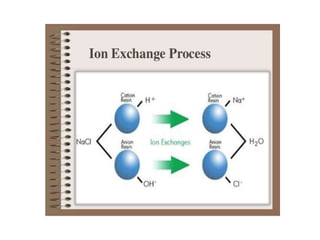
4} Ion exchange resin-drug complexes
• Resins are the materials which are insoluble in
water. Resin contains anionic groups such as
amino or quaternary ammonium groups and
cationic groups such as carboxilic groups, or
sulfonic groups in repeating positions on the
chain. A drug resin complex is formed by
prolonged exposure of drug to the resin. The drug
from these complexes gets exchanged in
gastrointestinal tract and later they are released
with excess of sodium and chlorin present in gi
tract.
5} pH dependent formulation
• Some drugs on dissolution and absorption in GIT,
changes the pH present in the GI tract, so dosage
forms are formulated using sufficient amount of
buffering agent like salt of phosphoric, citric or
tartaric acids these salts adjust pH to the desired
value when the dosage form move across the GIT.
Permeable coating agents are used to coat the
drug and buffer present in the dosage form, which
allows the aqueous medium to enter in it and
prevents the dispersion of the tablets.
6} Osmotic pressure controlled systems
• These types of systems are also known as oros
which follows the mechanism of osmotic
pressure where the drug is released at constant
zero order rate. The reservoir made up of the
drug and osmotic agent like manitol or KCl
which is surrounded by semi permeable
membrane.
Refrences
• https://onlinelibrary.wiley.com/doi/pdf/10.10
02/jps.2600521210
• https://www.pharmatutor.org/articles/sustain
ed-release-drug-delivery-system-concise-
review
• https://www.slideshare.net/prashantmane01/
sustained-release-drug-delivery-system