PRESENTED BY
P.ANURADHA
M.PHARMACY
PHARMACEUTICALANALYSIS&QA
SEMINAR ON
Introduction:
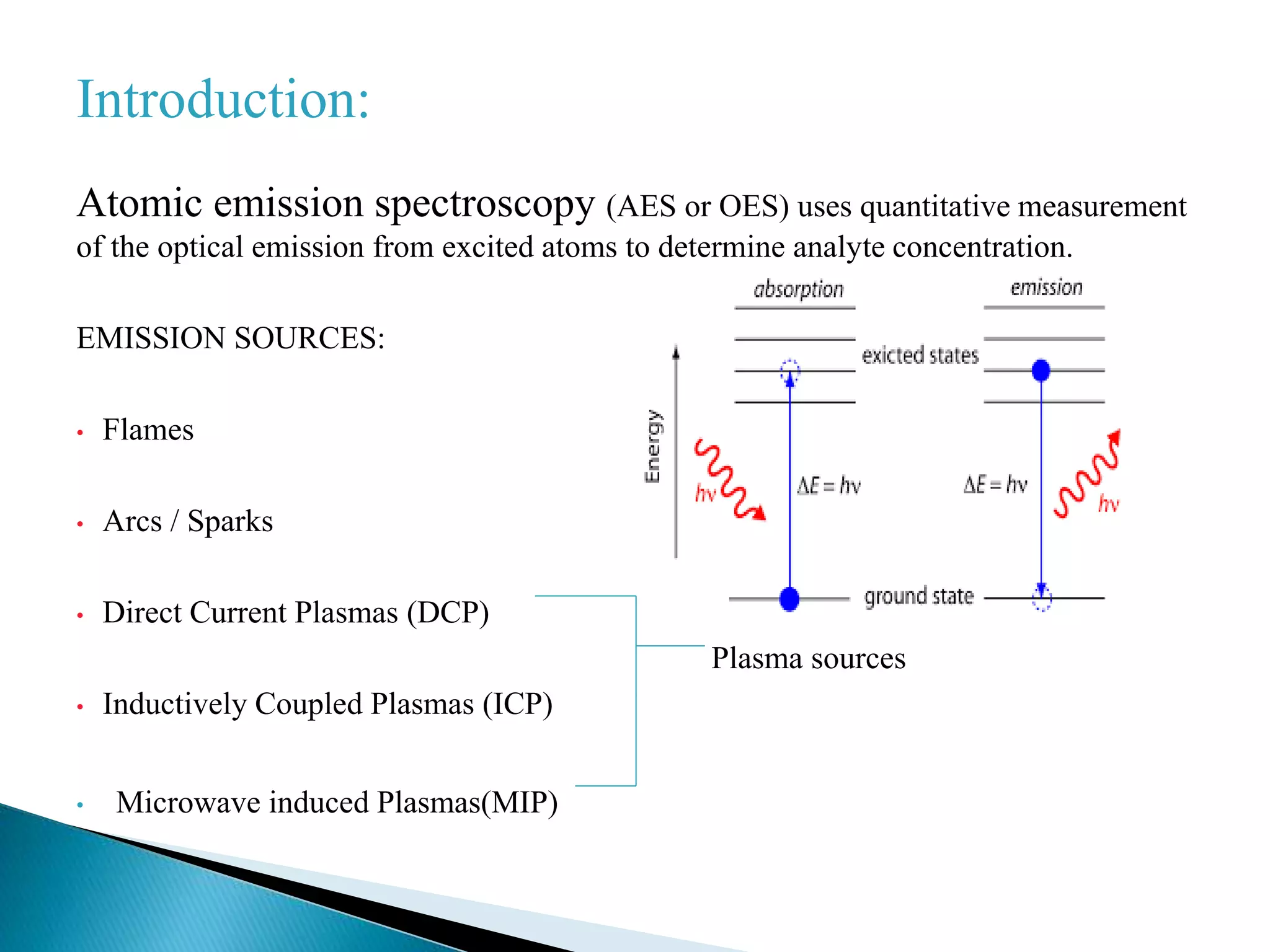
Atomic emission spectroscopy (AES or OES) uses quantitative measurement
of the optical emission from excited atoms to determine analyte concentration.
EMISSION SOURCES:
• Flames
• Arcs / Sparks
• Direct Current Plasmas (DCP)
Plasma sources
• Inductively Coupled Plasmas (ICP)
• Microwave induced Plasmas(MIP)
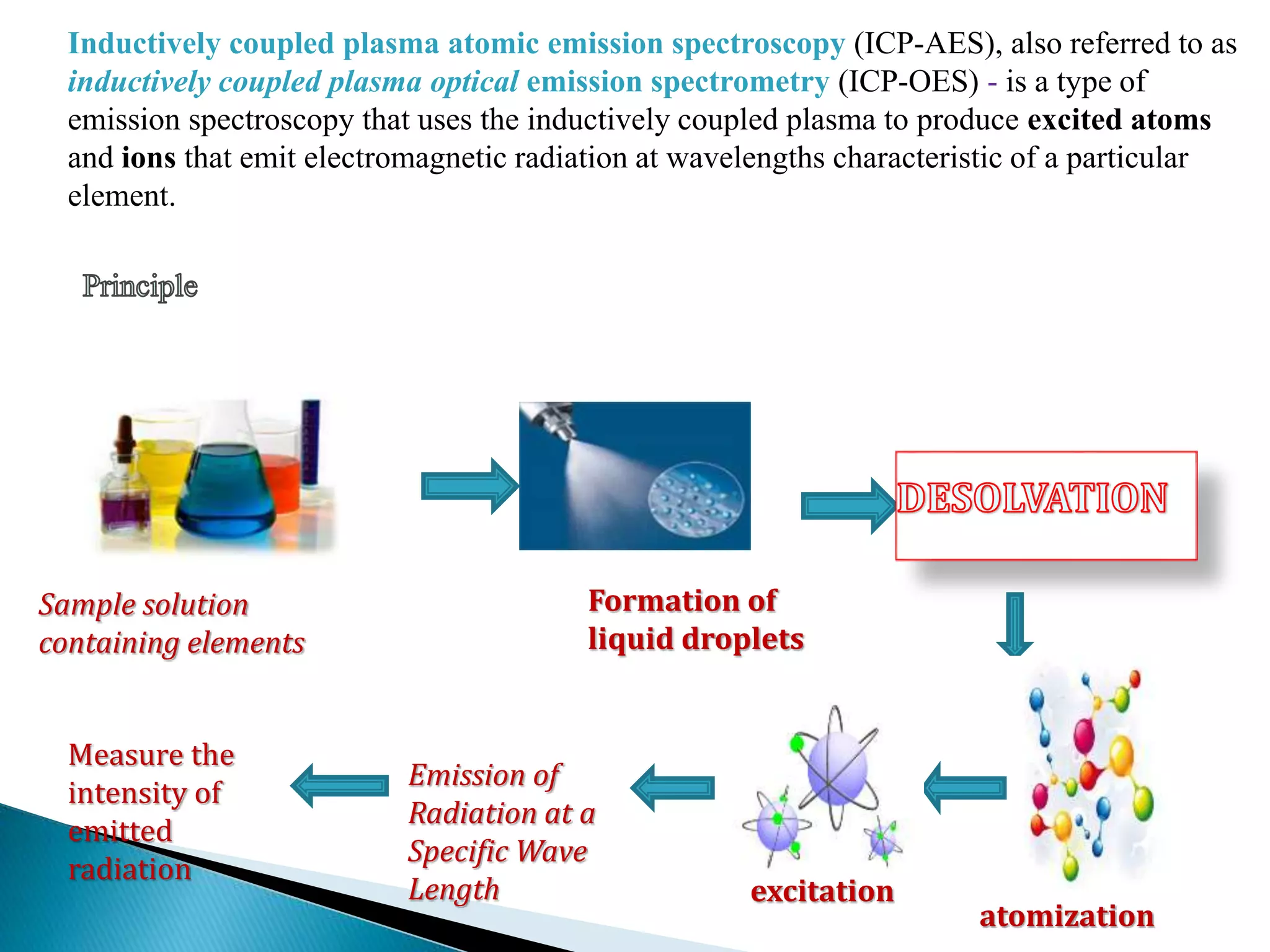
Inductively coupled plasma atomic emission spectroscopy (ICP-AES), also referred to as
inductively coupled plasma optical emission spectrometry (ICP-OES) - is a type of
emission spectroscopy that uses the inductively coupled plasma to produce excited atoms
and ions that emit electromagnetic radiation at wavelengths characteristic of a particular
element.
Sample solution
containing elements
Formation of
liquid droplets
atomization
excitation
Emission of
Radiation at a
Specific Wave
Length
Measure the
intensity of
emitted
radiation
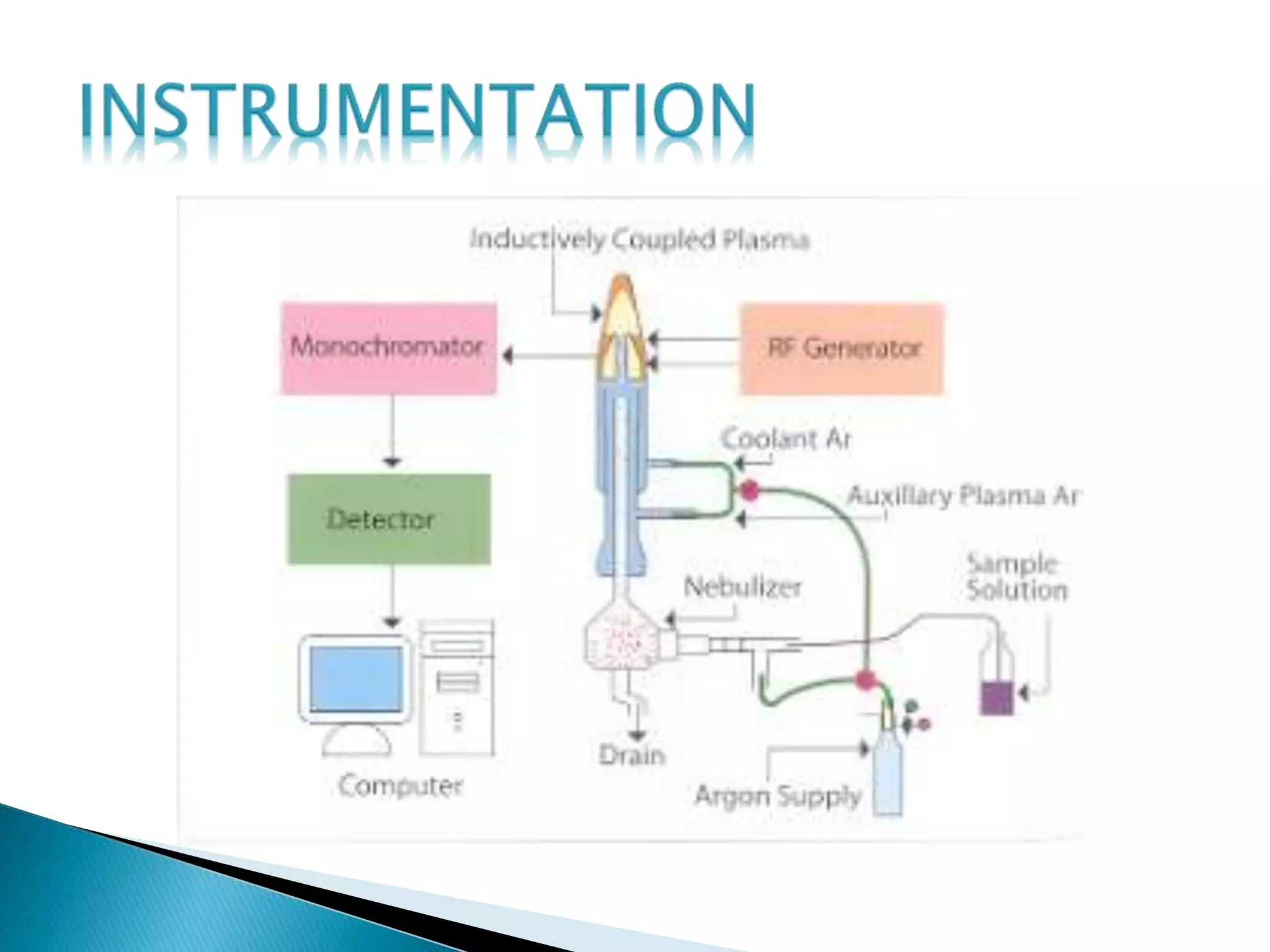
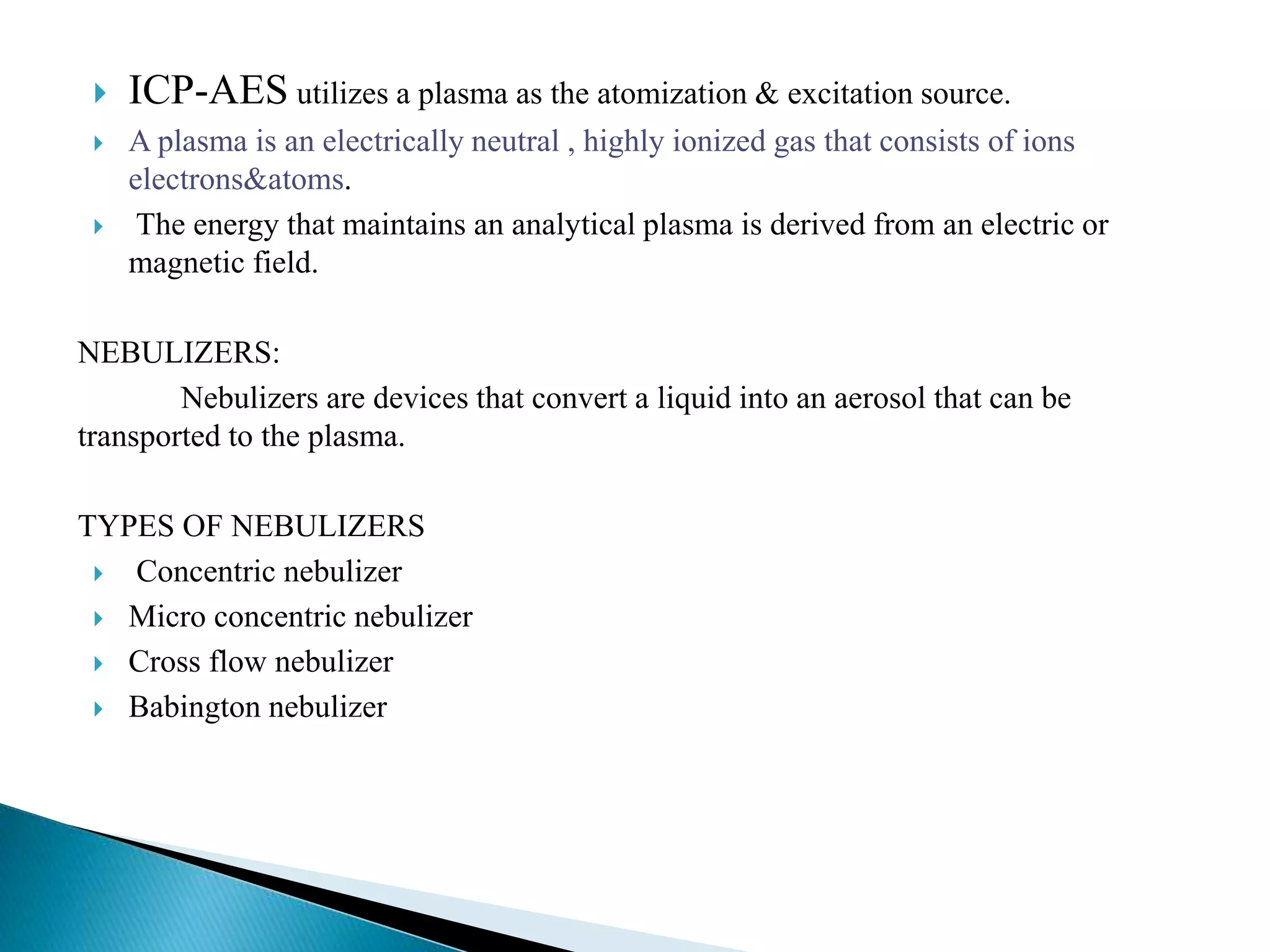
 ICP-AES utilizes a plasma as the atomization & excitation source.
 A plasma is an electrically neutral , highly ionized gas that consists of ions
electrons&atoms.
 The energy that maintains an analytical plasma is derived from an electric or
magnetic field.
NEBULIZERS:
Nebulizers are devices that convert a liquid into an aerosol that can be
transported to the plasma.
TYPES OF NEBULIZERS
 Concentric nebulizer
 Micro concentric nebulizer
 Cross flow nebulizer
 Babington nebulizer
PUMPS:
Peristaltic pumps are almost exclusively
the pumps of choice for ICP-AES.
• The pumps utilize a series of rollers that
push the sample solution through the tubing
using a process known as peristalsis.
• With a pumped solution, the flow rate of
the solution into the nebulizer is fixed and is
not as dependent on solution parameters such
as viscosity and surface tension.
SPRAY CHAMBER:
 A spray chamber is placed between the
nebulizer & the torch.
 The primary function of the spray chamber
is to remove large droplets from the aerosol.
 The secondary purpose is to smooth out pulses
that occur during nebulization due to pumping of the solution.
 It is designed to allow droplets with diameters
of about 10 micrometre or smaller to pass to the plasma.
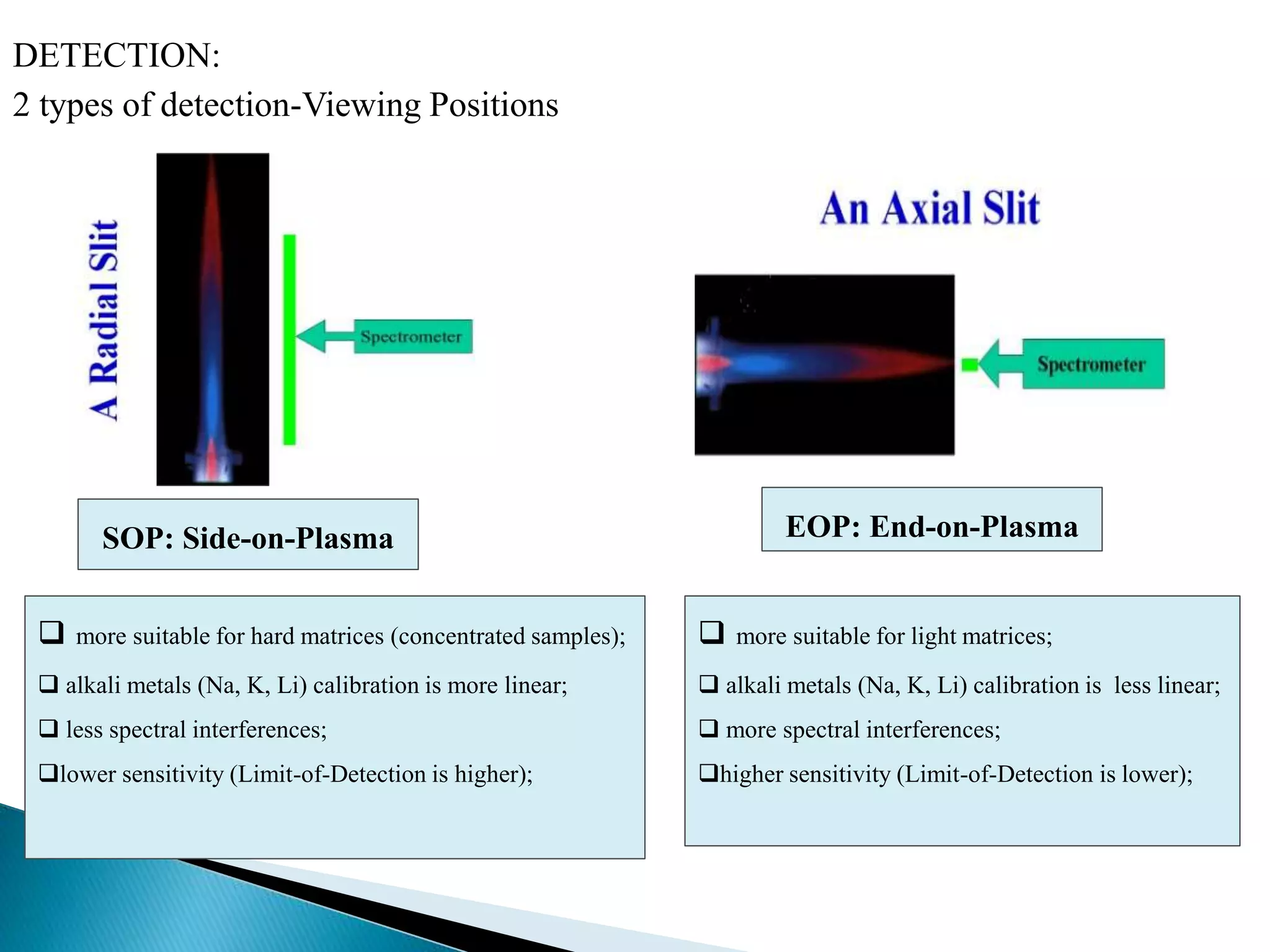
DETECTION:
2 types of detection-Viewing Positions
SOP: Side-on-Plasma EOP: End-on-Plasma
 more suitable for hard matrices (concentrated samples);
 alkali metals (Na, K, Li) calibration is more linear;
 less spectral interferences;
lower sensitivity (Limit-of-Detection is higher);
 more suitable for light matrices;
 alkali metals (Na, K, Li) calibration is less linear;
 more spectral interferences;
higher sensitivity (Limit-of-Detection is lower);
HOW TO PERFORM SIMULTANEOUS ANALYSIS
Spectrometers:
Function-To isolate specific spectral lines emitted from the analyte from all of the
other emissions produced by the other atoms,ions&molecules within plasma.
There are several devices available
 Monochromators
Simultaneous analysis was carried out by using:
 Polychromators , which are Paschen-Runge optics coupled to highly sensitivity
detectors known as Photomultiplers(PMT).
 Echelle grating optics, coupled to solid state detectors(CCD,CID) also known as
Charge transfer devices.
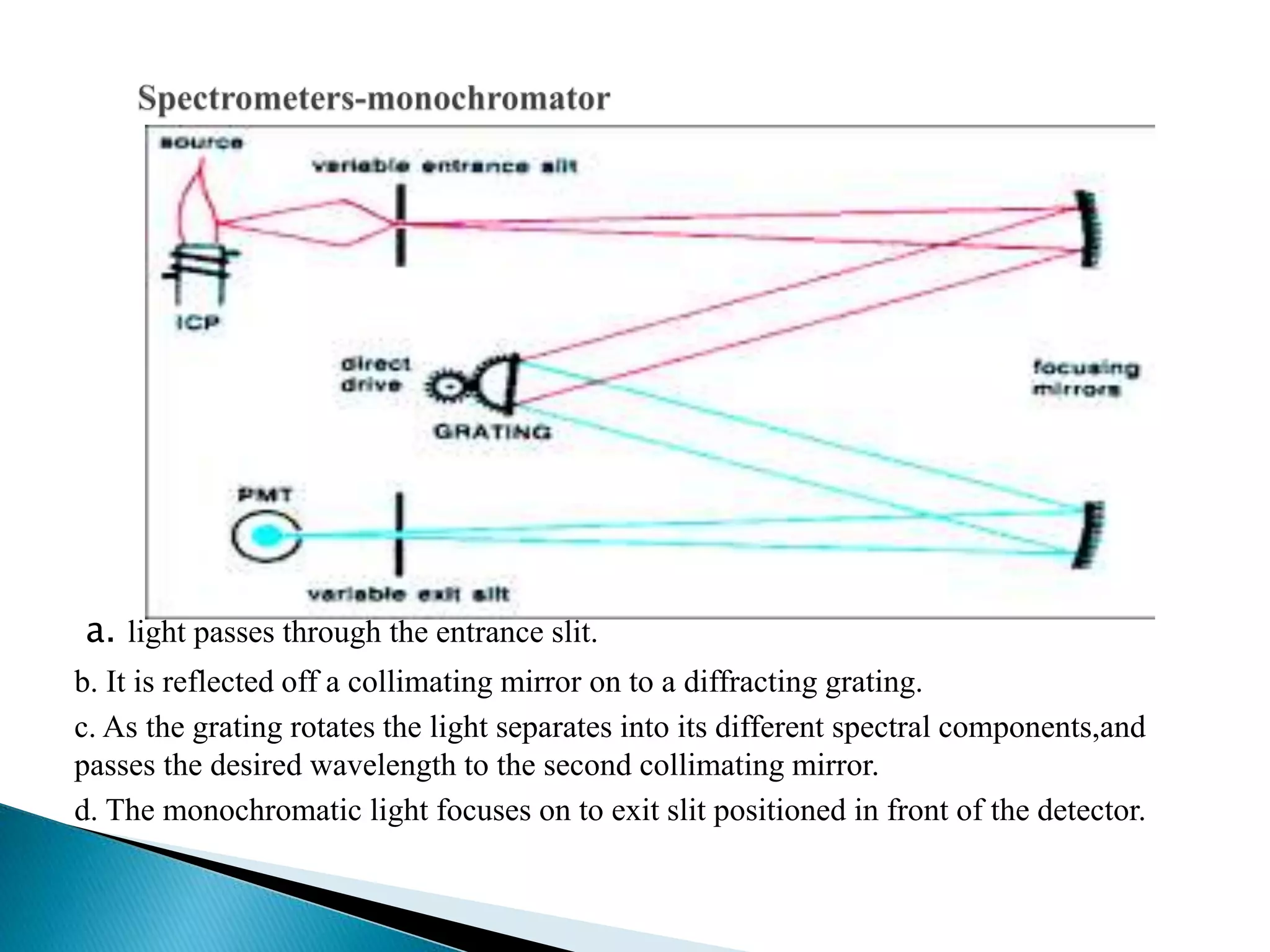
a. light passes through the entrance slit.
b. It is reflected off a collimating mirror on to a diffracting grating.
c. As the grating rotates the light separates into its different spectral components,and
passes the desired wavelength to the second collimating mirror.
d. The monochromatic light focuses on to exit slit positioned in front of the detector.
PMT is to convert optical rotation(photons) into an electrical signal(electrons).The
vaccum tube devices are very sensitive&cover a large wavelength range.
It consists of a vaccum photocell with an anode, photocathode and a number
of dynodes which have an increasingly positive potential with respect to the photocathode.
 Clinical Analysis: metals in biological fluids (blood, urine).
 Environmental Analysis: trace metals and other elements in waters, soils,
plants, composts and sludges.
 Pharmaceuticals: traces of catalysts used; traces of poison metals (Cd, Pb
etc).
 Industry: trace metal analysis in raw materials; noble metals determination.
 Forensic science: gunshot powder residue analysis, toxicological examination
( e.g., thallium (Tl) determination.
 Boss, C.B. and Freden, K.J. Concepts, Instrumentation and Techniques in
Inductively Coupled Plasma Optical Emission Spectrometry. 1997
 Skoog, D. Fundamentals of Analytical Chemistry, 2004
 Inductively Coupled Plasmas in Analytical Atomic Spectrometry; Montaser, A.;
Golightly, D. W., Eds.; VCH Publishers: New York, 1988
 Fredeen, C. B. (n.d.). http://www.atoomspectrometrie.nl/Icpconceptsbook.pdf.

INDUCTIVELY COUPLED PLASMA -ATOMIC EMISSION SPECTROSCOPY

  • 1.
  • 2.
    Introduction: Atomic emission spectroscopy(AES or OES) uses quantitative measurement of the optical emission from excited atoms to determine analyte concentration. EMISSION SOURCES: • Flames • Arcs / Sparks • Direct Current Plasmas (DCP) Plasma sources • Inductively Coupled Plasmas (ICP) • Microwave induced Plasmas(MIP)
  • 3.
    Inductively coupled plasmaatomic emission spectroscopy (ICP-AES), also referred to as inductively coupled plasma optical emission spectrometry (ICP-OES) - is a type of emission spectroscopy that uses the inductively coupled plasma to produce excited atoms and ions that emit electromagnetic radiation at wavelengths characteristic of a particular element. Sample solution containing elements Formation of liquid droplets atomization excitation Emission of Radiation at a Specific Wave Length Measure the intensity of emitted radiation
  • 5.
     ICP-AES utilizesa plasma as the atomization & excitation source.  A plasma is an electrically neutral , highly ionized gas that consists of ions electrons&atoms.  The energy that maintains an analytical plasma is derived from an electric or magnetic field. NEBULIZERS: Nebulizers are devices that convert a liquid into an aerosol that can be transported to the plasma. TYPES OF NEBULIZERS  Concentric nebulizer  Micro concentric nebulizer  Cross flow nebulizer  Babington nebulizer
  • 7.
    PUMPS: Peristaltic pumps arealmost exclusively the pumps of choice for ICP-AES. • The pumps utilize a series of rollers that push the sample solution through the tubing using a process known as peristalsis. • With a pumped solution, the flow rate of the solution into the nebulizer is fixed and is not as dependent on solution parameters such as viscosity and surface tension.
  • 8.
    SPRAY CHAMBER:  Aspray chamber is placed between the nebulizer & the torch.  The primary function of the spray chamber is to remove large droplets from the aerosol.  The secondary purpose is to smooth out pulses that occur during nebulization due to pumping of the solution.  It is designed to allow droplets with diameters of about 10 micrometre or smaller to pass to the plasma.
  • 10.
    DETECTION: 2 types ofdetection-Viewing Positions SOP: Side-on-Plasma EOP: End-on-Plasma  more suitable for hard matrices (concentrated samples);  alkali metals (Na, K, Li) calibration is more linear;  less spectral interferences; lower sensitivity (Limit-of-Detection is higher);  more suitable for light matrices;  alkali metals (Na, K, Li) calibration is less linear;  more spectral interferences; higher sensitivity (Limit-of-Detection is lower);
  • 11.
    HOW TO PERFORMSIMULTANEOUS ANALYSIS Spectrometers: Function-To isolate specific spectral lines emitted from the analyte from all of the other emissions produced by the other atoms,ions&molecules within plasma. There are several devices available  Monochromators Simultaneous analysis was carried out by using:  Polychromators , which are Paschen-Runge optics coupled to highly sensitivity detectors known as Photomultiplers(PMT).  Echelle grating optics, coupled to solid state detectors(CCD,CID) also known as Charge transfer devices.
  • 12.
    a. light passesthrough the entrance slit. b. It is reflected off a collimating mirror on to a diffracting grating. c. As the grating rotates the light separates into its different spectral components,and passes the desired wavelength to the second collimating mirror. d. The monochromatic light focuses on to exit slit positioned in front of the detector.
  • 14.
    PMT is toconvert optical rotation(photons) into an electrical signal(electrons).The vaccum tube devices are very sensitive&cover a large wavelength range. It consists of a vaccum photocell with an anode, photocathode and a number of dynodes which have an increasingly positive potential with respect to the photocathode.
  • 15.
     Clinical Analysis:metals in biological fluids (blood, urine).  Environmental Analysis: trace metals and other elements in waters, soils, plants, composts and sludges.  Pharmaceuticals: traces of catalysts used; traces of poison metals (Cd, Pb etc).  Industry: trace metal analysis in raw materials; noble metals determination.  Forensic science: gunshot powder residue analysis, toxicological examination ( e.g., thallium (Tl) determination.
  • 16.
     Boss, C.B.and Freden, K.J. Concepts, Instrumentation and Techniques in Inductively Coupled Plasma Optical Emission Spectrometry. 1997  Skoog, D. Fundamentals of Analytical Chemistry, 2004  Inductively Coupled Plasmas in Analytical Atomic Spectrometry; Montaser, A.; Golightly, D. W., Eds.; VCH Publishers: New York, 1988  Fredeen, C. B. (n.d.). http://www.atoomspectrometrie.nl/Icpconceptsbook.pdf.