Structure and Function of the Left Temporal Lobe
(Nielsen & Anderson, n.d.)
1
Superior Temporal Gyrus
Middle Temporal Gyrus
Inferior Temporal Gyrus
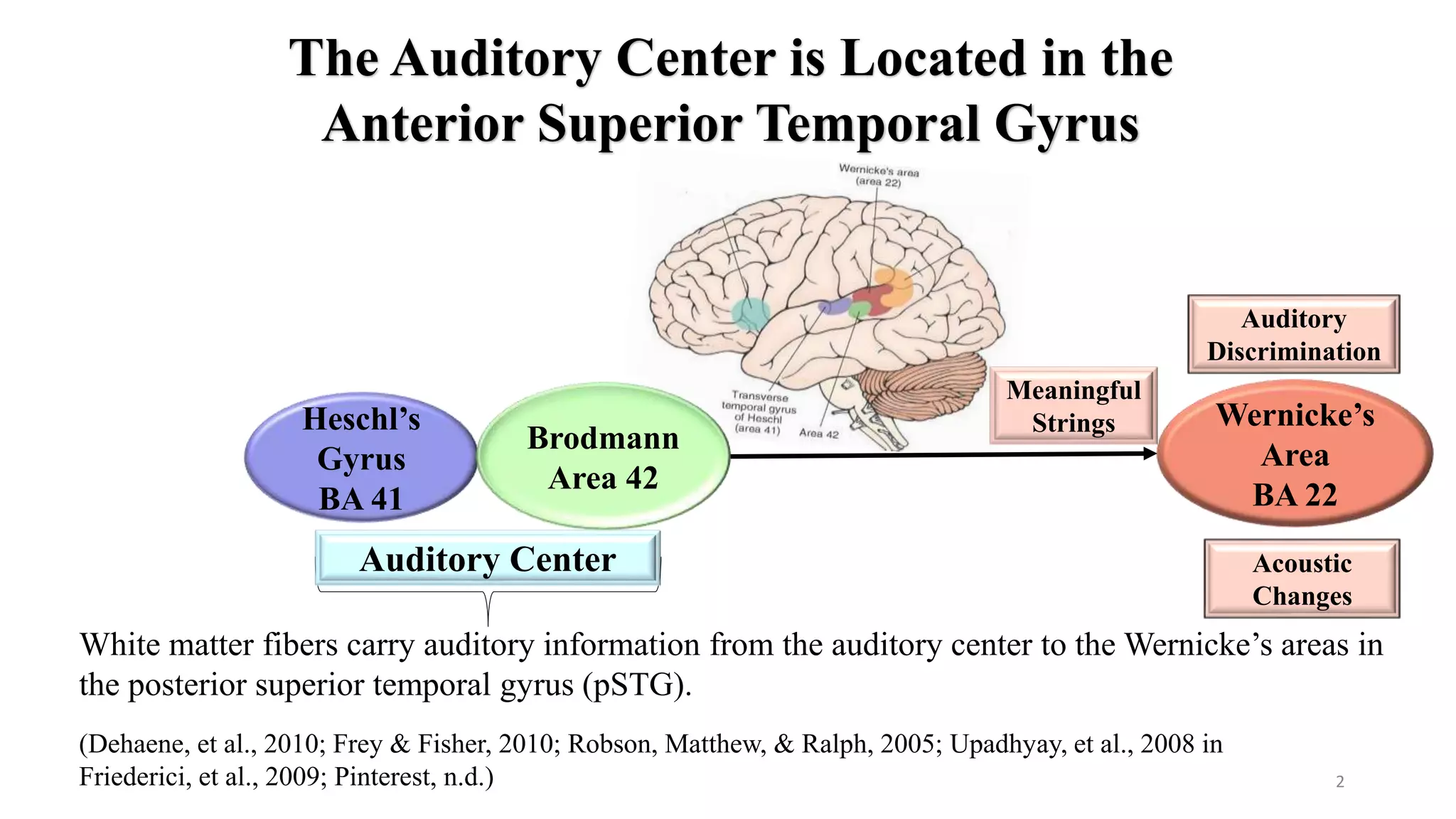
Heschl’s
Gyrus
BA 41
Brodmann
Area 42
(Dehaene, et al., 2010; Frey & Fisher, 2010; Robson, Matthew, & Ralph, 2005; Upadhyay, et al., 2008 in
Friederici, et al., 2009; Pinterest, n.d.)
Wernicke’s
Area
BA 22
The Auditory Center is Located in the
Anterior Superior Temporal Gyrus
White matter fibers carry auditory information from the auditory center to the Wernicke’s areas in
the posterior superior temporal gyrus (pSTG).
Auditory Center
Meaningful
Strings
Auditory
Discrimination
Acoustic
Changes
2
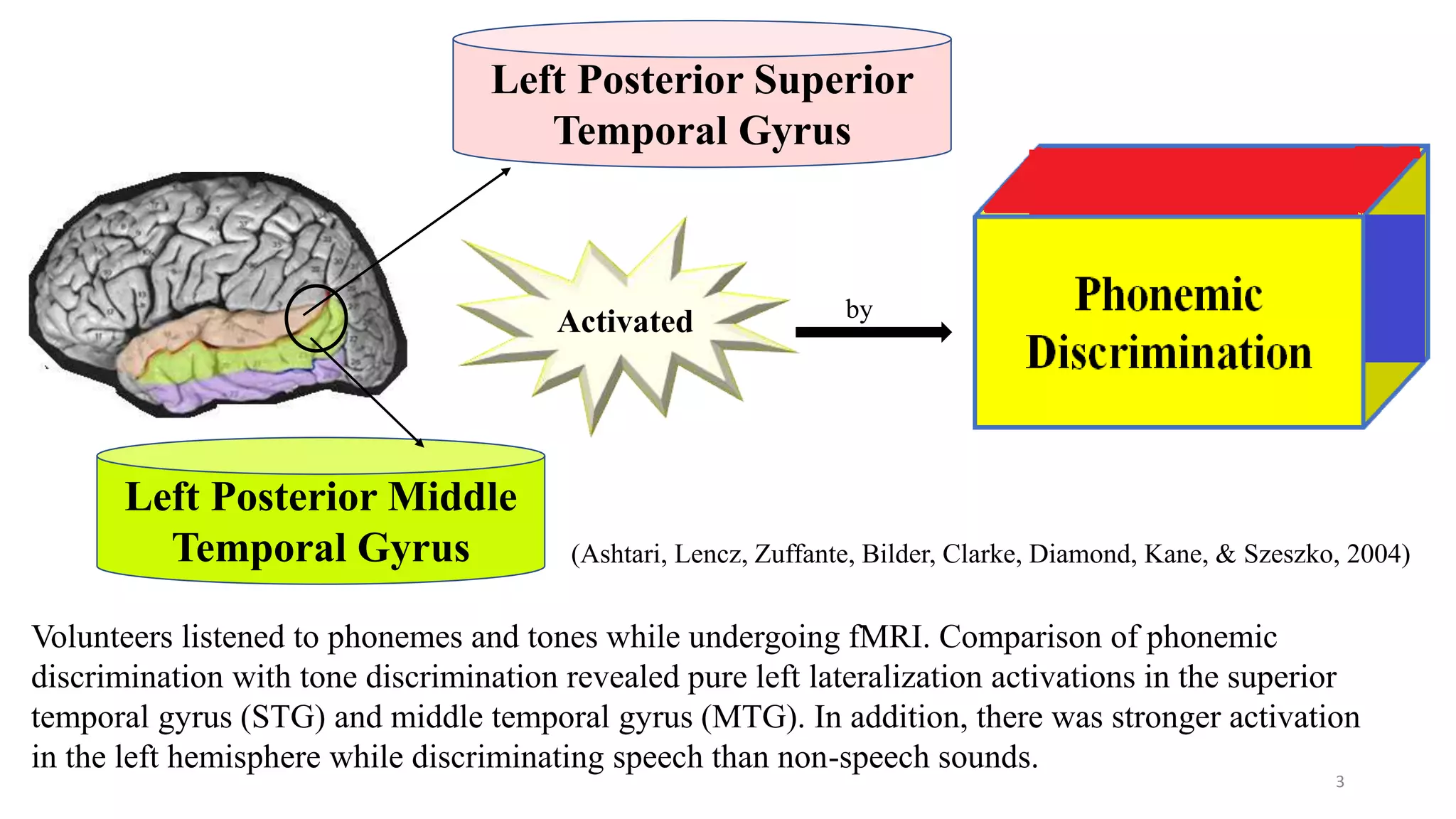
Left Posterior Superior
Temporal Gyrus
Activated
(Ashtari, Lencz, Zuffante, Bilder, Clarke, Diamond, Kane, & Szeszko, 2004)
Left Posterior Middle
Temporal Gyrus
Volunteers listened to phonemes and tones while undergoing fMRI. Comparison of phonemic
discrimination with tone discrimination revealed pure left lateralization activations in the superior
temporal gyrus (STG) and middle temporal gyrus (MTG). In addition, there was stronger activation
in the left hemisphere while discriminating speech than non-speech sounds.
3
by
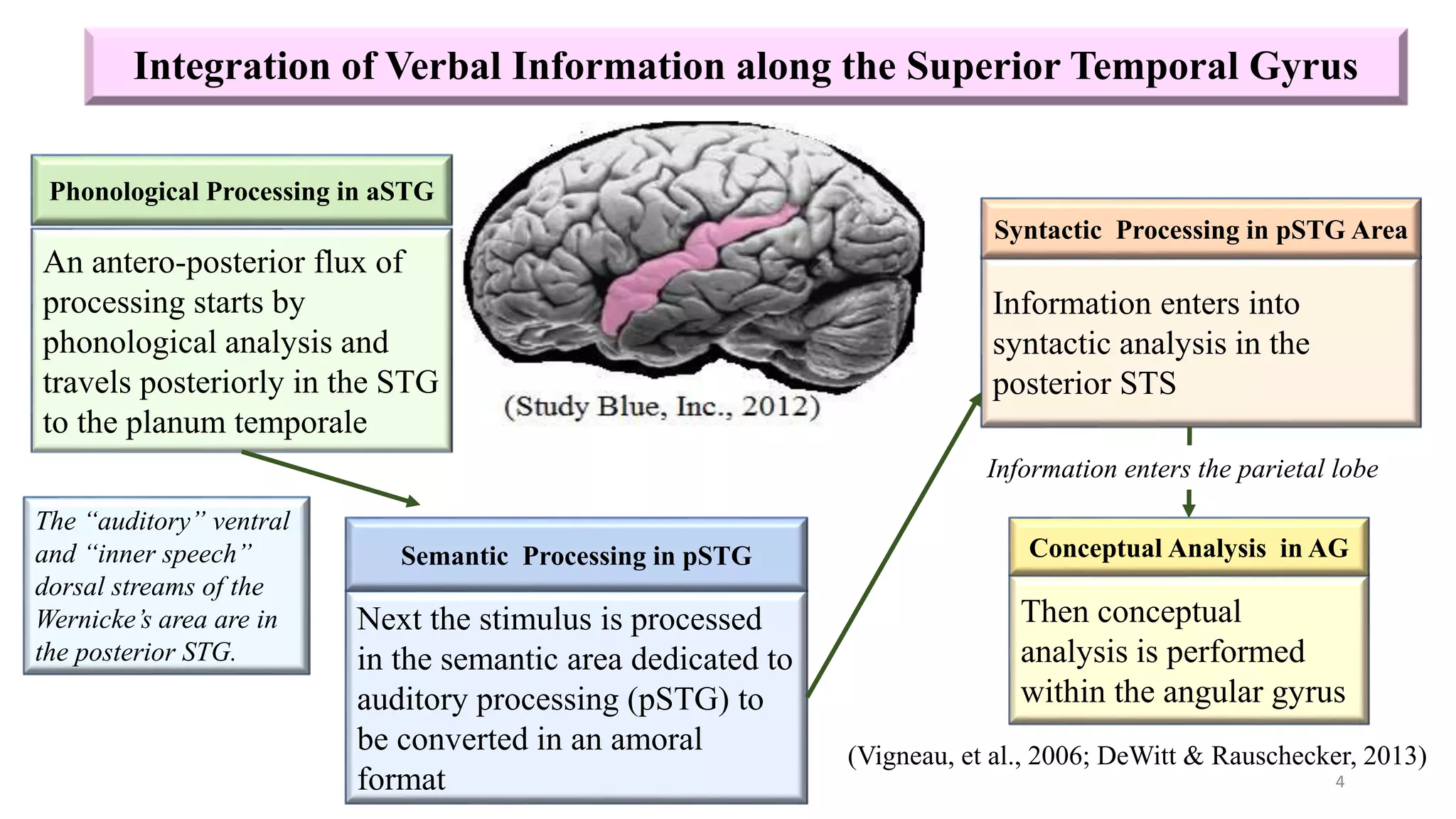
Integration of Verbal Information along the Superior Temporal Gyrus
An antero-posterior flux of
processing starts by
phonological analysis and
travels posteriorly in the STG
to the planum temporale
Next the stimulus is processed
in the semantic area dedicated to
auditory processing (pSTG) to
be converted in an amoral
format
Information enters into
syntactic analysis in the
posterior STS
Then conceptual
analysis is performed
within the angular gyrus
(Vigneau, et al., 2006; DeWitt & Rauschecker, 2013)
Phonological Processing in aSTG
Semantic Processing in pSTG
Syntactic Processing in pSTG Area
Conceptual Analysis in AG
4
The “auditory” ventral
and “inner speech”
dorsal streams of the
Wernicke’s area are in
the posterior STG.
Information enters the parietal lobe
Compilation of Neuroimaging Data Revealed How Verbal
Information is most likely Integration of along the Superior
Temporal Gyrus
Compilation of neuroimaging
data revealed how verbal
information is most likely
integrated along the superior
temporal gyrus (STG).
5
Posterior STS
Vigneau and Colleagues (2006)
STS – Superior Temporal Sulcus
(Frey & Fischer, 2010; Wikipedia, 2014 April 9)
6
Decreased Activation Along the Left Superior Temporal Gyrus
Negatively Affects Reading Skills
Children with poor
reading skills experience
reduced activation in the
auditory system and across
the left superior temporal
gyrus.
Auditory Center (BA 41/42)
Middle Temporal Gyrus
7
(BlueStudy Inc., 2017)
Left Middle Temporal Gyrus Stores Verbal Knowledge
• Decodes Grapheme-Phonemes
• Involved with Lexical Semantics
• Obtains Semantic Information from
the Sound-to-Meaning Network
(Bach, et al., 2011; Hickok and Poeppel, 2000, 2004, 2007 and Vigneau et al., 2006 in Bach, et al., 2011; Wikipedia,
2012, December 12)
8
Visual and Auditory Decoding Activate the Left MTG
Activations focused on the Left Hemisphere
 MTG (BA 21 and BA 38)
 Posterior MTG regions extend to the SMG
(BA 40) and the Posterior Insular cortex
 Limbic regions are involved bilaterally
MTG – Middle Temporal Gyrus (BA 21)
Anterior MTG – (BA 38)
SMG – Supramarginal Gyrus (BA 40)
(Lindberg & Scheef, 2007)
9
Brain Regions with Significant Functional Connectivity with
Left Middle Temporal Gyrus
Right Middle
Temporal gyrus
Angular gyri
Precentral Cortex
Middle Frontal Gyrus
Inferior Frontal Gyri
Ventromedial Frontal Cortex
Dorsomedial Frontal Cortices
Brain Regions with Significant
Functional Connectivity to the
Left Middle Temporal Gyrus
Posterior
Cingulate Gyri
Inferior Occipital
Gyri
(Wei, Liang, He, Zang, Han, Caramazza, & Bi, 2012)
FRONTAL LOBE
PARIETAL LOBE
LIMBIC SYSTEMTEMPORAL LOBE
OCCIPITAL LOBE
Left MTG
Is intricately involved in
Processing Semantics
10
Spontaneous Conceptual Processing
Occurs in the Left Middle Temporal Gyrus
11
Wei and colleagues (2012) found that the blood oxygen level-dependent (BOLD) signal in the left
posterior middle temporal gyrus (MTG) was highly correlated with semantic processing efficiency.
(Wei, Liang, He, Zang, Han, Caramazza, & Bi, 2012)
Left Inferior Frontal Gyrus
Ventromedial Prefrontal Cortices
Posterior Cingulate Gyrus
Dorsomedial Prefrontal Cortices
Bilateral Anterior Temporal Lobe
Bilateral Medial Temporal Lobe
The strength of the functional
connectivity between the left
MTG and a series of brain
regions also significantly
predicted conceptual behavior
MiddleTemporalGyrusisconnectedto
Left Inferior Temporal Gyrus
Inferior Temporal Gyrus
White Matter
Track
Second White
Matter track
Left Middle and Inferior
Temporal Gyri
Parieto-Temporal
Junction
(Saur, Kreher, Schnell, Kummerer, Kellmeyer, Vry, Umarova, et al., 2008; Weems & Reggie, 2006) 12
Ventral Pathway
Primary Visual and
Secondary Visual Areas
(V1/V2)
Semantic Language
Pathway
Which courses
along the
Left Inferior Temporal Gyrus
(Saur, Kreher, Schnell, Kummerer, Kellmeyer, Vry, Umarova, et al., 2008; Weems & Reggie, 2006)
Sound-to-Meaning
Interface
Widely Distributed
Conceptual
Representations
Mapping Sound-Based
Representations of
Speech
(2008)
13
by
to
The Ventral Stream is Located between the
Left MTG and ITG
Ventral Stream
Serves as a
Relationship found between IQ and
Specific Brain Regions Volume
Soria and colleagues (2009) found a
positive correlation between WISC-
IV Full-Scale IQ, and gray matter
volume in the Middle Temporal
Gyri (BA 21), the Postcentral gyri
(BA 1, 2, 3) and BA 7 bilaterally.
The Right Hemisphere’s Semantic Performance
Does Not Depend upon Tissue Integrity
(Caplan, Chen, & Waters, 1996; Tyler, Wright, Stamatakis, & 2011; Wright, et al., 2012)
Right Middle Temporal Gyrus
Right Superior Temporal Gyrus
Semantic performance correlated
with activation in the right
superior and middle temporal gyri
regardless of tissue integrity.(Culham, May 2016)
15
ozella.brundidge@gmail.com 4/13/2017
Image
Library
StorageObject
Recognition
Phonological
processing
Grapheme-phoneme
decoding
Decoding
Lexical
processing
Print sensitive
 Access lexical and
semantic information from
sound-to-meaning network
Left Posterior MTG
• Identification of learning and
morphologic information
Left Middle MTG
Integrate semantic and
morpho-syntactic information
• Major projection of Dorsal Stream
travels through the posterior
Cingulate and Retrosplenial cortices
• Subserves auditory-motor
integration
• Detects motion
Activated while generating
*Action Words”
Medial Temporal/Visual Association Area 5 (MT/V5)
Lexical Semantics
Language
Comprehension
Auditory
processing skills
Language
Stores Mental
Lexicon
16
Middle Temporal Gyrus (BA 21)
Stores Verbal Knowledge
17
Inferior Temporal Gyrus
(Wikimedia.org, 2012)
Posterior Inferior Temporal Gyrus (pITG)
Phonological Cluster
(Vigneau, et al., 2006 Meta-analysis: Beauregard, 1997; Paulesu, 2000, Calvert, 1999, Sekiyama, 2003; Cohen, 2002; Fiez, 1999; Hagoort,
1999; Adams & Janata, 2002; Kosslyn, 1994; Martin, 1995; Thompson-Schill, 1995; Wiggs, 1999; Damasio, 2001; Buckner, 2000; Booth,
2002; Binder, 2003; Chee, 1998; Crosson, 1999; Etard, 1999; Vingerhoets, 2003; Warburton, 1996)
Increased activation during
• Letter and pseudoword reading
• Grapheme-phonemic conversion
• Audiovisual integration of syllables
• Presentation of faces pronouncing syllables
18
ozella.brundidge@gmail.com 4/25/2017
Posterior Inferior Temporal Gyrus (pITG)
Semantic Cluster
(Vigneau 2006 Meta-analysis: Beauregard, 1997; Paulesu, 2000, Calvert, 1999, Sekiyama, 2003; Cohen, 2002; Fiez, 1999; Hagoort,
1999; Adams & Janata, 2002; Kosslyn, 1994; Martin, 1995; Thompson-Schill, 1995; Wiggs, 1999; Damasio, 2001; Buckner, 2000;
Booth, 2002; Binder, 2003; Chee, 1998; Crosson, 1999; Etard, 1999; Vingerhoets, 2003; Warburton, 1996)
• Slightly ventral (6mm) of phonological cluster
• Reading words
• Recruited by semantic association tasks involving pictures of objects or visual scenes
• Verbal processing - Sensitive to verbal semantic priming
• Verbal semantic knowledge retrieval
• Categorization and word generation
• Fast access to deep semantic processing in multiple modalities
19
Cortical Competition in the Fusiform Gyrus
Learning to Read Causes the Brain to Re-Use its Natural Resources
• The occipital lobe inherits the ability to see faces,
houses, and patterns.
• Exposure to letters and words (~6.5 years old)
activates the fusiform gyrus to recruit substrate from
the occipital lobe resulting in print-sensitivity.
• The modified area is called the visual word form
area (VWFA).
• VWFA/Occipitotemporal region stores words.Cortical competition leads to neuroplasticity.
VWFAFusiform
Gyrus
(Bach, et al., 2013; Brem, Bach, Kucian, et al., 2009; Carreiras, Seghier, Baquero, et al., 2009; 2013; Dehaene, et al., 2010;
Frey & Fischer, 2010; Haier & Jung, 2008; Fiebach, et al., 2002)
fMRISagittal View
20
ozella.brundidge@gmail.com 4/18/2017
• Modified print-sensitive area
• Process grapheme-phoneme
• VWFA is involved with
o Word reading
o Writing words
o Spelling words
(Brem, et al., 2010; Broc, et al., 2011; Bolger, et al., 2005; Dehaene, 2013; Hubbard, 2007; Roux, et al., 2009)
Visual Word Form Area (VWFA)
Critical Component of the Mature Reading and Writing Networks
21
ozella.brundidge@gmail.com 4/20/2017
Wikipedia: The free enclopedia, 3 April 2017
• Understands written language
• Understands meaning
• Mid-fusiform gyrus and VWFA are a
part of writing system across cultures
(Brem, et al., 2010; Broc, et al., 2011; Bolger, et al., 2005; Dehaene, 2013; Hubbard, 2007; Roux, et al., 2009)
Visual Word Form Area (VWFA)
Critical Component of the Mature Reading and Writing Networks
22
ozella.brundidge@gmail.com 4/20/2017
(Study Blue, In.c, 2017)
Injury to the Left Inferior Temporal Gyrus can
Lead to Visual Anomia
23
• Information processing and recognition of visual objects
occur in the ventral stream, which runs through the inferior
temporal cortex.
• Damage to the left inferior temporal lobe (IT) is associated
with visual anomia, an inability to name visual objects, yet
retained the ability to comprehend and repeat speech heard.
(Weems & Reggie, 2006; ; Fazzi, E., Bova, S., Giovenzana, A., Signorini, Uggetti, Bianchi, 2009; Wikimedia
Commons, the free media repository, 15 December 2012; )
Right Superior Temporal Sulcus (STS) Area
belongs to the Speech-Processing NetworkRight Superior Temporal Sulcus (STS) Area
Face-specific resting
functional connectivity
(Aeby, et al., 2012; Turk-Browne, Norman-Haignere, & McCarthy, 2010 in 2012; Belin et al., 2000, 2004 in 2012;
Bourguignon et al., 2012 in Aeby, et al.,2012; Hickok and Poeppel, 2007 in 2012; Hein and Knight, 2008 in 2012)
Processing
Implicated in
Face
Processing
24
(Howard, 2015)
Voices Prosody
Fusiform
Gyrus
Posterior
STS
Located
between
the (ozella.brundidge@gmail.com 6/2/2017)
Implicated in
Right Superior Temporal Sulcus (STS) Area
belongs to the Speech-Processing Network
Right Superior Temporal Sulcus (STS) Area
belongs to the Speech-Processing Network
Involved with
(Aeby, et al., 2012; Turk-Browne, Norman-Haignere, & McCarthy, 2010 in 2012; Belin et al., 2000, 2004 in 2012;
Bourguignon et al., 2012 in Aeby, et al.,2012; Hickok and Poeppel, 2007 in 2012; Hein and Knight, 2008 in 2012)
Tissue Organization
(measured by
FA – Fractional Anisotropy)
Experiences
• FA decreases between 34-39
gestational weeks followed by an
increase in FA between 40-43
weeks of gestation.
• Major Microstructural and
Maturational Changes are
influenced by gene expression
High-Level Cognitive
Functions
Involved in
• Motion processing
• Social perception
• Theory of mind
• Inter-individual
communicative behavior
25
(Howard, 2015)
Verbal Non-Verbal
both
Communicative
Behaviors
(ozella.brundidge@gmail.com 6/2/2017)
such as
Regions of the Temporal Lobe Activated while Processing Language
Temporal Lobe Phonological
Processing
Semantics Sentence
Comprehension
Superior Temporal Gyrus
(STG)
Anterior STG
Posterior STG
Planum temporale
Anterior STG
Posterior STG
Anterior STG
Middle Temporal Gyrus
(MTG)
Middle MTG Middle lateral MTG
Temporopolar Pole
Posterior MTG
Middle lateral MTG
Temporopolar Pole
Inferior Temporal Gyrus
(ITG)
Posterior ITG Posterior ITG
Anterior Fusiform Gyrus
NA
(Vigneau, et al., 2006)Anterior STG – Auditory Center; Posterior STG – Wernicke’s area
Structures and Functions of the Temporal Lobe
Temporal
Lobe
Structure
Function
Auditory
Process-
ing
Connect
Meaning-
ful
Sounds
Phonolog
Processin
g
Phonolo
Coding
Speech
Sounds
Decode
Phonem
es
Decode
Grapheme
Phonemes
Process
Grapheme
Phonemes
Verbal
Abilitie
s
Print
Sensitivity
Reading Spellin
g
Auditory
Center
√ √ √ - - - - - - Semantics
Sentence
Comp/SC
-
Wernicke
’s Area
-
Auditory
Discrim
√ √
Phonemic
Discrim
- √
Decode
Words
- -
Encode
Words
√
Auditor
y WM
Understan
Written
Language
√
Semantics
STS – SC
-
Planum
Temporal
√ Stores
Aud Lexi
- √ √ - √ √ - - - -
Middle
Temporal
Gyrus
- - √
Phonemic
Discrim
- - √ - Stores
Pictures
Knowle
√
Lexical
Semantics
mlMTG
Sema SC
TP Pole
Mental
Lexico
n
OTR - - - - - √ √ - - - - Store
words
Inferior
Temporal
Gyrus
- -
Understa
Meaning
pFG -
Word
Reading
-
Name
Vis Obje
-
Visual
Reading
-
ITG
- - ITG
Understan
Writt Lang
√ mFG
pFG/aFG
Semantics
mFG
ITG
VWFA - - - - - - √ - √ √ √
OTR – Occiptotemporal Region; VWFA – Visual Word Form Area; TP – Temporopolar; FG Fusiform Gyrus; a – anterior; p – posterior

Structure and function of the left temporal lobe

  • 1.
    Structure and Functionof the Left Temporal Lobe (Nielsen & Anderson, n.d.) 1 Superior Temporal Gyrus Middle Temporal Gyrus Inferior Temporal Gyrus
  • 2.
    Heschl’s Gyrus BA 41 Brodmann Area 42 (Dehaene,et al., 2010; Frey & Fisher, 2010; Robson, Matthew, & Ralph, 2005; Upadhyay, et al., 2008 in Friederici, et al., 2009; Pinterest, n.d.) Wernicke’s Area BA 22 The Auditory Center is Located in the Anterior Superior Temporal Gyrus White matter fibers carry auditory information from the auditory center to the Wernicke’s areas in the posterior superior temporal gyrus (pSTG). Auditory Center Meaningful Strings Auditory Discrimination Acoustic Changes 2
  • 3.
    Left Posterior Superior TemporalGyrus Activated (Ashtari, Lencz, Zuffante, Bilder, Clarke, Diamond, Kane, & Szeszko, 2004) Left Posterior Middle Temporal Gyrus Volunteers listened to phonemes and tones while undergoing fMRI. Comparison of phonemic discrimination with tone discrimination revealed pure left lateralization activations in the superior temporal gyrus (STG) and middle temporal gyrus (MTG). In addition, there was stronger activation in the left hemisphere while discriminating speech than non-speech sounds. 3 by
  • 4.
    Integration of VerbalInformation along the Superior Temporal Gyrus An antero-posterior flux of processing starts by phonological analysis and travels posteriorly in the STG to the planum temporale Next the stimulus is processed in the semantic area dedicated to auditory processing (pSTG) to be converted in an amoral format Information enters into syntactic analysis in the posterior STS Then conceptual analysis is performed within the angular gyrus (Vigneau, et al., 2006; DeWitt & Rauschecker, 2013) Phonological Processing in aSTG Semantic Processing in pSTG Syntactic Processing in pSTG Area Conceptual Analysis in AG 4 The “auditory” ventral and “inner speech” dorsal streams of the Wernicke’s area are in the posterior STG. Information enters the parietal lobe
  • 5.
    Compilation of NeuroimagingData Revealed How Verbal Information is most likely Integration of along the Superior Temporal Gyrus Compilation of neuroimaging data revealed how verbal information is most likely integrated along the superior temporal gyrus (STG). 5 Posterior STS Vigneau and Colleagues (2006) STS – Superior Temporal Sulcus
  • 6.
    (Frey & Fischer,2010; Wikipedia, 2014 April 9) 6 Decreased Activation Along the Left Superior Temporal Gyrus Negatively Affects Reading Skills Children with poor reading skills experience reduced activation in the auditory system and across the left superior temporal gyrus. Auditory Center (BA 41/42)
  • 7.
  • 8.
    Left Middle TemporalGyrus Stores Verbal Knowledge • Decodes Grapheme-Phonemes • Involved with Lexical Semantics • Obtains Semantic Information from the Sound-to-Meaning Network (Bach, et al., 2011; Hickok and Poeppel, 2000, 2004, 2007 and Vigneau et al., 2006 in Bach, et al., 2011; Wikipedia, 2012, December 12) 8
  • 9.
    Visual and AuditoryDecoding Activate the Left MTG Activations focused on the Left Hemisphere  MTG (BA 21 and BA 38)  Posterior MTG regions extend to the SMG (BA 40) and the Posterior Insular cortex  Limbic regions are involved bilaterally MTG – Middle Temporal Gyrus (BA 21) Anterior MTG – (BA 38) SMG – Supramarginal Gyrus (BA 40) (Lindberg & Scheef, 2007) 9
  • 10.
    Brain Regions withSignificant Functional Connectivity with Left Middle Temporal Gyrus Right Middle Temporal gyrus Angular gyri Precentral Cortex Middle Frontal Gyrus Inferior Frontal Gyri Ventromedial Frontal Cortex Dorsomedial Frontal Cortices Brain Regions with Significant Functional Connectivity to the Left Middle Temporal Gyrus Posterior Cingulate Gyri Inferior Occipital Gyri (Wei, Liang, He, Zang, Han, Caramazza, & Bi, 2012) FRONTAL LOBE PARIETAL LOBE LIMBIC SYSTEMTEMPORAL LOBE OCCIPITAL LOBE Left MTG Is intricately involved in Processing Semantics 10
  • 11.
    Spontaneous Conceptual Processing Occursin the Left Middle Temporal Gyrus 11 Wei and colleagues (2012) found that the blood oxygen level-dependent (BOLD) signal in the left posterior middle temporal gyrus (MTG) was highly correlated with semantic processing efficiency. (Wei, Liang, He, Zang, Han, Caramazza, & Bi, 2012) Left Inferior Frontal Gyrus Ventromedial Prefrontal Cortices Posterior Cingulate Gyrus Dorsomedial Prefrontal Cortices Bilateral Anterior Temporal Lobe Bilateral Medial Temporal Lobe The strength of the functional connectivity between the left MTG and a series of brain regions also significantly predicted conceptual behavior MiddleTemporalGyrusisconnectedto
  • 12.
    Left Inferior TemporalGyrus Inferior Temporal Gyrus White Matter Track Second White Matter track Left Middle and Inferior Temporal Gyri Parieto-Temporal Junction (Saur, Kreher, Schnell, Kummerer, Kellmeyer, Vry, Umarova, et al., 2008; Weems & Reggie, 2006) 12 Ventral Pathway Primary Visual and Secondary Visual Areas (V1/V2) Semantic Language Pathway Which courses along the
  • 13.
    Left Inferior TemporalGyrus (Saur, Kreher, Schnell, Kummerer, Kellmeyer, Vry, Umarova, et al., 2008; Weems & Reggie, 2006) Sound-to-Meaning Interface Widely Distributed Conceptual Representations Mapping Sound-Based Representations of Speech (2008) 13 by to The Ventral Stream is Located between the Left MTG and ITG Ventral Stream Serves as a
  • 14.
    Relationship found betweenIQ and Specific Brain Regions Volume Soria and colleagues (2009) found a positive correlation between WISC- IV Full-Scale IQ, and gray matter volume in the Middle Temporal Gyri (BA 21), the Postcentral gyri (BA 1, 2, 3) and BA 7 bilaterally.
  • 15.
    The Right Hemisphere’sSemantic Performance Does Not Depend upon Tissue Integrity (Caplan, Chen, & Waters, 1996; Tyler, Wright, Stamatakis, & 2011; Wright, et al., 2012) Right Middle Temporal Gyrus Right Superior Temporal Gyrus Semantic performance correlated with activation in the right superior and middle temporal gyri regardless of tissue integrity.(Culham, May 2016) 15 ozella.brundidge@gmail.com 4/13/2017
  • 16.
    Image Library StorageObject Recognition Phonological processing Grapheme-phoneme decoding Decoding Lexical processing Print sensitive  Accesslexical and semantic information from sound-to-meaning network Left Posterior MTG • Identification of learning and morphologic information Left Middle MTG Integrate semantic and morpho-syntactic information • Major projection of Dorsal Stream travels through the posterior Cingulate and Retrosplenial cortices • Subserves auditory-motor integration • Detects motion Activated while generating *Action Words” Medial Temporal/Visual Association Area 5 (MT/V5) Lexical Semantics Language Comprehension Auditory processing skills Language Stores Mental Lexicon 16 Middle Temporal Gyrus (BA 21) Stores Verbal Knowledge
  • 17.
  • 18.
    Posterior Inferior TemporalGyrus (pITG) Phonological Cluster (Vigneau, et al., 2006 Meta-analysis: Beauregard, 1997; Paulesu, 2000, Calvert, 1999, Sekiyama, 2003; Cohen, 2002; Fiez, 1999; Hagoort, 1999; Adams & Janata, 2002; Kosslyn, 1994; Martin, 1995; Thompson-Schill, 1995; Wiggs, 1999; Damasio, 2001; Buckner, 2000; Booth, 2002; Binder, 2003; Chee, 1998; Crosson, 1999; Etard, 1999; Vingerhoets, 2003; Warburton, 1996) Increased activation during • Letter and pseudoword reading • Grapheme-phonemic conversion • Audiovisual integration of syllables • Presentation of faces pronouncing syllables 18 ozella.brundidge@gmail.com 4/25/2017
  • 19.
    Posterior Inferior TemporalGyrus (pITG) Semantic Cluster (Vigneau 2006 Meta-analysis: Beauregard, 1997; Paulesu, 2000, Calvert, 1999, Sekiyama, 2003; Cohen, 2002; Fiez, 1999; Hagoort, 1999; Adams & Janata, 2002; Kosslyn, 1994; Martin, 1995; Thompson-Schill, 1995; Wiggs, 1999; Damasio, 2001; Buckner, 2000; Booth, 2002; Binder, 2003; Chee, 1998; Crosson, 1999; Etard, 1999; Vingerhoets, 2003; Warburton, 1996) • Slightly ventral (6mm) of phonological cluster • Reading words • Recruited by semantic association tasks involving pictures of objects or visual scenes • Verbal processing - Sensitive to verbal semantic priming • Verbal semantic knowledge retrieval • Categorization and word generation • Fast access to deep semantic processing in multiple modalities 19
  • 20.
    Cortical Competition inthe Fusiform Gyrus Learning to Read Causes the Brain to Re-Use its Natural Resources • The occipital lobe inherits the ability to see faces, houses, and patterns. • Exposure to letters and words (~6.5 years old) activates the fusiform gyrus to recruit substrate from the occipital lobe resulting in print-sensitivity. • The modified area is called the visual word form area (VWFA). • VWFA/Occipitotemporal region stores words.Cortical competition leads to neuroplasticity. VWFAFusiform Gyrus (Bach, et al., 2013; Brem, Bach, Kucian, et al., 2009; Carreiras, Seghier, Baquero, et al., 2009; 2013; Dehaene, et al., 2010; Frey & Fischer, 2010; Haier & Jung, 2008; Fiebach, et al., 2002) fMRISagittal View 20 ozella.brundidge@gmail.com 4/18/2017
  • 21.
    • Modified print-sensitivearea • Process grapheme-phoneme • VWFA is involved with o Word reading o Writing words o Spelling words (Brem, et al., 2010; Broc, et al., 2011; Bolger, et al., 2005; Dehaene, 2013; Hubbard, 2007; Roux, et al., 2009) Visual Word Form Area (VWFA) Critical Component of the Mature Reading and Writing Networks 21 ozella.brundidge@gmail.com 4/20/2017 Wikipedia: The free enclopedia, 3 April 2017
  • 22.
    • Understands writtenlanguage • Understands meaning • Mid-fusiform gyrus and VWFA are a part of writing system across cultures (Brem, et al., 2010; Broc, et al., 2011; Bolger, et al., 2005; Dehaene, 2013; Hubbard, 2007; Roux, et al., 2009) Visual Word Form Area (VWFA) Critical Component of the Mature Reading and Writing Networks 22 ozella.brundidge@gmail.com 4/20/2017 (Study Blue, In.c, 2017)
  • 23.
    Injury to theLeft Inferior Temporal Gyrus can Lead to Visual Anomia 23 • Information processing and recognition of visual objects occur in the ventral stream, which runs through the inferior temporal cortex. • Damage to the left inferior temporal lobe (IT) is associated with visual anomia, an inability to name visual objects, yet retained the ability to comprehend and repeat speech heard. (Weems & Reggie, 2006; ; Fazzi, E., Bova, S., Giovenzana, A., Signorini, Uggetti, Bianchi, 2009; Wikimedia Commons, the free media repository, 15 December 2012; )
  • 24.
    Right Superior TemporalSulcus (STS) Area belongs to the Speech-Processing NetworkRight Superior Temporal Sulcus (STS) Area Face-specific resting functional connectivity (Aeby, et al., 2012; Turk-Browne, Norman-Haignere, & McCarthy, 2010 in 2012; Belin et al., 2000, 2004 in 2012; Bourguignon et al., 2012 in Aeby, et al.,2012; Hickok and Poeppel, 2007 in 2012; Hein and Knight, 2008 in 2012) Processing Implicated in Face Processing 24 (Howard, 2015) Voices Prosody Fusiform Gyrus Posterior STS Located between the (ozella.brundidge@gmail.com 6/2/2017) Implicated in
  • 25.
    Right Superior TemporalSulcus (STS) Area belongs to the Speech-Processing Network Right Superior Temporal Sulcus (STS) Area belongs to the Speech-Processing Network Involved with (Aeby, et al., 2012; Turk-Browne, Norman-Haignere, & McCarthy, 2010 in 2012; Belin et al., 2000, 2004 in 2012; Bourguignon et al., 2012 in Aeby, et al.,2012; Hickok and Poeppel, 2007 in 2012; Hein and Knight, 2008 in 2012) Tissue Organization (measured by FA – Fractional Anisotropy) Experiences • FA decreases between 34-39 gestational weeks followed by an increase in FA between 40-43 weeks of gestation. • Major Microstructural and Maturational Changes are influenced by gene expression High-Level Cognitive Functions Involved in • Motion processing • Social perception • Theory of mind • Inter-individual communicative behavior 25 (Howard, 2015) Verbal Non-Verbal both Communicative Behaviors (ozella.brundidge@gmail.com 6/2/2017) such as
  • 26.
    Regions of theTemporal Lobe Activated while Processing Language Temporal Lobe Phonological Processing Semantics Sentence Comprehension Superior Temporal Gyrus (STG) Anterior STG Posterior STG Planum temporale Anterior STG Posterior STG Anterior STG Middle Temporal Gyrus (MTG) Middle MTG Middle lateral MTG Temporopolar Pole Posterior MTG Middle lateral MTG Temporopolar Pole Inferior Temporal Gyrus (ITG) Posterior ITG Posterior ITG Anterior Fusiform Gyrus NA (Vigneau, et al., 2006)Anterior STG – Auditory Center; Posterior STG – Wernicke’s area
  • 27.
    Structures and Functionsof the Temporal Lobe Temporal Lobe Structure Function Auditory Process- ing Connect Meaning- ful Sounds Phonolog Processin g Phonolo Coding Speech Sounds Decode Phonem es Decode Grapheme Phonemes Process Grapheme Phonemes Verbal Abilitie s Print Sensitivity Reading Spellin g Auditory Center √ √ √ - - - - - - Semantics Sentence Comp/SC - Wernicke ’s Area - Auditory Discrim √ √ Phonemic Discrim - √ Decode Words - - Encode Words √ Auditor y WM Understan Written Language √ Semantics STS – SC - Planum Temporal √ Stores Aud Lexi - √ √ - √ √ - - - - Middle Temporal Gyrus - - √ Phonemic Discrim - - √ - Stores Pictures Knowle √ Lexical Semantics mlMTG Sema SC TP Pole Mental Lexico n OTR - - - - - √ √ - - - - Store words Inferior Temporal Gyrus - - Understa Meaning pFG - Word Reading - Name Vis Obje - Visual Reading - ITG - - ITG Understan Writt Lang √ mFG pFG/aFG Semantics mFG ITG VWFA - - - - - - √ - √ √ √ OTR – Occiptotemporal Region; VWFA – Visual Word Form Area; TP – Temporopolar; FG Fusiform Gyrus; a – anterior; p – posterior