Temporal Lobe: Key in
Hearing, Memory, and
Language
By: Ashmit Tomar 332G
Table of content:
1. Introduction to the Temporal Lobe
2. Auditory Processing
3. Memory Formation and Storage
4. Emotional Processing & Language Comprehension
5. Key Gyri of the Temporal Lobe
6. Borders of the Temporal Lobe
7. Connectivity with Other Lobes
8. Impact of Damage to the Temporal Lobe
9. Temporal Lobe Disorders
10. REFRENCES
Introduction to the
Temporal Lobe
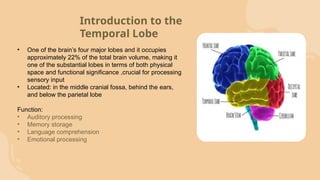
• One of the brain’s four major lobes and it occupies
approximately 22% of the total brain volume, making it
one of the substantial lobes in terms of both physical
space and functional significance ,crucial for processing
sensory input
• Located: in the middle cranial fossa, behind the ears,
and below the parietal lobe
Function:
• Auditory processing
• Memory storage
• Language comprehension
• Emotional processing
Auditory Processing
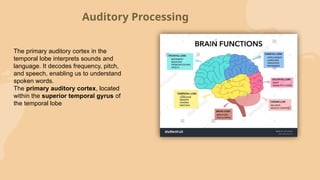
The primary auditory cortex in the
temporal lobe interprets sounds and
language. It decodes frequency, pitch,
and speech, enabling us to understand
spoken words.
The primary auditory cortex, located
within the superior temporal gyrus of
the temporal lobe
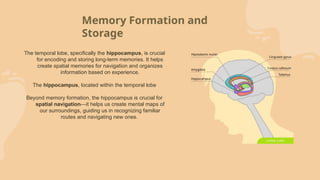
The temporal lobe, specifically the hippocampus, is crucial
for encoding and storing long-term memories. It helps
create spatial memories for navigation and organizes
information based on experience.
The hippocampus, located within the temporal lobe
Beyond memory formation, the hippocampus is crucial for
spatial navigation—it helps us create mental maps of
our surroundings, guiding us in recognizing familiar
routes and navigating new ones.
Memory Formation and
Storage
Emotional Processing & Language
Comprehension
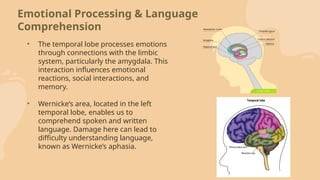
• The temporal lobe processes emotions
through connections with the limbic
system, particularly the amygdala. This
interaction influences emotional
reactions, social interactions, and
memory.
• Wernicke’s area, located in the left
temporal lobe, enables us to
comprehend spoken and written
language. Damage here can lead to
difficulty understanding language,
known as Wernicke’s aphasia.
Key Gyri of the Temporal
Lobe
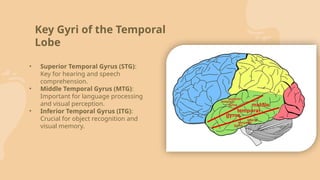
• Superior Temporal Gyrus (STG):
Key for hearing and speech
comprehension.
• Middle Temporal Gyrus (MTG):
Important for language processing
and visual perception.
• Inferior Temporal Gyrus (ITG):
Crucial for object recognition and
visual memory.
Borders of the Temporal
Lobe
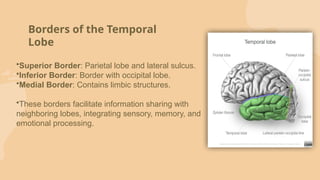
•Superior Border: Parietal lobe and lateral sulcus.
•Inferior Border: Border with occipital lobe.
•Medial Border: Contains limbic structures.
•These borders facilitate information sharing with
neighboring lobes, integrating sensory, memory, and
emotional processing.
Connectivity with Other
Lobes
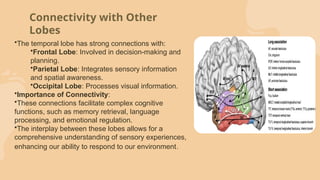
•The temporal lobe has strong connections with:
•Frontal Lobe: Involved in decision-making and
planning.
•Parietal Lobe: Integrates sensory information
and spatial awareness.
•Occipital Lobe: Processes visual information.
•Importance of Connectivity:
•These connections facilitate complex cognitive
functions, such as memory retrieval, language
processing, and emotional regulation.
•The interplay between these lobes allows for a
comprehensive understanding of sensory experiences,
enhancing our ability to respond to our environment.
Impact of Damage to the
Temporal Lobe
Memory loss or amnesia
Language comprehension issues (aphasia)
Emotional processing difficulties
Auditory processing challenges
Damage can affect everyday abilities, from recalling
memories to understanding language.
& Temporal Lobe Disorders
Temporal Lobe Epilepsy: Characterized by seizures originating in the
temporal lobe.
Alzheimer’s Disease: Affects the hippocampus, impacting memory.
Wernicke’s Aphasia: Difficulty understanding language due to damage in
Wernicke’s area.
REFRENCES :
1. National Institute of Neurological Disorders and Stroke (NINDS)
2. Frontiers in Human Neuroscience
3. PubMed Central (PMC)
temporal lobe and its function by ashmit.pptx

temporal lobe and its function by ashmit.pptx

  • 1.
    Temporal Lobe: Keyin Hearing, Memory, and Language By: Ashmit Tomar 332G
  • 2.
    Table of content: 1.Introduction to the Temporal Lobe 2. Auditory Processing 3. Memory Formation and Storage 4. Emotional Processing & Language Comprehension 5. Key Gyri of the Temporal Lobe 6. Borders of the Temporal Lobe 7. Connectivity with Other Lobes 8. Impact of Damage to the Temporal Lobe 9. Temporal Lobe Disorders 10. REFRENCES
  • 3.
    Introduction to the TemporalLobe • One of the brain’s four major lobes and it occupies approximately 22% of the total brain volume, making it one of the substantial lobes in terms of both physical space and functional significance ,crucial for processing sensory input • Located: in the middle cranial fossa, behind the ears, and below the parietal lobe Function: • Auditory processing • Memory storage • Language comprehension • Emotional processing
  • 4.
    Auditory Processing The primaryauditory cortex in the temporal lobe interprets sounds and language. It decodes frequency, pitch, and speech, enabling us to understand spoken words. The primary auditory cortex, located within the superior temporal gyrus of the temporal lobe
  • 5.
    The temporal lobe,specifically the hippocampus, is crucial for encoding and storing long-term memories. It helps create spatial memories for navigation and organizes information based on experience. The hippocampus, located within the temporal lobe Beyond memory formation, the hippocampus is crucial for spatial navigation—it helps us create mental maps of our surroundings, guiding us in recognizing familiar routes and navigating new ones. Memory Formation and Storage
  • 6.
    Emotional Processing &Language Comprehension • The temporal lobe processes emotions through connections with the limbic system, particularly the amygdala. This interaction influences emotional reactions, social interactions, and memory. • Wernicke’s area, located in the left temporal lobe, enables us to comprehend spoken and written language. Damage here can lead to difficulty understanding language, known as Wernicke’s aphasia.
  • 7.
    Key Gyri ofthe Temporal Lobe • Superior Temporal Gyrus (STG): Key for hearing and speech comprehension. • Middle Temporal Gyrus (MTG): Important for language processing and visual perception. • Inferior Temporal Gyrus (ITG): Crucial for object recognition and visual memory.
  • 8.
    Borders of theTemporal Lobe •Superior Border: Parietal lobe and lateral sulcus. •Inferior Border: Border with occipital lobe. •Medial Border: Contains limbic structures. •These borders facilitate information sharing with neighboring lobes, integrating sensory, memory, and emotional processing.
  • 9.
    Connectivity with Other Lobes •Thetemporal lobe has strong connections with: •Frontal Lobe: Involved in decision-making and planning. •Parietal Lobe: Integrates sensory information and spatial awareness. •Occipital Lobe: Processes visual information. •Importance of Connectivity: •These connections facilitate complex cognitive functions, such as memory retrieval, language processing, and emotional regulation. •The interplay between these lobes allows for a comprehensive understanding of sensory experiences, enhancing our ability to respond to our environment.
  • 10.
    Impact of Damageto the Temporal Lobe Memory loss or amnesia Language comprehension issues (aphasia) Emotional processing difficulties Auditory processing challenges Damage can affect everyday abilities, from recalling memories to understanding language. & Temporal Lobe Disorders Temporal Lobe Epilepsy: Characterized by seizures originating in the temporal lobe. Alzheimer’s Disease: Affects the hippocampus, impacting memory. Wernicke’s Aphasia: Difficulty understanding language due to damage in Wernicke’s area.
  • 11.
    REFRENCES : 1. NationalInstitute of Neurological Disorders and Stroke (NINDS) 2. Frontiers in Human Neuroscience 3. PubMed Central (PMC)