Early Cognitive
Abilities Related
to Learning
1
ozella.brundidge@gmail.com 9/26/2017
(The Regents of the University of Michigan, 2017)
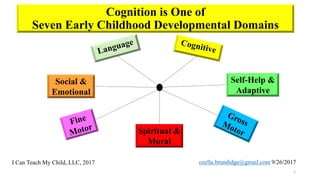
Cognition is One of
Seven Early Childhood Developmental Domains
2
Social &
Emotional
Self-Help &
Adaptive
Spiritual &
Moral
ozella.brundidge@gmail.com 9/26/2017I Can Teach My Child, LLC, 2017
LBW, PT birth, and SGA infants were more likely to have significantly lower performance on cognitive
skills underlying school readiness
3
(Caravale, Mirante, Vagnoni, & Vicari, 2012; Michel, Roethlisberger, Neuenschwander, & Robers, 2011; Rose,
Feldman, Jankowski, & Van Rossem, 2008)
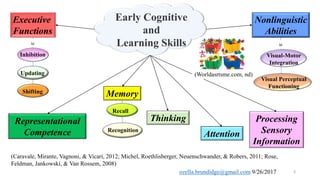
Early Cognitive
and
Learning Skills
Attention
Memory
Thinking Processing
Sensory
Information
ozella.brundidge@gmail.com 9/26/2017
Executive
Functions
Inhibition
Updating
Shifting
ie
Nonlinguistic
Abilities
ie
Visual-Motor
Integration
Visual Perceptual
Functioning
(Worldasrtsme.com, nd)
Recall
Recognition
Representational
Competence
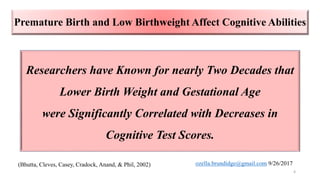
Researchers have Known for nearly Two Decades that
Lower Birth Weight and Gestational Age
were Significantly Correlated with Decreases in
Cognitive Test Scores.
(Bhutta, Cleves, Casey, Cradock, Anand, & Phil, 2002)
4
Premature Birth and Low Birthweight Affect Cognitive Abilities
ozella.brundidge@gmail.com 9/26/2017
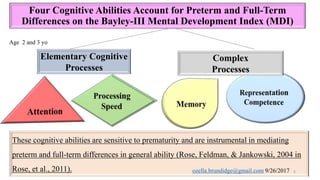
These cognitive abilities are sensitive to prematurity and are instrumental in mediating
preterm and full-term differences in general ability (Rose, Feldman, & Jankowski, 2004 in
Rose, et al., 2011).
Four Cognitive Abilities Account for Preterm and Full-Term
Differences on the Bayley-III Mental Development Index (MDI)
Elementary Cognitive
Processes
Complex
Processes
5
Age 2 and 3 yo
ozella.brundidge@gmail.com 9/26/2017
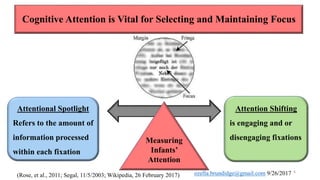
Cognitive Attention is Vital for Selecting and Maintaining Focus
Attention Shifting
is engaging and or
disengaging fixations
Attentional Spotlight
Refers to the amount of
information processed
within each fixation
(Rose, et al., 2011; Segal, 11/5/2003; Wikipedia, 26 February 2017)
Measuring
Infants’
Attention
6
ozella.brundidge@gmail.com 9/26/2017
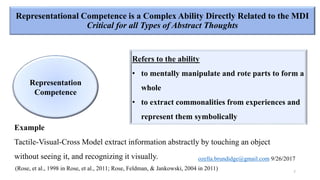
Representation
Competence
Refers to the ability
• to mentally manipulate and rote parts to form a
whole
• to extract commonalities from experiences and
represent them symbolically
Representational Competence is a Complex Ability Directly Related to the MDI
Critical for all Types of Abstract Thoughts
Example
Tactile-Visual-Cross Model extract information abstractly by touching an object
without seeing it, and recognizing it visually.
(Rose, et al., 1998 in Rose, et al., 2011; Rose, Feldman, & Jankowski, 2004 in 2011) 7
ozella.brundidge@gmail.com 9/26/2017
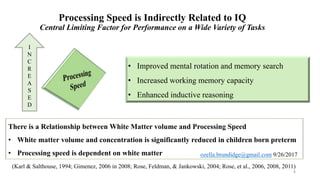
• Improved mental rotation and memory search
• Increased working memory capacity
• Enhanced inductive reasoning
Processing Speed is Indirectly Related to IQ
Central Limiting Factor for Performance on a Wide Variety of Tasks
I
N
C
R
E
A
S
E
D
There is a Relationship between White Matter volume and Processing Speed
• White matter volume and concentration is significantly reduced in children born preterm
• Processing speed is dependent on white matter
(Karl & Salthouse, 1994; Gimenez, 2006 in 2008; Rose, Feldman, & Jankowski, 2004; Rose, et al., 2006, 2008, 2011)
8
ozella.brundidge@gmail.com 9/26/2017
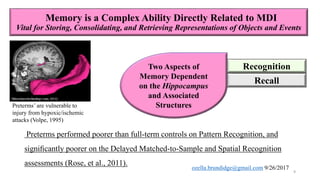
Memory is a Complex Ability Directly Related to MDI
Vital for Storing, Consolidating, and Retrieving Representations of Objects and Events
Recognition
Recall
Preterms performed poorer than full-term controls on Pattern Recognition, and
significantly poorer on the Delayed Matched-to-Sample and Spatial Recognition
assessments (Rose, et al., 2011).
Preterms’ are vulnerable to
injury from hypoxic/ischemic
attacks (Volpe, 1995)
Two Aspects of
Memory Dependent
on the Hippocampus
and Associated
Structures
9
ozella.brundidge@gmail.com 9/26/2017
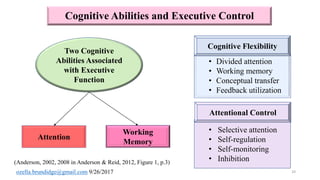
Cognitive Abilities and Executive Control
• Divided attention
• Working memory
• Conceptual transfer
• Feedback utilization
• Selective attention
• Self-regulation
• Self-monitoring
• Inhibition
Cognitive Flexibility
Attentional Control
(Anderson, 2002, 2008 in Anderson & Reid, 2012, Figure 1, p.3)
10
Two Cognitive
Abilities Associated
with Executive
Function
Attention
Working
Memory
ozella.brundidge@gmail.com 9/26/2017
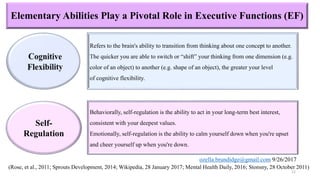
Elementary Abilities Play a Pivotal Role in Executive Functions (EF)
Self-
Regulation
Refers to the brain's ability to transition from thinking about one concept to another.
The quicker you are able to switch or “shift” your thinking from one dimension (e.g.
color of an object) to another (e.g. shape of an object), the greater your level
of cognitive flexibility.
Behaviorally, self-regulation is the ability to act in your long-term best interest,
consistent with your deepest values.
Emotionally, self-regulation is the ability to calm yourself down when you're upset
and cheer yourself up when you're down.
(Rose, et al., 2011; Sprouts Development, 2014; Wikipedia, 28 January 2017; Mental Health Daily, 2016; Stonsny, 28 October 2011)
11
ozella.brundidge@gmail.com 9/26/2017
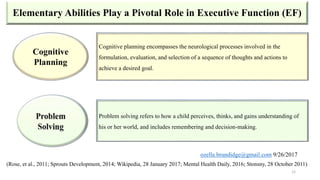
Elementary Abilities Play a Pivotal Role in Executive Function (EF)
Cognitive
Planning
Cognitive planning encompasses the neurological processes involved in the
formulation, evaluation, and selection of a sequence of thoughts and actions to
achieve a desired goal.
Problem solving refers to how a child perceives, thinks, and gains understanding of
his or her world, and includes remembering and decision-making.
(Rose, et al., 2011; Sprouts Development, 2014; Wikipedia, 28 January 2017; Mental Health Daily, 2016; Stonsny, 28 October 2011)
12
ozella.brundidge@gmail.com 9/26/2017
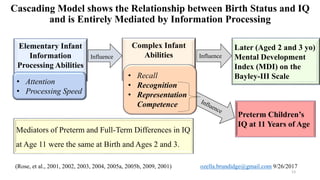
Cascading Model shows the Relationship between Birth Status and IQ
and is Entirely Mediated by Information Processing
Elementary Infant
Information
Processing Abilities
Complex Infant
Abilities
Later (Aged 2 and 3 yo)
Mental Development
Index (MDI) on the
Bayley-III Scale
Influence Influence
• Attention
• Processing Speed
Preterm Children’s
IQ at 11 Years of Age
Mediators of Preterm and Full-Term Differences in IQ
at Age 11 were the same at Birth and Ages 2 and 3.
(Rose, et al., 2001, 2002, 2003, 2004, 2005a, 2005b, 2009, 2001)
13
ozella.brundidge@gmail.com 9/26/2017
• Recall
• Recognition
• Representation
Competence
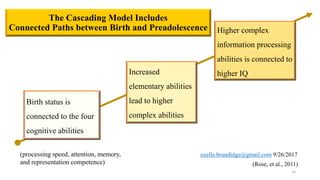
The Cascading Model Includes
Connected Paths between Birth and Preadolescence
Birth status is
connected to the four
cognitive abilities
Increased
elementary abilities
lead to higher
complex abilities
Higher complex
information processing
abilities is connected to
higher IQ
(processing speed, attention, memory,
and representation competence) (Rose, et al., 2011)
14
ozella.brundidge@gmail.com 9/26/2017
Cognitive and Neuropsychological Characteristics of Late
Preterm (34-36 GA) Preschoolers Born with Complications
Skills of LPT are
Associated with
Skills LPT are Not
Associated with
Visuospatial
(p=.005) Executive
Function
Visuomotor
(p=.012)
Noun Fluency
[p=.018]
Action-Verb Fluency
[p=.026]
Measured by
• Attention/Working Memory
• Receptive Language
• Expressive Language
• Nonverbal Reasoning
• Manual Coordination/
Dexterity Deficit
(Baron, Erickson, Ahronovich, Coulehan, Baker, & Litman, 2009) 15
ozella.brundidge@gmail.com 9/26/2017
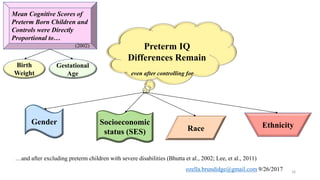
IQ differences remain even after controlling for gender, socioeconomic status (SES),
race, and ethnicity and after excluding children with severe disabilities from the
study population (Bhutta et al., 2002 in Lee, et a;., 2011)
16
Preterm IQ
Differences Remain
Gender Socioeconomic
status (SES) Race Ethnicity
…and after excluding preterm children with severe disabilities (Bhutta et al., 2002; Lee, et al., 2011)
even after controlling for
Mean Cognitive Scores of
Preterm Born Children and
Controls were Directly
Proportional to…
Birth
Weight
Gestational
Age
(2002)
ozella.brundidge@gmail.com 9/26/2017
Early Cognitive
Abilities Related
to Learning
17
ozella.brundidge@gmail.com 9/26/2017
(The Regents of the University of Michigan, 2017)
End of

Early cognitive abilities related to learning

  • 1.
    Early Cognitive Abilities Related toLearning 1 ozella.brundidge@gmail.com 9/26/2017 (The Regents of the University of Michigan, 2017)
  • 2.
    Cognition is Oneof Seven Early Childhood Developmental Domains 2 Social & Emotional Self-Help & Adaptive Spiritual & Moral ozella.brundidge@gmail.com 9/26/2017I Can Teach My Child, LLC, 2017
  • 3.
    LBW, PT birth,and SGA infants were more likely to have significantly lower performance on cognitive skills underlying school readiness 3 (Caravale, Mirante, Vagnoni, & Vicari, 2012; Michel, Roethlisberger, Neuenschwander, & Robers, 2011; Rose, Feldman, Jankowski, & Van Rossem, 2008) Early Cognitive and Learning Skills Attention Memory Thinking Processing Sensory Information ozella.brundidge@gmail.com 9/26/2017 Executive Functions Inhibition Updating Shifting ie Nonlinguistic Abilities ie Visual-Motor Integration Visual Perceptual Functioning (Worldasrtsme.com, nd) Recall Recognition Representational Competence
  • 4.
    Researchers have Knownfor nearly Two Decades that Lower Birth Weight and Gestational Age were Significantly Correlated with Decreases in Cognitive Test Scores. (Bhutta, Cleves, Casey, Cradock, Anand, & Phil, 2002) 4 Premature Birth and Low Birthweight Affect Cognitive Abilities ozella.brundidge@gmail.com 9/26/2017
  • 5.
    These cognitive abilitiesare sensitive to prematurity and are instrumental in mediating preterm and full-term differences in general ability (Rose, Feldman, & Jankowski, 2004 in Rose, et al., 2011). Four Cognitive Abilities Account for Preterm and Full-Term Differences on the Bayley-III Mental Development Index (MDI) Elementary Cognitive Processes Complex Processes 5 Age 2 and 3 yo ozella.brundidge@gmail.com 9/26/2017
  • 6.
    Cognitive Attention isVital for Selecting and Maintaining Focus Attention Shifting is engaging and or disengaging fixations Attentional Spotlight Refers to the amount of information processed within each fixation (Rose, et al., 2011; Segal, 11/5/2003; Wikipedia, 26 February 2017) Measuring Infants’ Attention 6 ozella.brundidge@gmail.com 9/26/2017
  • 7.
    Representation Competence Refers to theability • to mentally manipulate and rote parts to form a whole • to extract commonalities from experiences and represent them symbolically Representational Competence is a Complex Ability Directly Related to the MDI Critical for all Types of Abstract Thoughts Example Tactile-Visual-Cross Model extract information abstractly by touching an object without seeing it, and recognizing it visually. (Rose, et al., 1998 in Rose, et al., 2011; Rose, Feldman, & Jankowski, 2004 in 2011) 7 ozella.brundidge@gmail.com 9/26/2017
  • 8.
    • Improved mentalrotation and memory search • Increased working memory capacity • Enhanced inductive reasoning Processing Speed is Indirectly Related to IQ Central Limiting Factor for Performance on a Wide Variety of Tasks I N C R E A S E D There is a Relationship between White Matter volume and Processing Speed • White matter volume and concentration is significantly reduced in children born preterm • Processing speed is dependent on white matter (Karl & Salthouse, 1994; Gimenez, 2006 in 2008; Rose, Feldman, & Jankowski, 2004; Rose, et al., 2006, 2008, 2011) 8 ozella.brundidge@gmail.com 9/26/2017
  • 9.
    Memory is aComplex Ability Directly Related to MDI Vital for Storing, Consolidating, and Retrieving Representations of Objects and Events Recognition Recall Preterms performed poorer than full-term controls on Pattern Recognition, and significantly poorer on the Delayed Matched-to-Sample and Spatial Recognition assessments (Rose, et al., 2011). Preterms’ are vulnerable to injury from hypoxic/ischemic attacks (Volpe, 1995) Two Aspects of Memory Dependent on the Hippocampus and Associated Structures 9 ozella.brundidge@gmail.com 9/26/2017
  • 10.
    Cognitive Abilities andExecutive Control • Divided attention • Working memory • Conceptual transfer • Feedback utilization • Selective attention • Self-regulation • Self-monitoring • Inhibition Cognitive Flexibility Attentional Control (Anderson, 2002, 2008 in Anderson & Reid, 2012, Figure 1, p.3) 10 Two Cognitive Abilities Associated with Executive Function Attention Working Memory ozella.brundidge@gmail.com 9/26/2017
  • 11.
    Elementary Abilities Playa Pivotal Role in Executive Functions (EF) Self- Regulation Refers to the brain's ability to transition from thinking about one concept to another. The quicker you are able to switch or “shift” your thinking from one dimension (e.g. color of an object) to another (e.g. shape of an object), the greater your level of cognitive flexibility. Behaviorally, self-regulation is the ability to act in your long-term best interest, consistent with your deepest values. Emotionally, self-regulation is the ability to calm yourself down when you're upset and cheer yourself up when you're down. (Rose, et al., 2011; Sprouts Development, 2014; Wikipedia, 28 January 2017; Mental Health Daily, 2016; Stonsny, 28 October 2011) 11 ozella.brundidge@gmail.com 9/26/2017
  • 12.
    Elementary Abilities Playa Pivotal Role in Executive Function (EF) Cognitive Planning Cognitive planning encompasses the neurological processes involved in the formulation, evaluation, and selection of a sequence of thoughts and actions to achieve a desired goal. Problem solving refers to how a child perceives, thinks, and gains understanding of his or her world, and includes remembering and decision-making. (Rose, et al., 2011; Sprouts Development, 2014; Wikipedia, 28 January 2017; Mental Health Daily, 2016; Stonsny, 28 October 2011) 12 ozella.brundidge@gmail.com 9/26/2017
  • 13.
    Cascading Model showsthe Relationship between Birth Status and IQ and is Entirely Mediated by Information Processing Elementary Infant Information Processing Abilities Complex Infant Abilities Later (Aged 2 and 3 yo) Mental Development Index (MDI) on the Bayley-III Scale Influence Influence • Attention • Processing Speed Preterm Children’s IQ at 11 Years of Age Mediators of Preterm and Full-Term Differences in IQ at Age 11 were the same at Birth and Ages 2 and 3. (Rose, et al., 2001, 2002, 2003, 2004, 2005a, 2005b, 2009, 2001) 13 ozella.brundidge@gmail.com 9/26/2017 • Recall • Recognition • Representation Competence
  • 14.
    The Cascading ModelIncludes Connected Paths between Birth and Preadolescence Birth status is connected to the four cognitive abilities Increased elementary abilities lead to higher complex abilities Higher complex information processing abilities is connected to higher IQ (processing speed, attention, memory, and representation competence) (Rose, et al., 2011) 14 ozella.brundidge@gmail.com 9/26/2017
  • 15.
    Cognitive and NeuropsychologicalCharacteristics of Late Preterm (34-36 GA) Preschoolers Born with Complications Skills of LPT are Associated with Skills LPT are Not Associated with Visuospatial (p=.005) Executive Function Visuomotor (p=.012) Noun Fluency [p=.018] Action-Verb Fluency [p=.026] Measured by • Attention/Working Memory • Receptive Language • Expressive Language • Nonverbal Reasoning • Manual Coordination/ Dexterity Deficit (Baron, Erickson, Ahronovich, Coulehan, Baker, & Litman, 2009) 15 ozella.brundidge@gmail.com 9/26/2017
  • 16.
    IQ differences remaineven after controlling for gender, socioeconomic status (SES), race, and ethnicity and after excluding children with severe disabilities from the study population (Bhutta et al., 2002 in Lee, et a;., 2011) 16 Preterm IQ Differences Remain Gender Socioeconomic status (SES) Race Ethnicity …and after excluding preterm children with severe disabilities (Bhutta et al., 2002; Lee, et al., 2011) even after controlling for Mean Cognitive Scores of Preterm Born Children and Controls were Directly Proportional to… Birth Weight Gestational Age (2002) ozella.brundidge@gmail.com 9/26/2017
  • 17.
    Early Cognitive Abilities Related toLearning 17 ozella.brundidge@gmail.com 9/26/2017 (The Regents of the University of Michigan, 2017) End of

Editor's Notes

  • #3 Cognition is one of seven early childhood developmental domains. The other domains are: language, social and emotional, self-help and adaptive, spiritual and moral, fine motor, and gross motor.
  • #4 Early cognitive abilities include processing sensory information, attention, thinking, memory, representational competence, nonlinguistic, and executive functions. Michel, E., Roethlisberger, M., Neuenschwander, R., & Roebers, C. M. (2011). Development of Cognitive Skills in Children with Motor Coordination Impairments at 12-Month Follow-up. Child Neuropsychology: A Journal on Normal and Abnormal Development in Childhood and Adolescence, 17(2). doi: 10.1080/09297049.2010.525501 Worldartsme.com (nd). Hands on manipulatives. Retrieved from http://worldartsme.com/images/hands-on-manipulatives-clipart-1.jpg Wooden activity cube toy bead shape sorter xylophone clock educational toddler. Retrieved from https://i.ebayimg.com/00/s/ODAwWDYwMA==/z/3xwAAOSw4CFYx-Kb/$_58.JPG Dreamstimes (2017). Colorful train with happy smiling kid on and colorful pencils, playing blocks, ABC book, numbers for preschool active learning. Retrieved from https://teachingsexed.files.wordpress.com/2014/03/meaningful-engagement.jpg Ebay (2017). Children born preterm, small for gestational age, or with low birth weight have significantly lower cognitive school readiness after controlling for social factors and prenatal risks. Retrieved from https://www.ebay.co.uk/p/8189-active-cube-sun-preschool-learning-toys-by-legler/1934697559
  • #5 It is well accepted that premature birth and low birthweight affect cognitive abilities.
  • #6 The four cognitive abilities which account for preterm and full-term differences on the mental development index (MDI) are attention, processing speed, memory, and representation competence.
  • #7 Cognitive attention is vital for selecting and maintaining focus on perceived information experienced by the senses. Wikipedia (26 February 2017). Attention. https://en.wikipedia.org/wiki/Attention
  • #8 Representational competence is a complex ability directly related to the MDI.
  • #9 Processing speed is indirectly related to the intelligence quotient (IQ).
  • #10 Memory is also a complex ability directly related to MDI.
  • #11 Attention and working memory are cognitive abilities associated with Executive control.
  • #12 The elementary abilities that play a pivotal role in executive functions are cognitive flexibility, self-regulation, cognitive planning, and problem solving. Cognitive flexibility – from Mental Health Daily Mental Health Blog (2016). What Is Cognitive Flexibility http://mentalhealthdaily.com/2015/07/24/ what-is-cognitive-flexibility/ Self-regulation – Stosny, S. (Oct 28, 2011). Self-Regulation-To feel better, focus on what is most important. Psychology Today blog. Retrieved from https://www.psychology today.com/blog/anger-in-the-age-entitlement/201110/self-regulation Cognitive planning – Wikipedia (28 January 2017). Planning (cognitive). Retrieved from https://en.wikipedia.org/wiki/Planning_(cognitive) Problem solving – Sprouts Development (2014). Problem Solving Skills. Retrieved from http://sproutsdevelopment.com/resources/problem-solving/
  • #13  Cognitive flexibility – from Mental Health Daily Mental Health Blog (2016). What Is Cognitive Flexibility http://mentalhealthdaily.com/2015/07/24/ what-is-cognitive-flexibility/ Self-regulation – Stosny, S. (Oct 28, 2011). Self-Regulation-To feel better, focus on what is most important. Psychology Today blog. Retrieved from https://www.psychology today.com/blog/anger-in-the-age-entitlement/201110/self-regulation Cognitive planning – Wikipedia (28 January 2017). Planning (cognitive). Retrieved from https://en.wikipedia.org/wiki/Planning_(cognitive) Problem solving – Sprouts Development (2014). Problem Solving Skills. Retrieved from http://sproutsdevelopment.com/resources/problem-solving/
  • #14 The Cascading Model shows that elementary infant information processing abilities influence complex infant abilities, also which influence MDI scores at 2 and 3-years of age and preterm preadolescence children’s IQ.
  • #15 The Cascading Model revealed connected paths between cognitive abilities at birth and high complex information processes associated with IQ.
  • #16 Researchers have found that cognitive and neuropsychological characteristics of late preterm preschoolers born with complications are visuospatial, visuomotor, and executive function. LPT birth was associated with visuospatial (p=.005), visuomotor (p=.012), and executive function (noun [p=.018] and action-verb [p=.026] fluency) relative deficits, but not attention/working memory, receptive or expressive language, nonverbal reasoning, or manual coordination/dexterity deficit.
  • #17 Preterm IQ differences remain even after controlling for gender, socioeconomic status, race, and ethnicity.
  • #18 Linkedin Essay Cognition is one of seven early childhood developmental domains. The other domains are: language, social and emotional, self-help and adaptive, spiritual and moral, fine motor, and gross motor. Early cognitive abilities include processing sensory information, attention, thinking, memory, representational competence, nonlinguistic, and executive functions. It is well accepted that premature birth and low birthweight affect cognitive abilities. The four cognitive abilities which account for preterm and full-term differences on the Baylor mental development index (MDI) are attention, processing speed, memory, and representation competence. Cognitive attention is vital for selecting and maintaining focus on perceived information experienced by the senses. Representational Competence is a complex ability directly related to the MDI. While Processing speed is indirectly related to the intelligence quotient (IQ), and Memory is also a complex ability directly related to MDI. The elementary abilities that play a pivotal role in executive functions are cognitive flexibility, self-regulation, cognitive planning, and problem solving. Attention and working memory are cognitive abilities associated with Executive control. The Cascading Model shows that elementary infant information processing abilities influence complex infant abilities, also influence MDI scores at 2 and 3-years of age and preterm preadolescence children’s IQ. The Cascading Model revealed connected paths between cognitive abilities at birth and high complex information processes associated with IQ. Researchers have found that cognitive and neuropsychological characteristics of late preterm preschoolers born with complications are visuospatial, visuomotor, and executive function. Preterm IQ differences remain even after controlling for gender, socioeconomic status, race, and ethnicity.