Effects of Premature Birth on Neurocognitive Development and Academic
Performance: Longitudinal IEP Review of PT and SGA Student
Alamy, 2015; Beery, Buktenic , 2011; Woodcock-Johnson III Normative Update (NU) Complete, 1Ozella Brundidge 4/1/2017
Epidemiology of Preterm Birth
“Preterm birth is the most frequent cause of infant mortality, as well as the leading
cause of long term neurologic disabilities in children, including cerebral palsy and
developmental delays” (Shapiro-Mendoza & Lackritz, 2012, p. 120).
2
Preterm birth is an increasing public health problem in developed countries.2,5,6
3
Preterm Birth is an Increasing Public Health
Problem in the United States and
Developed Countries.
Cserjesi, Van Braeckel, Butcher, Kerstjens, Reijneveld, Bouma, Geuze, 2012; Goldenberg, Culhane, Iams, Romero,
2008 in 2012; Kramer, Demissie, Yang, Platt, Sauvé, Liston, 2000 in 2012; van Baar, Vermaas, Knots, de Kleine,
Soons, 2009 in 2012; Shapiro-Mendoza & Lackritz, 2012)
(Harrison-Dunn, 2016)
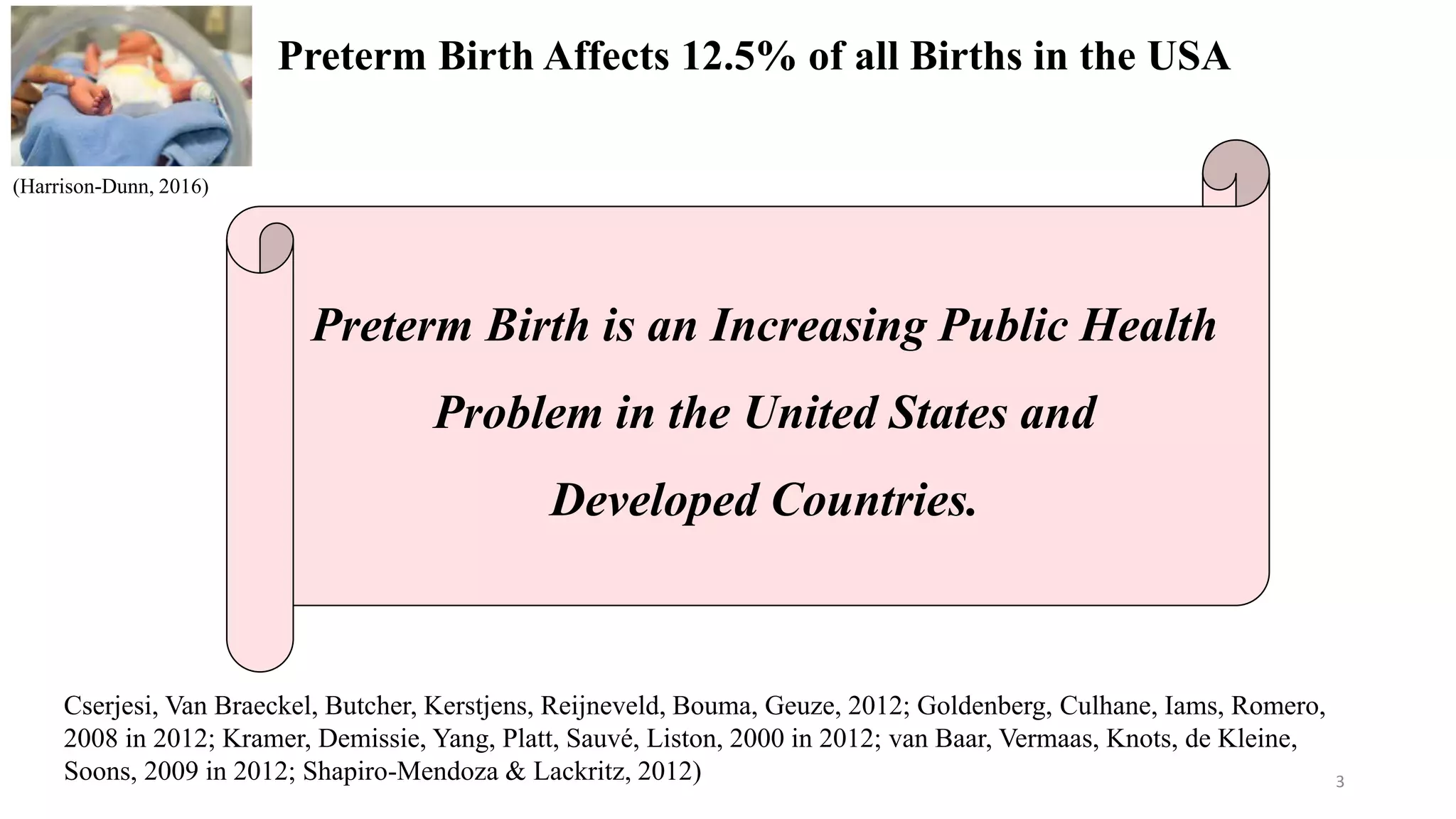
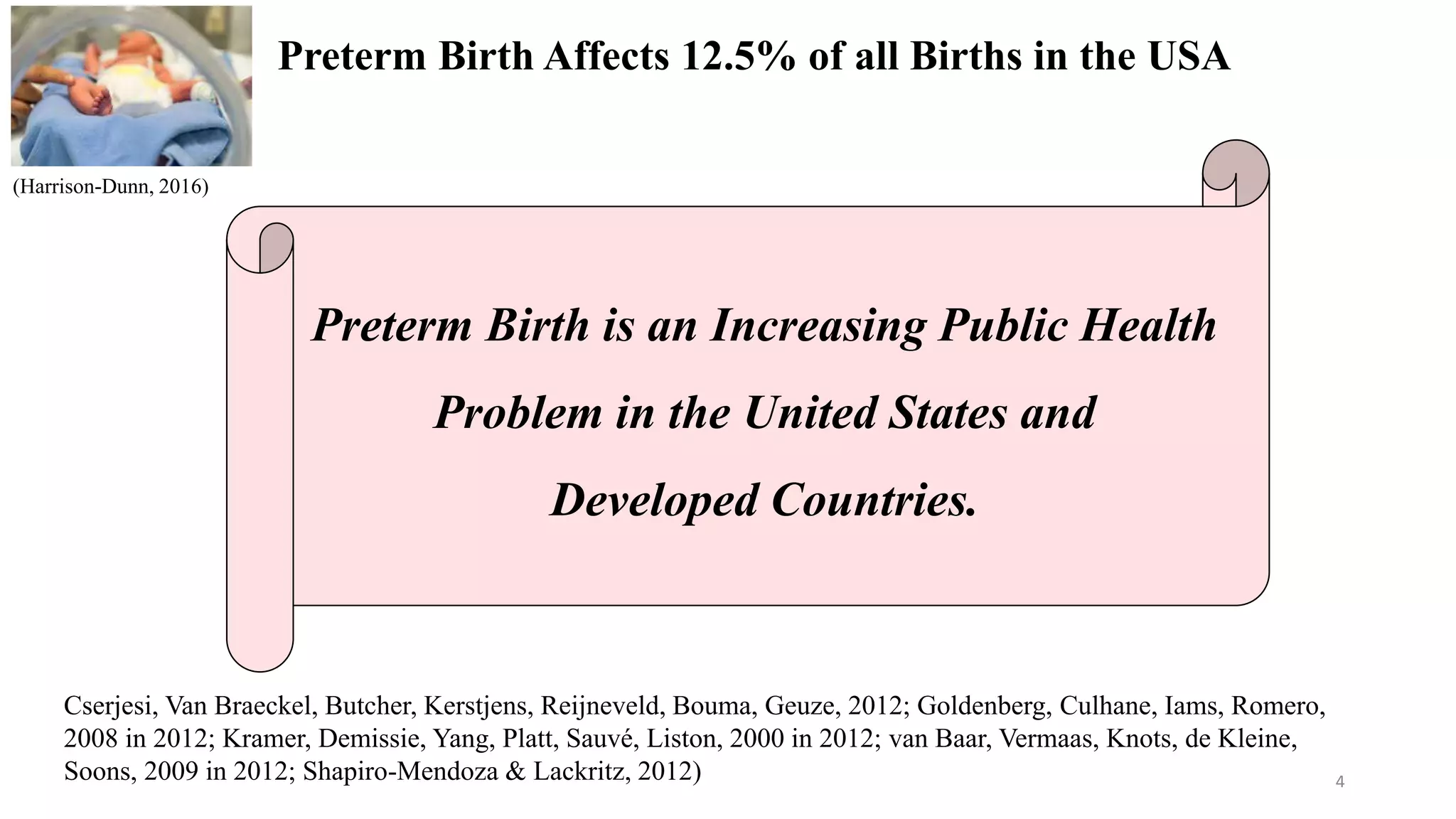
Preterm Birth Affects 12.5% of all Births in the USA
Preterm birth is an increasing public health problem in developed countries.2,5,6
4
Preterm Birth is an Increasing Public Health
Problem in the United States and
Developed Countries.
Cserjesi, Van Braeckel, Butcher, Kerstjens, Reijneveld, Bouma, Geuze, 2012; Goldenberg, Culhane, Iams, Romero,
2008 in 2012; Kramer, Demissie, Yang, Platt, Sauvé, Liston, 2000 in 2012; van Baar, Vermaas, Knots, de Kleine,
Soons, 2009 in 2012; Shapiro-Mendoza & Lackritz, 2012)
(Harrison-Dunn, 2016)
Preterm Birth Affects 12.5% of all Births in the USA
Preterm Infants are being Delivered at an Increasingly Early Gestational Age
5
Reasons for the Increase in Preterm Deliveries Include:
 An increase in elective deliveries for medical indications
 Increased use of caesarean section
(Kerr-Wilson, Mackay, Smith, & Pell, 2011 Meta-analysis citations: Howson, Merialdi, Lawn, et al., 2009; Noman, Morris,
& Chalmers, 2009; Goldenberg, Culhane, Iams, et al., 2008)
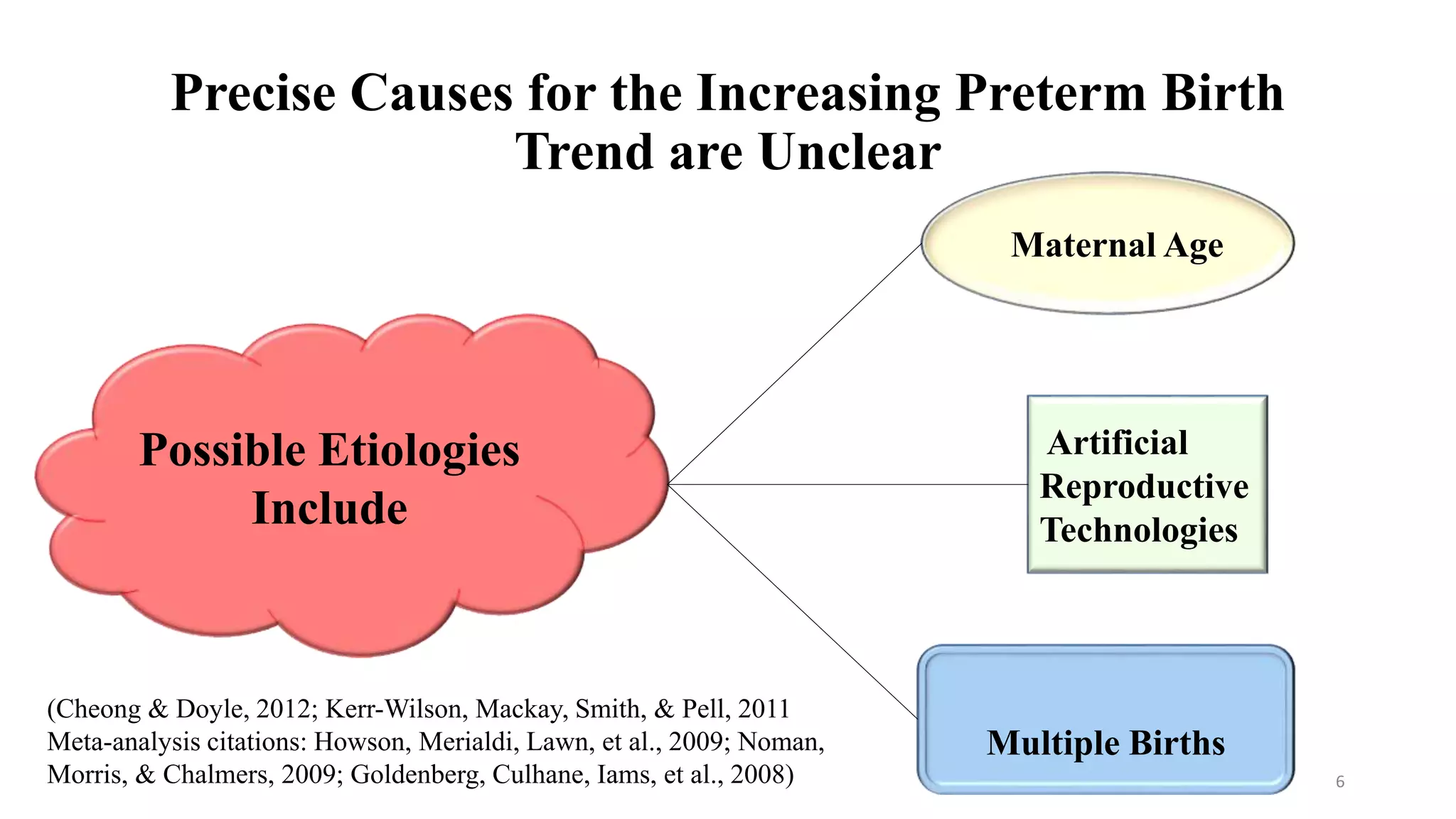
Precise Causes for the Increasing Preterm Birth
Trend are Unclear
6
Possible Etiologies
Include
Maternal Age
Artificial
Reproductive
Technologies
Multiple Births
(Cheong & Doyle, 2012; Kerr-Wilson, Mackay, Smith, & Pell, 2011
Meta-analysis citations: Howson, Merialdi, Lawn, et al., 2009; Noman,
Morris, & Chalmers, 2009; Goldenberg, Culhane, Iams, et al., 2008)
late preterm children not only have increased mortality and in-hospital morbidity including respiratory difficulties, but also
long-term cognitive, school performance, behaviour and psychiatric problems.
7(Cheong & Doyle, 2012)
Compared to Term,
Late Preterm
Children
have
Mortality
In-Hospital
Morbidity
Long-Term
Cognitive
Problems
School
Performance
Psychiatric
Problems
Behaviour
Problems
more
more
moreincreased
increased
poorer
The Practice of Delivering Infants Early when they Can be Delivered at Full-Term may Represent a
Larger Societal Burden than Previously Recognized
8(Lipkind, et al., 2012; Bastek, Sammel, Srinivas, Posencheg, & Elovitz, 2008 in 2012)
Evidence suggest that infants born late preterm have similar risks of adverse neonatal
morbidities as preterm infants delivered at 32-33+6 weeks’gestation.
The Practice of Delivering Infants Early when they
Can be Delivered at Full-Term may Represent a
Larger Societal Burden than Previously Recognized
(Montgomery, n.d.)
A Full 40-Week Gestation can help Prevent
Future Academic Difficulties
9
Late Preterm (LPT) Born Children are Not Reaching their
Full Academic Potential, and Require Additional Educational
Services that Might have been Avoided.
(Aeby, Van Bogaert, David, Baleriaux, Vermeylen, Metens, & De Tiege, 2012; Lipkind, et al., 2012; Bastek,
Sammel, Srinivas, Posencheg, & Elovitz, 2008 in 2012)
Evidence suggest that infants born late preterm (34-36+6 weeks’gestation) have similar
risks of adverse neonatal morbidities as moderate preterm infants delivered at 32-33+6
weeks’gestation.
The rising incidence and the possibility of long-term developmental impairments have triggered
growing concerns about the economic consequences of moderate prematurity for society.7,8
10
The increasing cases of moderate preterm (32-33 GA)
children with long-term developmental impairments have
triggered growing concerns about the medical, education,
and economic consequences for society.
(Jain, 2008; Stephens & Vohr, 2009)
(Kerstjens, et al., 2011; Mangham, Petrou, Doyle, Draper, Marlow, 2009 in 2011; Jain, 2008 in 2011)
(Brankin, n.d.)
A Normal Gestation Lasts 40 Weeks. Each year, Nearly 15 Million Infants are Born Premature
Worldwide.
11
A Normal Gestation Lasts 40 Weeks.
Each Year, Nearly 15 Million Infants
are Born Premature Worldwide.
(Barde, Yeatman, Lee, Glover, & Feldman, 2012; Noort-van der Speek, M.C. Franken, N.Weisglas-Kuperus, 2012 in
Ribeiro, C. D, Atramindes, D. V., Fuertes, M. G., dos Santos, P. N., Lamonica, D. A. (2016)
Meredith Woman's Corporation (2017)
the early interruption of the typical course of
pregnancy can lead to structural and anatomic
changes of the central nervous system
12
(Ribeiro, Abramides, Fuertes, Santos, Lamonica, 2016; Maria-Mengel & Linhares, 2007 in 2016; Reidy, et al., 2013 in
2016; Wohr, 2013 in 2016; Samra, et al., 2011 in 2016; Ballot, et al., 2012 in 2016; Ortiz-Mantilla, et al., 2008 in 2016)
Prematurity is Considered a Biological Risk Factor for
Atypical Developmental Trajectories
(123rf.com, 2017)
Early Interruption of the Typical
9.5 Month Course of Pregnancy can
Lead to Structural, Anatomic, &
Biological Changes in the Neonate’s
Central Nervous Center
(Study.com, 2017)
The Impact of Stress, Race, Poverty, and
Related Environmental Factors on Fetal Development
• Experience disproportionately high rates
of preterm delivery and low birth weight
• Are more than twice as likely to die during
their 1st year of life than White American
infants.
(Giscombé & Lobel, 2005; Myhre & Myhre, 2011)
13
African American Infants
Factors Associated with Ethnic Differences in
Adverse Birth Outcomes
• Ethnicity, socioeconomic status (SES), and health behaviors
• Higher levels of stress in African American women
• Greater vulnerability to stress in African Americans
• The impact of racism as a contributor to stress or as a
factor that exacerbates stress effects
• Ethnic differences in stress-related neuroendocrine,
vascular, and immunological processes.
14
(Giscombé & Lobel, 2005)
(Etsy, Inc., 2017)
Infants of African American
Mothers are Disproportionately
Affected by Premature Deliveries
• 1.5 times the risk of preterm birth
• 3.4 times the risk of preterm-related
mortality
15
(Shapiro-Mendoza & Lackritz, 2012; ClipartFest, 2016)
Late Preterm Infants (34-36 weeks gestation) Account for up to 75%
of Preterm Births and make up a significant proportion of all
neonatal admissions.
16
Neonatal Intensive Care Unit (NICU) Admission by
Race 2009-2010
Late Preterm Infants (34-36 weeks gestation) Account for up to 75%
of Preterm Births and make up a significant proportion of all
neonatal admissions.
17(Davidoff, Dias, Damus, et al., 2006 in McGowan, et al., 2012
Late Preterm Infants (34-36 𝟔
𝟕 weeks)
make up a Significant Proportion of all
Neonatal Intensive Care Admissions.
Over 400,000 Infants were Born Premature in the United States in 2013
The percentage of preterm births in the United States by race and Hispanic origin in 2013 (CDC, 2015).
According to the
Center for Disease
Control and
Prevention (CDC),
16.3% of all African
American Infants
were Born Preterm in
2013 (CDC, 2015).
18
Absence of Prospective Data on Late Preterm Outcomes
• Late preterm (LPT) infants have been ignored in follow-up, because
they were thought to be at low risk for permanent impairments.
• Since LPTs are prone to having temporary clinical problems, this may
have led to a less rigorous approach to their perinatal and postnatal
management, and to the absence of prospective data sets that track
outcomes.
19
Jain, 2008
Decreasing Gestational Age is Associated with
Neuropsychological Deficits
20(Bhutta, Cleves, Casey, Cradock, Anand, 2002 in Cserjesi, et al., 2012)
• The mean cognitive scores of preterm-born cases and term-born controls
were directly proportional to their birth weight (R2 = 0.51; P<.001) and
gestational age (R2 = 0.49; P<.001).
• Preterm-born children also showed increases in externalizing and
internalizing behaviors in 81% of studies, and had more than twice the
relative risks for developing ADHD (pooled RR, 2.64; 95% CI, 1.85-3.78).
Bhutta and colleagues’ (2002) previous study findings:
Moderately preterm infants born at ≥32 weeks’ gestational age (GA) currently
make up over 80% of all preterm births in developed countries
21(Stichting Perinatale Registratie Nederland, 2008 in Cserjesi, et al., 2012; Agarwal & Jain, Oct 19, 2013)
Moderately Preterm Infants Born at ≥32 weeks’
Gestational Age (GA) made up over 80% of all
preterm births in developed countries in 2006
Preterm Birth Effects 12.5% of all Births in the USA
22(Shapiro-Mendoza & Lack, 2012)
The preterm birth rate has increased by 33% in the last 25 years,
primarily due to the rise in late preterm births (34-36 weeks' gestation).
Infants of African American Mothers are Disproportionately Affected
 1.5 times the risk of preterm birth
 3.4 times the risk of preterm-related mortality
The Potential Risk for Preterm Birth as a Result of Exposure to Environmental Pollutants is
Poorly Understood
23
Environmental chemical pollutants, such as the
neurotoxin lead, tobacco smoke, and air pollutants are
suspects to contributing higher rates of preterm births
among African Americans living in inner cities or near
toxic waste sites.
The Potential Risk for Preterm Birth as a Result of Exposure
to Environmental Pollutants is Poorly Understood
(Behrman & Butler, 2007; thegirlwiththeblog, 2013 March 12; Fresh Water Systems.com,2017)
End of
Epidemiology of Preterm Birth
24

Epidemiology of Preterm Birth

  • 1.
    Effects of PrematureBirth on Neurocognitive Development and Academic Performance: Longitudinal IEP Review of PT and SGA Student Alamy, 2015; Beery, Buktenic , 2011; Woodcock-Johnson III Normative Update (NU) Complete, 1Ozella Brundidge 4/1/2017
  • 2.
    Epidemiology of PretermBirth “Preterm birth is the most frequent cause of infant mortality, as well as the leading cause of long term neurologic disabilities in children, including cerebral palsy and developmental delays” (Shapiro-Mendoza & Lackritz, 2012, p. 120). 2
  • 3.
    Preterm birth isan increasing public health problem in developed countries.2,5,6 3 Preterm Birth is an Increasing Public Health Problem in the United States and Developed Countries. Cserjesi, Van Braeckel, Butcher, Kerstjens, Reijneveld, Bouma, Geuze, 2012; Goldenberg, Culhane, Iams, Romero, 2008 in 2012; Kramer, Demissie, Yang, Platt, Sauvé, Liston, 2000 in 2012; van Baar, Vermaas, Knots, de Kleine, Soons, 2009 in 2012; Shapiro-Mendoza & Lackritz, 2012) (Harrison-Dunn, 2016) Preterm Birth Affects 12.5% of all Births in the USA
  • 4.
    Preterm birth isan increasing public health problem in developed countries.2,5,6 4 Preterm Birth is an Increasing Public Health Problem in the United States and Developed Countries. Cserjesi, Van Braeckel, Butcher, Kerstjens, Reijneveld, Bouma, Geuze, 2012; Goldenberg, Culhane, Iams, Romero, 2008 in 2012; Kramer, Demissie, Yang, Platt, Sauvé, Liston, 2000 in 2012; van Baar, Vermaas, Knots, de Kleine, Soons, 2009 in 2012; Shapiro-Mendoza & Lackritz, 2012) (Harrison-Dunn, 2016) Preterm Birth Affects 12.5% of all Births in the USA
  • 5.
    Preterm Infants arebeing Delivered at an Increasingly Early Gestational Age 5 Reasons for the Increase in Preterm Deliveries Include:  An increase in elective deliveries for medical indications  Increased use of caesarean section (Kerr-Wilson, Mackay, Smith, & Pell, 2011 Meta-analysis citations: Howson, Merialdi, Lawn, et al., 2009; Noman, Morris, & Chalmers, 2009; Goldenberg, Culhane, Iams, et al., 2008)
  • 6.
    Precise Causes forthe Increasing Preterm Birth Trend are Unclear 6 Possible Etiologies Include Maternal Age Artificial Reproductive Technologies Multiple Births (Cheong & Doyle, 2012; Kerr-Wilson, Mackay, Smith, & Pell, 2011 Meta-analysis citations: Howson, Merialdi, Lawn, et al., 2009; Noman, Morris, & Chalmers, 2009; Goldenberg, Culhane, Iams, et al., 2008)
  • 7.
    late preterm childrennot only have increased mortality and in-hospital morbidity including respiratory difficulties, but also long-term cognitive, school performance, behaviour and psychiatric problems. 7(Cheong & Doyle, 2012) Compared to Term, Late Preterm Children have Mortality In-Hospital Morbidity Long-Term Cognitive Problems School Performance Psychiatric Problems Behaviour Problems more more moreincreased increased poorer
  • 8.
    The Practice ofDelivering Infants Early when they Can be Delivered at Full-Term may Represent a Larger Societal Burden than Previously Recognized 8(Lipkind, et al., 2012; Bastek, Sammel, Srinivas, Posencheg, & Elovitz, 2008 in 2012) Evidence suggest that infants born late preterm have similar risks of adverse neonatal morbidities as preterm infants delivered at 32-33+6 weeks’gestation. The Practice of Delivering Infants Early when they Can be Delivered at Full-Term may Represent a Larger Societal Burden than Previously Recognized (Montgomery, n.d.)
  • 9.
    A Full 40-WeekGestation can help Prevent Future Academic Difficulties 9 Late Preterm (LPT) Born Children are Not Reaching their Full Academic Potential, and Require Additional Educational Services that Might have been Avoided. (Aeby, Van Bogaert, David, Baleriaux, Vermeylen, Metens, & De Tiege, 2012; Lipkind, et al., 2012; Bastek, Sammel, Srinivas, Posencheg, & Elovitz, 2008 in 2012) Evidence suggest that infants born late preterm (34-36+6 weeks’gestation) have similar risks of adverse neonatal morbidities as moderate preterm infants delivered at 32-33+6 weeks’gestation.
  • 10.
    The rising incidenceand the possibility of long-term developmental impairments have triggered growing concerns about the economic consequences of moderate prematurity for society.7,8 10 The increasing cases of moderate preterm (32-33 GA) children with long-term developmental impairments have triggered growing concerns about the medical, education, and economic consequences for society. (Jain, 2008; Stephens & Vohr, 2009) (Kerstjens, et al., 2011; Mangham, Petrou, Doyle, Draper, Marlow, 2009 in 2011; Jain, 2008 in 2011) (Brankin, n.d.)
  • 11.
    A Normal GestationLasts 40 Weeks. Each year, Nearly 15 Million Infants are Born Premature Worldwide. 11 A Normal Gestation Lasts 40 Weeks. Each Year, Nearly 15 Million Infants are Born Premature Worldwide. (Barde, Yeatman, Lee, Glover, & Feldman, 2012; Noort-van der Speek, M.C. Franken, N.Weisglas-Kuperus, 2012 in Ribeiro, C. D, Atramindes, D. V., Fuertes, M. G., dos Santos, P. N., Lamonica, D. A. (2016) Meredith Woman's Corporation (2017)
  • 12.
    the early interruptionof the typical course of pregnancy can lead to structural and anatomic changes of the central nervous system 12 (Ribeiro, Abramides, Fuertes, Santos, Lamonica, 2016; Maria-Mengel & Linhares, 2007 in 2016; Reidy, et al., 2013 in 2016; Wohr, 2013 in 2016; Samra, et al., 2011 in 2016; Ballot, et al., 2012 in 2016; Ortiz-Mantilla, et al., 2008 in 2016) Prematurity is Considered a Biological Risk Factor for Atypical Developmental Trajectories (123rf.com, 2017) Early Interruption of the Typical 9.5 Month Course of Pregnancy can Lead to Structural, Anatomic, & Biological Changes in the Neonate’s Central Nervous Center (Study.com, 2017)
  • 13.
    The Impact ofStress, Race, Poverty, and Related Environmental Factors on Fetal Development • Experience disproportionately high rates of preterm delivery and low birth weight • Are more than twice as likely to die during their 1st year of life than White American infants. (Giscombé & Lobel, 2005; Myhre & Myhre, 2011) 13 African American Infants
  • 14.
    Factors Associated withEthnic Differences in Adverse Birth Outcomes • Ethnicity, socioeconomic status (SES), and health behaviors • Higher levels of stress in African American women • Greater vulnerability to stress in African Americans • The impact of racism as a contributor to stress or as a factor that exacerbates stress effects • Ethnic differences in stress-related neuroendocrine, vascular, and immunological processes. 14 (Giscombé & Lobel, 2005) (Etsy, Inc., 2017)
  • 15.
    Infants of AfricanAmerican Mothers are Disproportionately Affected by Premature Deliveries • 1.5 times the risk of preterm birth • 3.4 times the risk of preterm-related mortality 15 (Shapiro-Mendoza & Lackritz, 2012; ClipartFest, 2016)
  • 16.
    Late Preterm Infants(34-36 weeks gestation) Account for up to 75% of Preterm Births and make up a significant proportion of all neonatal admissions. 16 Neonatal Intensive Care Unit (NICU) Admission by Race 2009-2010
  • 17.
    Late Preterm Infants(34-36 weeks gestation) Account for up to 75% of Preterm Births and make up a significant proportion of all neonatal admissions. 17(Davidoff, Dias, Damus, et al., 2006 in McGowan, et al., 2012 Late Preterm Infants (34-36 𝟔 𝟕 weeks) make up a Significant Proportion of all Neonatal Intensive Care Admissions.
  • 18.
    Over 400,000 Infantswere Born Premature in the United States in 2013 The percentage of preterm births in the United States by race and Hispanic origin in 2013 (CDC, 2015). According to the Center for Disease Control and Prevention (CDC), 16.3% of all African American Infants were Born Preterm in 2013 (CDC, 2015). 18
  • 19.
    Absence of ProspectiveData on Late Preterm Outcomes • Late preterm (LPT) infants have been ignored in follow-up, because they were thought to be at low risk for permanent impairments. • Since LPTs are prone to having temporary clinical problems, this may have led to a less rigorous approach to their perinatal and postnatal management, and to the absence of prospective data sets that track outcomes. 19 Jain, 2008
  • 20.
    Decreasing Gestational Ageis Associated with Neuropsychological Deficits 20(Bhutta, Cleves, Casey, Cradock, Anand, 2002 in Cserjesi, et al., 2012) • The mean cognitive scores of preterm-born cases and term-born controls were directly proportional to their birth weight (R2 = 0.51; P<.001) and gestational age (R2 = 0.49; P<.001). • Preterm-born children also showed increases in externalizing and internalizing behaviors in 81% of studies, and had more than twice the relative risks for developing ADHD (pooled RR, 2.64; 95% CI, 1.85-3.78). Bhutta and colleagues’ (2002) previous study findings:
  • 21.
    Moderately preterm infantsborn at ≥32 weeks’ gestational age (GA) currently make up over 80% of all preterm births in developed countries 21(Stichting Perinatale Registratie Nederland, 2008 in Cserjesi, et al., 2012; Agarwal & Jain, Oct 19, 2013) Moderately Preterm Infants Born at ≥32 weeks’ Gestational Age (GA) made up over 80% of all preterm births in developed countries in 2006
  • 22.
    Preterm Birth Effects12.5% of all Births in the USA 22(Shapiro-Mendoza & Lack, 2012) The preterm birth rate has increased by 33% in the last 25 years, primarily due to the rise in late preterm births (34-36 weeks' gestation). Infants of African American Mothers are Disproportionately Affected  1.5 times the risk of preterm birth  3.4 times the risk of preterm-related mortality
  • 23.
    The Potential Riskfor Preterm Birth as a Result of Exposure to Environmental Pollutants is Poorly Understood 23 Environmental chemical pollutants, such as the neurotoxin lead, tobacco smoke, and air pollutants are suspects to contributing higher rates of preterm births among African Americans living in inner cities or near toxic waste sites. The Potential Risk for Preterm Birth as a Result of Exposure to Environmental Pollutants is Poorly Understood (Behrman & Butler, 2007; thegirlwiththeblog, 2013 March 12; Fresh Water Systems.com,2017)
  • 24.
    End of Epidemiology ofPreterm Birth 24

Editor's Notes

  • #2 Alamy (2015). African American boy writing in a classroom in Washington DC. Retrieved from http://www.alamy.com/stock-photo-african-american-boy-writing-in-a-classroom-in-washington-dc-34085287.html Woodcock-Johnson® III Normative Update (NU) Complete (2015). http://www.riverpub.com/products/wjIIIComplete/ Beery-Buktenica Developmental Test of Visual-Motor Integration, 6th Edition (BEERY™ VMI 6) 2010 | Beery, Keith E., Buktenica, Norman A., and Beery, Natasha A. http://www.pearsonassess.ca/en/programs/00/62/35/p006235.html?prodCategory=ot-motor-visual-motor Bender Visual-Motor Gestalt Test, Second Edition (Bender-Gestalt II) Lauretta Bender, MD, the American Orthopsychiatric Association, Inc., Revised by Scott L. Decker, PhD, Gary G. Brannigan http://www.pearsonclinical.com/psychology/products/100000190/bender-visual-motor-gestalt-test-second-edition-bender-gestalt-ii.html
  • #3 Shapiro-Mendoza, C. K. & Lackritz, E. M. (2012). Epidemiology of late and moderate preterm birth. Semin Fetal Neonatal Med. 2012 June ; 17(3): 120–125. doi:10.1016/j.siny.2012.01.007
  • #4 Harrison-Dunn, A. (26 November 2016). Study quashes claim probiotic reduces NEC, sepsis & death in preterm infants, Image of baby in incubator. http://www.nutraingredients.com/var/plain_site/storage/images/publications/food-beverage-nutrition/nutraingredients.com/research/study-quashes-claim-probiotic-reduces-nec-sepsis-death-in-preterm-infants/10377543-1-eng-GB/Study-quashes-claim-probiotic-reduces-NEC-sepsis-death-in-preterm-infants.jpg
  • #5 Harrison-Dunn, A. (26 November 2016). Study quashes claim probiotic reduces NEC, sepsis & death in preterm infants, Image of baby in incubator. http://www.nutraingredients.com/var/plain_site/storage/images/publications/food-beverage-nutrition/nutraingredients.com/research/study-quashes-claim-probiotic-reduces-nec-sepsis-death-in-preterm-infants/10377543-1-eng-GB/Study-quashes-claim-probiotic-reduces-NEC-sepsis-death-in-preterm-infants.jpg
  • #6 1 Howson CP, Merialdi M, Lawn JE et al. White Paper on Preterm Birth: The Global and Regional Toll. New York: March of the Dimes Foundation, 2009. www.marchofthedimes.com/files/66423_MODComplete. pdf. 2 Noman JE, Morris C, Chalmers J. The effect of changing patterns of obstertric care in Scotland (1980–2004) on rates of preterm birth and its neonatal consequences: perinatal database study. PLOS Med 2009;6(9):e1000153. 3 Goldenberg RL, Culhane JF, Iams JD et al. Epidemiology and causes of preterm birth. Lancet 2008;371:75–84.
  • #7 Cheong, J. L. & Doyle, L. W. (2012). Increasing rates of prematurity and epidemiology of late preterm birth. Journal of Paediatric and Children Health, 48(9), 784-788. doi: 10.1111/j.1440-1754.2012.02536.x
  • #9 Montgomery, M. (n.d.). First photo ultrasound sonogram wood picture FRAME silhouette baby bump African American expectant mother photo display Keepsake. https://www.pinterest.com/pin/155092780892117230/ 7. Bastek JA, Sammel MD, Paré E, Srinivas SK, Posencheg MA, Elovitz MA. Adverse neonatal outcomes: examining the risks between preterm, late preterm, and term infants. Am J Obstet Gynecol 2008;199:367.e1-8.
  • #10 7. Bastek JA, Sammel MD, Paré E, Srinivas SK, Posencheg MA, Elovitz MA. Adverse neonatal outcomes: examining the risks between preterm, late preterm, and term infants. Am J Obstet Gynecol 2008;199:367.e1-8. doi: 10.1016/j.ajog.2008.08.002
  • #11 Brankin, J. P. (n.d.) Image of preterm infant holding adult’s hand. Getty Images. https://www.theguardian.com/society/2017/feb/07/developmental-delay-in-moderate-to-late-preterm-babies-study-finds
  • #13 Study.com, (2017). Central Nervous System: Definition, Function & Parts. Retrieved from http://study.com/academy/lesson/central-nervous-system-definition-function-parts.html 123RF (03/16/2017). Limited vector - Biological risk sign. https://www.123rf.com/photo_5454346_biological-risk-sign.html
  • #14 Drs. Scott and Jennifer Myhre Paradox Uganda blog. (Wednesday, March 16, 2011). My world, a nursery tour by phone photos. http://paradoxuganda.blogspot.com/2011/03/my-world-nursery-tour-by-phone-photos.html
  • #15 Brochin, R., Leone, S., Phillips, D., Shepard, N., Zisa, D., & Angerio, A. (2008). The cellular effect of lead poisoning and its clinical picture. The Georgetown Undergraduate Journal of Health Sciences, 5(2). https://blogs.commons.georgetown.edu/journal-of-health-sciences/issues-2/previous-volumes/vol-5-no-2-december-2008/the-cellular-effect-of-lead-poisoning-and-its-clinical-picture/ THE GEORGETOWN UNDERGRADUATE JOURNAL OF HEALTH SCIENCES 5 (2), Robert Brochin1 , Siena Leone2 , Dylan Phillips1 , Nicholas Shepard1 , Diane Zisa1 , & Allan Angerio Fresh Water Systems.com (2017). Lead in water. https://www.freshwatersystems.com/s-289-lead-in-water.aspx Etsy, Inc. (2017). Pregnancy Maternity Baby Afro Mother Woman Print Illustration Watercolor. https://www.etsy.com/listing/103706847/pregnancy-maternity-baby-afro-mother Giscombé, C. L. & Lobel, M. (2005). Explaining disproportionately high rates of adverse birth outcomes among African Americans: The impact of stress, racism, and related factors in pregnancy (Abstract). Psychological Bulletin, 131(5), Sep 2005, 662 683. doi: http://dx.doi.org/10.1037/0033-2909.131.5.662 Retrieved from http://psycnet.apa.org/psycinfo/2005-11504-005
  • #16 ClipartFest (2016). Ethnic Clip Art | Pregnant. Retrieved from https://clipartfest.com/download/f40e47523979b4641a5b377fd1c57185a55b8ee0.html
  • #17 Centers for disease control and prevention, pregnancy risk assessment monitoring system 2009-2010. analysis condicted by the centers for disease control and prevention, division of reproductive health, national center for chronic disease prevention and health promotion U.S. Department of Health and Human Services (2013). Infant Morbidity. Child Health USA. https://mchb.hrsa.gov/chusa13/perinatal-health-status-indicators/p/infant-morbidity.html Counting multiple births
  • #18 U.S. Department of Health and Human Services (2013). Infant Morbidity. Child Health USA. https://mchb.hrsa.gov/chusa13/perinatal-health-status-indicators/p/infant-morbidity.html Counting multiple births
  • #19 Over 400,000 Infants wer Born Premature in the United States in 2013---Non-Hispanic White 10.2%; Non-Hispanic Black 16.3%; Hispanic 11.3%; Asian or Pacific Islander 10.2%; American Indian 13.1% (CDC, 2015)
  • #20 Jain, L. (2008). School Outcome in Late Preterm Infants: A Cause for Concern. Journal of Pediatrics, 153, 5-6. doi: 10.1016/j.jpeds.2008.03.001 Jain L. Morbidity and mortality in late-preterm infants: more than just transient tachypnea! J Pediatr 2007;151:445-6. Late preterm infants (LPI) have been defined as infants born at 34 0/7 through 36 6/7 weeks of gestation (Engle, 2006) and Late preterm infants (LPI) comprise around 74% of all preterm infants (Davidoff et al., 2006).
  • #21 Abstract Bhutta, A. T., Cleves, M. A., Casey, P. H., Cradock, M. M., & Anand, K. J. (2002). Cognitive and Behavioral Outcomes of School-Aged Children Who Were Born Preterm. JAMA. 2002;288(6):728-737. doi:10.1001/jama.288.6.728. ABSTRACT  Context The cognitive and behavioral outcomes of school-aged children who were born preterm have been reported extensively. Many of these studies have methodological flaws that preclude an accurate estimate of the long-term outcomes of prematurity. Objective To estimate the effect of preterm birth on cognition and behavior in school-aged children. Data Sources MEDLINE search (1980 to November 2001) for English-language articles, supplemented by a manual search of personal files maintained by 2 of the authors. Study Selection We included case-control studies reporting cognitive and/or behavioral data of children who were born preterm and who were evaluated after their fifth birthday if the attrition rate was less than 30%. From the 227 reviewed studies, cognitive data from 15 studies and behavioral data from 16 studies were selected. Data Extraction Data on population demographics, study characteristics, and cognitive and behavioral outcomes were extracted from each study, entered in a customized database, and reviewed twice to minimize error. Differences between the mean cognitive scores of cases and controls were pooled. Homogeneity across studies was formally tested using a general variance-based method and graphically using Galbraith plots. Linear meta-analysis regression models were fitted to explore the impact of birth weight and gestational age on cognitive outcomes. Study-specific relative risks (RRs) were calculated for the incidence of attention-deficit/hyperactivity disorder (ADHD) and pooled. Quality assessment of the studies was performed based on a 10-point scale. Publication bias was examined using Begg modified funnel plots and formally tested using the Egger weighted-linear regression method. Data Synthesis Among 1556 cases and 1720 controls, controls had significantly higher cognitive scores compared with children who were born preterm (weighted mean difference, 10.9; 95% confidence interval [CI], 9.2-12.5). The mean cognitive scores of preterm-born cases and term-born controls were directly proportional to their birth weight (R2 = 0.51; P<.001) and gestational age (R2 = 0.49; P<.001). Age at evaluation had no significant correlation with mean difference in cognitive scores (R2 = 0.12; P = .20). Preterm-born children showed increases in externalizing and internalizing behaviors in 81% of studies and had more than twice the RR for developing ADHD (pooled RR, 2.64; 95% CI, 1.85-3.78). No differences were noted in cognition and behaviors based on the quality of the study. Conclusions Children who were born preterm are at risk for reduced cognitive test scores and their immaturity at birth is directly proportional to the mean cognitive scores at school age. Preterm-born children also show an increased incidence of ADHD and other behaviors.
  • #22  Agarwal, J. & Jain, S. (Oct 19, 2013). Role of progesterone in Pregnancy. Health & Medicine. https://www.slideshare.net/LifecareCentre/role-of-progesterone-in-pregnancy-27354617
  • #23 Semin Fetal Neonatal Med. 2012 June ; 17(3): 120–125. doi:10.1016/j.siny.2012.01.007. abstract
  • #24 Thegirlwiththeblog 2013 March 1210 Things I Hate Today (Because I Have Nothing Better to Write about While I Wait For My Film to Develop). https://thegirlwiththeblog.wordpress.com/2012/03/