WellnessWellness
presentationpresentation
Outline of presentationOutline of presentation
• Definition of wellness
• Continuum of wellness
• Physical dimension
• Risks involved
Health and Wellness
Health
• Being sound in body,
mind, and spirit.
• Not merely the
absence of disease or
infirmity, but a state
of complete physical,
mental, and social
well well-being.
Wellness
• Purposeful, enjoyable
living.
• A deliberate lifestyle
choice characterized
by personal
responsibility and
optimal enhancement
of physical, mental,
and spiritual health.
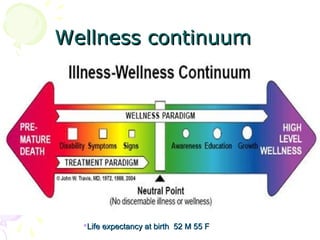
Wellness continuumWellness continuum
Life expectancy at birth 52 M 55 FLife expectancy at birth 52 M 55 F
Dimensions of wellnessDimensions of wellness
• Physical dimension: Good physical fitness and
confidence in one’s personal ability to take care of health
problems.
• Emotional: refers to both our emotional and mental
states – that is, to our feelings and our thoughts.
• Spiritual: Refers to individuals identify their own basic
purpose in life; learn how to experience love, joy, peace,
and fulfillment; and help themselves and others achieve
their full potential.
• Occupational: Deriving personal satisfaction from your
vocation, that provides creativity and challenge.
• Social: The ability to interact effectively with other
people and the social environment, to develop satisfying
interpersonal relationships, and to fulfill social roles.
• Intellectual: Your ability to think and learn from life
experience, your openness to ideas, and your capacity to
question and evaluate information.
• Environmental: The impact your world has on your well
well-being.
Changes in healthChanges in health
(epidemiologic transition)(epidemiologic transition)
• Earlier, leading causes of death were primarily
infectious diseases – A result of disease
causing organisms (pathogens) - viruses,
bacteria, fungi, protozoa, parasitic worms.
• Today leading causes of death are chronic
diseases – Develops over many years and are
heavily influenced by lifestyle
• The developing countries are currently going
through a rapid epidemiologic transition
Leading causes of mortalityLeading causes of mortality
Kenya
• HIV/AIDS
• Lower respiratory
infections
• Diarrhoeal diseases
• Tuberculosis
• Malaria
• Cerebrovascular disease
• Heart disease
• Prenatal conditions
• Road traffic accidents
• Chronic obstructive
pulmonary disease
USA
• Heart Disease
• Stroke
• Cancer
• Chronic Lung Disease
• Accidents/ injuries
• Pneumonia/Influenza
• Diabetes
• HIV
• Chronic Liver Disease
10 Major Public Health
Issues
• 1. Lack of Physical activity
• 2. Overweight and obesity
• 3. Tobacco use
• 4. Substance abuse
• 5. Irresponsible sexual
behavior
• 6. Mental health
• 7. Injury and violence
• 8. Environmental quality
• 9. Immunization
• 10.Access to health care
What Is BMI?What Is BMI?
• Body mass index (BMI) =
weight (kg)/height (m)2
• BMI is an effective screening tool; it is
not a diagnostic tool
• For children, BMI is age and gender
specific, so BMI-for-age is the measure
used
BMI: Normal, Overweight,BMI: Normal, Overweight,
ObesityObesity
Underweight <
18.5%
Normal 18.5 – 25%
Overweight 25 –
30%
Obesity >30%
Other measureOther measure
• Abdominal
circumference:
– measures the
deposition fat in the
abdomen
– High correlation with fat
deposition else where
• Waist hip ratio:
– Measure for
cardiovascular/
cerebrovascular risk
Overweight and Obesity Are KnownOverweight and Obesity Are Known
Risk Factors For Major DiseasesRisk Factors For Major Diseases
Diabetes
Hypertension
Heart and vascular disease
Stroke
Hypertension (high blood pressure)
Gallbladder disease
Degeneration of joints causing
morbidity problems
Some cancers (uterine, breast,
kidney, gallbladder)
Other risksOther risks
• Increased surgical risk, and poor
wound healing
• Increased rates of depression,
suicide
• Increased cholesterol

Health and Wellness

  • 1.
  • 2.
    Outline of presentationOutlineof presentation • Definition of wellness • Continuum of wellness • Physical dimension • Risks involved
  • 3.
    Health and Wellness Health •Being sound in body, mind, and spirit. • Not merely the absence of disease or infirmity, but a state of complete physical, mental, and social well well-being. Wellness • Purposeful, enjoyable living. • A deliberate lifestyle choice characterized by personal responsibility and optimal enhancement of physical, mental, and spiritual health.
  • 4.
    Wellness continuumWellness continuum Lifeexpectancy at birth 52 M 55 FLife expectancy at birth 52 M 55 F
  • 5.
    Dimensions of wellnessDimensionsof wellness • Physical dimension: Good physical fitness and confidence in one’s personal ability to take care of health problems. • Emotional: refers to both our emotional and mental states – that is, to our feelings and our thoughts. • Spiritual: Refers to individuals identify their own basic purpose in life; learn how to experience love, joy, peace, and fulfillment; and help themselves and others achieve their full potential. • Occupational: Deriving personal satisfaction from your vocation, that provides creativity and challenge. • Social: The ability to interact effectively with other people and the social environment, to develop satisfying interpersonal relationships, and to fulfill social roles. • Intellectual: Your ability to think and learn from life experience, your openness to ideas, and your capacity to question and evaluate information. • Environmental: The impact your world has on your well well-being.
  • 6.
    Changes in healthChangesin health (epidemiologic transition)(epidemiologic transition) • Earlier, leading causes of death were primarily infectious diseases – A result of disease causing organisms (pathogens) - viruses, bacteria, fungi, protozoa, parasitic worms. • Today leading causes of death are chronic diseases – Develops over many years and are heavily influenced by lifestyle • The developing countries are currently going through a rapid epidemiologic transition
  • 7.
    Leading causes ofmortalityLeading causes of mortality Kenya • HIV/AIDS • Lower respiratory infections • Diarrhoeal diseases • Tuberculosis • Malaria • Cerebrovascular disease • Heart disease • Prenatal conditions • Road traffic accidents • Chronic obstructive pulmonary disease USA • Heart Disease • Stroke • Cancer • Chronic Lung Disease • Accidents/ injuries • Pneumonia/Influenza • Diabetes • HIV • Chronic Liver Disease
  • 8.
    10 Major PublicHealth Issues • 1. Lack of Physical activity • 2. Overweight and obesity • 3. Tobacco use • 4. Substance abuse • 5. Irresponsible sexual behavior • 6. Mental health • 7. Injury and violence • 8. Environmental quality • 9. Immunization • 10.Access to health care
  • 9.
    What Is BMI?WhatIs BMI? • Body mass index (BMI) = weight (kg)/height (m)2 • BMI is an effective screening tool; it is not a diagnostic tool • For children, BMI is age and gender specific, so BMI-for-age is the measure used
  • 10.
    BMI: Normal, Overweight,BMI:Normal, Overweight, ObesityObesity Underweight < 18.5% Normal 18.5 – 25% Overweight 25 – 30% Obesity >30%
  • 11.
    Other measureOther measure •Abdominal circumference: – measures the deposition fat in the abdomen – High correlation with fat deposition else where • Waist hip ratio: – Measure for cardiovascular/ cerebrovascular risk
  • 14.
    Overweight and ObesityAre KnownOverweight and Obesity Are Known Risk Factors For Major DiseasesRisk Factors For Major Diseases Diabetes Hypertension Heart and vascular disease Stroke Hypertension (high blood pressure) Gallbladder disease Degeneration of joints causing morbidity problems Some cancers (uterine, breast, kidney, gallbladder)
  • 15.
    Other risksOther risks •Increased surgical risk, and poor wound healing • Increased rates of depression, suicide • Increased cholesterol

Editor's Notes

  • #10 Body Mass Index (BMI) is an anthropometric index of weight and height (stature) that is defined as body weight in kilograms divided by height in meters squared. BMI is the commonly accepted index for classifying adiposity in adults and it is recommended for use with children and adolescents. Like weight-for-height, BMI is a screening tool used to identify individuals who are underweight or overweight. BMI is not a diagnostic tool. For example, a child who is relatively heavy may have a high BMI for his or her age or high weight-for-stature. To determine whether the child has excess fat, further assessment needed might include triceps skinfold measurements. To determine a counseling strategy, assessments of diet, health, and physical activity are needed. BMI is gender specific and age specific for children. BMI-for-age is the measure used for ages 2 to 20 years since BMI changes substantially as children get older. Whereas for adults, BMI is neither age nor gender specific and nutritional status is defined by fixed cut points.