LIFESTYLE  DISEASES  AND WELLNESS -IT STARTS WITH YOU
The World Health Organization (1947): “Health is a state of complete physical, mental, and social well-being and not merely the absence of disease or infirmity.”  Wellness is the process of moving toward optimal health.
lifestyle diseases are those caused by -------- DIABETES HYPERTENSION CEREBRAL  STROKE CANCERS EYE PROBLEMS BACK PAIN SEXUALLY TRANSMITTED DISEASE MENTAL ILLNESS-DEPRESSION, INSOMNIA RESPIRATORY DISEASES OTHERS- OSTEOPOROSIS, ARTHRITIS Top 10 Lifestyle Diseases
Become widespread as countries become more industrialized.  Are potentially preventable Can be lowered with changes in diet, lifestyle, and environment.  Are a result of an inappropriate relationship of people with their environment.  The onset of lifestyle diseases is insidious, they take years to develop Once encountered do not lend themselves easily to cure.  Lifestyle diseases
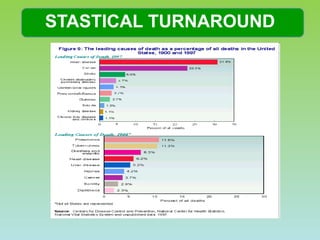
In 1900,top three causes of death were from communicable diseases.  Since the 1940's, most deaths have come from a completely different category of disease called lifestyle diseases.  Causes of Death
STASTICAL TURNAROUND
Disease Burden Cardiovascular diseases will be the largest cause of death and disability in India by 2020. 52% of cardiovascular diseases deaths occur below the age of 70 in India compared to 23% in established market economies. number of diabetics in the age group of 20-79 in 2010 to be around 50.7 million. Around 80% of these deaths will occur in low and middle-income countries. long hours and working under strict deadlines cause up to 75% of working women to suffer from depression or general anxiety disorder, compared to women with lesser levels of psychological demand at work.
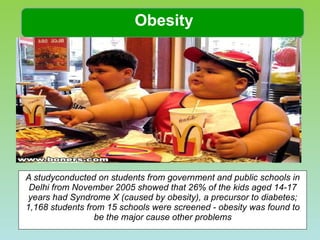
A studyconducted on students from government and public schools in Delhi from November 2005 showed that 26% of the kids aged 14-17 years had Syndrome X (caused by obesity), a precursor to diabetes; 1,168 students from 15 schools were screened - obesity was found to be the major cause other problems Obesity
Cost Of Our Lifestyle A report, jointly prepared by the World Health Organization (WHO) and the World Economic Forum, says  India will incur an  accumulated loss of $236.6 billion by 2015  on account of unhealthy lifestyles and faulty diet.  The report also points to the fact that countries like China, Russia and India currently lose more than 20 million productive life-years annually to chronic diseases
Lifestyle and Health Main factors contributing to the lifestyle diseases include Bad food habits-   Processed foods , Alcohol, Tobacco  Physical inactivity  Stress Wrong body posture Disturbed biological clock
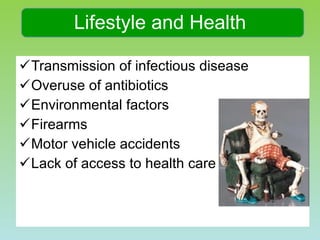
Transmission of infectious disease Overuse of antibiotics  Environmental factors  Firearms  Motor vehicle accidents  Lack of access to health care  Lifestyle and Health
Health Issues of College Students Mental health Food and weight Health care Substance use and abuse Sexual and relationship health Accidents and injuries
WHY WORRY???? Obviously, we have to die of something.  Modern science has eliminated the threat of death from most infectious diseases.  Lifestyle diseases are now the primary causes of death.  The question now becomes- death at what age?  The choice is yours: die young, or at a ripe old age.
Taking  Responsibility  for Your Health Taking responsibility for our  behaviors  changing our negative lifestyles to positive lifestyles; by doing so, we can avoid illness and achieve wellness, or optimal health.
Six Dimensions of Health and Wellness Emotional wellness  requires understanding emotions and coping with problems that arise in everyday life. Intellectual wellness  involves doing to earn a living or to contribute to society. Spiritual wellness  is the state of harmony between you and others. Occupational wellness  is being able to enjoy what you are having a mind open to new ideas and concepts
Social wellness  is the ability to perform social roles effectively, comfortably, and without harming others. Physical wellness  is a healthy body maintained by eating right, exercising regularly, avoiding harmful habits, making informed and responsible decisions about health, seeking medical care when needed, and participating in activities that help to prevent illness. Six Dimensions of Health and Wellness
Making Healthy Changes: The Health Belief Model Factors include: Perceived susceptibility Perceived seriousness Perceived benefits of taking action Barriers to taking action Cues to action
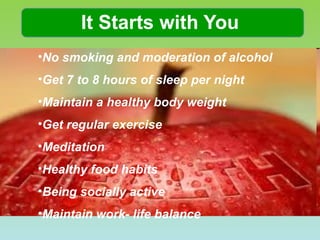
It Starts with You No smoking and moderation of alcohol Get 7 to 8 hours of sleep per night Maintain a healthy body weight Get regular exercise Meditation Healthy food habits Being socially active Maintain work- life balance
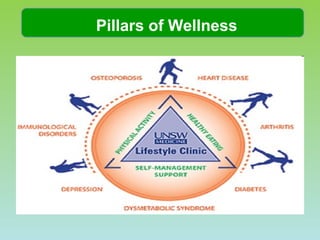
Pillars of Wellness
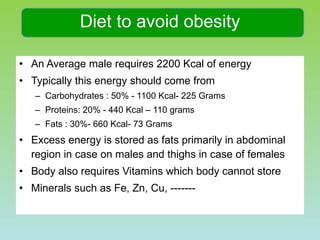
Diet to avoid obesity An Average male requires 2200 Kcal of energy Typically this energy should come from  Carbohydrates : 50% - 1100 Kcal- 225 Grams Proteins: 20% - 440 Kcal – 110 grams Fats : 30%- 660 Kcal- 73 Grams Excess energy is stored as fats primarily in abdominal region in case on males and thighs in case of females Body also requires Vitamins which body cannot store Minerals such as Fe, Zn, Cu, -------
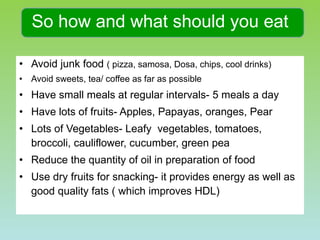
So how and what should you eat Avoid junk food  ( pizza, samosa, Dosa, chips, cool drinks) Avoid sweets, tea/ coffee as far as possible Have small meals at regular intervals- 5 meals a day Have lots of fruits- Apples, Papayas, oranges, Pear Lots of Vegetables- Leafy  vegetables, tomatoes, broccoli, cauliflower, cucumber, green pea Reduce the quantity of oil in preparation of food Use dry fruits for snacking- it provides energy as well as good quality fats ( which improves HDL)
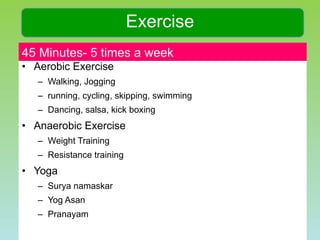
Exercise Aerobic Exercise Walking, Jogging running, cycling, skipping, swimming Dancing, salsa, kick boxing Anaerobic Exercise Weight Training Resistance training Yoga Surya namaskar Yog Asan Pranayam 45 Minutes- 5 times a week
THANK YOU

Cfm_Presentation

  • 1.
    LIFESTYLE  DISEASES AND WELLNESS -IT STARTS WITH YOU
  • 2.
    The World HealthOrganization (1947): “Health is a state of complete physical, mental, and social well-being and not merely the absence of disease or infirmity.” Wellness is the process of moving toward optimal health.
  • 3.
    lifestyle diseases arethose caused by -------- DIABETES HYPERTENSION CEREBRAL STROKE CANCERS EYE PROBLEMS BACK PAIN SEXUALLY TRANSMITTED DISEASE MENTAL ILLNESS-DEPRESSION, INSOMNIA RESPIRATORY DISEASES OTHERS- OSTEOPOROSIS, ARTHRITIS Top 10 Lifestyle Diseases
  • 4.
    Become widespread ascountries become more industrialized. Are potentially preventable Can be lowered with changes in diet, lifestyle, and environment. Are a result of an inappropriate relationship of people with their environment. The onset of lifestyle diseases is insidious, they take years to develop Once encountered do not lend themselves easily to cure. Lifestyle diseases
  • 5.
    In 1900,top threecauses of death were from communicable diseases. Since the 1940's, most deaths have come from a completely different category of disease called lifestyle diseases. Causes of Death
  • 6.
  • 7.
    Disease Burden Cardiovasculardiseases will be the largest cause of death and disability in India by 2020. 52% of cardiovascular diseases deaths occur below the age of 70 in India compared to 23% in established market economies. number of diabetics in the age group of 20-79 in 2010 to be around 50.7 million. Around 80% of these deaths will occur in low and middle-income countries. long hours and working under strict deadlines cause up to 75% of working women to suffer from depression or general anxiety disorder, compared to women with lesser levels of psychological demand at work.
  • 8.
    A studyconducted onstudents from government and public schools in Delhi from November 2005 showed that 26% of the kids aged 14-17 years had Syndrome X (caused by obesity), a precursor to diabetes; 1,168 students from 15 schools were screened - obesity was found to be the major cause other problems Obesity
  • 9.
    Cost Of OurLifestyle A report, jointly prepared by the World Health Organization (WHO) and the World Economic Forum, says India will incur an accumulated loss of $236.6 billion by 2015 on account of unhealthy lifestyles and faulty diet. The report also points to the fact that countries like China, Russia and India currently lose more than 20 million productive life-years annually to chronic diseases
  • 10.
    Lifestyle and HealthMain factors contributing to the lifestyle diseases include Bad food habits- Processed foods , Alcohol, Tobacco Physical inactivity Stress Wrong body posture Disturbed biological clock
  • 11.
    Transmission of infectiousdisease Overuse of antibiotics Environmental factors Firearms Motor vehicle accidents Lack of access to health care Lifestyle and Health
  • 12.
    Health Issues ofCollege Students Mental health Food and weight Health care Substance use and abuse Sexual and relationship health Accidents and injuries
  • 13.
    WHY WORRY???? Obviously,we have to die of something. Modern science has eliminated the threat of death from most infectious diseases. Lifestyle diseases are now the primary causes of death. The question now becomes- death at what age? The choice is yours: die young, or at a ripe old age.
  • 14.
    Taking Responsibility for Your Health Taking responsibility for our behaviors changing our negative lifestyles to positive lifestyles; by doing so, we can avoid illness and achieve wellness, or optimal health.
  • 15.
    Six Dimensions ofHealth and Wellness Emotional wellness requires understanding emotions and coping with problems that arise in everyday life. Intellectual wellness involves doing to earn a living or to contribute to society. Spiritual wellness is the state of harmony between you and others. Occupational wellness is being able to enjoy what you are having a mind open to new ideas and concepts
  • 16.
    Social wellness is the ability to perform social roles effectively, comfortably, and without harming others. Physical wellness is a healthy body maintained by eating right, exercising regularly, avoiding harmful habits, making informed and responsible decisions about health, seeking medical care when needed, and participating in activities that help to prevent illness. Six Dimensions of Health and Wellness
  • 17.
    Making Healthy Changes:The Health Belief Model Factors include: Perceived susceptibility Perceived seriousness Perceived benefits of taking action Barriers to taking action Cues to action
  • 18.
    It Starts withYou No smoking and moderation of alcohol Get 7 to 8 hours of sleep per night Maintain a healthy body weight Get regular exercise Meditation Healthy food habits Being socially active Maintain work- life balance
  • 19.
  • 20.
    Diet to avoidobesity An Average male requires 2200 Kcal of energy Typically this energy should come from Carbohydrates : 50% - 1100 Kcal- 225 Grams Proteins: 20% - 440 Kcal – 110 grams Fats : 30%- 660 Kcal- 73 Grams Excess energy is stored as fats primarily in abdominal region in case on males and thighs in case of females Body also requires Vitamins which body cannot store Minerals such as Fe, Zn, Cu, -------
  • 21.
    So how andwhat should you eat Avoid junk food ( pizza, samosa, Dosa, chips, cool drinks) Avoid sweets, tea/ coffee as far as possible Have small meals at regular intervals- 5 meals a day Have lots of fruits- Apples, Papayas, oranges, Pear Lots of Vegetables- Leafy vegetables, tomatoes, broccoli, cauliflower, cucumber, green pea Reduce the quantity of oil in preparation of food Use dry fruits for snacking- it provides energy as well as good quality fats ( which improves HDL)
  • 22.
    Exercise Aerobic ExerciseWalking, Jogging running, cycling, skipping, swimming Dancing, salsa, kick boxing Anaerobic Exercise Weight Training Resistance training Yoga Surya namaskar Yog Asan Pranayam 45 Minutes- 5 times a week
  • 23.