



Dr Abdelrahman Mosaad
• Health : the state of being free from illness or
injury , describing a person's mental or
physical condition
• Style : a particular procedure by which
something is done ; a manner or way
• Lifestyle : the way in which a person live
• Being Healthy is a priority for every living
human , to have a normal easy going life
this is a well known fact , but … do people
work for being healthy ?! , do people adapt
themselves to a healthy style ?! , do people
obligate themselves to follow a healthy life
style ?!
• The overall health of the community is a priority
for the governments all over the world
• Do the governments makes laws and regulations
that guarantee or help the communities and the
people to be healthy ?! Do the non-
governmental organizations take there
complementary role with the governmental
organizations ?! Are the safety and health roles
are applied in occupational working places ?!
• Being healthy is multi-factorial issue ..
- the main burden is upon the person or the
human himself
- family , community and governmental and
non-governmental organizations are all
having important roles in guaranteeing the
health of the people or a single human
• The human should maintain a healthy
lifestyle in order be always healthy and living
well
Components of healthy lifestyle
# A healthy lifestyle is mostly associated with:
• Good diet
• Physical exercise
• Good sleeping pattern
• Personal hygiene
• No bad habits or addiction
• Health education
• Safe environment
• Physical fitness
• Love through social support and healthy
relationships
• Emotions
• Active social life
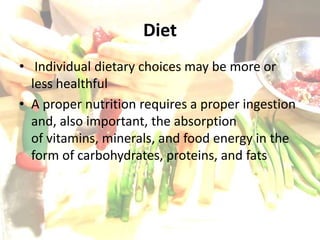
Diet
• Individual dietary choices may be more or
less healthful
• A proper nutrition requires a proper ingestion
and, also important, the absorption
of vitamins, minerals, and food energy in the
form of carbohydrates, proteins, and fats
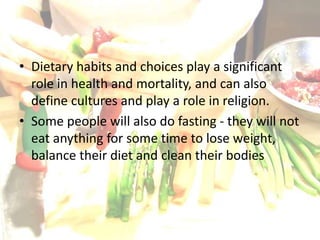
• Dietary habits and choices play a significant
role in health and mortality, and can also
define cultures and play a role in religion.
• Some people will also do fasting - they will not
eat anything for some time to lose weight,
balance their diet and clean their bodies
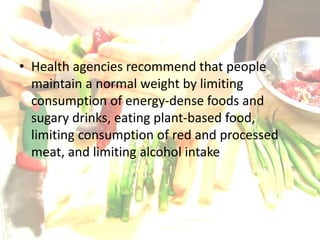
• Health agencies recommend that people
maintain a normal weight by limiting
consumption of energy-dense foods and
sugary drinks, eating plant-based food,
limiting consumption of red and processed
meat, and limiting alcohol intake
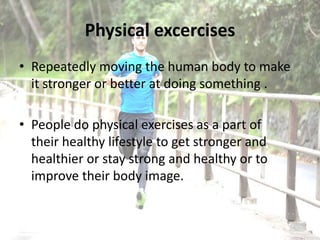
Physical excercises
• Repeatedly moving the human body to make
it stronger or better at doing something .
• People do physical exercises as a part of
their healthy lifestyle to get stronger and
healthier or stay strong and healthy or to
improve their body image.
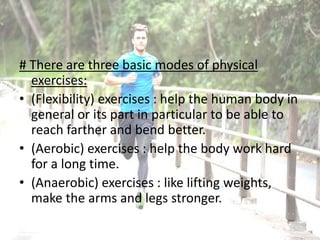
# There are three basic modes of physical
exercises:
• (Flexibility) exercises : help the human body in
general or its part in particular to be able to
reach farther and bend better.
• (Aerobic) exercises : help the body work hard
for a long time.
• (Anaerobic) exercises : like lifting weights,
make the arms and legs stronger.
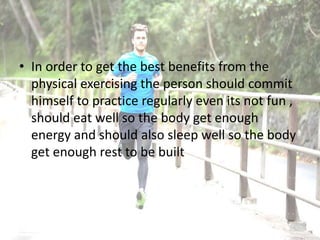
• In order to get the best benefits from the
physical exercising the person should commit
himself to practice regularly even its not fun ,
should eat well so the body get enough
energy and should also sleep well so the body
get enough rest to be built
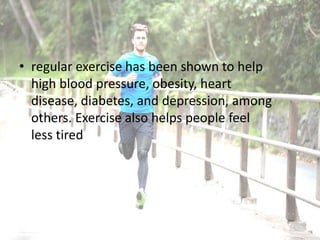
• regular exercise has been shown to help
high blood pressure, obesity, heart
disease, diabetes, and depression, among
others. Exercise also helps people feel
less tired
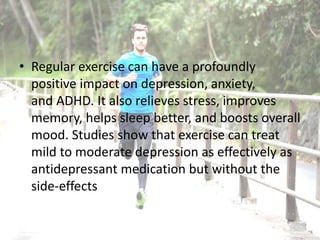
• Regular exercise can have a profoundly
positive impact on depression, anxiety,
and ADHD. It also relieves stress, improves
memory, helps sleep better, and boosts overall
mood. Studies show that exercise can treat
mild to moderate depression as effectively as
antidepressant medication but without the
side-effects
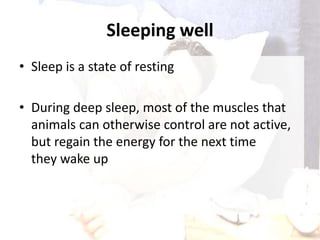
Sleeping well
• Sleep is a state of resting
• During deep sleep, most of the muscles that
animals can otherwise control are not active,
but regain the energy for the next time
they wake up
• Sleep is extremely important to human health
and well-being
• Humans and animals need sleep in order for
their bodies to be prepared for the next day.
Everyday activities, one’s appearance, and
how one expresses oneself all rely on this
necessity
• If one is tired (from not getting enough sleep),
one will not be able to function properly in
common activities.
• Being sleep-deprived leads to struggling to
remember information, altering one’s mood,
energy, health, focus and a number of other
effects
• Sleep deprivation (not allowing a person
enough sleep) can even be used
as torture. Also, the immune system releases
compounds known as cytokines which are
used to help fight inflammation and infection.
• If a person does not receive enough sleep,
they will not have enough cytokines to protect
them from getting sick.
• The body may not have time to complete
memory recollection, muscle repair, and
release hormones that regulate growth and
appetite.
• Nap : sleep for a short time in the early
afternoon for a quick rest
• A successful nap should run between 15-30
minutes, and longer naps taking 30-60
minutes will result in feeling dazed and less
attentive
• According to national sleep foundations and researches
: there are different amounts of sleep that are
recommended :
- Toddlers (4 to 12 months) : 12 to 16 hours (w/ naps)
- Toddlers (1-2 years) : 11 to 14 hours (w/ naps)
- Preschoolers (3-5 years) : 10 to 13 hours (w/ naps)
- Grade Schoolers (6 to 12 years) : 9 to 12 hours
- Teenagers(13-18 years) : 8 to 10 hours
- Adults (including old age) : 7 to 9 hours
# For better sleeping hygiene :
• get to sleep quick and early
• avoid extreme emotion in the hours before
sleep
• try to get up at the same time every day
(sticking to a routine)
• sleep in a cool, quiet and very dark place with
the right mattress, lighting, blanket, pillow and
temperature.
• avoid bright light the last hour before bedtime.
Eat dinner at least 3 hours before bedtime so the
digestive system has time to break it down.
• avoid a big meal just before bedtime
• get enough exercise every day
• sleep in varying positions. However, avoid
sleeping on the stomach as it starts to flatten the
curve of the spine, which can lead to severe
lower back pains
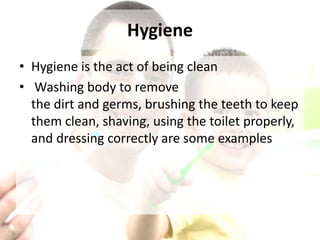
Hygiene
• Hygiene is the act of being clean
• Washing body to remove
the dirt and germs, brushing the teeth to keep
them clean, shaving, using the toilet properly,
and dressing correctly are some examples
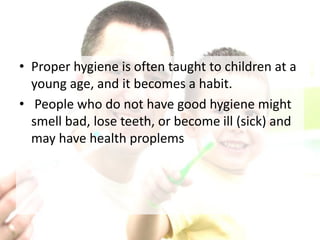
• Proper hygiene is often taught to children at a
young age, and it becomes a habit.
• People who do not have good hygiene might
smell bad, lose teeth, or become ill (sick) and
may have health proplems
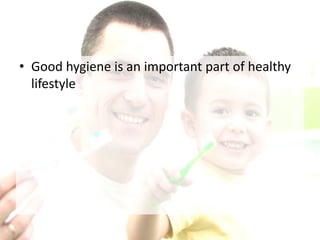
• Good hygiene is an important part of healthy
lifestyle
Physical fitness
• Physical fitness is the ability to be physically
active, to move and respond to the
environment.
• People can take various tests to measure their
physical performance. Such tests are
necessary for some occupations, such
as soldiers and firefighters.
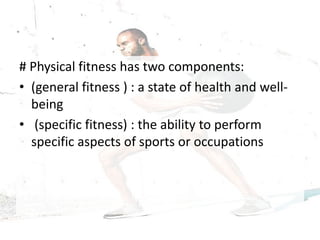
# Physical fitness has two components:
• (general fitness ) : a state of health and well-
being
• (specific fitness) : the ability to perform
specific aspects of sports or occupations
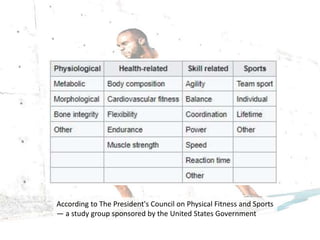
According to The President's Council on Physical Fitness and Sports
— a study group sponsored by the United States Government
• Health-related components: those factors that are
related to how well the systems of your bodywork.
• Body composition is the relative percentage of body
fat compared to lean body mass (muscle, bone, water,
etc)
• Cardiovascular fitness: the ability of the circulatory
system (heart and blood vessels) to supply oxygen to
working muscles during exercise.
• Flexibility: the range of movement possible at various
joints.
Emotions and psychological health
• Emotions are what we feel
• Emotions are caused by a complex
mixture of hormones and
the unconscious mind.
• Only with great difficulty can we control
our emotions by conscious effort. They
cause mammals to
change behaviour according to changes
in their situation.
A scientific definition is not simple; over
90 definitions have been offered by
experts. A definition of emotion needs
to includes three things :
• conscious experience (feelings)
• expressions which can be seen by
others
• actions of the body
('physiological arousal')
• emotions involve body systems which
have operated for hundreds of
millions of years. These are
the hormone system, the autonomic
nervous system and the
'lower' brain centres
(hindbrain and midbrain)
• questions like "how are you doing?" or
"how is your mood?" capture the
essence of psychological health,
psychologists have found that it
actually involves two separate issues.
There is an upside and a downside,
both of which need to be considered
• It is also important to know that
psychological health is an issue quite
different from mental or emotional
disorder.
• The research on well-being concerns
itself with the feelings of normal
individuals and subjects from the
general population
• When we talk about psychological
health, we are referring to how ordinary
people are doing in life. In other words,
if you are feeling distressed, that
doesn't necessarily mean that you are
mentally ill
• Ordinary life often presents the
individual with extraordinary
challenges, complexities, setbacks and
hardships.
• Psychological health concerns itself
with how you cope, how you are doing
in response, and whether you find life
to be interesting and enjoyable.
Although life is better when we are
feeling good, there is no avoiding the
fact that there will be ups and downs
• Mental health should be maintained ,
and the person should take care of his
mental health and avoid any problems
or circumstances that could affect his
health nigatively
• Ten tips to stay mentally and
psychologically healthy
1. Take care of your physical health
2. Get fresh air and exposure to sunlight
3. Take care of yourself at first
4. Spend time with people whose
company you enjoy and get avail
5. Pursue a hobby, or a new activity
6. Manage your stress
7. Identify your strengths, weaknesses,
and boundaries
8. Practice gratitude
9. Express yourself
10. Ask for help when you feel
overwhelmed
Active social life
• A person’s social life consists of the various
bonds they form with others, such as
family, friends, members of their
community , and strangers . It can be
measured by the duration and quality of
the social interactions they have on a
regular basis , both in person and online
• People with strong social connections may live
longer and healthier lives, according to
numerous studies
• people who are isolated face a 50% greater
risk of premature death than those who have
stronger social connections.
• It was cited in a study suggesting that the
social isolation carries a risk of mortality that’s
similar to that of other major risk factors, such
as smoking
• the stress of isolation can weaken people’s
immune systems, making them more
susceptible to infectious diseases. She also
noted that people with strong social
connections tend to have better health
behaviors, like eating healthy foods and being
physically active . said by Lisa Berkman , director of the Harvard
Center for Population and Development Studies
• Making friends may seem like a mysterious
process, but it’s actually rooted in some basic
social truths. For example, it’s easiest to
develop friendships with people who are in
close proximity, share similar interests, and
support your social identity.
• Maintaining a friendship requires you to be
supportive, disclose personal information,
interact regularly, and be more positive than
negative on balance.
• Being present and having a positive attitude
can go a long way to opening up the
possibility for a deeper friendship.
• People have the freedom today to build their
particular social cohort both online and
offline; their social circles may include family,
friends, professional mentors, and other
important individuals in their lives
• Online social ties can be a powerful source of
social support and joy, especially for people
who are isolated for geographical or other
reasons.
• There is, however, no substitute for face-to-
face interaction, and those who spend time
among friends and family report higher levels
of well-being than individuals with fewer ties
"in real life."
Love
• Love is a mix of feelings and actions that
shows a deep liking for someone or something
• Romantic love can lead to things such
as dating, marriage and sex, but a person can
also feel for friends, such as platonic love,
or family
• There are also chemical reactions within the
brain that can be triggered by the different
types of love
• Their are many kinds of love. There can
be self-love, love towards a friend (such
as platonic love), love in romance,
towards family, toward God, or towards an
object or idea
• Often love can be confused with other
feelings. Being sexually or physically attracted
is the feeling of lust. Lust and love may be
thought of as different. Normal friendship is a
form of love that can be distracted by lust and
misunderstanding.
• Helen Fisher, an expert in the topic of
romantic love, divides it into three stages: lust,
attraction, and attachment. Lust makes people
like each other, attraction encourages people
to focus on mating, and attachment helps
people tolerate the spouse (or the child)
• Lust is the passionate or sexual desire that
promotes mating. This usually lasts only a few
weeks or months
• Attraction is more for one person specially
• Recent studies in neuroscience say that as
people fall in love, the brain releases
chemicals, including dopamine. These
chemicals make people less hungry and
sleepy, and also adds an intense feeling of
excitement. Researches show that this stage
normally lasts from one and a half to three
years.
• Love has consequences for health and well-
being. Joyful activities such as love activate
areas in the brain responsible for emotion,
attention, motivation and memory, and it may
further lead to reduction of cortisol, which
reduces stress
• Healthy love relationship could be one of the
most important points of maintaining health
of an adult human
Avoiding addiction and bad habits
• Addiction is when the body or mind badly
wants or needs something in order to work
right
• People can be addicted
to drugs, cigarettes, alcohol, caffeine, and
many other things
• Addiction always has a negative impact
on persons health
• When somebody is addicted to
something, they can become sick if they
do not get the thing they are addicted to.
But taking more of the thing they are
addicted to can also hurt their health
• Addiction takes place when the addictive
element enters the body. The blood
stream moves the element around the body
so that it gets to the brain, and makes the
person feel that they are enjoying it; then they
want more of that substance
• This takes place remarkably fast for some
addictions such as hashish and cocaine; but all
of them control the consumer. Once under
this control, the consumer does not have a
completely free will, and listens to the
addiction's bidding.
• People can also be addicted to other things
which are not drugs. You may hear people talk
about being "addicted to the Internet" or
"addicted to chocolate" or gambling. This
means that they get into a habit of enjoying
that thing, so if they have to go without it for
a while, they miss it a lot
• Addiction is similar to a major disease like
chronic heart disease or perhaps diabetes, but
addictions are not taken as seriously as these
major diseases
• addicts need to go to a doctor or hospital to
cure the addiction, so they no longer crave
(want or need) the drug or whatever else
• The American Society of Addiction Medicine
(ASAM) defines addiction as a treatable,
chronic medical disease involving complex
interactions among brain circuits, genetics,
the environment, and an individual’s life
experiences
• People with addiction use substances or
engage in behaviors that become compulsive
and often continue despite harmful
consequences
• Prevention efforts and treatment approaches
for addiction are generally as successful as
those for other chronic diseases.
# symptoms of addiction :
• Tolerance, which is the need to engage in the
addictive behavior more and more to get the
desired effect
• Difficulty cutting down or controlling the
addictive behavior
• Extreme mood changes – happy, sad, excited,
anxious, etc
• Weight loss or weight gain
• Pupils of the eyes seeming smaller or larger
than usual
• Withdrawal happens when the person does
not take the substance or engage in the
activity, and they experience unpleasant
symptoms, which are often the opposite of
the effects of the addictive behavior
• How to avoid addiction :
1. Understand how addiction develops
2. Identify Your Personal Triggers First
3. Avoid Stress and avoid peer pressure
4. Find the support you need and pull others for
help
5. Deal positively with life pressures
6. Seek counseling
7. Distract yourself and fill your time with
positivity and good habits and good people
8 . Keep learning and keep motivated
Safe environment
• Environment means anything that surrounds
us. It can be living (biotic) or non-living
(abiotic) things.
• It includes physical, chemical and other
natural forces. Living things live in their
environment. They constantly interact with it
and adapt themselves to conditions in their
environment.
• In the environment there are different
interactions
between animals, plants, soil, water, and
other living and non-living things
• In psychology and medicine, a person's
environment is the people, physical things and
places that the person lives with.
• The environment affects the growth and
development of the person. It affects the
person's behavior, body, mind and heart.
• The living conditions of living organisms in an
environment are affected by the weather or
climate changes in the environment
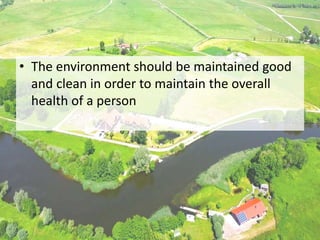
• The environment should be maintained good
and clean in order to maintain the overall
health of a person
Health education
• Education : A complex and planned
learning experiences that aims to bring
about changes in cognitive (knowledge)
, affective (attitude , belief , value) and
psychomotor (skill) domains of behavior
Aims of health education :
• Motivating people to adopt health-
promoting behaviors by providing
appropriate knowledge and helping to
develop positive attitude.
• Helping people to make decisions about
their health and acquire the necessary
confidence and skills to put their
decisions into practice
Approaches to health education :
• The persuasion approach –deliberate attempt to
influence the other persons to do what we want
them to do (DIRECTIVE APPROACH)
• The informed decision making approach-giving
people information, problem solving and decision
making skills to make decisions but leaving the
actual choice to the people. E.g. family planning
methods
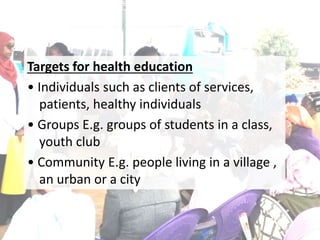
Targets for health education
• Individuals such as clients of services,
patients, healthy individuals
• Groups E.g. groups of students in a class,
youth club
• Community E.g. people living in a village ,
an urban or a city
Conclusion
Health is the most important owned thing ! , it is
important for developing the human as will as
developing the communities and the whole
life on the earth
Humans should be well educated by all the
topics that are necessary for being healthy
and having a healthy lifestyle
Humans themselves are having their role , every
single human has a responsibility for being
healthy and maintain a healthy lifestyle
• Individuals , communities , governments ,
governmental and non governmental
organizations , leaders , countries and
global organizations should cooperate in an
organized way to guarantee health and
healthy lifestyle all over the globe
ً
‫ل‬
‫جزي‬
ً
‫ا‬
‫شكر‬

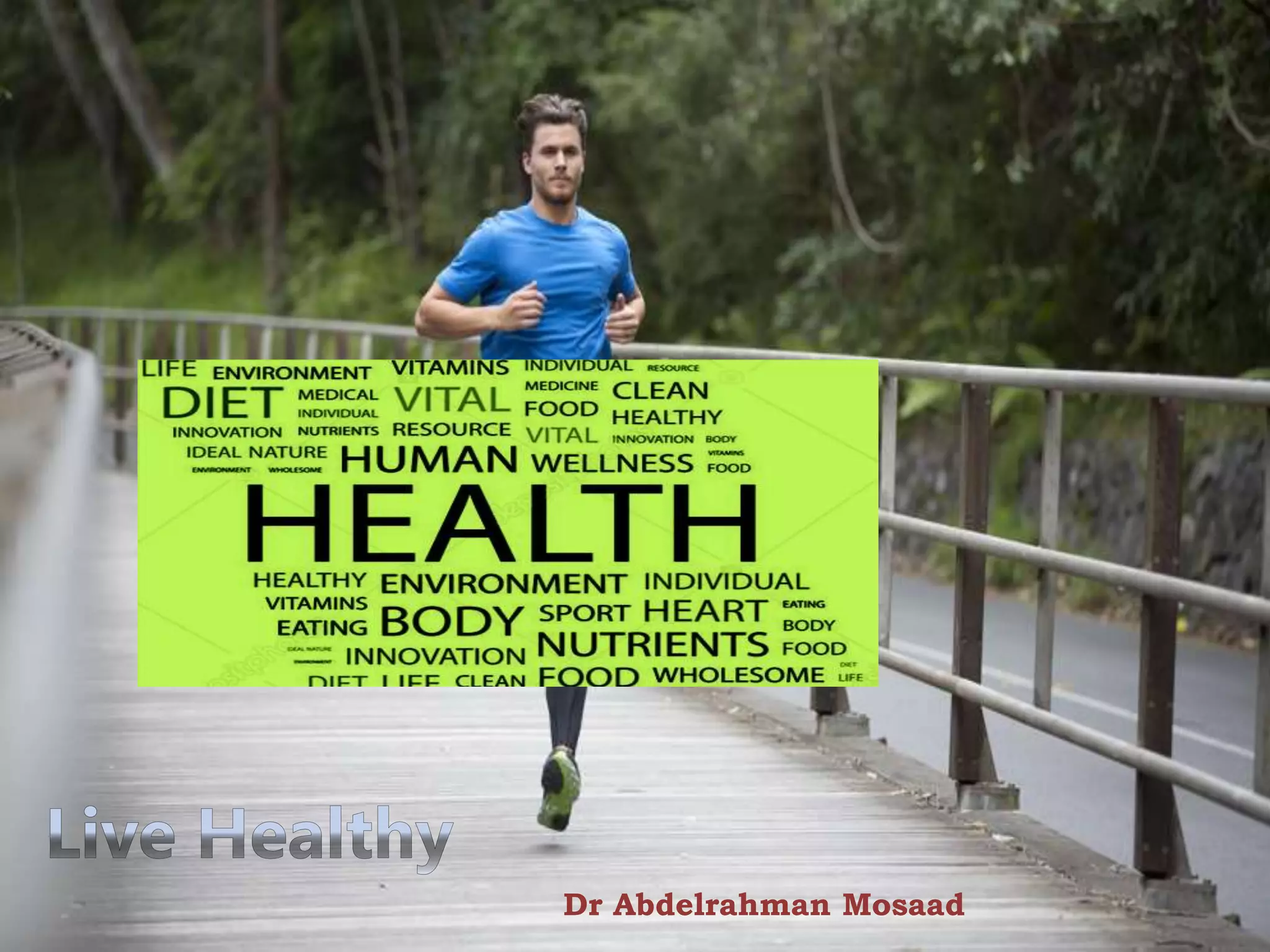
Health presentation ( live healthy)

  • 1.
  • 2.
    • Health :the state of being free from illness or injury , describing a person's mental or physical condition • Style : a particular procedure by which something is done ; a manner or way • Lifestyle : the way in which a person live
  • 3.
    • Being Healthyis a priority for every living human , to have a normal easy going life this is a well known fact , but … do people work for being healthy ?! , do people adapt themselves to a healthy style ?! , do people obligate themselves to follow a healthy life style ?!
  • 4.
    • The overallhealth of the community is a priority for the governments all over the world • Do the governments makes laws and regulations that guarantee or help the communities and the people to be healthy ?! Do the non- governmental organizations take there complementary role with the governmental organizations ?! Are the safety and health roles are applied in occupational working places ?!
  • 5.
    • Being healthyis multi-factorial issue .. - the main burden is upon the person or the human himself - family , community and governmental and non-governmental organizations are all having important roles in guaranteeing the health of the people or a single human
  • 6.
    • The humanshould maintain a healthy lifestyle in order be always healthy and living well
  • 7.
    Components of healthylifestyle # A healthy lifestyle is mostly associated with: • Good diet • Physical exercise • Good sleeping pattern • Personal hygiene • No bad habits or addiction
  • 8.
    • Health education •Safe environment • Physical fitness • Love through social support and healthy relationships • Emotions • Active social life
  • 9.
    Diet • Individual dietarychoices may be more or less healthful • A proper nutrition requires a proper ingestion and, also important, the absorption of vitamins, minerals, and food energy in the form of carbohydrates, proteins, and fats
  • 10.
    • Dietary habitsand choices play a significant role in health and mortality, and can also define cultures and play a role in religion. • Some people will also do fasting - they will not eat anything for some time to lose weight, balance their diet and clean their bodies
  • 11.
    • Health agenciesrecommend that people maintain a normal weight by limiting consumption of energy-dense foods and sugary drinks, eating plant-based food, limiting consumption of red and processed meat, and limiting alcohol intake
  • 12.
    Physical excercises • Repeatedlymoving the human body to make it stronger or better at doing something . • People do physical exercises as a part of their healthy lifestyle to get stronger and healthier or stay strong and healthy or to improve their body image.
  • 13.
    # There arethree basic modes of physical exercises: • (Flexibility) exercises : help the human body in general or its part in particular to be able to reach farther and bend better. • (Aerobic) exercises : help the body work hard for a long time. • (Anaerobic) exercises : like lifting weights, make the arms and legs stronger.
  • 14.
    • In orderto get the best benefits from the physical exercising the person should commit himself to practice regularly even its not fun , should eat well so the body get enough energy and should also sleep well so the body get enough rest to be built
  • 15.
    • regular exercisehas been shown to help high blood pressure, obesity, heart disease, diabetes, and depression, among others. Exercise also helps people feel less tired
  • 16.
    • Regular exercisecan have a profoundly positive impact on depression, anxiety, and ADHD. It also relieves stress, improves memory, helps sleep better, and boosts overall mood. Studies show that exercise can treat mild to moderate depression as effectively as antidepressant medication but without the side-effects
  • 17.
    Sleeping well • Sleepis a state of resting • During deep sleep, most of the muscles that animals can otherwise control are not active, but regain the energy for the next time they wake up
  • 18.
    • Sleep isextremely important to human health and well-being • Humans and animals need sleep in order for their bodies to be prepared for the next day. Everyday activities, one’s appearance, and how one expresses oneself all rely on this necessity
  • 19.
    • If oneis tired (from not getting enough sleep), one will not be able to function properly in common activities. • Being sleep-deprived leads to struggling to remember information, altering one’s mood, energy, health, focus and a number of other effects
  • 20.
    • Sleep deprivation(not allowing a person enough sleep) can even be used as torture. Also, the immune system releases compounds known as cytokines which are used to help fight inflammation and infection.
  • 21.
    • If aperson does not receive enough sleep, they will not have enough cytokines to protect them from getting sick. • The body may not have time to complete memory recollection, muscle repair, and release hormones that regulate growth and appetite.
  • 22.
    • Nap :sleep for a short time in the early afternoon for a quick rest • A successful nap should run between 15-30 minutes, and longer naps taking 30-60 minutes will result in feeling dazed and less attentive
  • 23.
    • According tonational sleep foundations and researches : there are different amounts of sleep that are recommended : - Toddlers (4 to 12 months) : 12 to 16 hours (w/ naps) - Toddlers (1-2 years) : 11 to 14 hours (w/ naps) - Preschoolers (3-5 years) : 10 to 13 hours (w/ naps) - Grade Schoolers (6 to 12 years) : 9 to 12 hours - Teenagers(13-18 years) : 8 to 10 hours - Adults (including old age) : 7 to 9 hours
  • 24.
    # For bettersleeping hygiene : • get to sleep quick and early • avoid extreme emotion in the hours before sleep • try to get up at the same time every day (sticking to a routine) • sleep in a cool, quiet and very dark place with the right mattress, lighting, blanket, pillow and temperature.
  • 25.
    • avoid brightlight the last hour before bedtime. Eat dinner at least 3 hours before bedtime so the digestive system has time to break it down. • avoid a big meal just before bedtime • get enough exercise every day • sleep in varying positions. However, avoid sleeping on the stomach as it starts to flatten the curve of the spine, which can lead to severe lower back pains
  • 26.
    Hygiene • Hygiene isthe act of being clean • Washing body to remove the dirt and germs, brushing the teeth to keep them clean, shaving, using the toilet properly, and dressing correctly are some examples
  • 27.
    • Proper hygieneis often taught to children at a young age, and it becomes a habit. • People who do not have good hygiene might smell bad, lose teeth, or become ill (sick) and may have health proplems
  • 28.
    • Good hygieneis an important part of healthy lifestyle
  • 29.
    Physical fitness • Physicalfitness is the ability to be physically active, to move and respond to the environment. • People can take various tests to measure their physical performance. Such tests are necessary for some occupations, such as soldiers and firefighters.
  • 30.
    # Physical fitnesshas two components: • (general fitness ) : a state of health and well- being • (specific fitness) : the ability to perform specific aspects of sports or occupations
  • 31.
    According to ThePresident's Council on Physical Fitness and Sports — a study group sponsored by the United States Government
  • 32.
    • Health-related components:those factors that are related to how well the systems of your bodywork. • Body composition is the relative percentage of body fat compared to lean body mass (muscle, bone, water, etc) • Cardiovascular fitness: the ability of the circulatory system (heart and blood vessels) to supply oxygen to working muscles during exercise. • Flexibility: the range of movement possible at various joints.
  • 33.
    Emotions and psychologicalhealth • Emotions are what we feel • Emotions are caused by a complex mixture of hormones and the unconscious mind. • Only with great difficulty can we control our emotions by conscious effort. They cause mammals to change behaviour according to changes in their situation.
  • 34.
    A scientific definitionis not simple; over 90 definitions have been offered by experts. A definition of emotion needs to includes three things : • conscious experience (feelings) • expressions which can be seen by others • actions of the body ('physiological arousal')
  • 35.
    • emotions involvebody systems which have operated for hundreds of millions of years. These are the hormone system, the autonomic nervous system and the 'lower' brain centres (hindbrain and midbrain)
  • 36.
    • questions like"how are you doing?" or "how is your mood?" capture the essence of psychological health, psychologists have found that it actually involves two separate issues. There is an upside and a downside, both of which need to be considered
  • 37.
    • It isalso important to know that psychological health is an issue quite different from mental or emotional disorder. • The research on well-being concerns itself with the feelings of normal individuals and subjects from the general population
  • 38.
    • When wetalk about psychological health, we are referring to how ordinary people are doing in life. In other words, if you are feeling distressed, that doesn't necessarily mean that you are mentally ill
  • 39.
    • Ordinary lifeoften presents the individual with extraordinary challenges, complexities, setbacks and hardships. • Psychological health concerns itself with how you cope, how you are doing in response, and whether you find life to be interesting and enjoyable. Although life is better when we are feeling good, there is no avoiding the fact that there will be ups and downs
  • 40.
    • Mental healthshould be maintained , and the person should take care of his mental health and avoid any problems or circumstances that could affect his health nigatively
  • 41.
    • Ten tipsto stay mentally and psychologically healthy 1. Take care of your physical health 2. Get fresh air and exposure to sunlight 3. Take care of yourself at first 4. Spend time with people whose company you enjoy and get avail 5. Pursue a hobby, or a new activity
  • 42.
    6. Manage yourstress 7. Identify your strengths, weaknesses, and boundaries 8. Practice gratitude 9. Express yourself 10. Ask for help when you feel overwhelmed
  • 43.
    Active social life •A person’s social life consists of the various bonds they form with others, such as family, friends, members of their community , and strangers . It can be measured by the duration and quality of the social interactions they have on a regular basis , both in person and online
  • 44.
    • People withstrong social connections may live longer and healthier lives, according to numerous studies • people who are isolated face a 50% greater risk of premature death than those who have stronger social connections.
  • 45.
    • It wascited in a study suggesting that the social isolation carries a risk of mortality that’s similar to that of other major risk factors, such as smoking
  • 46.
    • the stressof isolation can weaken people’s immune systems, making them more susceptible to infectious diseases. She also noted that people with strong social connections tend to have better health behaviors, like eating healthy foods and being physically active . said by Lisa Berkman , director of the Harvard Center for Population and Development Studies
  • 47.
    • Making friendsmay seem like a mysterious process, but it’s actually rooted in some basic social truths. For example, it’s easiest to develop friendships with people who are in close proximity, share similar interests, and support your social identity.
  • 48.
    • Maintaining afriendship requires you to be supportive, disclose personal information, interact regularly, and be more positive than negative on balance. • Being present and having a positive attitude can go a long way to opening up the possibility for a deeper friendship.
  • 49.
    • People havethe freedom today to build their particular social cohort both online and offline; their social circles may include family, friends, professional mentors, and other important individuals in their lives
  • 50.
    • Online socialties can be a powerful source of social support and joy, especially for people who are isolated for geographical or other reasons. • There is, however, no substitute for face-to- face interaction, and those who spend time among friends and family report higher levels of well-being than individuals with fewer ties "in real life."
  • 51.
    Love • Love isa mix of feelings and actions that shows a deep liking for someone or something • Romantic love can lead to things such as dating, marriage and sex, but a person can also feel for friends, such as platonic love, or family • There are also chemical reactions within the brain that can be triggered by the different types of love
  • 52.
    • Their aremany kinds of love. There can be self-love, love towards a friend (such as platonic love), love in romance, towards family, toward God, or towards an object or idea
  • 53.
    • Often lovecan be confused with other feelings. Being sexually or physically attracted is the feeling of lust. Lust and love may be thought of as different. Normal friendship is a form of love that can be distracted by lust and misunderstanding.
  • 54.
    • Helen Fisher,an expert in the topic of romantic love, divides it into three stages: lust, attraction, and attachment. Lust makes people like each other, attraction encourages people to focus on mating, and attachment helps people tolerate the spouse (or the child)
  • 55.
    • Lust isthe passionate or sexual desire that promotes mating. This usually lasts only a few weeks or months • Attraction is more for one person specially
  • 56.
    • Recent studiesin neuroscience say that as people fall in love, the brain releases chemicals, including dopamine. These chemicals make people less hungry and sleepy, and also adds an intense feeling of excitement. Researches show that this stage normally lasts from one and a half to three years.
  • 57.
    • Love hasconsequences for health and well- being. Joyful activities such as love activate areas in the brain responsible for emotion, attention, motivation and memory, and it may further lead to reduction of cortisol, which reduces stress
  • 58.
    • Healthy loverelationship could be one of the most important points of maintaining health of an adult human
  • 59.
    Avoiding addiction andbad habits • Addiction is when the body or mind badly wants or needs something in order to work right • People can be addicted to drugs, cigarettes, alcohol, caffeine, and many other things
  • 60.
    • Addiction alwayshas a negative impact on persons health • When somebody is addicted to something, they can become sick if they do not get the thing they are addicted to. But taking more of the thing they are addicted to can also hurt their health
  • 61.
    • Addiction takesplace when the addictive element enters the body. The blood stream moves the element around the body so that it gets to the brain, and makes the person feel that they are enjoying it; then they want more of that substance
  • 62.
    • This takesplace remarkably fast for some addictions such as hashish and cocaine; but all of them control the consumer. Once under this control, the consumer does not have a completely free will, and listens to the addiction's bidding.
  • 63.
    • People canalso be addicted to other things which are not drugs. You may hear people talk about being "addicted to the Internet" or "addicted to chocolate" or gambling. This means that they get into a habit of enjoying that thing, so if they have to go without it for a while, they miss it a lot
  • 64.
    • Addiction issimilar to a major disease like chronic heart disease or perhaps diabetes, but addictions are not taken as seriously as these major diseases • addicts need to go to a doctor or hospital to cure the addiction, so they no longer crave (want or need) the drug or whatever else
  • 65.
    • The AmericanSociety of Addiction Medicine (ASAM) defines addiction as a treatable, chronic medical disease involving complex interactions among brain circuits, genetics, the environment, and an individual’s life experiences
  • 66.
    • People withaddiction use substances or engage in behaviors that become compulsive and often continue despite harmful consequences • Prevention efforts and treatment approaches for addiction are generally as successful as those for other chronic diseases.
  • 67.
    # symptoms ofaddiction : • Tolerance, which is the need to engage in the addictive behavior more and more to get the desired effect • Difficulty cutting down or controlling the addictive behavior • Extreme mood changes – happy, sad, excited, anxious, etc
  • 68.
    • Weight lossor weight gain • Pupils of the eyes seeming smaller or larger than usual • Withdrawal happens when the person does not take the substance or engage in the activity, and they experience unpleasant symptoms, which are often the opposite of the effects of the addictive behavior
  • 69.
    • How toavoid addiction : 1. Understand how addiction develops 2. Identify Your Personal Triggers First 3. Avoid Stress and avoid peer pressure 4. Find the support you need and pull others for help
  • 70.
    5. Deal positivelywith life pressures 6. Seek counseling 7. Distract yourself and fill your time with positivity and good habits and good people 8 . Keep learning and keep motivated
  • 71.
    Safe environment • Environmentmeans anything that surrounds us. It can be living (biotic) or non-living (abiotic) things. • It includes physical, chemical and other natural forces. Living things live in their environment. They constantly interact with it and adapt themselves to conditions in their environment.
  • 72.
    • In theenvironment there are different interactions between animals, plants, soil, water, and other living and non-living things
  • 73.
    • In psychologyand medicine, a person's environment is the people, physical things and places that the person lives with. • The environment affects the growth and development of the person. It affects the person's behavior, body, mind and heart.
  • 74.
    • The livingconditions of living organisms in an environment are affected by the weather or climate changes in the environment
  • 75.
    • The environmentshould be maintained good and clean in order to maintain the overall health of a person
  • 76.
    Health education • Education: A complex and planned learning experiences that aims to bring about changes in cognitive (knowledge) , affective (attitude , belief , value) and psychomotor (skill) domains of behavior
  • 77.
    Aims of healtheducation : • Motivating people to adopt health- promoting behaviors by providing appropriate knowledge and helping to develop positive attitude. • Helping people to make decisions about their health and acquire the necessary confidence and skills to put their decisions into practice
  • 78.
    Approaches to healtheducation : • The persuasion approach –deliberate attempt to influence the other persons to do what we want them to do (DIRECTIVE APPROACH) • The informed decision making approach-giving people information, problem solving and decision making skills to make decisions but leaving the actual choice to the people. E.g. family planning methods
  • 79.
    Targets for healtheducation • Individuals such as clients of services, patients, healthy individuals • Groups E.g. groups of students in a class, youth club • Community E.g. people living in a village , an urban or a city
  • 80.
    Conclusion Health is themost important owned thing ! , it is important for developing the human as will as developing the communities and the whole life on the earth Humans should be well educated by all the topics that are necessary for being healthy and having a healthy lifestyle
  • 81.
    Humans themselves arehaving their role , every single human has a responsibility for being healthy and maintain a healthy lifestyle
  • 82.
    • Individuals ,communities , governments , governmental and non governmental organizations , leaders , countries and global organizations should cooperate in an organized way to guarantee health and healthy lifestyle all over the globe
  • 83.