Dr. Vinod K. Ravaliya MPT
     Lecturer, KMPIP
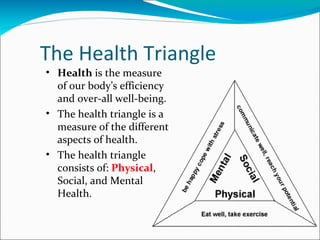
The Health Triangle
• Health is the measure
  of our body’s efficiency
  and over-all well-being.
• The health triangle is a
  measure of the different
  aspects of health.
• The health triangle
  consists of: Physical,
  Social, and Mental
  Health.
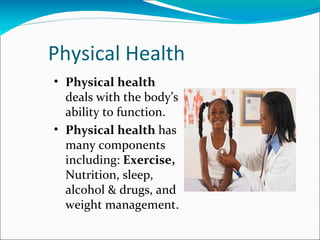
Physical Health
• Physical health
  deals with the body’s
  ability to function.
• Physical health has
  many components
  including: Exercise,
  Nutrition, sleep,
  alcohol & drugs, and
  weight management.
How the concept of exercise
   emerged?
 The benefits of exercise have been known since antiquity.
 Marcus Cicero, around 65 BC, stated: "It is exercise alone that
  supports the spirits, and keeps the mind in vigor." However,
  the link between physical health and exercise (or lack of it)
  was only discovered in 1949 and reported in 1953 by a team
  led by Jerry Morris.
 Dr. Morris noted that bus drivers had a sedentary occupation
  and a higher incidence of heart disease, while bus conductors
  were forced to move continually and had a lower incidence
  heart disease.
Reasons To Exercise
Weight Control
Reduced risk of Cardiovascular diseases
Reduction in stress and depression
Enjoyment
Building self-esteem
Socializing
Reasons for Not Exercising
       Lack of Time
       Lack of Energy
       Lack of Motivation
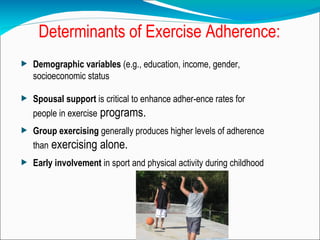
Determinants of Exercise Adherence:
 Demographic variables (e.g., education, income, gender,
  socioeconomic status

 Spousal support is critical to enhance adher-ence rates for
  people in exercise programs.
 Group exercising generally produces higher levels of adherence
  than exercising alone.
 Early involvement in sport and physical activity during childhood
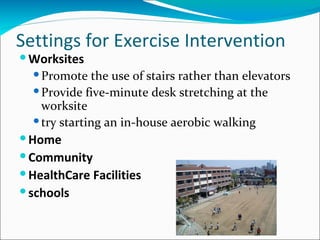
Settings for Exercise Intervention
 Worksites
   Promote the use of stairs rather than elevators
   Provide five-minute desk stretching at the
    worksite
   try starting an in-house aerobic walking
 Home
 Community
 HealthCare Facilities
 schools
Exercise and Aging
 Functional capacity peaks between 20 and 30
  years of age and decreases with advancing years.
 Active people show 25% higher functional
  capacity at any age over sedentary counterparts!
 Physical capacity will decline with age, but older
  people can still improve!
Exercise and Aging
 Cardiovascular System Responds to
 Training at any AGE!!
 Exercise diminishes increase in BF% seen
 with aging
Aging vs. Sedentary Lifestyle
Aging and being sedentary combined,
 facilitates loss of physical capacity.
Many people blame “getting old” for
 everything (usually lack of activity).
Human body improves with
 activity...REGARDLESS OF AGE!!!
Fight against Lifestyle
      Disorders
Cardiovascular Diseases & Exercise
Cardiovascular diseases including:
 Coronary Artery Disease (CAD) is the
 leading killer
Cardiovascular disease includes all
 diseases associated with the heart
 and / or blood vessels.
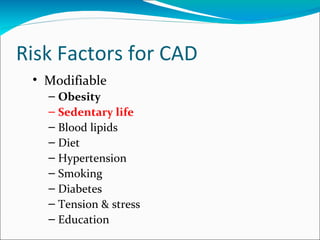
Risk Factors for CAD
 • Modifiable
   – Obesity
   – Sedentary life
   – Blood lipids
   – Diet
   – Hypertension
   – Smoking
   – Diabetes
   – Tension & stress
   – Education
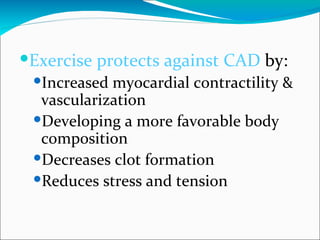
Exercise protects against CAD by:
 Increased myocardial contractility &
  vascularization
 Developing a more favorable body
  composition
 Decreases clot formation
 Reduces stress and tension
Hypertension & Exercise
Often called “silent killer”
   Most people do not know they have it
   90% of causes are of unknown etiology
    (
    (essential hypertension)
   Uncorrected, HT can lead to heart failure,
    heart attack, stroke, and kidney failure.
  Exercise is often the best way lower
   borderline – hypertension.
Diabetes and Exercise
 Most diabetics are Type II, adult onset.

 Exercise and obesity are the two largest risk factors
  for Type II diabetes.

 Most Type II diabetics can control blood glucose with
  diet and exercise and can often live completely
  free of insulin therapy.
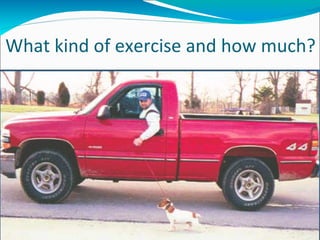
What kind of exercise and how much?
 Follow FITT Principle:
   Frequency-each day of the week
   Intensity- rate using Talk-test, Borg's RPE scale, HR
   Time- Not <30 and >60 minutes preferably
   Type- endurance training, strength training, aerobic
    program, anaerobic program, weight lifting training etc..
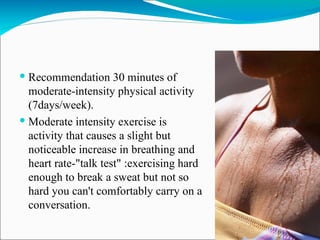
 Recommendation 30 minutes of
  moderate-intensity physical activity
  (7days/week).
 Moderate intensity exercise is
  activity that causes a slight but
  noticeable increase in breathing and
  heart rate-"talk test" :exercising hard
  enough to break a sweat but not so
  hard you can't comfortably carry on a
  conversation.
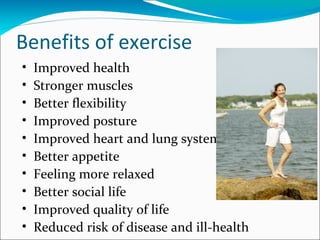
Benefits of exercise
•   Improved health
•   Stronger muscles
•   Better flexibility
•   Improved posture
•   Improved heart and lung system
•   Better appetite
•   Feeling more relaxed
•   Better social life
•   Improved quality of life
•   Reduced risk of disease and ill-health
Summary
 Exercise reduces risk factors in some most common
  health problems: heart disease, obesity , diabetes, and
  stress
 Exercise gives healthy and long life
 Doing exercise will reduce economic burden of your
  family by reducing risk of lifestyle disorders.
 Your positive attitude will be the strength of our
  society.
Exercise & health

Exercise & health

  • 1.
    Dr. Vinod K.Ravaliya MPT Lecturer, KMPIP
  • 2.
    The Health Triangle •Health is the measure of our body’s efficiency and over-all well-being. • The health triangle is a measure of the different aspects of health. • The health triangle consists of: Physical, Social, and Mental Health.
  • 3.
    Physical Health • Physicalhealth deals with the body’s ability to function. • Physical health has many components including: Exercise, Nutrition, sleep, alcohol & drugs, and weight management.
  • 4.
    How the conceptof exercise emerged?  The benefits of exercise have been known since antiquity.  Marcus Cicero, around 65 BC, stated: "It is exercise alone that supports the spirits, and keeps the mind in vigor." However, the link between physical health and exercise (or lack of it) was only discovered in 1949 and reported in 1953 by a team led by Jerry Morris.  Dr. Morris noted that bus drivers had a sedentary occupation and a higher incidence of heart disease, while bus conductors were forced to move continually and had a lower incidence heart disease.
  • 5.
    Reasons To Exercise WeightControl Reduced risk of Cardiovascular diseases Reduction in stress and depression Enjoyment Building self-esteem Socializing
  • 6.
    Reasons for NotExercising Lack of Time Lack of Energy Lack of Motivation
  • 7.
    Determinants of ExerciseAdherence:  Demographic variables (e.g., education, income, gender, socioeconomic status  Spousal support is critical to enhance adher-ence rates for people in exercise programs.  Group exercising generally produces higher levels of adherence than exercising alone.  Early involvement in sport and physical activity during childhood
  • 8.
    Settings for ExerciseIntervention  Worksites  Promote the use of stairs rather than elevators  Provide five-minute desk stretching at the worksite  try starting an in-house aerobic walking  Home  Community  HealthCare Facilities  schools
  • 9.
    Exercise and Aging Functional capacity peaks between 20 and 30 years of age and decreases with advancing years.  Active people show 25% higher functional capacity at any age over sedentary counterparts!  Physical capacity will decline with age, but older people can still improve!
  • 10.
    Exercise and Aging Cardiovascular System Responds to Training at any AGE!! Exercise diminishes increase in BF% seen with aging
  • 11.
    Aging vs. SedentaryLifestyle Aging and being sedentary combined, facilitates loss of physical capacity. Many people blame “getting old” for everything (usually lack of activity). Human body improves with activity...REGARDLESS OF AGE!!!
  • 12.
  • 13.
    Cardiovascular Diseases &Exercise Cardiovascular diseases including: Coronary Artery Disease (CAD) is the leading killer Cardiovascular disease includes all diseases associated with the heart and / or blood vessels.
  • 14.
    Risk Factors forCAD • Modifiable – Obesity – Sedentary life – Blood lipids – Diet – Hypertension – Smoking – Diabetes – Tension & stress – Education
  • 15.
    Exercise protects againstCAD by: Increased myocardial contractility & vascularization Developing a more favorable body composition Decreases clot formation Reduces stress and tension
  • 16.
    Hypertension & Exercise Oftencalled “silent killer”  Most people do not know they have it  90% of causes are of unknown etiology ( (essential hypertension)  Uncorrected, HT can lead to heart failure, heart attack, stroke, and kidney failure. Exercise is often the best way lower borderline – hypertension.
  • 17.
    Diabetes and Exercise Most diabetics are Type II, adult onset.  Exercise and obesity are the two largest risk factors for Type II diabetes.  Most Type II diabetics can control blood glucose with diet and exercise and can often live completely free of insulin therapy.
  • 18.
    What kind ofexercise and how much?
  • 19.
     Follow FITTPrinciple:  Frequency-each day of the week  Intensity- rate using Talk-test, Borg's RPE scale, HR  Time- Not <30 and >60 minutes preferably  Type- endurance training, strength training, aerobic program, anaerobic program, weight lifting training etc..
  • 20.
     Recommendation 30minutes of moderate-intensity physical activity (7days/week).  Moderate intensity exercise is activity that causes a slight but noticeable increase in breathing and heart rate-"talk test" :exercising hard enough to break a sweat but not so hard you can't comfortably carry on a conversation.
  • 21.
    Benefits of exercise • Improved health • Stronger muscles • Better flexibility • Improved posture • Improved heart and lung system • Better appetite • Feeling more relaxed • Better social life • Improved quality of life • Reduced risk of disease and ill-health
  • 22.
    Summary  Exercise reducesrisk factors in some most common health problems: heart disease, obesity , diabetes, and stress  Exercise gives healthy and long life  Doing exercise will reduce economic burden of your family by reducing risk of lifestyle disorders.  Your positive attitude will be the strength of our society.