Health and wellness
CHAPTER: 01
• The doctor of the future will give no medicine, but will interest
his patient in the care of human frame, in diet, and in the
cause and prevention of diseases
THOMAS EDISON
Health
• is level of functional or metabolic efficiency of a
living being.
• general condition of a person's mind and body,
usually meaning to be free from illness, injury or pain
• (as in "good health" or "healthy").
• Word health drive from old English term hal meaning
sound or whole.
• Webster dictionary define as “the state of being healthy
happy and prosperous”
• The World Health Organization (WHO) defined health in
1946 as
"a state of complete physical, mental, and social well-being
and not merely the absence of disease or infirmity.“
Classification systems
• Classification systems such as WHO Family of
International Classifications, including
• International Classification of Functioning, Disability and
Health (ICF) and
• International Classification of Diseases (ICD), are
commonly used to define and measure the components
of health.
• Classification of death and injury resulting from
terrorism
• Classification of Health intevention ICHI
Aims of health care providers
• Systematic activities to prevent or cure health
problems and promote good health in humans are
undertaken by health care providers.
• term "healthy" is also widely used
• healthy communities
• healthy cities
• healthy environments.
• It is increasingly recognized that health is maintained and
improved not only through the advancement and application of
health science, but also through the efforts and intelligent lifestyle
choices of the individual and society.
• ( WHO) main determinants of health include
• social and economic environment,
• the physical environment,
• the person's individual characteristics and
behaviors.[6]
determinants of health
• key factors (if people are healthy or unhealthy include)
• Income and social status
• Social support networks
• Education and literacy
• Employment/working conditions
• Social environments
• Physical environments
• Personal health practices and coping skills
• Healthy child development
• Biology and genetics
• Health care services
• Gender
• Culture
3 interdependent fields as key determinants of
an individual's health.
• Lifestyle:
• aggregation of personal decisions (i.e., over which individual
has control) that can be said to contribute to, or cause, illness
or death;
• Environmental:
• all matters related to health external to human body and over
which the individual has little or no control;
• Biomedical:
• all aspects of health, physical and mental, developed within
human body as influenced by genetic make-up.
Prevention Practice: A Holistic Perspective for
Physical Therapy
Health
Wellness
Dimension of Wellness
Model of Wellness
Quality of Life
Holistic Health
Risk Reduction
The Physical Therapist’s Role in Promoting Health and
Wellness
Preventive practice is holistic practice of medicine that
encompasses care of the individual in the context of that
person’s home , work, and community.
The impact of prevention practice influences not only
the individual but also influences the society.
As a member of the health care team physical therapist play a key role
in identifying risk factors for poor health and
promoting wellness through various strategies including
screening ,
health education to encourage self responsibility and
awareness of risk factors and promoting healthy style behaviors.
Optimal Health
A balance of physical, mental and social health.
Life style changes promoting health can be facilitated
through a combination of effort that are
 Enhance self awareness and knowledge of health
habits
Change behavior that interfere with good health
Create environments that support good health
practice.
Poor Health
• Poor health may include
• physical ailments
• causing acute or chronic disabilities as well as
• mental issue that limit independent functioning.
Wellness
Wellness often used synonymously with health
National wellness institute define as “wellness is an active
process of becoming aware of and making choice
decision toward more successful existence”.
In other words wellness is active life long process of becoming
aware of choice and making decisions to ward a more balanced and
fulfilling life.
Wellness integrates
mental, social,
 occupational , emotional,
spiritual and physical dimension
of ones life and reflects ones ability to function effectively.
Dimensions of Wellness
• According to system theory of wellness the
multiple dimensions of wellness are essential sub
elements of a larger system , yet these dimensions
function independently as their own sub element.
• When one dimension is disrupted other dimension
of wellness reciprocally interrelated to that
dimension are also disrupted.
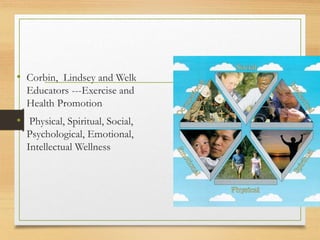
• Corbin, Lindsey and Welk
Educators ---Exercise and
Health Promotion
• Physical, Spiritual, Social,
Psychological, Emotional,
Intellectual Wellness
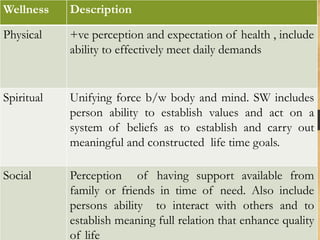
Wellness Description
Physical +ve perception and expectation of health , include
ability to effectively meet daily demands
Spiritual Unifying force b/w body and mind. SW includes
person ability to establish values and act on a
system of beliefs as to establish and carry out
meaningful and constructed life time goals.
Social Perception of having support available from
family or friends in time of need. Also include
persons ability to interact with others and to
establish meaning full relation that enhance quality
of life
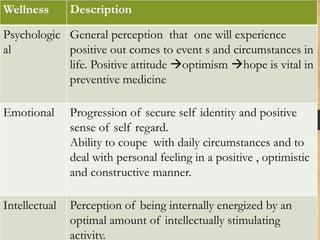
Wellness Description
Psychologic
al
General perception that one will experience
positive out comes to event s and circumstances in
life. Positive attitude optimism hope is vital in
preventive medicine
Emotional Progression of secure self identity and positive
sense of self regard.
Ability to coupe with daily circumstances and to
deal with personal feeling in a positive , optimistic
and constructive manner.
Intellectual Perception of being internally energized by an
optimal amount of intellectually stimulating
activity.
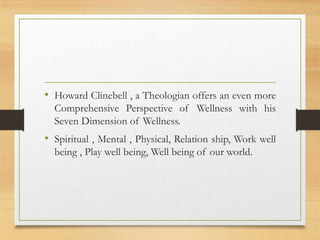
• Howard Clinebell , a Theologian offers an even more
Comprehensive Perspective of Wellness with his
Seven Dimension of Wellness.
• Spiritual , Mental , Physical, Relation ship, Work well
being , Play well being, Well being of our world.
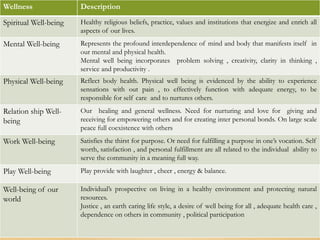
Wellness Description
Spiritual Well-being Healthy religious beliefs, practice, values and institutions that energize and enrich all
aspects of our lives.
Mental Well-being Represents the profound interdependence of mind and body that manifests itself in
our mental and physical health.
Mental well being incorporates problem solving , creativity, clarity in thinking ,
service and productivity .
Physical Well-being Reflect body health. Physical well being is evidenced by the ability to experience
sensations with out pain , to effectively function with adequate energy, to be
responsible for self care and to nurtures others.
Relation ship Well-
being
Our healing and general wellness. Need for nurturing and love for giving and
receiving for empowering others and for creating inter personal bonds. On large scale
peace full coexistence with others
Work Well-being Satisfies the thirst for purpose. Or need for fulfilling a purpose in one’s vocation. Self
worth, satisfaction , and personal fulfillment are all related to the individual ability to
serve the community in a meaning full way.
Play Well-being Play provide with laughter , cheer , energy & balance.
Well-being of our
world
Individual’s prospective on living in a healthy environment and protecting natural
resources.
Justice , an earth caring life style, a desire of well being for all , adequate health care ,
dependence on others in community , political participation
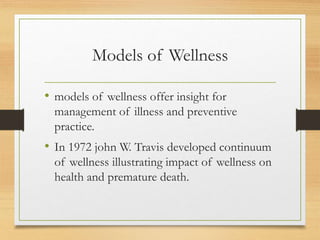
Models of Wellness
• models of wellness offer insight for
management of illness and preventive
practice.
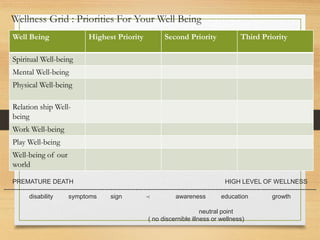
• In 1972 john W. Travis developed continuum
of wellness illustrating impact of wellness on
health and premature death.
PREMATURE DEATH HIGH LEVEL OF WELLNESS
--------------------------------------------------------------------------------------------------------------------------------------------------------
disability symptoms sign p awareness education growth
neutral point
( no discernible illness or wellness)
Wellness Grid : Priorities For Your Well Being
Well Being Highest Priority Second Priority Third Priority
Spiritual Well-being
Mental Well-being
Physical Well-being
Relation ship Well-
being
Work Well-being
Play Well-being
Well-being of our
world
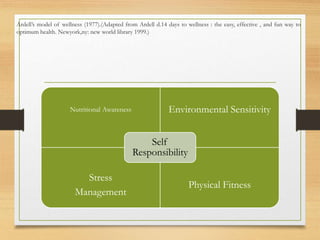
Ardell’s model of wellness (1977).(Adapted from Ardell d.14 days to wellness : the easy, effective , and fun way to
optimum health. Newyork,ny: new world library 1999.)
Nutritional Awareness Environmental Sensitivity
Stress
Management
Physical Fitness
Self
Responsibility
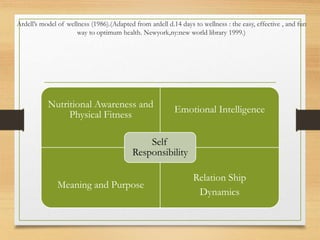
Ardell’s model of wellness (1986).(Adapted from ardell d.14 days to wellness : the easy, effective , and fun
way to optimum health. Newyork,ny:new world library 1999.)
Nutritional Awareness and
Physical Fitness
Emotional Intelligence
Meaning and Purpose
Relation Ship
Dynamics
Self
Responsibility
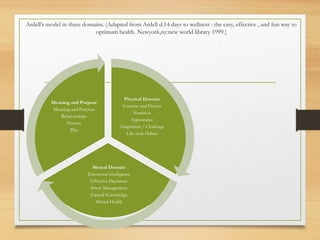
Ardell’s model in three domains. (Adapted from Ardell d.14 days to wellness : the easy, effective , and fun way to
optimum health. Newyork,ny:new world library 1999.)
Physical Domain
Exercise and Fitness
Nutrition
Appearance
Adaptation / Challenge
Life style Habits
Mental Domain
Emotional intelligence
Effective Decisions
Stress Management
Factual Knowledge
Mental Health
Meaning and Purpose
Meaning and Purpose
Relationships
Humor
Play
Comparing Holistic Medicine
and
Conventional Medicine
HOLISTIC HEALTH
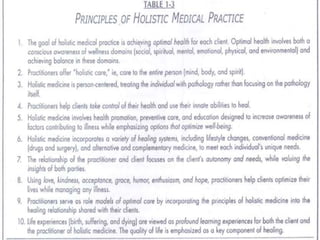
• The philosophy of holistic health care is compatible with
medicine designed to restore health and wellness.
• The health care provider’s comprehensive role in health
care requires a holistic prospective of the individual
seeking care.
• This holistic prospective looks beyond physical
functioning of individual and recognize the importance
of multiple factors contributing to good health and
optimal wellness , emphasizing the unity of mind , spirit
and body.
• According to American holistic health association ,this expanded
perspective of holistic care considers the whole person and the whole
situation.
• The characteristic of holistic medicine that apply to wellness practice
incorporate recognizing the interdependent parts of whole being ,
including the physical, mental , emotional and spiritual aspects of the
individual.
HOLISTIC HEALTH
This recognition of multiple factors influencing health
and wellness leads to following
• Identifying and managing root causes of disease
processes.
• Empowering the individual to manage these
pathological processes.
• Providing a comprehensive perspective of the
individual in multiple social roles.
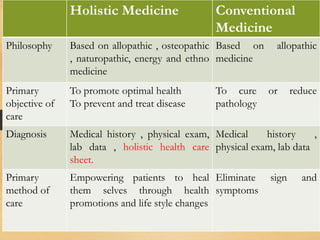
Holistic Medicine Conventional
Medicine
Philosophy Based on allopathic , osteopathic
, naturopathic, energy and ethno
medicine
Based on allopathic
medicine
Primary
objective of
care
To promote optimal health
To prevent and treat disease
To cure or reduce
pathology
Diagnosis Medical history , physical exam,
lab data , holistic health care
sheet.
Medical history ,
physical exam, lab data
Primary
method of
care
Empowering patients to heal
them selves through health
promotions and life style changes
Eliminate sign and
symptoms
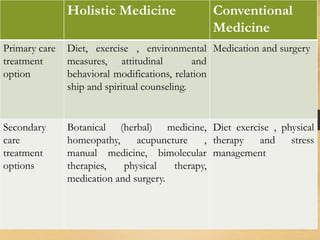
Holistic Medicine Conventional
Medicine
Primary care
treatment
option
Diet, exercise , environmental
measures, attitudinal and
behavioral modifications, relation
ship and spiritual counseling.
Medication and surgery
Secondary
care
treatment
options
Botanical (herbal) medicine,
homeopathy, acupuncture ,
manual medicine, bimolecular
therapies, physical therapy,
medication and surgery.
Diet exercise , physical
therapy and stress
management
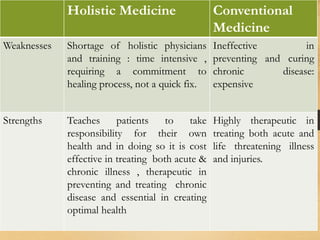
Holistic Medicine Conventional
Medicine
Weaknesses Shortage of holistic physicians
and training : time intensive ,
requiring a commitment to
healing process, not a quick fix.
Ineffective in
preventing and curing
chronic disease:
expensive
Strengths Teaches patients to take
responsibility for their own
health and in doing so it is cost
effective in treating both acute &
chronic illness , therapeutic in
preventing and treating chronic
disease and essential in creating
optimal health
Highly therapeutic in
treating both acute and
life threatening illness
and injuries.
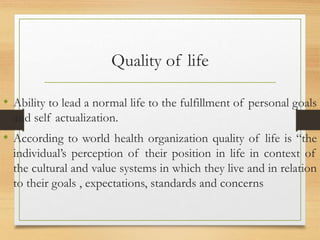
Quality of life
• Ability to lead a normal life to the fulfillment of personal goals
and self actualization.
• According to world health organization quality of life is “the
individual’s perception of their position in life in context of
the cultural and value systems in which they live and in relation
to their goals , expectations, standards and concerns
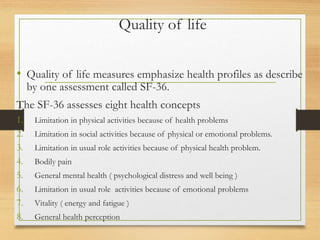
Quality of life
• Quality of life measures emphasize health profiles as describe
by one assessment called SF-36.
The SF-36 assesses eight health concepts
1. Limitation in physical activities because of health problems
2. Limitation in social activities because of physical or emotional problems.
3. Limitation in usual role activities because of physical health problem.
4. Bodily pain
5. General mental health ( psychological distress and well being )
6. Limitation in usual role activities because of emotional problems
7. Vitality ( energy and fatigue )
8. General health perception
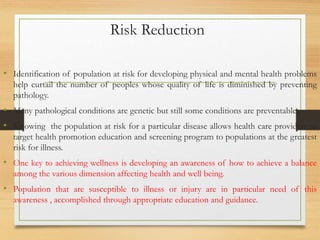
Risk Reduction
• Identification of population at risk for developing physical and mental health problems
help curtail the number of peoples whose quality of life is diminished by preventing
pathology.
• Many pathological conditions are genetic but still some conditions are preventable.
• Knowing the population at risk for a particular disease allows health care providers to
target health promotion education and screening program to populations at the greatest
risk for illness.
• One key to achieving wellness is developing an awareness of how to achieve a balance
among the various dimension affecting health and well being.
• Population that are susceptible to illness or injury are in particular need of this
awareness , accomplished through appropriate education and guidance.
Risk Reduction
• Risk factor that may predispose an individual to
diminished well being and health problems include
• physical risk factors:
• poor nutrition ,physical inactivity,
• poor physical environment and
• substance abuse:
• psychological,
• spiritual and
• social risk factors:
• low self-esteem and
• lacking values and
• a direction in one’s life plan:
• environmental risk factors:
• persons, things or conditions that negatively influence other dimensions.
• By identifying and addressing these risk factors, the health professional
can reduce the incidence of injury and illness
The Physical Therapist Role in
Promoting Health and Wellness
• Physical therapist are beginning to play major roles as
prevention practitioners in health care.
• While physical therapist have traditionally been
involved in the management of physical impairment
and functional limitation associated with an
individual’s medical problem’s
• Their current role encompasses identifying risk
factors and developing health promotion strategies
that significantly affect health ,fitness and wellness.
• Physical therapist are uniquely prepared to apply their extensive
knowledge for improving or adopting movements and
motor task for more independent functions.
• In addition physical therapist are experts in examining and evaluating the
motor capability , goals and functional limitations of individual with
musculoskeletal, neurological ,cardiopulmonary ,integumentary , and
other body system impairments
• Knowledge that spans the spectrum of optimizing health and managing illness enables
therapist to design customized exercises that address potential medical complications that
may arise in population at risk.
• A key role of health care management is directing clients energies toward improving
capabilities for functional independence maintaining optimal health and fulfilling
important role in their lives.
• The physical therapist determine an individual’s functional capabilities by examining the
requisite motor skills and behaviors needed to perform task relevant to that individual’s
role in society .
• In one case a physical therapists may help an elite athlete prepare for an Olympic event
ensuring that the training schedule for the athlete promotes optimal performance and
prevent injuries.
• PT may evaluate an older patient requisite abilities for resuming multiple roles on home,
In social circles and in community..function in this respect comprises not only the
physical capabilities of the individual but also include the psychosocial environment and
well being of individual.
• Social support can contribute significantly to individual wellbeing..this well being in turn
leads to the individual’s ability to develop a personal sense of meaningful living.
• According to the Guide To Physical Therapist Practice physical therapist
“restore, maintain , and promote not only optimal physical function but
optimal wellness and fitness and optimal quality of life as it relates to
movement and health”.
• The practice of physical therapy encompasses the full spectrum of health and
wellness that includes preventing disease and illness as well as optimizing
health.
• Physical therapist play key role in providing education , guidance , consultation,
and direct intervention to enable individual to maintain physical activity of self
care, mobility , leisure skills , work and play.
• Impairment:
• Any loss or abnormality of psychological, physiological, or anatomocal
structure of function
• Disability:
• Any restriction or lack (resulting from the impairment) of ability to
perform any activity in a manner or within the range considered normal
for a human being.
• Handicap:
• A disadvantage for a given individual, resulting from an impairment or a
disability, that limits or prevents the fulfilment of a role that is normal
for this individual.

HW-1Holistic Perspective for Physical Therapy...ppt

  • 1.
  • 2.
    • The doctorof the future will give no medicine, but will interest his patient in the care of human frame, in diet, and in the cause and prevention of diseases THOMAS EDISON
  • 3.
    Health • is levelof functional or metabolic efficiency of a living being. • general condition of a person's mind and body, usually meaning to be free from illness, injury or pain • (as in "good health" or "healthy"). • Word health drive from old English term hal meaning sound or whole. • Webster dictionary define as “the state of being healthy happy and prosperous”
  • 4.
    • The WorldHealth Organization (WHO) defined health in 1946 as "a state of complete physical, mental, and social well-being and not merely the absence of disease or infirmity.“
  • 5.
    Classification systems • Classificationsystems such as WHO Family of International Classifications, including • International Classification of Functioning, Disability and Health (ICF) and • International Classification of Diseases (ICD), are commonly used to define and measure the components of health.
  • 6.
    • Classification ofdeath and injury resulting from terrorism • Classification of Health intevention ICHI
  • 7.
    Aims of healthcare providers • Systematic activities to prevent or cure health problems and promote good health in humans are undertaken by health care providers.
  • 8.
    • term "healthy"is also widely used • healthy communities • healthy cities • healthy environments.
  • 9.
    • It isincreasingly recognized that health is maintained and improved not only through the advancement and application of health science, but also through the efforts and intelligent lifestyle choices of the individual and society.
  • 10.
    • ( WHO)main determinants of health include • social and economic environment, • the physical environment, • the person's individual characteristics and behaviors.[6]
  • 11.
    determinants of health •key factors (if people are healthy or unhealthy include) • Income and social status • Social support networks • Education and literacy • Employment/working conditions • Social environments • Physical environments • Personal health practices and coping skills • Healthy child development • Biology and genetics • Health care services • Gender • Culture
  • 12.
    3 interdependent fieldsas key determinants of an individual's health. • Lifestyle: • aggregation of personal decisions (i.e., over which individual has control) that can be said to contribute to, or cause, illness or death; • Environmental: • all matters related to health external to human body and over which the individual has little or no control; • Biomedical: • all aspects of health, physical and mental, developed within human body as influenced by genetic make-up.
  • 13.
    Prevention Practice: AHolistic Perspective for Physical Therapy
  • 14.
    Health Wellness Dimension of Wellness Modelof Wellness Quality of Life Holistic Health Risk Reduction The Physical Therapist’s Role in Promoting Health and Wellness
  • 15.
    Preventive practice isholistic practice of medicine that encompasses care of the individual in the context of that person’s home , work, and community. The impact of prevention practice influences not only the individual but also influences the society.
  • 16.
    As a memberof the health care team physical therapist play a key role in identifying risk factors for poor health and promoting wellness through various strategies including screening , health education to encourage self responsibility and awareness of risk factors and promoting healthy style behaviors.
  • 17.
    Optimal Health A balanceof physical, mental and social health. Life style changes promoting health can be facilitated through a combination of effort that are  Enhance self awareness and knowledge of health habits Change behavior that interfere with good health Create environments that support good health practice.
  • 18.
    Poor Health • Poorhealth may include • physical ailments • causing acute or chronic disabilities as well as • mental issue that limit independent functioning.
  • 19.
    Wellness Wellness often usedsynonymously with health National wellness institute define as “wellness is an active process of becoming aware of and making choice decision toward more successful existence”.
  • 20.
    In other wordswellness is active life long process of becoming aware of choice and making decisions to ward a more balanced and fulfilling life. Wellness integrates mental, social,  occupational , emotional, spiritual and physical dimension of ones life and reflects ones ability to function effectively.
  • 21.
    Dimensions of Wellness •According to system theory of wellness the multiple dimensions of wellness are essential sub elements of a larger system , yet these dimensions function independently as their own sub element. • When one dimension is disrupted other dimension of wellness reciprocally interrelated to that dimension are also disrupted.
  • 22.
    • Corbin, Lindseyand Welk Educators ---Exercise and Health Promotion • Physical, Spiritual, Social, Psychological, Emotional, Intellectual Wellness
  • 23.
    Wellness Description Physical +veperception and expectation of health , include ability to effectively meet daily demands Spiritual Unifying force b/w body and mind. SW includes person ability to establish values and act on a system of beliefs as to establish and carry out meaningful and constructed life time goals. Social Perception of having support available from family or friends in time of need. Also include persons ability to interact with others and to establish meaning full relation that enhance quality of life
  • 24.
    Wellness Description Psychologic al General perceptionthat one will experience positive out comes to event s and circumstances in life. Positive attitude optimism hope is vital in preventive medicine Emotional Progression of secure self identity and positive sense of self regard. Ability to coupe with daily circumstances and to deal with personal feeling in a positive , optimistic and constructive manner. Intellectual Perception of being internally energized by an optimal amount of intellectually stimulating activity.
  • 25.
    • Howard Clinebell, a Theologian offers an even more Comprehensive Perspective of Wellness with his Seven Dimension of Wellness. • Spiritual , Mental , Physical, Relation ship, Work well being , Play well being, Well being of our world.
  • 26.
    Wellness Description Spiritual Well-beingHealthy religious beliefs, practice, values and institutions that energize and enrich all aspects of our lives. Mental Well-being Represents the profound interdependence of mind and body that manifests itself in our mental and physical health. Mental well being incorporates problem solving , creativity, clarity in thinking , service and productivity . Physical Well-being Reflect body health. Physical well being is evidenced by the ability to experience sensations with out pain , to effectively function with adequate energy, to be responsible for self care and to nurtures others. Relation ship Well- being Our healing and general wellness. Need for nurturing and love for giving and receiving for empowering others and for creating inter personal bonds. On large scale peace full coexistence with others Work Well-being Satisfies the thirst for purpose. Or need for fulfilling a purpose in one’s vocation. Self worth, satisfaction , and personal fulfillment are all related to the individual ability to serve the community in a meaning full way. Play Well-being Play provide with laughter , cheer , energy & balance. Well-being of our world Individual’s prospective on living in a healthy environment and protecting natural resources. Justice , an earth caring life style, a desire of well being for all , adequate health care , dependence on others in community , political participation
  • 27.
    Models of Wellness •models of wellness offer insight for management of illness and preventive practice. • In 1972 john W. Travis developed continuum of wellness illustrating impact of wellness on health and premature death.
  • 28.
    PREMATURE DEATH HIGHLEVEL OF WELLNESS -------------------------------------------------------------------------------------------------------------------------------------------------------- disability symptoms sign p awareness education growth neutral point ( no discernible illness or wellness) Wellness Grid : Priorities For Your Well Being Well Being Highest Priority Second Priority Third Priority Spiritual Well-being Mental Well-being Physical Well-being Relation ship Well- being Work Well-being Play Well-being Well-being of our world
  • 29.
    Ardell’s model ofwellness (1977).(Adapted from Ardell d.14 days to wellness : the easy, effective , and fun way to optimum health. Newyork,ny: new world library 1999.) Nutritional Awareness Environmental Sensitivity Stress Management Physical Fitness Self Responsibility
  • 30.
    Ardell’s model ofwellness (1986).(Adapted from ardell d.14 days to wellness : the easy, effective , and fun way to optimum health. Newyork,ny:new world library 1999.) Nutritional Awareness and Physical Fitness Emotional Intelligence Meaning and Purpose Relation Ship Dynamics Self Responsibility
  • 31.
    Ardell’s model inthree domains. (Adapted from Ardell d.14 days to wellness : the easy, effective , and fun way to optimum health. Newyork,ny:new world library 1999.) Physical Domain Exercise and Fitness Nutrition Appearance Adaptation / Challenge Life style Habits Mental Domain Emotional intelligence Effective Decisions Stress Management Factual Knowledge Mental Health Meaning and Purpose Meaning and Purpose Relationships Humor Play
  • 32.
  • 33.
    HOLISTIC HEALTH • Thephilosophy of holistic health care is compatible with medicine designed to restore health and wellness. • The health care provider’s comprehensive role in health care requires a holistic prospective of the individual seeking care. • This holistic prospective looks beyond physical functioning of individual and recognize the importance of multiple factors contributing to good health and optimal wellness , emphasizing the unity of mind , spirit and body.
  • 34.
    • According toAmerican holistic health association ,this expanded perspective of holistic care considers the whole person and the whole situation. • The characteristic of holistic medicine that apply to wellness practice incorporate recognizing the interdependent parts of whole being , including the physical, mental , emotional and spiritual aspects of the individual.
  • 35.
    HOLISTIC HEALTH This recognitionof multiple factors influencing health and wellness leads to following • Identifying and managing root causes of disease processes. • Empowering the individual to manage these pathological processes. • Providing a comprehensive perspective of the individual in multiple social roles.
  • 37.
    Holistic Medicine Conventional Medicine PhilosophyBased on allopathic , osteopathic , naturopathic, energy and ethno medicine Based on allopathic medicine Primary objective of care To promote optimal health To prevent and treat disease To cure or reduce pathology Diagnosis Medical history , physical exam, lab data , holistic health care sheet. Medical history , physical exam, lab data Primary method of care Empowering patients to heal them selves through health promotions and life style changes Eliminate sign and symptoms
  • 38.
    Holistic Medicine Conventional Medicine Primarycare treatment option Diet, exercise , environmental measures, attitudinal and behavioral modifications, relation ship and spiritual counseling. Medication and surgery Secondary care treatment options Botanical (herbal) medicine, homeopathy, acupuncture , manual medicine, bimolecular therapies, physical therapy, medication and surgery. Diet exercise , physical therapy and stress management
  • 39.
    Holistic Medicine Conventional Medicine WeaknessesShortage of holistic physicians and training : time intensive , requiring a commitment to healing process, not a quick fix. Ineffective in preventing and curing chronic disease: expensive Strengths Teaches patients to take responsibility for their own health and in doing so it is cost effective in treating both acute & chronic illness , therapeutic in preventing and treating chronic disease and essential in creating optimal health Highly therapeutic in treating both acute and life threatening illness and injuries.
  • 40.
    Quality of life •Ability to lead a normal life to the fulfillment of personal goals and self actualization. • According to world health organization quality of life is “the individual’s perception of their position in life in context of the cultural and value systems in which they live and in relation to their goals , expectations, standards and concerns
  • 41.
    Quality of life •Quality of life measures emphasize health profiles as describe by one assessment called SF-36. The SF-36 assesses eight health concepts 1. Limitation in physical activities because of health problems 2. Limitation in social activities because of physical or emotional problems. 3. Limitation in usual role activities because of physical health problem. 4. Bodily pain 5. General mental health ( psychological distress and well being ) 6. Limitation in usual role activities because of emotional problems 7. Vitality ( energy and fatigue ) 8. General health perception
  • 42.
    Risk Reduction • Identificationof population at risk for developing physical and mental health problems help curtail the number of peoples whose quality of life is diminished by preventing pathology. • Many pathological conditions are genetic but still some conditions are preventable. • Knowing the population at risk for a particular disease allows health care providers to target health promotion education and screening program to populations at the greatest risk for illness. • One key to achieving wellness is developing an awareness of how to achieve a balance among the various dimension affecting health and well being. • Population that are susceptible to illness or injury are in particular need of this awareness , accomplished through appropriate education and guidance.
  • 43.
    Risk Reduction • Riskfactor that may predispose an individual to diminished well being and health problems include • physical risk factors: • poor nutrition ,physical inactivity, • poor physical environment and • substance abuse: • psychological, • spiritual and • social risk factors:
  • 44.
    • low self-esteemand • lacking values and • a direction in one’s life plan: • environmental risk factors: • persons, things or conditions that negatively influence other dimensions. • By identifying and addressing these risk factors, the health professional can reduce the incidence of injury and illness
  • 45.
    The Physical TherapistRole in Promoting Health and Wellness • Physical therapist are beginning to play major roles as prevention practitioners in health care. • While physical therapist have traditionally been involved in the management of physical impairment and functional limitation associated with an individual’s medical problem’s • Their current role encompasses identifying risk factors and developing health promotion strategies that significantly affect health ,fitness and wellness.
  • 46.
    • Physical therapistare uniquely prepared to apply their extensive knowledge for improving or adopting movements and motor task for more independent functions. • In addition physical therapist are experts in examining and evaluating the motor capability , goals and functional limitations of individual with musculoskeletal, neurological ,cardiopulmonary ,integumentary , and other body system impairments
  • 47.
    • Knowledge thatspans the spectrum of optimizing health and managing illness enables therapist to design customized exercises that address potential medical complications that may arise in population at risk. • A key role of health care management is directing clients energies toward improving capabilities for functional independence maintaining optimal health and fulfilling important role in their lives. • The physical therapist determine an individual’s functional capabilities by examining the requisite motor skills and behaviors needed to perform task relevant to that individual’s role in society . • In one case a physical therapists may help an elite athlete prepare for an Olympic event ensuring that the training schedule for the athlete promotes optimal performance and prevent injuries. • PT may evaluate an older patient requisite abilities for resuming multiple roles on home, In social circles and in community..function in this respect comprises not only the physical capabilities of the individual but also include the psychosocial environment and well being of individual. • Social support can contribute significantly to individual wellbeing..this well being in turn leads to the individual’s ability to develop a personal sense of meaningful living.
  • 48.
    • According tothe Guide To Physical Therapist Practice physical therapist “restore, maintain , and promote not only optimal physical function but optimal wellness and fitness and optimal quality of life as it relates to movement and health”. • The practice of physical therapy encompasses the full spectrum of health and wellness that includes preventing disease and illness as well as optimizing health. • Physical therapist play key role in providing education , guidance , consultation, and direct intervention to enable individual to maintain physical activity of self care, mobility , leisure skills , work and play.
  • 49.
    • Impairment: • Anyloss or abnormality of psychological, physiological, or anatomocal structure of function • Disability: • Any restriction or lack (resulting from the impairment) of ability to perform any activity in a manner or within the range considered normal for a human being. • Handicap: • A disadvantage for a given individual, resulting from an impairment or a disability, that limits or prevents the fulfilment of a role that is normal for this individual.