
ComprehensiveComprehensive
Wellness ProgramWellness Program
IntroductionIntroduction
• What is a comprehensive wellness
program?
• It is a program that requires
wellness to be part of the
organization’s culture.
• To begin with, a wellness committee
should be formed constituting a
representative mix of management
staff and employees.
Cont’dCont’d
• The wellness committee should
develop a mission and goals for the
organization related to wellness that
is incorporated into overall formal
goals and objectives.
Examples of wellnessExamples of wellness
committee goalscommittee goals
1) Wellness related activities to be
conducted once a month.
2) Awareness meetings, displays and
notifications to employees be made
to their involvement.
3) Distribution of educational materials
in various formats (posters, emails,
flyers, newsletters).
4) Follow-up at the end of promotion.
Comprehensive WorkplaceComprehensive Workplace
Program modelProgram model
1) The Health Risk Assessment (HRA).
This is a survey to evaluate the risk
factors of each individual in the
organization.
The HRA pinpoints the exact risk
factors that individuals within a
company are dealing with.
Contd”Contd”
2)Wellness coaches. The next step is
to address the risk factors through
wellness coaches. These coaches
are specially trained to analyze and
review the HRA in order to create
and guide the employee to
implement a plan of action.
Wellness coaches not only provide a
line of support but also a line of
education.
Contd”Contd”
3) Support programs. They encourage
the employee to carry out their
action plans. These programs
should cater for the employees
needs and may include:
a) Stress management programs
b) Financial wellness programs
c) Weight, fitness & nutrition
programs.
d) Smoking cessations
Issues to ponder….Issues to ponder….
1) Companies are not in the wellness
business. This means that they are
trying to implement a program that
is not their area of expertise.
2) Most companies do not have a
comprehensive wellness system in
place.
keep walking no matter what…………keep walking no matter what…………
Daily Nation 22 Sept 2011Daily Nation 22 Sept 2011
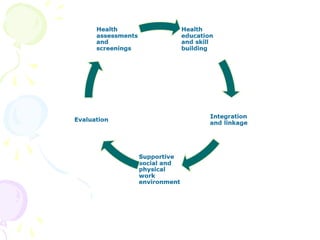
5 elements of CWP5 elements of CWP
1) Health assessments &
screenings.
Measures employees’ health status,
lifestyle habits & health risks on a
number of various topics such as
stress levels, nutrition, depression
and physical activity levels.
Cont’dCont’d
2) Health education & skill
building.
Behavior change programs that
focus on skill development, health
education & awareness raising on
specific topics related to employees’
interests and needs.
Cont’dCont’d
3) Integration & linkage.
Integration health promotion and
wellness concepts into the culture
and structure of the organization.
Links and coordinates health
promotion programs cross-
functionally with other employee
benefits and benefits and supports.
Cont’dCont’d
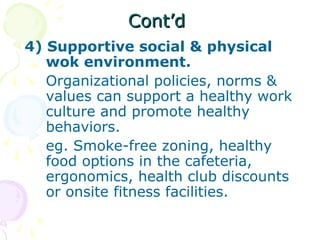
4) Supportive social & physical
wok environment.
Organizational policies, norms &
values can support a healthy work
culture and promote healthy
behaviors.
eg. Smoke-free zoning, healthy
food options in the cafeteria,
ergonomics, health club discounts
or onsite fitness facilities.
Cont’dCont’d
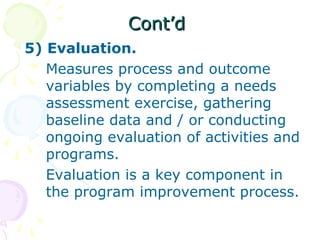
5) Evaluation.
Measures process and outcome
variables by completing a needs
assessment exercise, gathering
baseline data and / or conducting
ongoing evaluation of activities and
programs.
Evaluation is a key component in
the program improvement process.
END
Thank you for attention

Comprehensive wellness program

  • 1.
  • 2.
    IntroductionIntroduction • What isa comprehensive wellness program? • It is a program that requires wellness to be part of the organization’s culture. • To begin with, a wellness committee should be formed constituting a representative mix of management staff and employees.
  • 3.
    Cont’dCont’d • The wellnesscommittee should develop a mission and goals for the organization related to wellness that is incorporated into overall formal goals and objectives.
  • 4.
    Examples of wellnessExamplesof wellness committee goalscommittee goals 1) Wellness related activities to be conducted once a month. 2) Awareness meetings, displays and notifications to employees be made to their involvement. 3) Distribution of educational materials in various formats (posters, emails, flyers, newsletters). 4) Follow-up at the end of promotion.
  • 5.
    Comprehensive WorkplaceComprehensive Workplace ProgrammodelProgram model 1) The Health Risk Assessment (HRA). This is a survey to evaluate the risk factors of each individual in the organization. The HRA pinpoints the exact risk factors that individuals within a company are dealing with.
  • 6.
    Contd”Contd” 2)Wellness coaches. Thenext step is to address the risk factors through wellness coaches. These coaches are specially trained to analyze and review the HRA in order to create and guide the employee to implement a plan of action. Wellness coaches not only provide a line of support but also a line of education.
  • 7.
    Contd”Contd” 3) Support programs.They encourage the employee to carry out their action plans. These programs should cater for the employees needs and may include: a) Stress management programs b) Financial wellness programs c) Weight, fitness & nutrition programs. d) Smoking cessations
  • 8.
    Issues to ponder….Issuesto ponder…. 1) Companies are not in the wellness business. This means that they are trying to implement a program that is not their area of expertise. 2) Most companies do not have a comprehensive wellness system in place.
  • 9.
    keep walking nomatter what…………keep walking no matter what………… Daily Nation 22 Sept 2011Daily Nation 22 Sept 2011
  • 10.
    5 elements ofCWP5 elements of CWP 1) Health assessments & screenings. Measures employees’ health status, lifestyle habits & health risks on a number of various topics such as stress levels, nutrition, depression and physical activity levels.
  • 11.
    Cont’dCont’d 2) Health education& skill building. Behavior change programs that focus on skill development, health education & awareness raising on specific topics related to employees’ interests and needs.
  • 12.
    Cont’dCont’d 3) Integration &linkage. Integration health promotion and wellness concepts into the culture and structure of the organization. Links and coordinates health promotion programs cross- functionally with other employee benefits and benefits and supports.
  • 13.
    Cont’dCont’d 4) Supportive social& physical wok environment. Organizational policies, norms & values can support a healthy work culture and promote healthy behaviors. eg. Smoke-free zoning, healthy food options in the cafeteria, ergonomics, health club discounts or onsite fitness facilities.
  • 14.
    Cont’dCont’d 5) Evaluation. Measures processand outcome variables by completing a needs assessment exercise, gathering baseline data and / or conducting ongoing evaluation of activities and programs. Evaluation is a key component in the program improvement process.
  • 16.