Communicable Diseases and
Human Security
NOPE International Institute
2014
Joel Karanja
Overview of Communicable
diseases
 Introduction and Definition
 Importance of CDs
 Selected CDs of Public Health Concern
 Mounting a Global Response
 Approaches to intervention
 Key elements of a global response
Human Security in a globalized world
 The changing role of policy makers in an
increasingly globalized world
 Shared space = Shared Destiny
 Local actions have global consequences
 Global interventions can achieve positive
local impact
 As long as human interactions exist,
Communicable diseases will remain an issue.
Communicable Diseases: Definition
 Defined as

“any condition which is transmitted directly or indirectly to a
person from an infected person or animal through the agency of
an intermediate animal, host, or vector, or through the
inanimate environment”.
 Transmission is facilitated by the following
 More frequent human contact due to

Increase in the volume and means of transportation (affordable
international air travel),

globalization (increased trade and contact)
 Microbial adaptation and change
 Breakdown of public health capacity at various levels
 Change in human demographics and behavior
 Economic development and land use patterns
CD- Modes of transmission
 Direct

Blood-borne or sexual – HIV, Hepatitis B,C

Inhalation – Tuberculosis, influenza, anthrax

Food-borne – E.coli, Salmonella,

Contaminated water- Cholera, rotavirus, Hepatitis A
 Indirect

Vector-borne- malaria, onchocerciasis, trypanosomiasis

Formites
 Zoonotic diseases – animal handling and feeding
practices (Mad cow disease, Avian Influenza)
Importance of Communicable
Diseases
 Significant burden of disease especially
in low and middle income countries
 Social impact
 Economic impact
 Potential for rapid spread
 Human security concerns
Communicable Diseases account
for a significant global disease
burden
 In 2005, CDs accounted for about 30%
of the global BoD and 60% of the BoD
in Africa.
 CDs typically affect LIC and MICs
disproportionately.

Account for 40% of the disease burden in low
and middle income countries
 Most communicable diseases are
preventable or treatable.
Communicable Disease Burden VariesCommunicable Disease Burden Varies
Widely Among ContinentsWidely Among Continents
Communicable disease burden in
Europe
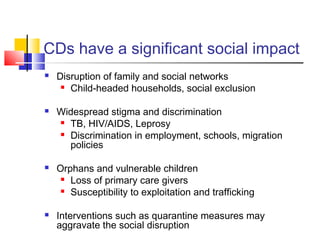
Causes of Death Vary Greatly by CountryCauses of Death Vary Greatly by Country
Income LevelIncome Level
Age distribution of death in Denmark around 2005
Male Female
80 60 40 20 0 20 40 60 80
0 - 4
15 - 19
30 - 34
45 - 49
60 - 64
75 - 79
90 - 94
Agegroup
Pe rc ent of total deaths
Age dis tribution of death in Sie rra Leone around 2005
Male Female
80 60 40 20 0 20 40 60 80
0 - 4
15 - 19
30 - 34
45 - 49
60 - 64
75 - 79
90 - 94
Agegroup
Pe rcent of total of deaths
CDs have a significant social impact
 Disruption of family and social networks
 Child-headed households, social exclusion
 Widespread stigma and discrimination
 TB, HIV/AIDS, Leprosy
 Discrimination in employment, schools, migration
policies
 Orphans and vulnerable children
 Loss of primary care givers
 Susceptibility to exploitation and trafficking
 Interventions such as quarantine measures may
aggravate the social disruption
CDs have a significant economic
impact in affected countries
 At the macro level
 Reduction in revenue for the country (e.g. tourism)

Estimated cost of SARS epidemic to Asian countries: $20 billion
(2003) or $2 million per case.

Drop in international travel to affected countries by 50-70%

Malaria causes an average loss of 1.3% annual GDP in countries
with intense transmission

The plague outbreak in India cost the economy over $1 billion
from travel restrictions and embargoes
 At the household level
 Poorer households are disproportionately affected
 Substantial loss in productivity and income for the infirmed and
caregiver
 Catastrophic costs of treating illness
International boundaries are
disappearing
 Borders are not very effective at stopping
communicable diseases.
 With increasing globalization

interdependence of countries – more trade and
human/animal interactions
 The rise in international traffic and commerce
makes challenges even more daunting
 Other global issues affect or are affected by
communicable diseases.

climate change

migration

Change in biodiversity
Human Security concerns
 Potential magnitude and rapid spread of
outbreaks/pandemics. e.g. SARS outbreak
 No country or region can contain a full blown
outbreak of Avian influenza
 Bioterrorism and intentional outbreaks
 Anthrax, Small pox
 New and re-emerging diseases
 Ebola, TB (MDR-TB and XDR-TB), HPAI, Rift
valley fever.
Communicable Diseases
Tuberculosis
 2 billion people infected with microbes that cause TB.
 Not everyone develops active disease
 A person is infected every second globally
 22 countries account for 80% of TB cases.
 >50% cases in Asia, 28% in Africa (which also has
the highest per capita prevalence)
 In 2005, there were 8.8 million new TB cases; 1.6
million deaths from TB (about 4400 a day)
 Highly stigmatizing disease
Tuberculosis and HIV
 A third of those living with HIV are co-infected with
TB
 About 200,000 people with HIV die annually from TB.
 Most common opportunistic infection in Africa
 70% of TB patients are co-infected with HIV in some
countries in Africa
 Impact of HIV on TB
 TB is harder to diagnose in HIV-positive people.
 TB progresses faster in HIV-infected people.
 TB in HIV-positive people is almost certain to be fatal if
undiagnosed or left untreated.
 TB occurs earlier in the course of HIV infection than many
other opportunistic infections.
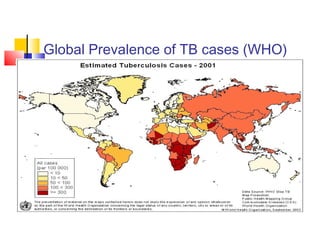
Global Prevalence of TB cases (WHO)
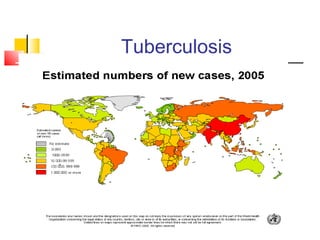
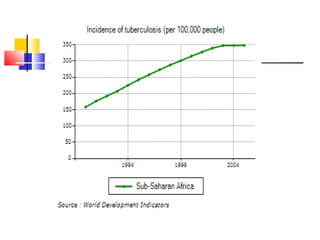
Tuberculosis
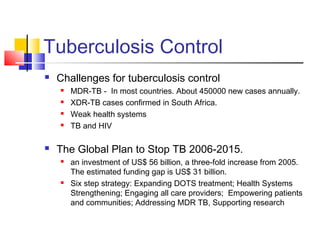
Tuberculosis Control
 Challenges for tuberculosis control
 MDR-TB - In most countries. About 450000 new cases annually.
 XDR-TB cases confirmed in South Africa.
 Weak health systems
 TB and HIV
 The Global Plan to Stop TB 2006-2015.
 an investment of US$ 56 billion, a three-fold increase from 2005.
The estimated funding gap is US$ 31 billion.
 Six step strategy: Expanding DOTS treatment; Health Systems
Strengthening; Engaging all care providers; Empowering patients
and communities; Addressing MDR TB, Supporting research
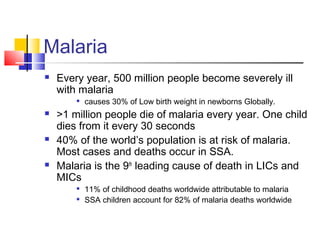
Malaria
 Every year, 500 million people become severely ill
with malaria

causes 30% of Low birth weight in newborns Globally.
 >1 million people die of malaria every year. One child
dies from it every 30 seconds
 40% of the world’s population is at risk of malaria.
Most cases and deaths occur in SSA.
 Malaria is the 9th
leading cause of death in LICs and
MICs

11% of childhood deaths worldwide attributable to malaria

SSA children account for 82% of malaria deaths worldwide
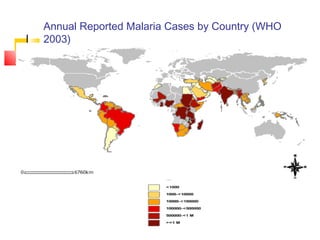
Annual Reported Malaria Cases by Country (WHO
2003)
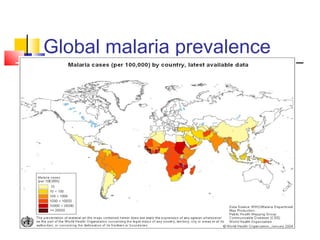
Global malaria prevalence
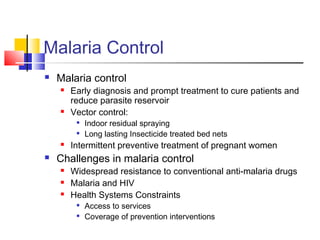
Malaria Control
 Malaria control
 Early diagnosis and prompt treatment to cure patients and
reduce parasite reservoir
 Vector control:

Indoor residual spraying

Long lasting Insecticide treated bed nets
 Intermittent preventive treatment of pregnant women
 Challenges in malaria control
 Widespread resistance to conventional anti-malaria drugs
 Malaria and HIV
 Health Systems Constraints

Access to services

Coverage of prevention interventions
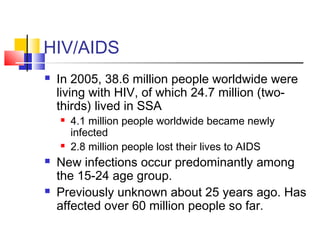
HIV/AIDS
 In 2005, 38.6 million people worldwide were
living with HIV, of which 24.7 million (two-
thirds) lived in SSA
 4.1 million people worldwide became newly
infected
 2.8 million people lost their lives to AIDS
 New infections occur predominantly among
the 15-24 age group.
 Previously unknown about 25 years ago. Has
affected over 60 million people so far.
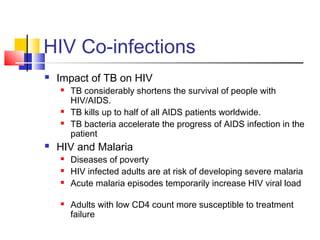
HIV Co-infections
 Impact of TB on HIV
 TB considerably shortens the survival of people with
HIV/AIDS.
 TB kills up to half of all AIDS patients worldwide.
 TB bacteria accelerate the progress of AIDS infection in the
patient
 HIV and Malaria
 Diseases of poverty
 HIV infected adults are at risk of developing severe malaria
 Acute malaria episodes temporarily increase HIV viral load
 Adults with low CD4 count more susceptible to treatment
failure
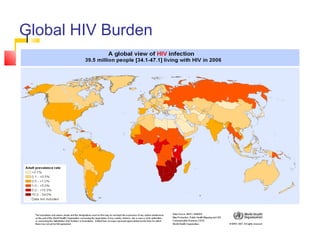
Global HIV Burden
HIV/AIDS
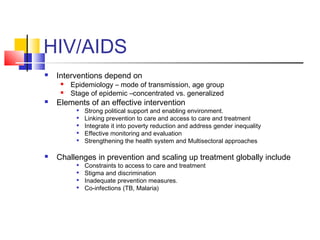
 Interventions depend on
 Epidemiology – mode of transmission, age group
 Stage of epidemic –concentrated vs. generalized
 Elements of an effective intervention

Strong political support and enabling environment.

Linking prevention to care and access to care and treatment

Integrate it into poverty reduction and address gender inequality

Effective monitoring and evaluation

Strengthening the health system and Multisectoral approaches
 Challenges in prevention and scaling up treatment globally include

Constraints to access to care and treatment

Stigma and discrimination

Inadequate prevention measures.

Co-infections (TB, Malaria)
Avian Influenza
 Seasonal influenza causes severe
illness in 3-5 million people and 250000
– 500000 deaths yearly
 1st
H5N1 avian influenza case in Hong
Kong in 1997.
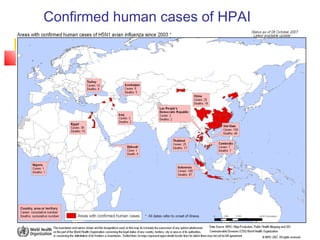
 By October 2007 – 331 human cases,
202 deaths.
Avian Influenza
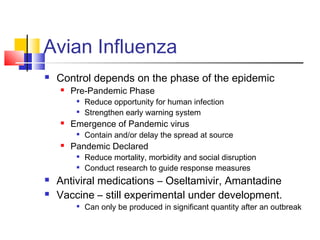
 Control depends on the phase of the epidemic
 Pre-Pandemic Phase

Reduce opportunity for human infection

Strengthen early warning system
 Emergence of Pandemic virus

Contain and/or delay the spread at source
 Pandemic Declared

Reduce mortality, morbidity and social disruption

Conduct research to guide response measures
 Antiviral medications – Oseltamivir, Amantadine
 Vaccine – still experimental under development.

Can only be produced in significant quantity after an outbreak
Confirmed human cases of HPAI
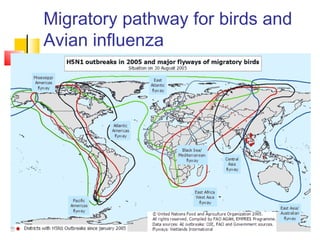
Migratory pathway for birds and
Avian influenza
Approaches to Interventions
 Personal Responsibility and action
 Utilitarian Approaches – “Greatest good
for the greatest number”
 Including non Health Systems
Interventions.
 Regulations and Laws
 Partnerships and Collaboration
 Enlightened Self Interest
Personal Responsibility and
action
 Improved hygiene and sanitation
 Hand washing, proper waste disposal, food
preparation and handling.
 Information, education and behavior change
 Changing harmful household practices
 Livestock handling, knowledge about contagion
 Cultural and social norms
 Self reporting of illnesses and compliance
with interventions and treatment.
Utilitarian Approaches – “Greatest good
for the greatest number”
 Reliance on personal responsibility

not always the optimal option given different knowledge levels
and values.

Public good nature of the interventions
 Social Isolation and Quarantine measures

Home treatment; Isolation
 Mass vaccination programs and campaigns

Polio, small pox, DPT, Hepatitis, Yellow fever
 Mass treatment programs –

Onchocerciasis, de-worming programs.
 For some CDs, intervention in other sectors is
required

Environmental health – elimination of breeding sites, spraying

Agricultural practices such as poultry handling and exposure to
soil pathogens during farming.
Regulations and Laws
 National response remains the bedrock of intervention

National laws and capacities vary.
 International Regulations and laws introduced

1851 – International Sanitary regulations in Europe following
cholera outbreak

1951- international sanitary regulation by WHO.

1969- Replaced by the International Health regulation
 Minor changes in 1973 and 1981
 cholera, plague, yellow fever, smallpox, relapsing fever and typhus

2005 – Revised International Health Regulation
 Challenge of enforceability of international agreements.
Regulation and laws – WHO
2005 International health
regulation
 IHR (2005) is a legally binding agreement among
member states of WHO to cooperate on a set of
defined areas of public health importance.
 Arrived at by consensus of all member countries of
WHO, with clear arbitration mechanisms
 Its elements include
 Notification:
 National IHR Focal Points and WHO IHR Contact Points
 Requirements for national core capacities
 Recommended measures
 External advice regarding the IHR (2005)
A paradigm shift - Enlightened
Self interest
 Communicable diseases have no borders.

Predominantly affect the poor, and poor countries

Also affect richer households and countries.
 Interventions are non-rival, non-exclusive and have
positive externalities.

Elimination and control of certain communicable diseases
increases global health security.

Limited financial incentives for the market to drive needed
innovation in research and drug development
 Mismatch between global health need and health
spending
 Global health security is therefore inextricably tied to
the effective control of CDs in developing world.
Global Mismatch Between DiseaseGlobal Mismatch Between Disease
Burden and Health SpendingBurden and Health Spending
Global Mismatch Between DiseaseGlobal Mismatch Between Disease
Burden and Health SpendingBurden and Health Spending
Thank You.

Communicabledisease

  • 1.
    Communicable Diseases and HumanSecurity NOPE International Institute 2014 Joel Karanja
  • 2.
    Overview of Communicable diseases Introduction and Definition  Importance of CDs  Selected CDs of Public Health Concern  Mounting a Global Response  Approaches to intervention  Key elements of a global response
  • 3.
    Human Security ina globalized world  The changing role of policy makers in an increasingly globalized world  Shared space = Shared Destiny  Local actions have global consequences  Global interventions can achieve positive local impact  As long as human interactions exist, Communicable diseases will remain an issue.
  • 4.
    Communicable Diseases: Definition Defined as  “any condition which is transmitted directly or indirectly to a person from an infected person or animal through the agency of an intermediate animal, host, or vector, or through the inanimate environment”.  Transmission is facilitated by the following  More frequent human contact due to  Increase in the volume and means of transportation (affordable international air travel),  globalization (increased trade and contact)  Microbial adaptation and change  Breakdown of public health capacity at various levels  Change in human demographics and behavior  Economic development and land use patterns
  • 5.
    CD- Modes oftransmission  Direct  Blood-borne or sexual – HIV, Hepatitis B,C  Inhalation – Tuberculosis, influenza, anthrax  Food-borne – E.coli, Salmonella,  Contaminated water- Cholera, rotavirus, Hepatitis A  Indirect  Vector-borne- malaria, onchocerciasis, trypanosomiasis  Formites  Zoonotic diseases – animal handling and feeding practices (Mad cow disease, Avian Influenza)
  • 6.
    Importance of Communicable Diseases Significant burden of disease especially in low and middle income countries  Social impact  Economic impact  Potential for rapid spread  Human security concerns
  • 7.
    Communicable Diseases account fora significant global disease burden  In 2005, CDs accounted for about 30% of the global BoD and 60% of the BoD in Africa.  CDs typically affect LIC and MICs disproportionately.  Account for 40% of the disease burden in low and middle income countries  Most communicable diseases are preventable or treatable.
  • 8.
    Communicable Disease BurdenVariesCommunicable Disease Burden Varies Widely Among ContinentsWidely Among Continents
  • 9.
  • 10.
    Causes of DeathVary Greatly by CountryCauses of Death Vary Greatly by Country Income LevelIncome Level Age distribution of death in Denmark around 2005 Male Female 80 60 40 20 0 20 40 60 80 0 - 4 15 - 19 30 - 34 45 - 49 60 - 64 75 - 79 90 - 94 Agegroup Pe rc ent of total deaths Age dis tribution of death in Sie rra Leone around 2005 Male Female 80 60 40 20 0 20 40 60 80 0 - 4 15 - 19 30 - 34 45 - 49 60 - 64 75 - 79 90 - 94 Agegroup Pe rcent of total of deaths
  • 11.
    CDs have asignificant social impact  Disruption of family and social networks  Child-headed households, social exclusion  Widespread stigma and discrimination  TB, HIV/AIDS, Leprosy  Discrimination in employment, schools, migration policies  Orphans and vulnerable children  Loss of primary care givers  Susceptibility to exploitation and trafficking  Interventions such as quarantine measures may aggravate the social disruption
  • 12.
    CDs have asignificant economic impact in affected countries  At the macro level  Reduction in revenue for the country (e.g. tourism)  Estimated cost of SARS epidemic to Asian countries: $20 billion (2003) or $2 million per case.  Drop in international travel to affected countries by 50-70%  Malaria causes an average loss of 1.3% annual GDP in countries with intense transmission  The plague outbreak in India cost the economy over $1 billion from travel restrictions and embargoes  At the household level  Poorer households are disproportionately affected  Substantial loss in productivity and income for the infirmed and caregiver  Catastrophic costs of treating illness
  • 13.
    International boundaries are disappearing Borders are not very effective at stopping communicable diseases.  With increasing globalization  interdependence of countries – more trade and human/animal interactions  The rise in international traffic and commerce makes challenges even more daunting  Other global issues affect or are affected by communicable diseases.  climate change  migration  Change in biodiversity
  • 14.
    Human Security concerns Potential magnitude and rapid spread of outbreaks/pandemics. e.g. SARS outbreak  No country or region can contain a full blown outbreak of Avian influenza  Bioterrorism and intentional outbreaks  Anthrax, Small pox  New and re-emerging diseases  Ebola, TB (MDR-TB and XDR-TB), HPAI, Rift valley fever.
  • 15.
  • 16.
    Tuberculosis  2 billionpeople infected with microbes that cause TB.  Not everyone develops active disease  A person is infected every second globally  22 countries account for 80% of TB cases.  >50% cases in Asia, 28% in Africa (which also has the highest per capita prevalence)  In 2005, there were 8.8 million new TB cases; 1.6 million deaths from TB (about 4400 a day)  Highly stigmatizing disease
  • 17.
    Tuberculosis and HIV A third of those living with HIV are co-infected with TB  About 200,000 people with HIV die annually from TB.  Most common opportunistic infection in Africa  70% of TB patients are co-infected with HIV in some countries in Africa  Impact of HIV on TB  TB is harder to diagnose in HIV-positive people.  TB progresses faster in HIV-infected people.  TB in HIV-positive people is almost certain to be fatal if undiagnosed or left untreated.  TB occurs earlier in the course of HIV infection than many other opportunistic infections.
  • 18.
    Global Prevalence ofTB cases (WHO)
  • 19.
  • 21.
    Tuberculosis Control  Challengesfor tuberculosis control  MDR-TB - In most countries. About 450000 new cases annually.  XDR-TB cases confirmed in South Africa.  Weak health systems  TB and HIV  The Global Plan to Stop TB 2006-2015.  an investment of US$ 56 billion, a three-fold increase from 2005. The estimated funding gap is US$ 31 billion.  Six step strategy: Expanding DOTS treatment; Health Systems Strengthening; Engaging all care providers; Empowering patients and communities; Addressing MDR TB, Supporting research
  • 22.
    Malaria  Every year,500 million people become severely ill with malaria  causes 30% of Low birth weight in newborns Globally.  >1 million people die of malaria every year. One child dies from it every 30 seconds  40% of the world’s population is at risk of malaria. Most cases and deaths occur in SSA.  Malaria is the 9th leading cause of death in LICs and MICs  11% of childhood deaths worldwide attributable to malaria  SSA children account for 82% of malaria deaths worldwide
  • 23.
    Annual Reported MalariaCases by Country (WHO 2003)
  • 24.
  • 25.
    Malaria Control  Malariacontrol  Early diagnosis and prompt treatment to cure patients and reduce parasite reservoir  Vector control:  Indoor residual spraying  Long lasting Insecticide treated bed nets  Intermittent preventive treatment of pregnant women  Challenges in malaria control  Widespread resistance to conventional anti-malaria drugs  Malaria and HIV  Health Systems Constraints  Access to services  Coverage of prevention interventions
  • 26.
    HIV/AIDS  In 2005,38.6 million people worldwide were living with HIV, of which 24.7 million (two- thirds) lived in SSA  4.1 million people worldwide became newly infected  2.8 million people lost their lives to AIDS  New infections occur predominantly among the 15-24 age group.  Previously unknown about 25 years ago. Has affected over 60 million people so far.
  • 27.
    HIV Co-infections  Impactof TB on HIV  TB considerably shortens the survival of people with HIV/AIDS.  TB kills up to half of all AIDS patients worldwide.  TB bacteria accelerate the progress of AIDS infection in the patient  HIV and Malaria  Diseases of poverty  HIV infected adults are at risk of developing severe malaria  Acute malaria episodes temporarily increase HIV viral load  Adults with low CD4 count more susceptible to treatment failure
  • 28.
  • 29.
    HIV/AIDS  Interventions dependon  Epidemiology – mode of transmission, age group  Stage of epidemic –concentrated vs. generalized  Elements of an effective intervention  Strong political support and enabling environment.  Linking prevention to care and access to care and treatment  Integrate it into poverty reduction and address gender inequality  Effective monitoring and evaluation  Strengthening the health system and Multisectoral approaches  Challenges in prevention and scaling up treatment globally include  Constraints to access to care and treatment  Stigma and discrimination  Inadequate prevention measures.  Co-infections (TB, Malaria)
  • 30.
    Avian Influenza  Seasonalinfluenza causes severe illness in 3-5 million people and 250000 – 500000 deaths yearly  1st H5N1 avian influenza case in Hong Kong in 1997.  By October 2007 – 331 human cases, 202 deaths.
  • 31.
    Avian Influenza  Controldepends on the phase of the epidemic  Pre-Pandemic Phase  Reduce opportunity for human infection  Strengthen early warning system  Emergence of Pandemic virus  Contain and/or delay the spread at source  Pandemic Declared  Reduce mortality, morbidity and social disruption  Conduct research to guide response measures  Antiviral medications – Oseltamivir, Amantadine  Vaccine – still experimental under development.  Can only be produced in significant quantity after an outbreak
  • 32.
  • 33.
    Migratory pathway forbirds and Avian influenza
  • 34.
    Approaches to Interventions Personal Responsibility and action  Utilitarian Approaches – “Greatest good for the greatest number”  Including non Health Systems Interventions.  Regulations and Laws  Partnerships and Collaboration  Enlightened Self Interest
  • 35.
    Personal Responsibility and action Improved hygiene and sanitation  Hand washing, proper waste disposal, food preparation and handling.  Information, education and behavior change  Changing harmful household practices  Livestock handling, knowledge about contagion  Cultural and social norms  Self reporting of illnesses and compliance with interventions and treatment.
  • 36.
    Utilitarian Approaches –“Greatest good for the greatest number”  Reliance on personal responsibility  not always the optimal option given different knowledge levels and values.  Public good nature of the interventions  Social Isolation and Quarantine measures  Home treatment; Isolation  Mass vaccination programs and campaigns  Polio, small pox, DPT, Hepatitis, Yellow fever  Mass treatment programs –  Onchocerciasis, de-worming programs.  For some CDs, intervention in other sectors is required  Environmental health – elimination of breeding sites, spraying  Agricultural practices such as poultry handling and exposure to soil pathogens during farming.
  • 37.
    Regulations and Laws National response remains the bedrock of intervention  National laws and capacities vary.  International Regulations and laws introduced  1851 – International Sanitary regulations in Europe following cholera outbreak  1951- international sanitary regulation by WHO.  1969- Replaced by the International Health regulation  Minor changes in 1973 and 1981  cholera, plague, yellow fever, smallpox, relapsing fever and typhus  2005 – Revised International Health Regulation  Challenge of enforceability of international agreements.
  • 38.
    Regulation and laws– WHO 2005 International health regulation  IHR (2005) is a legally binding agreement among member states of WHO to cooperate on a set of defined areas of public health importance.  Arrived at by consensus of all member countries of WHO, with clear arbitration mechanisms  Its elements include  Notification:  National IHR Focal Points and WHO IHR Contact Points  Requirements for national core capacities  Recommended measures  External advice regarding the IHR (2005)
  • 39.
    A paradigm shift- Enlightened Self interest  Communicable diseases have no borders.  Predominantly affect the poor, and poor countries  Also affect richer households and countries.  Interventions are non-rival, non-exclusive and have positive externalities.  Elimination and control of certain communicable diseases increases global health security.  Limited financial incentives for the market to drive needed innovation in research and drug development  Mismatch between global health need and health spending  Global health security is therefore inextricably tied to the effective control of CDs in developing world.
  • 40.
    Global Mismatch BetweenDiseaseGlobal Mismatch Between Disease Burden and Health SpendingBurden and Health Spending
  • 41.
    Global Mismatch BetweenDiseaseGlobal Mismatch Between Disease Burden and Health SpendingBurden and Health Spending
  • 42.

Editor's Notes

  • #2 Review the choice of the title
  • #3 Introduction and Definition Definition: Modes of transmission Examples of CDs Common Infectious diseases Neglected diseases History of Communicable Diseases Burden of Disease Global burden of disease and communicable diseases, by region, gender and income levels Importance of CDs Sheer Burden Economic impact Rate of spread Recurrence of diseases Security and CDs Interventions Why intervene? Why should policy makers care about CDs? History of interventions and policy issues What is needed for effective control of CDs Global Approaches Global responsibility International law Partnerships and collaboration Financial support World Bank’s role and involvement Total lending in health Special programs the Bank is involved in. Conclusions and Way forward
  • #5 These have become more important given the modern means of transportation and increased interaction across countries that makes it easy for an infectious pathogen to spread from one part of the world to another
  • #8 Even with the projected rise in the burden of NCDs, CDs are expected to account for 26% of the BoD in 2015 globally, and 56% in Africa. (Global Burden of Disease
  • #11 In Sierra Leone most deaths occur in the U5 age group, whereas in Denmark it is among those over 65.
  • #12 Global importance of Communicable Diseases Enormous burden and impact globally Economic impact Constrain health and development of infants and children and affect their schooling Stigma and discrimination against people with certain communicable diseases such as HIV/AIDS, TB. Leprosy Disruption of social networks and family structure e.g. with Orphans and other vulnerable children who have lost their parents or other care gives due to HIV/AIDS TB- Malaria HIV/AIDS etc
  • #13 Reduction in revenue for the country India example during the bubonic plague outbreak Substantial loss in productivity and income In Tanzania, men with AIDS lost an average of 197 days of work over an 18 month period. Catastrophic costs of treating illness
  • #14 In history, attempts at stopping communicable diseases from entering a country often proved ineffective
  • #17 Two billion people – one third of the world’s total population–are infected with the microbes that cause TB. Of these, 10% will become sick with active TB in their lifetime. Risks are higher in those with HIV infection. A total of 1.6 million people died from TB in 2005, equal to about 4400 deaths a day. TB is a disease of poverty, affecting mostly young adults in their most productive years. The vast majority of TB deaths are in the developing world, with more than half occurring in Asia TB/HIV- About 200 000 people with HIV die from TB every year, most of them in Africa. TB is a worldwide pandemic. Although the highest rates per capita are in Africa (28% of all TB cases), half of all new cases are in six Asian countries (Bangladesh, China, India, Indonesia, Pakistan and the Philippines). Multidrug-resistant TB (MDR-TB) is a form of TB that does not respond to the standard treatments using first-line drugs. MDR-TB is present in virtually all countries recently surveyed by WHO and its partners. About 450 000 new MDR-TB cases are estimated to occur every year. The highest occurrence rates of MDR-TB are in China and the countries of the former Soviet Union. Extensively drug-resistant TB (XDR-TB) occurs when resistance to second-line drugs develops. It is extremely difficult to treat and cases have been confirmed in South Africa and worldwide. WHO’s Stop TB Strategy aims to reach all patients and achieve the target under the Millennium Development Goals (MDG): to reduce by 2015 the prevalence of and deaths due to TB by 50% relative to 1990 and reverse the trend in incidence. The Global Plan to Stop TB 2006-2015, launched January 2006, aims to achieve the MDG target with an investment of US$ 56 billion. This represents a three-fold increase in investment from 2005. The estimated funding gap is US$ 31 billion.
  • #18 Most cases of XDR-TB were in HIV infected individuals.
  • #23 More than one million people die of malaria every year, mostly infants, young children and pregnant women and most of them in Africa Approximately, 40% of the world’s population, mostly those living in the world’s poorest countries, are at risk of malaria. Every year, more than 500 million people become severely ill with malaria. Most cases and deaths are in sub-Saharan Africa.
  • #26 With full LLITN coverage, child mortality from all causes is reduced by 18%
  • #27 One of the most devastating conditions of the 21st century An estimated 38.6 million [33.4 million–46.0 million] people worldwide were living with HIV in 2005. An estimated 4.1 million [3.4 million–6.2 million] became newly infected with HIV and an estimated 2.8 million [2.4 million–3.3 million] lost their lives to AIDS.
  • #28 Growing body of evidence on the interactions between both conditions Both are diseases of poverty
  • #32 Limited evidence suggests that some antiviral drugs, notably oseltamivir (commercially known as Tamiflu), can reduce the duration of viral replication and improve prospects of survival, provided they are administered within 48 hours following symptom onset.
  • #36 Improved hygiene and sanitation Hand washing, proper waste disposal, sewage system, cooking methods and boiling water Information, education and behavior change including household practices Livestock handling, knowledge about contagion, Cultural norms Poultry and farming methods, ….. Self reporting of illnesses and compliance with interventions and treatment Unexplained fevers, ARI symptoms, etc Compliance with medications to reduce potential for drug resistance. – hasn’t always worked - DOTS
  • #37 Utilitarian Approaches – “Greatest good for the greatest number” – Sort of cost benefit analyses, where the benefits of the intervention such as the lives saved or years of live gained, etc, exceed the costs which could range from just the prick of a needle to a minority developing side effects of the vaccine. Social Isolation and Quarantine measures Home treatment Isolation Mass Vaccination programs Polio in Nigeira
  • #38 Regulations and Laws- Challenge of enforceability, as it often relies on international cooperation and pressure
  • #39 Notification - The IHR (2005) require States to notify WHO of all events that may constitute a public health emergency of international concern and to respond to requests for verification of information regarding such events. Under the WHO Constitution, all WHO Member States are automatically bound by the new IHR (2005) unless they affirmatively opt out within a limited time period, namely by 15 December 2006. No WHO Member State has completely opted out, and only a very small number made reservations.
  • #40 The need to move beyond charity-model. Non-rival –The benefits from the Interventions can be enjoyed simultaneously by all in the community. Lack of access to TB drugs may fuel resistance and the development of MDR-TB
  • #43 The World Bank has committed more than $430 million to Booster projects. A nine-fold increase in IDA funding for malaria control in Africa.