Dr. Parag Moon 
Dept. Of Neurology, 
GMC ,Kota
 A group of disorders in which people 
experience significant physical symptoms for 
which there is no apparent organic cause 
 Symptoms are often inconsistent with possible 
physiological processes 
 People do not consciously produce or control 
the symptoms but truly experience the 
symptoms 
 Symptoms pass only when the psychological 
factors that led to the symptoms are resolved
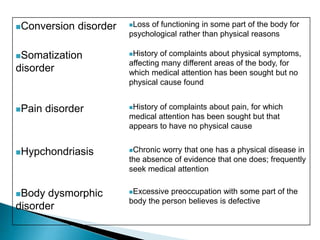
Conversion disorder Loss of functioning in some part of the body for 
psychological rather than physical reasons 
Somatization 
disorder 
History of complaints about physical symptoms, 
affecting many different areas of the body, for 
which medical attention has been sought but no 
physical cause found 
Pain disorder History of complaints about pain, for which 
medical attention has been sought but that 
appears to have no physical cause 
Hypchondriasis Chronic worry that one has a physical disease in 
the absence of evidence that one does; frequently 
seek medical attention 
Body dysmorphic 
disorder 
Excessive preoccupation with some part of the 
body the person believes is defective
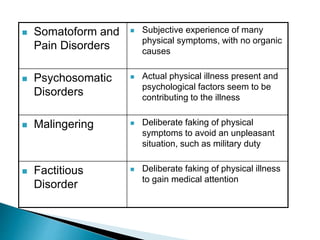
 Somatoform and 
Pain Disorders 
 Subjective experience of many 
physical symptoms, with no organic 
causes 
 Psychosomatic 
Disorders 
 Actual physical illness present and 
psychological factors seem to be 
contributing to the illness 
 Malingering  Deliberate faking of physical 
symptoms to avoid an unpleasant 
situation, such as military duty 
 Factitious 
Disorder 
 Deliberate faking of physical illness 
to gain medical attention
 Somatoform disorders are problems that 
appear to be medical but are due to 
psychosocial factors 
◦ Unlike psychophysiological disorders, in 
which psychosocial factors interact with 
physical ailments, somatoform disorders 
are psychological disorders masquerading 
as physical problems
 Dissociative disorders are patterns of memory 
loss and identity change that are caused 
almost entirely by psychosocial factors rather 
than physical ones
 When a physical ailment has no apparent medical 
cause, physicians may suspect a somatoform 
disorder 
 People with a somatoform disorder do not 
consciously want, or purposely produce, their 
symptoms 
◦ They believe their problems are genuinely medical 
 There are two main types of somatoform disorders: 
◦ Hysterical somatoform disorders 
◦ Preoccupation somatoform disorders
 People with hysterical somatoform 
disorders suffer actual changes in their 
physical functioning 
◦ These disorders are often hard to distinguish 
from genuine medical problems 
◦ It is always possible that a diagnosis of hysterical 
disorder is a mistake and that the patient’s 
problem has an undetected organic cause
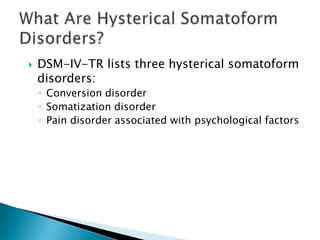
 DSM-IV-TR lists three hysterical somatoform 
disorders: 
◦ Conversion disorder 
◦ Somatization disorder 
◦ Pain disorder associated with psychological factors
 Recognized since the time of ancient Egypt. 
 An early name for somatization disorder 
was hysteria, a condition incorrectly 
thought to affect only women. (The word 
hysteria is derived from the Greek word for 
uterus, hystera.) 
 In the 17th century, Thomas Sydenham 
recognized that psychological factors, 
which he called antecedent sorrows, were 
involved in the pathogenesis of the 
symptoms.
 In 1859, Paul Briquet, a French physician, 
observed the multiplicity of the symptoms 
and the affected organ systems and 
commented on the usually chronic course 
of the disorder. 
 The disorder was called Briquet's syndrome 
for a time, although the term somatization 
disorder became the standard in the United 
States when the third edition of DSM (DSM-III) 
was introduced in 1980.
 Somatization is “the tendency to experience 
and communicate somatic distress and 
symptoms unaccounted by pathological 
findings.” 
 Can coincide with another illness.
 Prevalance- 0.2% to 2% among women and is 
less than 0.2% in men 
 Usually begins in the teenage and young 
adulthood years. 
 Onset after 30 years is extremely rare 
 More common in less educated and lower 
socioeconomic groups
 Observed in 10% to 20% of female first-degree 
relatives. 
 Male relatives of women with somatization 
disorder have an increased risk of antisocial 
personality, substance abuse disorders, and 
somatization disorder.
 Psychosocial Factors 
◦ interpretations of the symptoms as social communication 
 avoid obligations 
 express emotions 
 symbolize a feeling or a belief 
◦ the symptoms substitute for repressed instinctual impulses 
◦ A behavioral perspective 
 Biological Factors 
◦ characteristic attention and cognitive impairments 
◦ decreased metabolism in the frontal lobes and in the 
nondominant hemisphere 
◦ genetic components 
◦ Research into cytokines
 Patients with somatization disorder have the 
tendency to react to psychosocial distress 
and environmental stressors with physical 
bodily symptoms. 
 Can be vague and dramatic in reporting their 
medical history. 
 Frequently move abruptly from complaining 
of one symptom to another symptom.
 Usually present with numerous symptoms, 
such as headaches, back pain, persistent lack 
of sleep, stomach upset, and chronic 
tiredness 
 Without demonstrable medical causes 
 Have a persistent conviction of being ill, 
despite repeated negative results on 
laboratory tests, diagnostic tests, 
consultations with specialists, and recurrent 
hospitalizations
 Has impaired social/work/personal functioning 
 Symptoms may be exacerbated by stress 
 No element of feigning symptoms to occupy sick 
role (Facititious Disorder) or for material gain 
(Malingerer)
 Physical examination is normal 
 May reveal some skin lesions or scars that 
resulted from previously performed surgeries 
 Affects the patient’s perception of wellness 
 Patient begins to believe that she or he is 
physically disabled and unable to work 
 Characteristically deny the influences of 
psychosocial distress in producing the 
symptoms,resist psychiatric referral
 Diagnostic and Statistical Manual of Mental 
Disorders, Fourth Edition (DSM-IV) diagnostic 
criteria
 Medical conditions - multiple sclerosis, brain 
tumour, hyperparathyroidism, hyperthyroidism, 
lupus erythematosus 
 Affective (depressive) and anxiety disorders- 
1or2 symptoms of acute onset and short 
duration 
 Hypochondriasis - patient´s focus is on fear of 
disease not focus on symptoms 
 Panic disorder - somatic symptoms during 
panic episode only
 Conversion disorder - only one or two 
 Pain disorder - one or two unexplained pain 
complaints, not a lifetime history of 
multiple complaints 
 Delusional disorders - schizophrenia with 
somatic delusions or depressive disorder 
with hypochondriac delusions, bizzare, 
psychotic sy. 
 Undifferentiated somatization disorder - 
short duration (e.g. less than 2 years) and 
less striking symptoms
 The major importance for successful 
management  
 Trusting relationship between the patient and 
one (if possible) primary care physician 
 Frequent changes of doctors are frustrating and 
countertherapeutic. 
 Regularly scheduled visits every 4 or 6 weeks. 
 Brief outpatient visits - performance of at least 
partial physical examination during each visit 
directed at the organ system of complaint.
 Explain to the patient and family 
relationship between psych and somatic 
 Empathic attitude 
 Avoid more diagnostic tests, laboratory 
evaluations and operative procedures 
unless clearly indicated 
 Treatment of underlying depression and 
anxiety. 
 Potentially addicting medications should be 
avoided
 Psychotherapy, both individual and group 
◦ decreases personal health care expenditures 
(50%) 
◦ decreasing their rates of hospitalization. 
◦ helped to cope with their symptoms 
◦ to express underlying emotions 
◦ to develop alternative strategies for expressing 
their feelings
• Increased Activity Involvement 
–Combats stress 
–Improves overall mood 
–Provides Distraction from somatic 
symptoms 
–Pain perception has a subjective 
component—improved mood and 
distraction reduce the experience of pain 
–Exercise has physiological effects that 
combat somatization and stress
• Directly acts on physical symptoms, given its 
effects on breathing, heart rate, muscle 
tension, etc. 
• Patients report benefit soon upon learning 
the technique 
• Helps with stress management 
• Includes Diaphragmatic Breathing, 
Progressive Muscle Relaxation, Biofeedback
– Establish consistent sleep patterns (same bedtime and 
waketime everyday) 
– Go to bed only when sleepy (stimulus control) 
– If not asleep within 20-30 minutes leave bed and return 
when sleep again (stimulus control) 
– Comfortable sleep environment 
– Avoid alcohol/caffeine during 6 hours before bedtime 
– Exercise regularly, but not within 4 hours of bedtime
• Much like CBT for depression 
– Looking for adaptability of thoughts 
– Eliminating distortions 
• Use somatic symptoms as anchors for examining 
thoughts 
• Look for variations in adaptability of thoughts and 
discuss their effect 
• Patients are likely to have difficulty identifying 
thoughts/emotions.
Thanks
 Somatization Disorders:Diagnosis, Treatment, 
and Prognosis;Psychosocial: vol 32no2 Feb 
2011 
 Somatisation in neurological practice;J Neurol 
Neurosurg Psychiatry. Oct 2004; 57(10): 
1161–1164. 
 Somatization A Debilitating Syndrome in 
Primary Care; Psychosomatics 42:1, January- 
February 2001 
 Kaplans and Sadocks textbook of psychiatry

Somatization disorder

  • 1.
    Dr. Parag Moon Dept. Of Neurology, GMC ,Kota
  • 2.
     A groupof disorders in which people experience significant physical symptoms for which there is no apparent organic cause  Symptoms are often inconsistent with possible physiological processes  People do not consciously produce or control the symptoms but truly experience the symptoms  Symptoms pass only when the psychological factors that led to the symptoms are resolved
  • 3.
    Conversion disorder Lossof functioning in some part of the body for psychological rather than physical reasons Somatization disorder History of complaints about physical symptoms, affecting many different areas of the body, for which medical attention has been sought but no physical cause found Pain disorder History of complaints about pain, for which medical attention has been sought but that appears to have no physical cause Hypchondriasis Chronic worry that one has a physical disease in the absence of evidence that one does; frequently seek medical attention Body dysmorphic disorder Excessive preoccupation with some part of the body the person believes is defective
  • 4.
     Somatoform and Pain Disorders  Subjective experience of many physical symptoms, with no organic causes  Psychosomatic Disorders  Actual physical illness present and psychological factors seem to be contributing to the illness  Malingering  Deliberate faking of physical symptoms to avoid an unpleasant situation, such as military duty  Factitious Disorder  Deliberate faking of physical illness to gain medical attention
  • 5.
     Somatoform disordersare problems that appear to be medical but are due to psychosocial factors ◦ Unlike psychophysiological disorders, in which psychosocial factors interact with physical ailments, somatoform disorders are psychological disorders masquerading as physical problems
  • 6.
     Dissociative disordersare patterns of memory loss and identity change that are caused almost entirely by psychosocial factors rather than physical ones
  • 7.
     When aphysical ailment has no apparent medical cause, physicians may suspect a somatoform disorder  People with a somatoform disorder do not consciously want, or purposely produce, their symptoms ◦ They believe their problems are genuinely medical  There are two main types of somatoform disorders: ◦ Hysterical somatoform disorders ◦ Preoccupation somatoform disorders
  • 8.
     People withhysterical somatoform disorders suffer actual changes in their physical functioning ◦ These disorders are often hard to distinguish from genuine medical problems ◦ It is always possible that a diagnosis of hysterical disorder is a mistake and that the patient’s problem has an undetected organic cause
  • 9.
     DSM-IV-TR liststhree hysterical somatoform disorders: ◦ Conversion disorder ◦ Somatization disorder ◦ Pain disorder associated with psychological factors
  • 10.
     Recognized sincethe time of ancient Egypt.  An early name for somatization disorder was hysteria, a condition incorrectly thought to affect only women. (The word hysteria is derived from the Greek word for uterus, hystera.)  In the 17th century, Thomas Sydenham recognized that psychological factors, which he called antecedent sorrows, were involved in the pathogenesis of the symptoms.
  • 11.
     In 1859,Paul Briquet, a French physician, observed the multiplicity of the symptoms and the affected organ systems and commented on the usually chronic course of the disorder.  The disorder was called Briquet's syndrome for a time, although the term somatization disorder became the standard in the United States when the third edition of DSM (DSM-III) was introduced in 1980.
  • 12.
     Somatization is“the tendency to experience and communicate somatic distress and symptoms unaccounted by pathological findings.”  Can coincide with another illness.
  • 13.
     Prevalance- 0.2%to 2% among women and is less than 0.2% in men  Usually begins in the teenage and young adulthood years.  Onset after 30 years is extremely rare  More common in less educated and lower socioeconomic groups
  • 14.
     Observed in10% to 20% of female first-degree relatives.  Male relatives of women with somatization disorder have an increased risk of antisocial personality, substance abuse disorders, and somatization disorder.
  • 15.
     Psychosocial Factors ◦ interpretations of the symptoms as social communication  avoid obligations  express emotions  symbolize a feeling or a belief ◦ the symptoms substitute for repressed instinctual impulses ◦ A behavioral perspective  Biological Factors ◦ characteristic attention and cognitive impairments ◦ decreased metabolism in the frontal lobes and in the nondominant hemisphere ◦ genetic components ◦ Research into cytokines
  • 16.
     Patients withsomatization disorder have the tendency to react to psychosocial distress and environmental stressors with physical bodily symptoms.  Can be vague and dramatic in reporting their medical history.  Frequently move abruptly from complaining of one symptom to another symptom.
  • 17.
     Usually presentwith numerous symptoms, such as headaches, back pain, persistent lack of sleep, stomach upset, and chronic tiredness  Without demonstrable medical causes  Have a persistent conviction of being ill, despite repeated negative results on laboratory tests, diagnostic tests, consultations with specialists, and recurrent hospitalizations
  • 19.
     Has impairedsocial/work/personal functioning  Symptoms may be exacerbated by stress  No element of feigning symptoms to occupy sick role (Facititious Disorder) or for material gain (Malingerer)
  • 20.
     Physical examinationis normal  May reveal some skin lesions or scars that resulted from previously performed surgeries  Affects the patient’s perception of wellness  Patient begins to believe that she or he is physically disabled and unable to work  Characteristically deny the influences of psychosocial distress in producing the symptoms,resist psychiatric referral
  • 21.
     Diagnostic andStatistical Manual of Mental Disorders, Fourth Edition (DSM-IV) diagnostic criteria
  • 25.
     Medical conditions- multiple sclerosis, brain tumour, hyperparathyroidism, hyperthyroidism, lupus erythematosus  Affective (depressive) and anxiety disorders- 1or2 symptoms of acute onset and short duration  Hypochondriasis - patient´s focus is on fear of disease not focus on symptoms  Panic disorder - somatic symptoms during panic episode only
  • 26.
     Conversion disorder- only one or two  Pain disorder - one or two unexplained pain complaints, not a lifetime history of multiple complaints  Delusional disorders - schizophrenia with somatic delusions or depressive disorder with hypochondriac delusions, bizzare, psychotic sy.  Undifferentiated somatization disorder - short duration (e.g. less than 2 years) and less striking symptoms
  • 27.
     The majorimportance for successful management   Trusting relationship between the patient and one (if possible) primary care physician  Frequent changes of doctors are frustrating and countertherapeutic.  Regularly scheduled visits every 4 or 6 weeks.  Brief outpatient visits - performance of at least partial physical examination during each visit directed at the organ system of complaint.
  • 28.
     Explain tothe patient and family relationship between psych and somatic  Empathic attitude  Avoid more diagnostic tests, laboratory evaluations and operative procedures unless clearly indicated  Treatment of underlying depression and anxiety.  Potentially addicting medications should be avoided
  • 29.
     Psychotherapy, bothindividual and group ◦ decreases personal health care expenditures (50%) ◦ decreasing their rates of hospitalization. ◦ helped to cope with their symptoms ◦ to express underlying emotions ◦ to develop alternative strategies for expressing their feelings
  • 30.
    • Increased ActivityInvolvement –Combats stress –Improves overall mood –Provides Distraction from somatic symptoms –Pain perception has a subjective component—improved mood and distraction reduce the experience of pain –Exercise has physiological effects that combat somatization and stress
  • 31.
    • Directly actson physical symptoms, given its effects on breathing, heart rate, muscle tension, etc. • Patients report benefit soon upon learning the technique • Helps with stress management • Includes Diaphragmatic Breathing, Progressive Muscle Relaxation, Biofeedback
  • 32.
    – Establish consistentsleep patterns (same bedtime and waketime everyday) – Go to bed only when sleepy (stimulus control) – If not asleep within 20-30 minutes leave bed and return when sleep again (stimulus control) – Comfortable sleep environment – Avoid alcohol/caffeine during 6 hours before bedtime – Exercise regularly, but not within 4 hours of bedtime
  • 33.
    • Much likeCBT for depression – Looking for adaptability of thoughts – Eliminating distortions • Use somatic symptoms as anchors for examining thoughts • Look for variations in adaptability of thoughts and discuss their effect • Patients are likely to have difficulty identifying thoughts/emotions.
  • 34.
  • 35.
     Somatization Disorders:Diagnosis,Treatment, and Prognosis;Psychosocial: vol 32no2 Feb 2011  Somatisation in neurological practice;J Neurol Neurosurg Psychiatry. Oct 2004; 57(10): 1161–1164.  Somatization A Debilitating Syndrome in Primary Care; Psychosomatics 42:1, January- February 2001  Kaplans and Sadocks textbook of psychiatry