Dr Neeta Gupta
Associate Professor
Department of psychology
Certified Practitioner of EFT
& REBT (London) & CBT
(Scotland)
DAV PG College
Dehradun
Behavioural Approach of
Counselling
What is Behavioural Approach?
The behavioral approach suggests
that the keys to understanding
development are observable
behavior and external stimuli in
the environment. Behaviorism
states all behaviors are learned
Through interaction with the
environment through a process
called conditioning. Thus,
Behaviour is simply a response to
environmental stimuli.
John B. Watson and B. F. Skinner are the main propagators of
Behaviourism. Behaviourism rejected any reference to mind and viewed
overt and observable behaviour as the proper subject matter of
psychology. Through the scientific study of behaviour, it was hoped that
laws of learning could be derived that would promote the prediction and
control of behaviour.
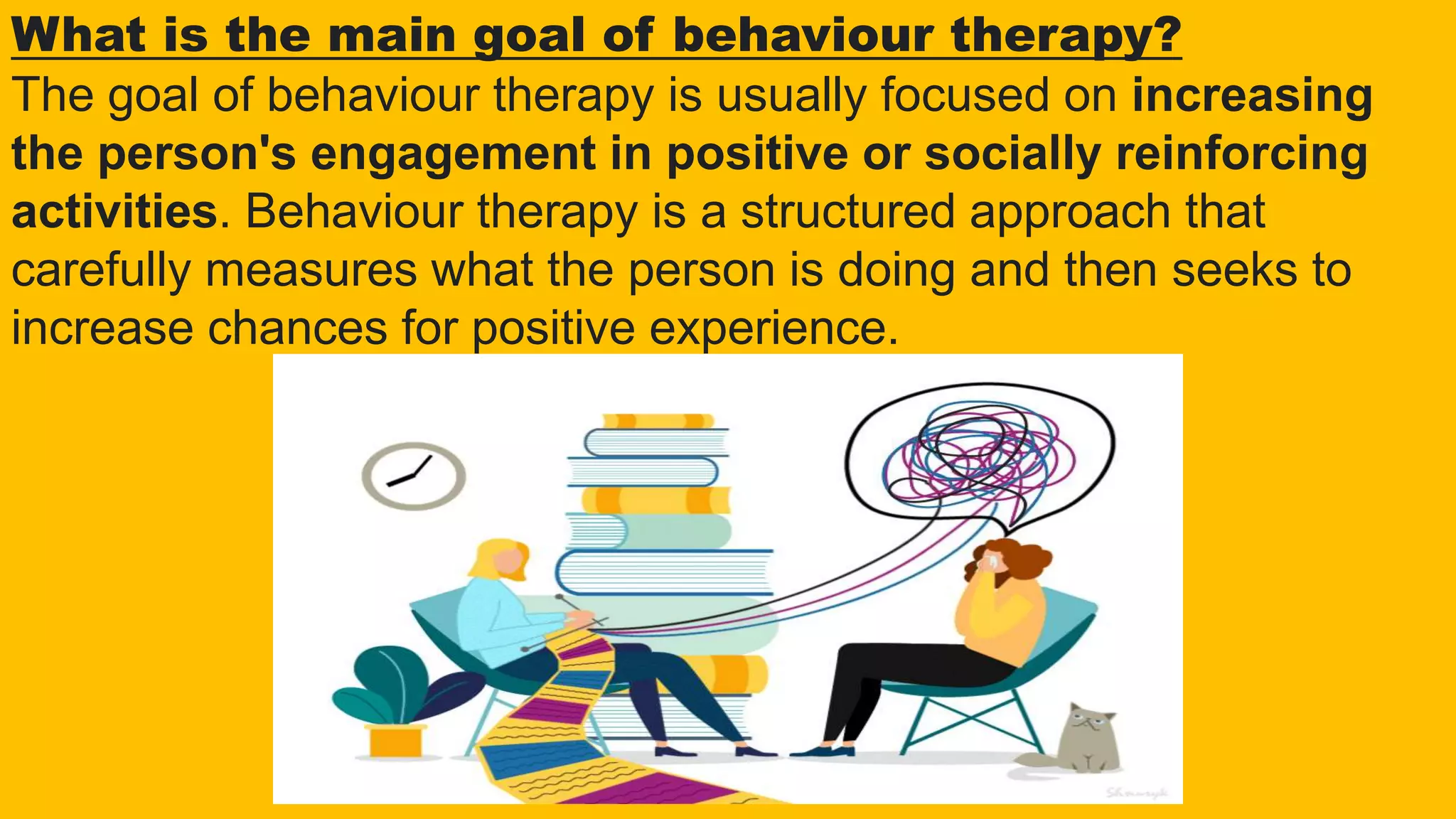
What is the main goal of behaviour therapy?
The goal of behaviour therapy is usually focused on increasing
the person's engagement in positive or socially reinforcing
activities. Behaviour therapy is a structured approach that
carefully measures what the person is doing and then seeks to
increase chances for positive experience.
Techniques of behavioural therapies
apply the learning principles to change maladaptive
behaviours (Weiten, 2007). The techniques do not focus on
clients achieving insights into their behaviour; rather the
focus is just on changing the behaviour.
For example, if a behavioural therapist is working with a
client who is a chain smoker ,the behavioural therapist will
design a program to eliminate the behaviour of smoking–
but there would be no focus on the issues or pathological
symptoms causing the chain smoking behaviour.
1.Systematic Desensitisation – Systematic desensitisation was developed by
Joseph Wolfe and was designed for clients with phobias.
This treatment follows a process of “counterconditioning”
meaning the association between the stimulus and the
anxiety is weakened through the use of relaxation
techniques, anxiety hierarchies and desensitisation
Step 1: Build a hierarchy of the anxiety-arousing stimuli.
The client lists all anxiety arousing stimuli, such as:
(1) Looking at the spider;
(2)Holding a spider in their hands.
Step 2: Train the client in deep muscle relaxation.
Relaxation techniques thought to the client.
Step 3: Client works through hierarchy while using relaxation
techniques.
Talks about anxiety of spiders and practices relaxation techniques.
Step 4: (used in some cases) Client confronts real fear.
Client is presented with a real spider and holds it in his/her hands.
2.Exposure Therapies – Exposure therapies are designed to expose the client to feared
situations similar to that of systematic desensitisation (Corey, 2005). The therapies included
are in
A.Vivo Desensitisation And
B. Flooding.
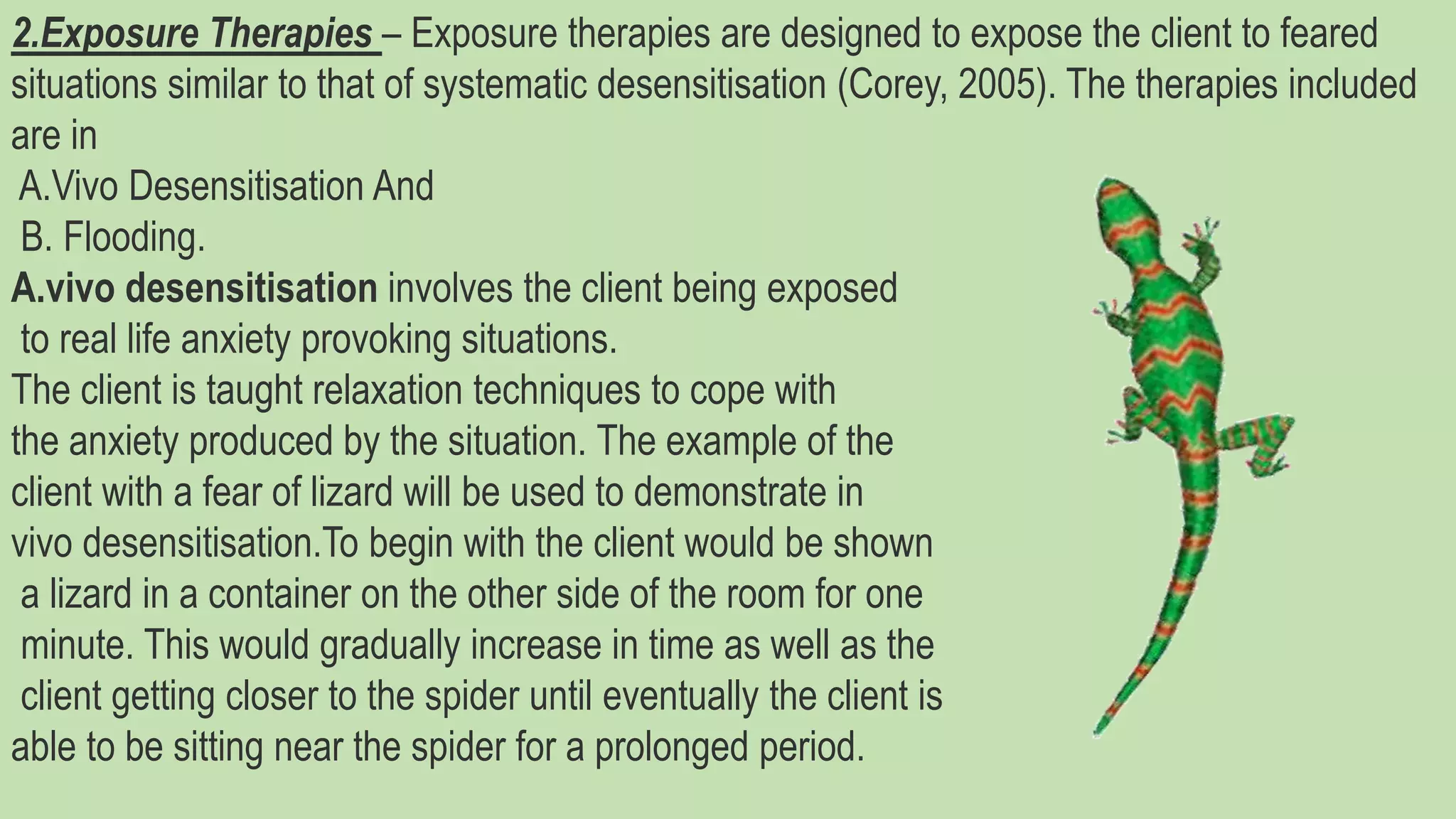
A.vivo desensitisation involves the client being exposed
to real life anxiety provoking situations.
The client is taught relaxation techniques to cope with
the anxiety produced by the situation. The example of the
client with a fear of lizard will be used to demonstrate in
vivo desensitisation.To begin with the client would be shown
a lizard in a container on the other side of the room for one
minute. This would gradually increase in time as well as the
client getting closer to the spider until eventually the client is
able to be sitting near the spider for a prolonged period.
B. Flooding –
Flooding involves the client being exposed to the actual or
imagined fearful situation for a prolonged period of time.
The example of the client with the spider fear would be that
the client would be exposed to the spider or the thought of
a spider for a prolonged period of time and uses relaxation
techniques to cope.
There may be ethical issues in using these techniques with
certain fears or traumatic events and the client should be
provided with information on the techniques before utilising
them so he or she understands the process.
3.Aversion Therapy :
The most controversial of the behavioural treatments, aversion
therapy is used by therapists as a last resort to an aversive
behaviour (Weiten, 2007). This treatment involves pairing the
aversive behaviour (such as drinking alcohol) with
a stimulus with an
undesirable response (such as a medication
that induces vomiting when taken with alcohol).
This is designed to reduce the targeted behaviour
(drinking alcohol) even when the stimulus with the
undesirable response is not taken (medication).
4.Modelling :
Modelling is used as a treatment that involves improving interpersonal skills
such as communication and how to act in a social setting. Techniques
involved in modelling are:
a.Live modelling involves the client watching a “model” such as the
counsellor perform a specific behaviour, the client then copies this
behaviour.
b.Modelling involves the client watching a behaviour indirectly such as a
video.
c.Role-playing is where the counsellor
a behaviour with the client in order for the
client to practice the behaviour.
d.Participant modelling involves the counsellor modelling
the behaviour and then getting the client to practice the
behaviour while the counsellor performs the behaviour.
e. Covert modelling is where the client cannot watch
someone perform the behaviour but instead the counsellor
gets the client to imagine a model performing the behaviour
(Sharf, 2000).
Behavioral Approach:
Behavioral counseling theories hold that
people engage in problematic thinking and behaviour when
their environment supports it.
When an environment reinforces or encourages these
problems, they will continue to occur.
Behavioural counsellors work to help clients identify the
reinforcements that are supporting problematic patterns of
thinking and acting and replace them with alternative
reinforcements for more desirable patterns.
Advantages of Behavioural Therapy
1. We learn to ACT on the world, rather than being passive toward it
We no longer passively react to life, like we've done all our lives.
2. Behavioral changes brain physiology
Cognitive-behavioral therapy changes the neural pathway associations in the brain. This
changes how we feel about ourselves and the world around us -- permanently. The
brain changes AFTER we take action. Brain imaging technology prove that the human
brain changes as a result of cognitive-behavioral therapy
3. We are energized to keep moving forward
Acting against our fears in a step-by-step fashion, with cognitive help and support, helps
us to build and keep momentum.
4. Progress against social anxiety occurs faster
With the right cognitive framework, we are able to be rational about our progress, so we
can move ahead with our behavioural experiments.
5. We no longer avoid events. Anxiety no longer restricts what we do in life.
Behavioral therapy changes how we act. Instead of avoiding situations and other
people, we learn to feel comfortable and confident, because we took action.
Limitations:
1.Behavioral therapy is a natural extension and application of many of
Skinner's views focusing on observable behaviour. This criticism states
that behaviour therapy ignores the importance of self or self-consciousness
to the exclusion of overt behavioural responses.
2.Behavior therapy treats symptoms rather than causes. The psychoanalytic
assumption is that early life events are the source of present difficulties. Instead,
the behavioural practitioner emphasizes changing environmental circumstances
and how those environmental forces reinforce particular behaviours.
3.Behavior therapy involves the use of control and manipulation by the therapist
toward the client. The therapist assumes a position of power with the client where
he or she, through the process of reinforcement, can potentially manipulate the
client's behaviour responses.
REFERENCES:
https://www.counsellingconnection.com/index.php/2009/10/08/behavioural-
techniques/
https://socialanxietyinstitute.org/top-5-list-benefits-behavioral-
therapy#:~:text=Anxiety%20no%20longer%20restricts%20what,feel%20more%20c
omfortable%20in%20situations.
https://images.squarespace-
cdn.com/content/v1/521813c4e4b0d4fe19773998/1595530394171-
E0VQNNEJ614VCL1PSEMP/Behavior.gif
https://practicalpie.com/wp-content/uploads/2020/06/B-F-Skinner.jpg
https://psych.athabascau.ca/open/wolpe/img/wolpepicture.jpg
https://thumbs.gfycat.com/AromaticNaughtyCornsnake-size_restricted.gif
https://media3.giphy.com/media/l2JdWdiFeSv9DsBdm/200w.gif?cid=82a1493byd5
b14kycrscaeqhwm8n0afd0kdxgueuf38cw4nx&rid=200w.gif&ct=g
https://thumbs.gfycat.com/AliveRemorsefulHuemul-max-1mb.gif
.

Behavioural Approach

  • 1.
    Dr Neeta Gupta AssociateProfessor Department of psychology Certified Practitioner of EFT & REBT (London) & CBT (Scotland) DAV PG College Dehradun Behavioural Approach of Counselling
  • 2.
    What is BehaviouralApproach? The behavioral approach suggests that the keys to understanding development are observable behavior and external stimuli in the environment. Behaviorism states all behaviors are learned Through interaction with the environment through a process called conditioning. Thus, Behaviour is simply a response to environmental stimuli.
  • 3.
    John B. Watsonand B. F. Skinner are the main propagators of Behaviourism. Behaviourism rejected any reference to mind and viewed overt and observable behaviour as the proper subject matter of psychology. Through the scientific study of behaviour, it was hoped that laws of learning could be derived that would promote the prediction and control of behaviour.
  • 4.
    What is themain goal of behaviour therapy? The goal of behaviour therapy is usually focused on increasing the person's engagement in positive or socially reinforcing activities. Behaviour therapy is a structured approach that carefully measures what the person is doing and then seeks to increase chances for positive experience.
  • 5.
    Techniques of behaviouraltherapies apply the learning principles to change maladaptive behaviours (Weiten, 2007). The techniques do not focus on clients achieving insights into their behaviour; rather the focus is just on changing the behaviour. For example, if a behavioural therapist is working with a client who is a chain smoker ,the behavioural therapist will design a program to eliminate the behaviour of smoking– but there would be no focus on the issues or pathological symptoms causing the chain smoking behaviour.
  • 6.
    1.Systematic Desensitisation –Systematic desensitisation was developed by Joseph Wolfe and was designed for clients with phobias. This treatment follows a process of “counterconditioning” meaning the association between the stimulus and the anxiety is weakened through the use of relaxation techniques, anxiety hierarchies and desensitisation Step 1: Build a hierarchy of the anxiety-arousing stimuli. The client lists all anxiety arousing stimuli, such as: (1) Looking at the spider; (2)Holding a spider in their hands.
  • 7.
    Step 2: Trainthe client in deep muscle relaxation. Relaxation techniques thought to the client. Step 3: Client works through hierarchy while using relaxation techniques. Talks about anxiety of spiders and practices relaxation techniques. Step 4: (used in some cases) Client confronts real fear. Client is presented with a real spider and holds it in his/her hands.
  • 8.
    2.Exposure Therapies –Exposure therapies are designed to expose the client to feared situations similar to that of systematic desensitisation (Corey, 2005). The therapies included are in A.Vivo Desensitisation And B. Flooding. A.vivo desensitisation involves the client being exposed to real life anxiety provoking situations. The client is taught relaxation techniques to cope with the anxiety produced by the situation. The example of the client with a fear of lizard will be used to demonstrate in vivo desensitisation.To begin with the client would be shown a lizard in a container on the other side of the room for one minute. This would gradually increase in time as well as the client getting closer to the spider until eventually the client is able to be sitting near the spider for a prolonged period.
  • 9.
    B. Flooding – Floodinginvolves the client being exposed to the actual or imagined fearful situation for a prolonged period of time. The example of the client with the spider fear would be that the client would be exposed to the spider or the thought of a spider for a prolonged period of time and uses relaxation techniques to cope. There may be ethical issues in using these techniques with certain fears or traumatic events and the client should be provided with information on the techniques before utilising them so he or she understands the process.
  • 10.
    3.Aversion Therapy : Themost controversial of the behavioural treatments, aversion therapy is used by therapists as a last resort to an aversive behaviour (Weiten, 2007). This treatment involves pairing the aversive behaviour (such as drinking alcohol) with a stimulus with an undesirable response (such as a medication that induces vomiting when taken with alcohol). This is designed to reduce the targeted behaviour (drinking alcohol) even when the stimulus with the undesirable response is not taken (medication).
  • 11.
    4.Modelling : Modelling isused as a treatment that involves improving interpersonal skills such as communication and how to act in a social setting. Techniques involved in modelling are: a.Live modelling involves the client watching a “model” such as the counsellor perform a specific behaviour, the client then copies this behaviour. b.Modelling involves the client watching a behaviour indirectly such as a video. c.Role-playing is where the counsellor a behaviour with the client in order for the client to practice the behaviour.
  • 12.
    d.Participant modelling involvesthe counsellor modelling the behaviour and then getting the client to practice the behaviour while the counsellor performs the behaviour. e. Covert modelling is where the client cannot watch someone perform the behaviour but instead the counsellor gets the client to imagine a model performing the behaviour (Sharf, 2000).
  • 13.
    Behavioral Approach: Behavioral counselingtheories hold that people engage in problematic thinking and behaviour when their environment supports it. When an environment reinforces or encourages these problems, they will continue to occur. Behavioural counsellors work to help clients identify the reinforcements that are supporting problematic patterns of thinking and acting and replace them with alternative reinforcements for more desirable patterns.
  • 14.
    Advantages of BehaviouralTherapy 1. We learn to ACT on the world, rather than being passive toward it We no longer passively react to life, like we've done all our lives. 2. Behavioral changes brain physiology Cognitive-behavioral therapy changes the neural pathway associations in the brain. This changes how we feel about ourselves and the world around us -- permanently. The brain changes AFTER we take action. Brain imaging technology prove that the human brain changes as a result of cognitive-behavioral therapy 3. We are energized to keep moving forward Acting against our fears in a step-by-step fashion, with cognitive help and support, helps us to build and keep momentum. 4. Progress against social anxiety occurs faster With the right cognitive framework, we are able to be rational about our progress, so we can move ahead with our behavioural experiments. 5. We no longer avoid events. Anxiety no longer restricts what we do in life. Behavioral therapy changes how we act. Instead of avoiding situations and other people, we learn to feel comfortable and confident, because we took action.
  • 15.
    Limitations: 1.Behavioral therapy isa natural extension and application of many of Skinner's views focusing on observable behaviour. This criticism states that behaviour therapy ignores the importance of self or self-consciousness to the exclusion of overt behavioural responses. 2.Behavior therapy treats symptoms rather than causes. The psychoanalytic assumption is that early life events are the source of present difficulties. Instead, the behavioural practitioner emphasizes changing environmental circumstances and how those environmental forces reinforce particular behaviours. 3.Behavior therapy involves the use of control and manipulation by the therapist toward the client. The therapist assumes a position of power with the client where he or she, through the process of reinforcement, can potentially manipulate the client's behaviour responses.
  • 16.
  • 17.