Mrs.Nagamani.T
Principal
Suyog College of Nursing
At the end of this Chapter you should be able
to:
 Know the history and origin of Science of
psychology
 explain the nature of psychology and its
definition;
 describe the scope of psychology;
 elaborate the basic psychological processes;
and
 explain the fields of psychology
 Understand the relevance of Psychology to
Nursing
 As human beings our curiosity drives us to know
the reasons behind various events happening
around us.
 Whenever we meet somebody or see someone
doing something we immediately try to
understand as to why this person is doing this
kind of activity.
 Similarly we often try to understand our own
experiences and behaviors in different situations.
 The knowledge of psychology helps the health
care professional to understand the situations
and to react accordingly.
 In simple words psychology is a systematic
and scientific study of mental processes,
experiences and behaviors - both overt and
covert.
 The word ‘psychology’ has its origin in two
Greek words ‘psyche’ and ‘logos’.
 The word ‘psyche’ in Greek language refers
to ‘spirit’ or ‘soul’ and the word ‘logos’
refers to ‘discourse’ or ‘study’.
 The term ‘psychology’, literally means the
science of the soul.
 According to the origin of the two Greek
words Psychology is the study of Soul or
Sprit. Soul is being Philosophical concept. it
is an abstract cannot be seen observe and it
is difficult to study even under microscopic
condition.
Hence this definition is rejected by the
Psychologist.
 During earlier times psychology was considered as
a discipline which deals with the study of soul. It
was called rational psychology.
 But modern psychology is empirical, and does not
deal with the problems relating to the soul.
 It deals with mental process apart from the soul or
mental substance.
 It is the science of experience and behavior, which
tells us how the mind works and behaves.
 It can predict the behavior of an individual, and
control it to a certain extent by putting him under
proper conditions. It seeks to discover the laws of
mind.
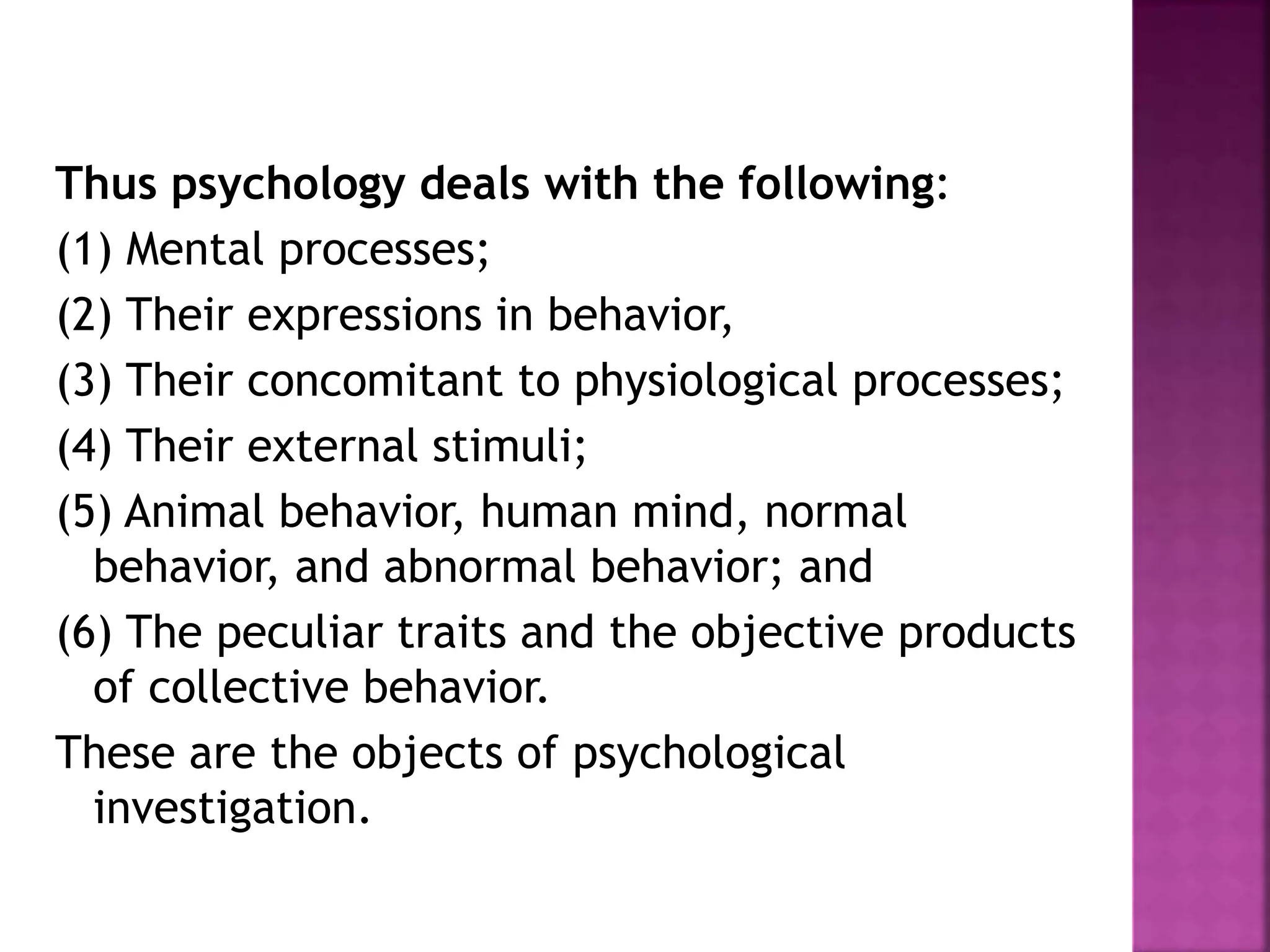
Thus psychology deals with the following:
(1) Mental processes;
(2) Their expressions in behavior,
(3) Their concomitant to physiological processes;
(4) Their external stimuli;
(5) Animal behavior, human mind, normal
behavior, and abnormal behavior; and
(6) The peculiar traits and the objective products
of collective behavior.
These are the objects of psychological
investigation.
 In the ancient time, Psychology was considered
to be a branch of Philosophy.
 From hundred years onward Psychology has
been separated from the subject of Philosophy
because of increased number of experimental
method by the Psychologists.
 Now it is called as Independent science.
 Later, the American Psychologist William
James (1890)fused the word “mind” in the
place of “Soul”. According to him Psychology
is a study of mind, it has no definite body,
shape, cannot be seen as observe and
difficult to study the nature of Mind by the
Psychologist. Hence this definition is also
rejected by the Psychologist.
 Later, the German Psychologist William
Wundt defined Psychology is the study of
consciousness. It is a part of the mind and
abstract. It is very difficult to study the
nature of consciousness by the Psychologist.
Hence, this definition is also rejected by the
Psychologist.
 He has studied Human behaviour accurately
through conducting his experiment on the object
like patient and predicting his behaviour for all
the Psychologist in his laboratory. Hence, all the
Psychologist called him as a “Father of
Psychology”.
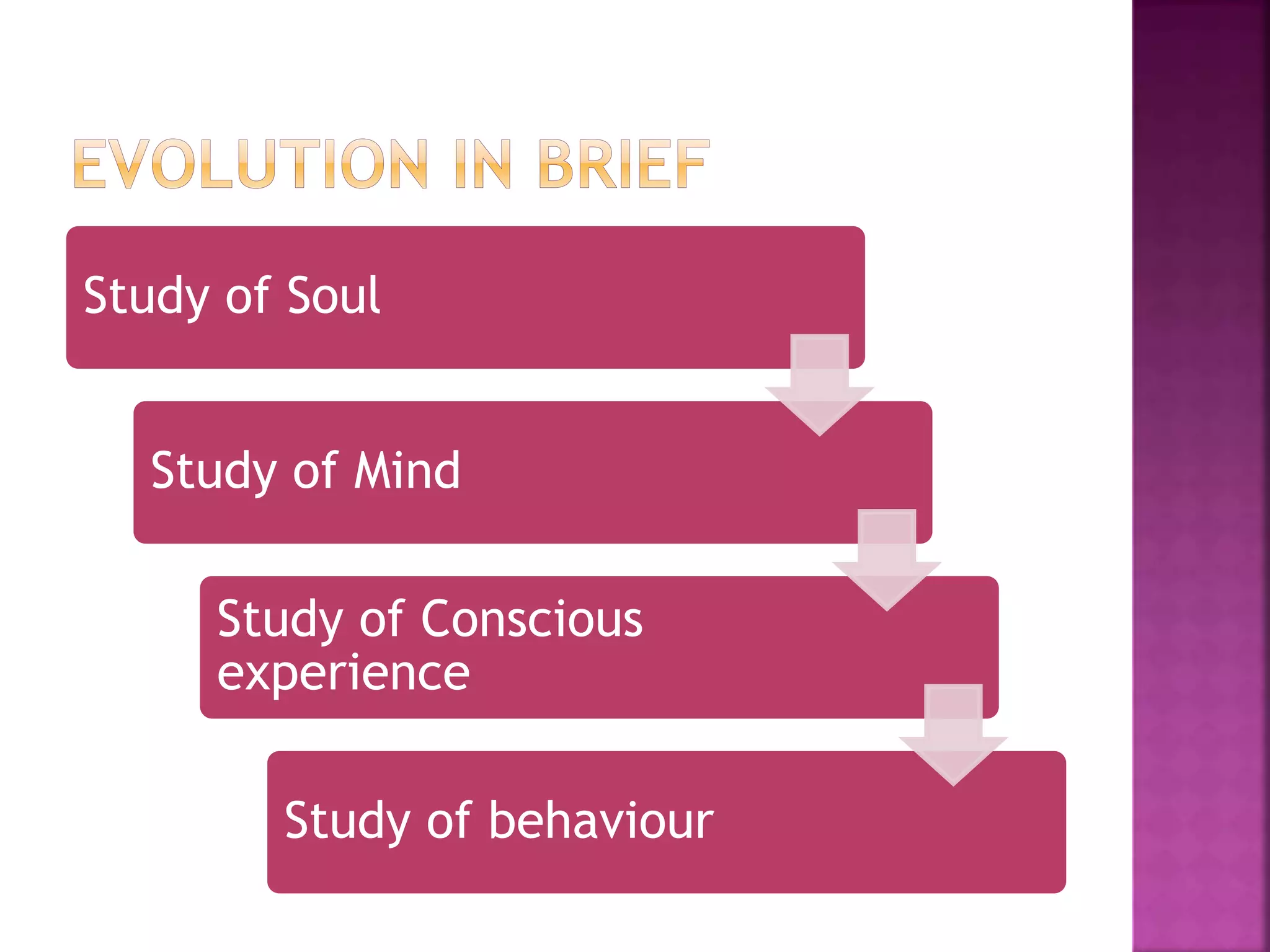
 Then, he defined his earlier definition as
Psychology as the Science of the behaviour of
Human beings.
 Later, the other Psychologist conducted an
experiment on the object like cow and
predicting behaviour of the cow. Then they
defined Psychology as the science of
behaviour of Human beings and Animals.
Study of Soul
Study of Mind
Study of Conscious
experience
Study of behaviour
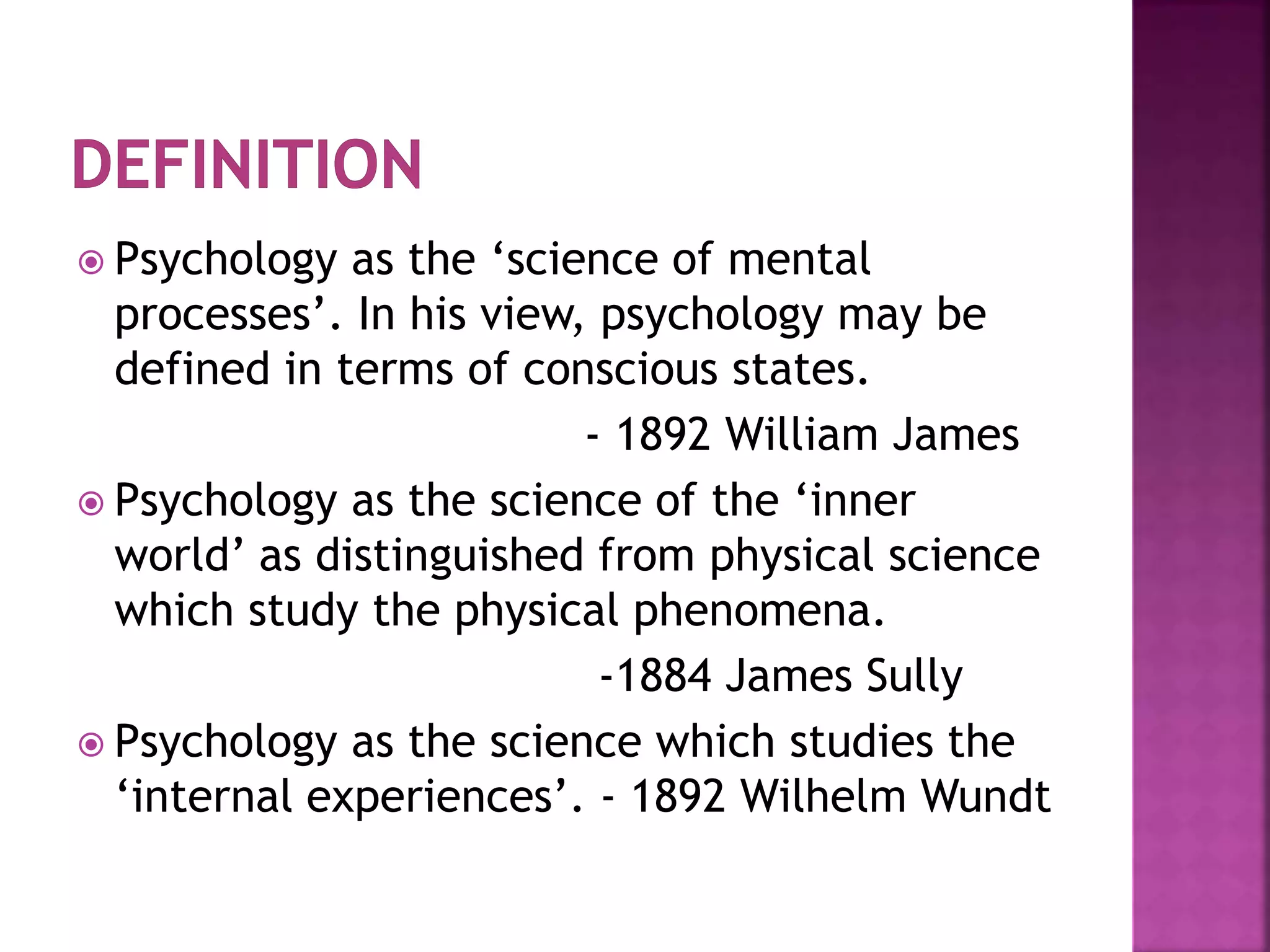
 Psychology as the ‘science of mental
processes’. In his view, psychology may be
defined in terms of conscious states.
- 1892 William James
 Psychology as the science of the ‘inner
world’ as distinguished from physical science
which study the physical phenomena.
-1884 James Sully
 Psychology as the science which studies the
‘internal experiences’. - 1892 Wilhelm Wundt
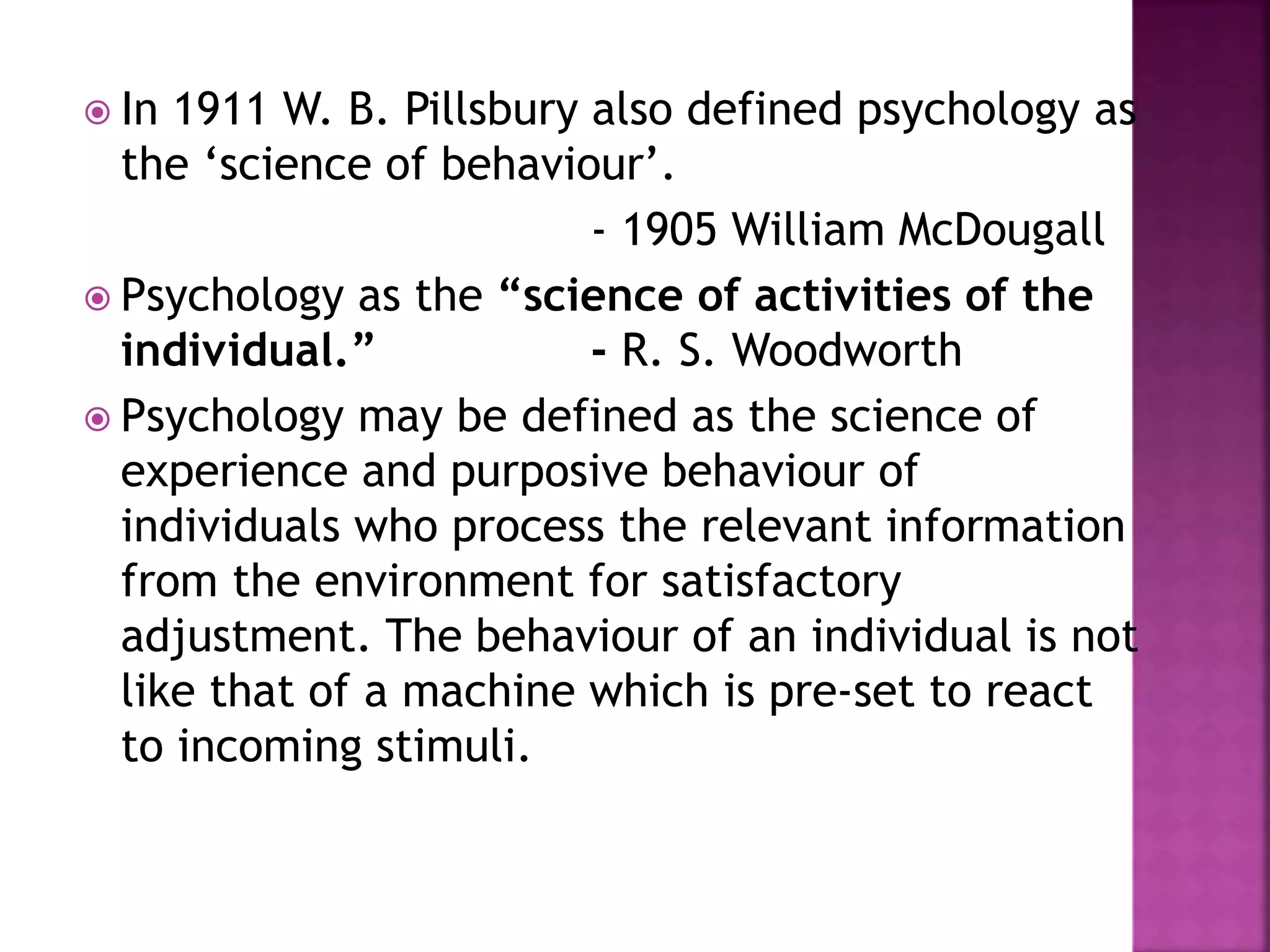
 In 1911 W. B. Pillsbury also defined psychology as
the ‘science of behaviour’.
- 1905 William McDougall
 Psychology as the “science of activities of the
individual.” - R. S. Woodworth
 Psychology may be defined as the science of
experience and purposive behaviour of
individuals who process the relevant information
from the environment for satisfactory
adjustment. The behaviour of an individual is not
like that of a machine which is pre-set to react
to incoming stimuli.
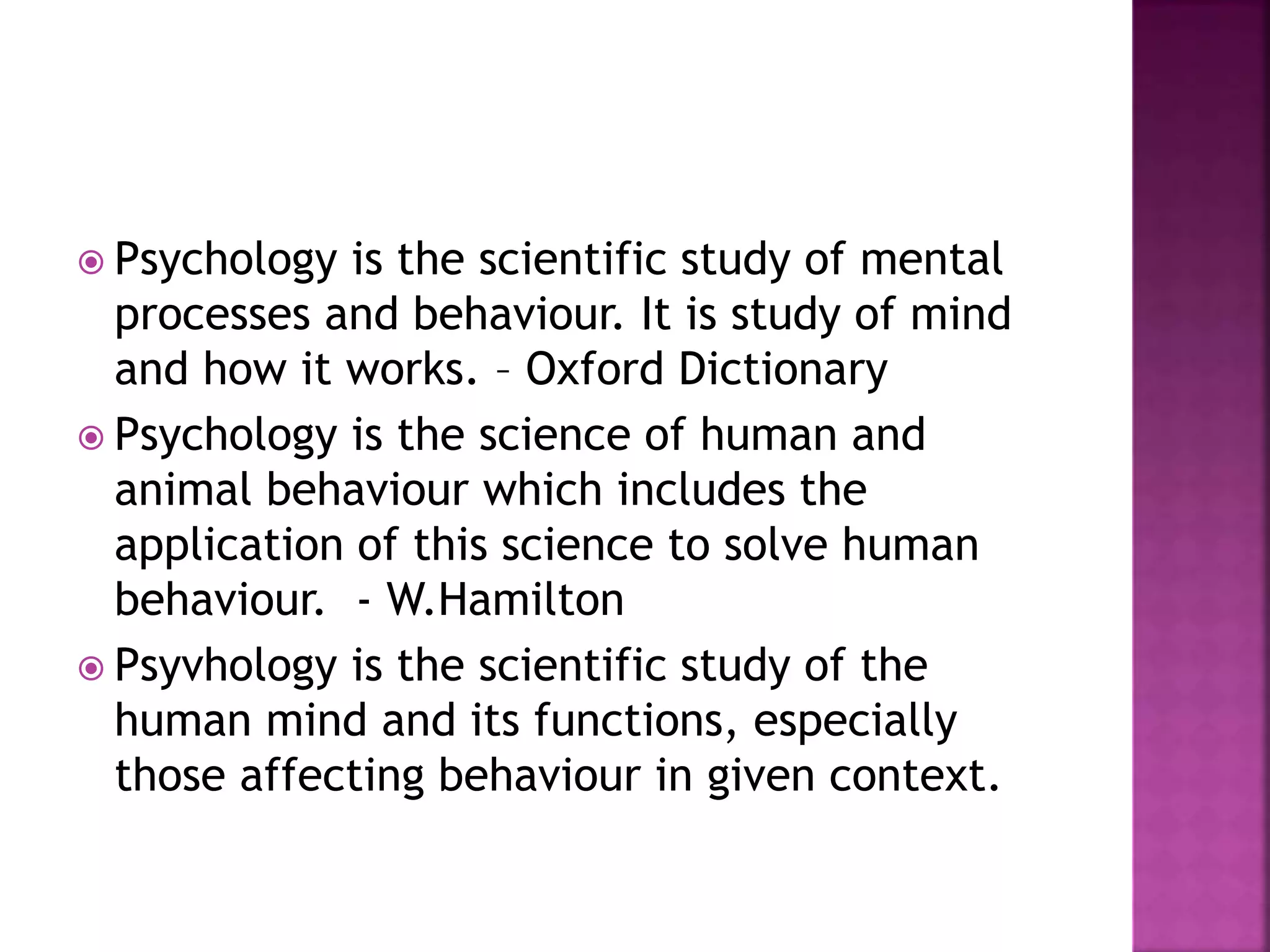
 Psychology is the scientific study of mental
processes and behaviour. It is study of mind
and how it works. – Oxford Dictionary
 Psychology is the science of human and
animal behaviour which includes the
application of this science to solve human
behaviour. - W.Hamilton
 Psyvhology is the scientific study of the
human mind and its functions, especially
those affecting behaviour in given context.
 As psychology has evolved as a science, its
fields of specialization have multiplied and
its educational and training requirements
have become formalized.
 Psychologists work in a variety of fields in
academic and professional settings.
 The scope of Psychology is very wide and
vast.
 It studies, describes and explains the
behaviour of all living organisms which are
created by Almighty (God).
 Behaviour is all activities of the human
beings or organisms and all living organisms
include Adolescents, adults, old aged people,
students, teachers, parents, producers,
consumers, official, clients, criminals,
witnesses etc. are studied in Psychology.
 When the Psychologist failed to study the
behaviour of all these living organisms, for
further convenience, they divided the scope
of Psychology into two main branches such as
Pure Psychology and Applied Psychology.
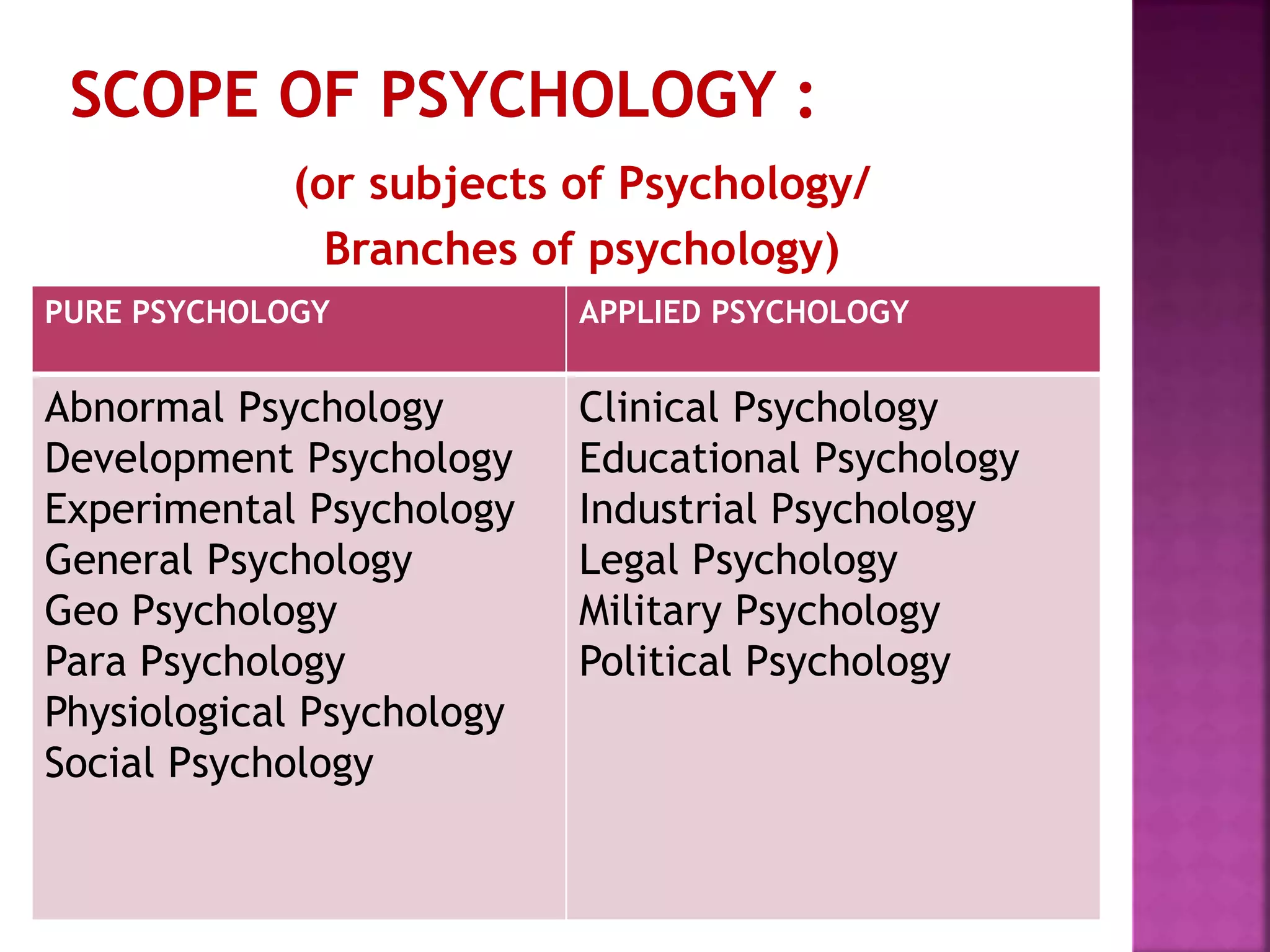
(or subjects of Psychology/
Branches of psychology)
PURE PSYCHOLOGY APPLIED PSYCHOLOGY
Abnormal Psychology
Development Psychology
Experimental Psychology
General Psychology
Geo Psychology
Para Psychology
Physiological Psychology
Social Psychology
Clinical Psychology
Educational Psychology
Industrial Psychology
Legal Psychology
Military Psychology
Political Psychology
 Abnormal Psychology: It is branched under pure
Psychology. It studies the behaviour of abnormal
people and it also studies mental disorders, their
causes and suggests treatment.
 Development Psychology: It is a branch of pure
Psychology. It studies growth and development
and behaviour of an individual from the birth
until his death. Further it is classified into three
types such as –
 Child Psychology
 Adolescent Psychology
 Adult and old aged Psychology
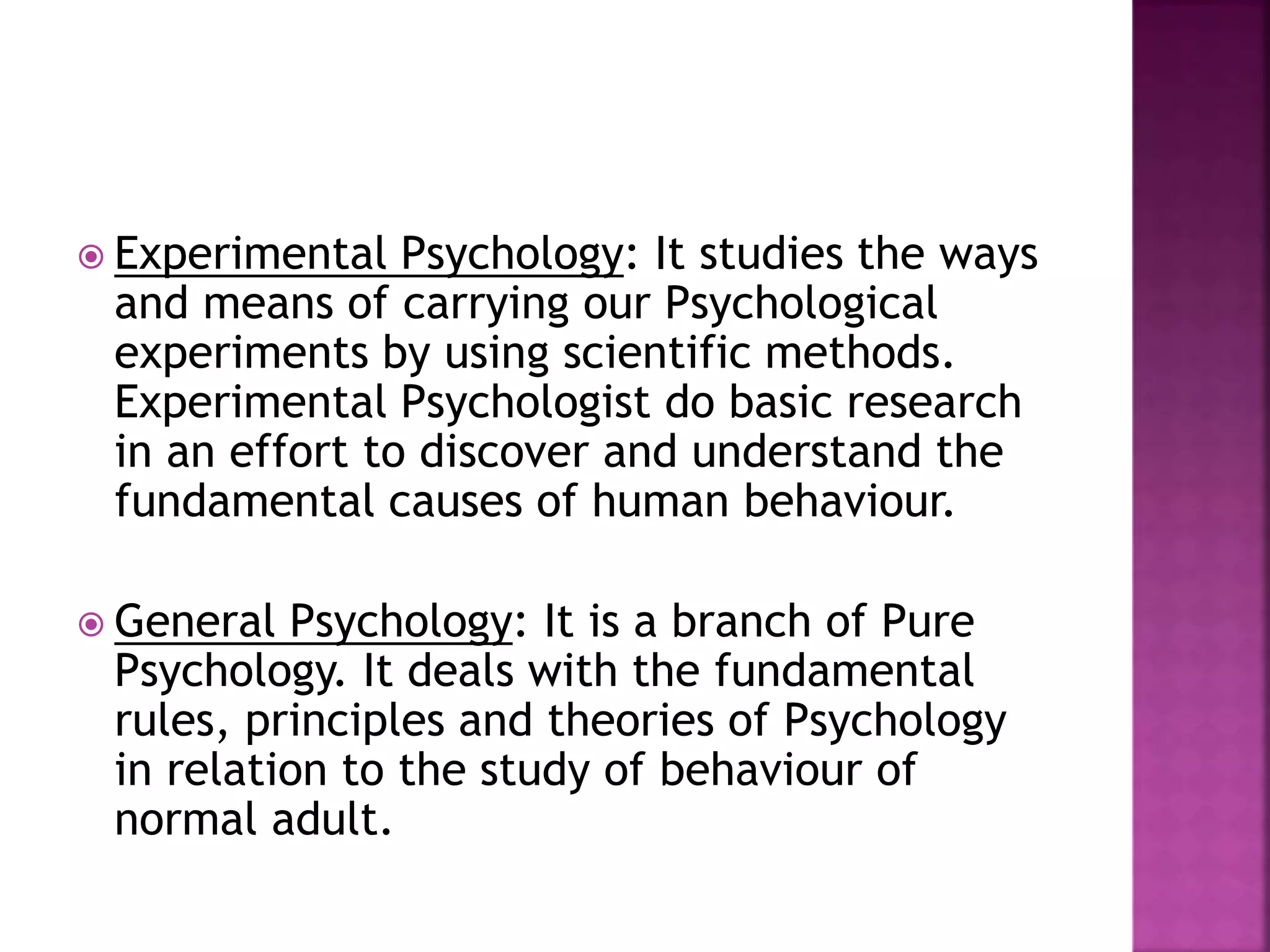
 Experimental Psychology: It studies the ways
and means of carrying our Psychological
experiments by using scientific methods.
Experimental Psychologist do basic research
in an effort to discover and understand the
fundamental causes of human behaviour.
 General Psychology: It is a branch of Pure
Psychology. It deals with the fundamental
rules, principles and theories of Psychology
in relation to the study of behaviour of
normal adult.
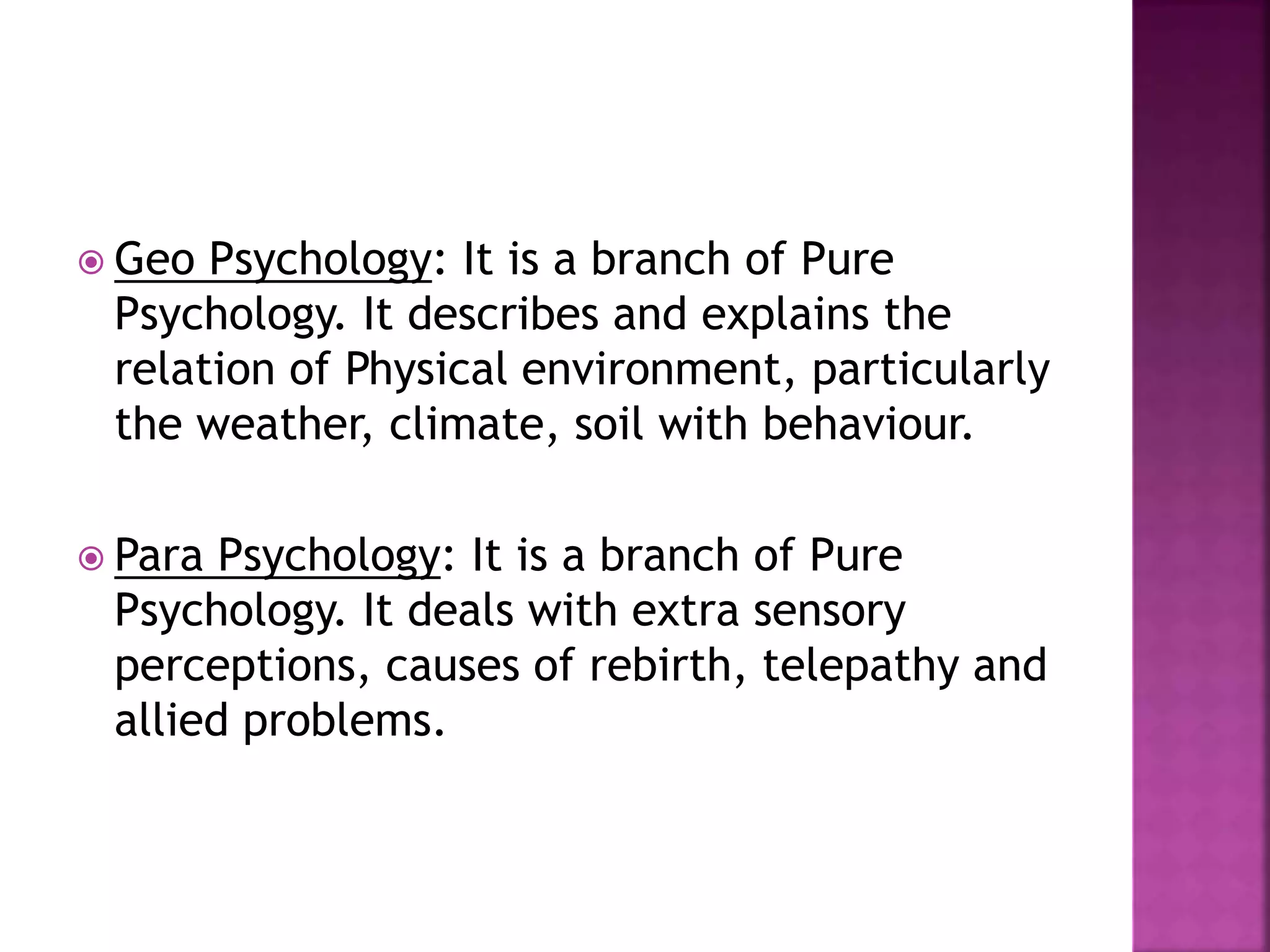
 Geo Psychology: It is a branch of Pure
Psychology. It describes and explains the
relation of Physical environment, particularly
the weather, climate, soil with behaviour.
 Para Psychology: It is a branch of Pure
Psychology. It deals with extra sensory
perceptions, causes of rebirth, telepathy and
allied problems.
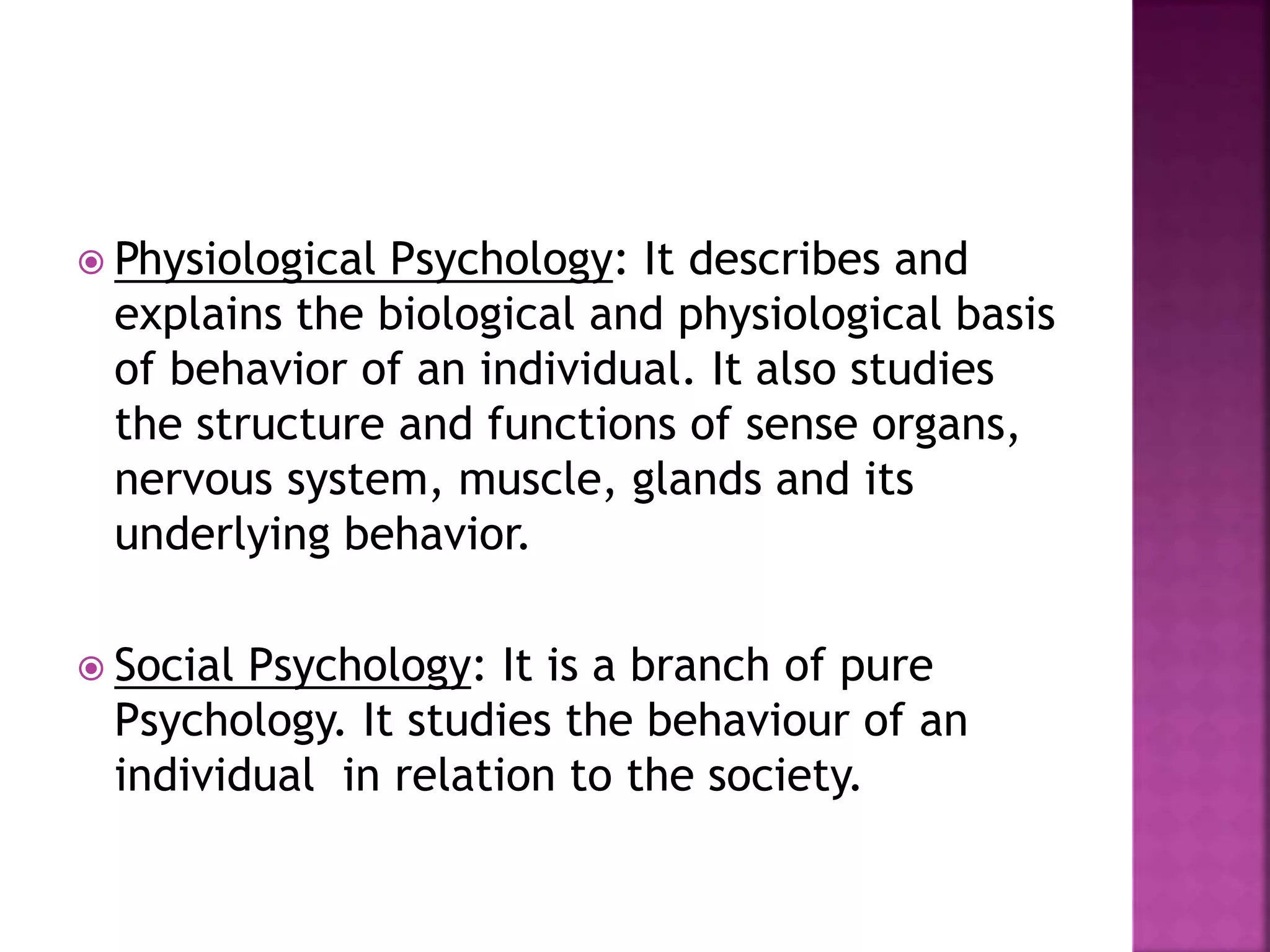
 Physiological Psychology: It describes and
explains the biological and physiological basis
of behavior of an individual. It also studies
the structure and functions of sense organs,
nervous system, muscle, glands and its
underlying behavior.
 Social Psychology: It is a branch of pure
Psychology. It studies the behaviour of an
individual in relation to the society.
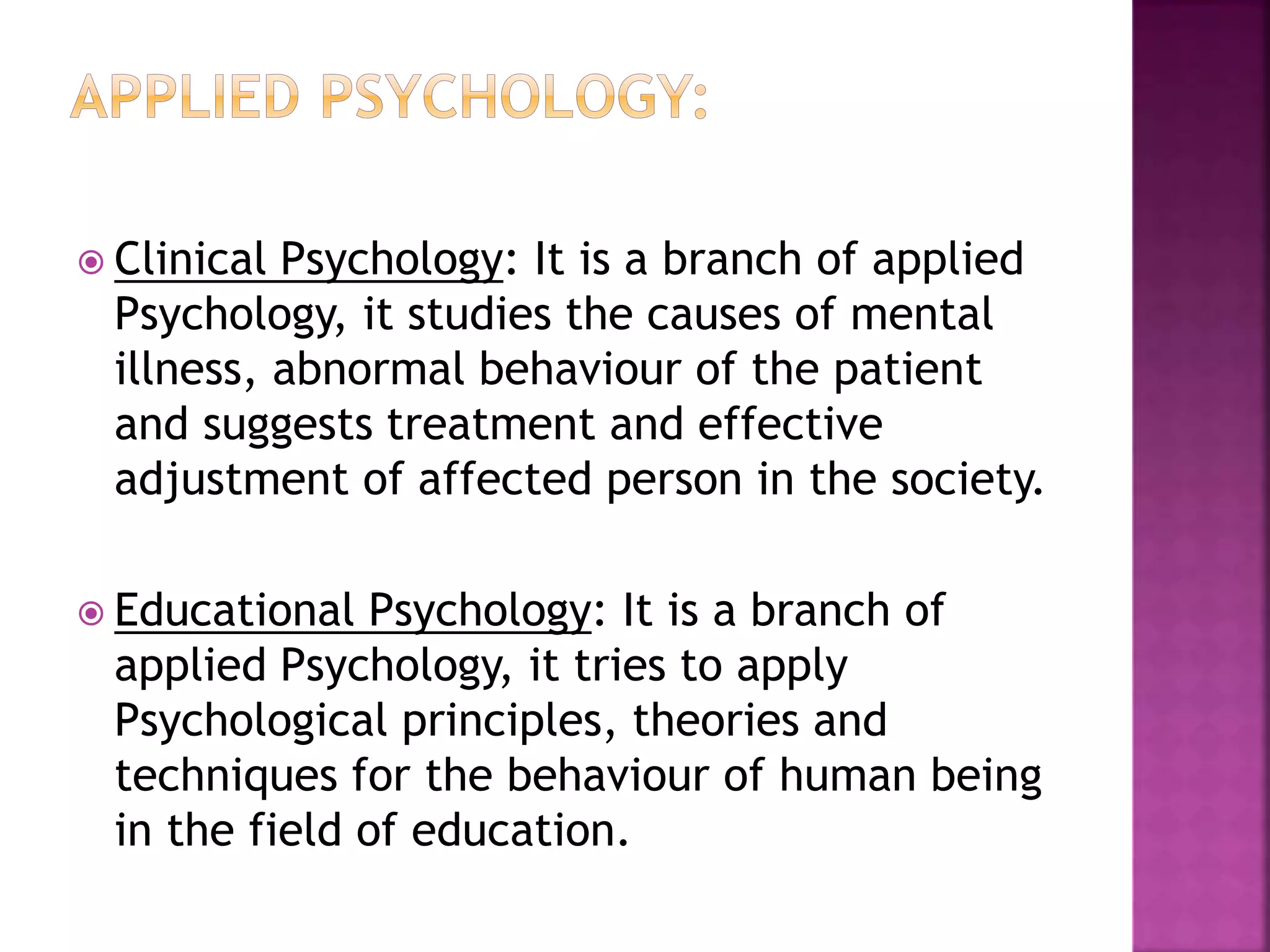
 Clinical Psychology: It is a branch of applied
Psychology, it studies the causes of mental
illness, abnormal behaviour of the patient
and suggests treatment and effective
adjustment of affected person in the society.
 Educational Psychology: It is a branch of
applied Psychology, it tries to apply
Psychological principles, theories and
techniques for the behaviour of human being
in the field of education.
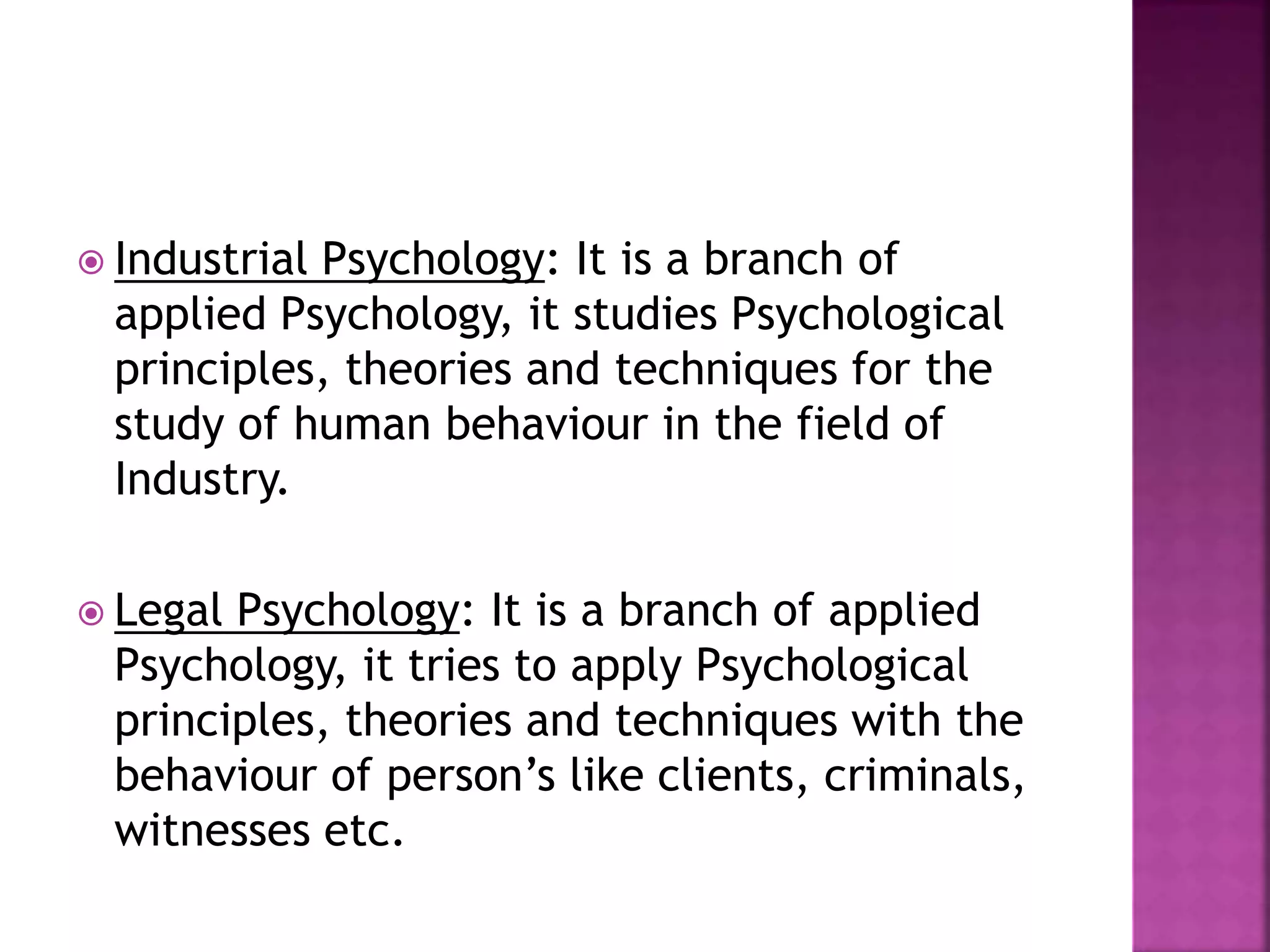
 Industrial Psychology: It is a branch of
applied Psychology, it studies Psychological
principles, theories and techniques for the
study of human behaviour in the field of
Industry.
 Legal Psychology: It is a branch of applied
Psychology, it tries to apply Psychological
principles, theories and techniques with the
behaviour of person’s like clients, criminals,
witnesses etc.
 Military Psychology: It is a branch of applied
Psychology, it tries to apply Psychological
principles, theories and techniques for study
of human behavior in the field of Military
science.
 Political Psychology: It is a branch of applied
Psychology, it tries to apply Psychological
principles, theories and techniques for the
study of human behavior in the field of
political science.
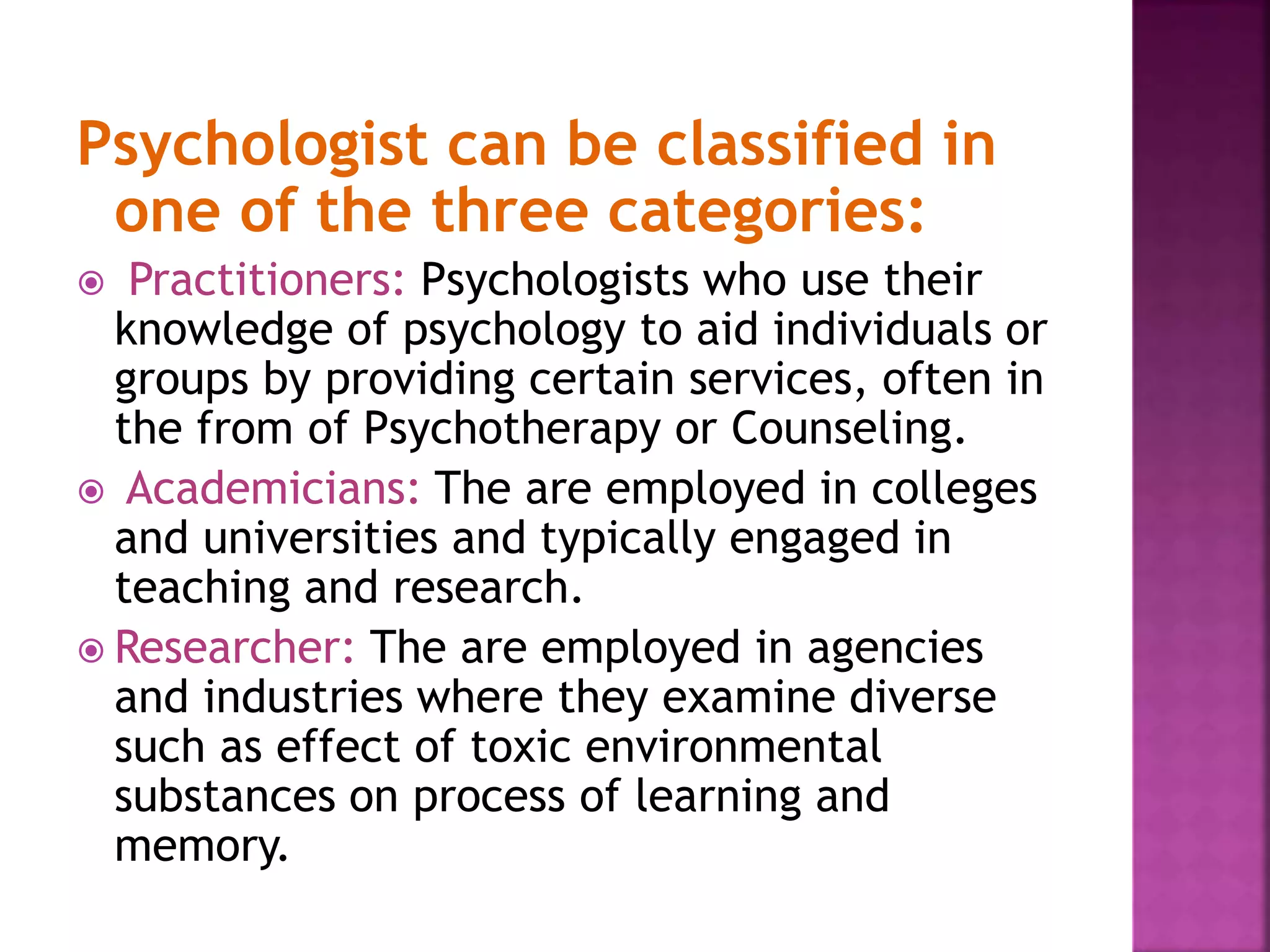
Psychologist can be classified in
one of the three categories:
 Practitioners: Psychologists who use their
knowledge of psychology to aid individuals or
groups by providing certain services, often in
the from of Psychotherapy or Counseling.
 Academicians: The are employed in colleges
and universities and typically engaged in
teaching and research.
 Researcher: The are employed in agencies
and industries where they examine diverse
such as effect of toxic environmental
substances on process of learning and
memory.
Research Specialties:
The Experimental Psychology: is a branch aims
at understanding the fundamental causes of
behaviour.
Study basic psychological processes as
sensation, perception, learning, memory,
cognition, motivation, and emotion.
Work mostly in the laboratory and may use
animals as well as human beings in their
research.
Study how people learn everything from
simple tasks such as sitting upright to more
complex things such as emotions and
language.
Physiological Psychology:
The branch of psychology that studies the
connection between the nervous and
endocrine system and behavior.
Developmental Psychology:
Concerns itself with the study of human
behaviour in all its aspects of growth and
development Also known as Genetic
Psychology Involves the development of an
individual in terms of stages.
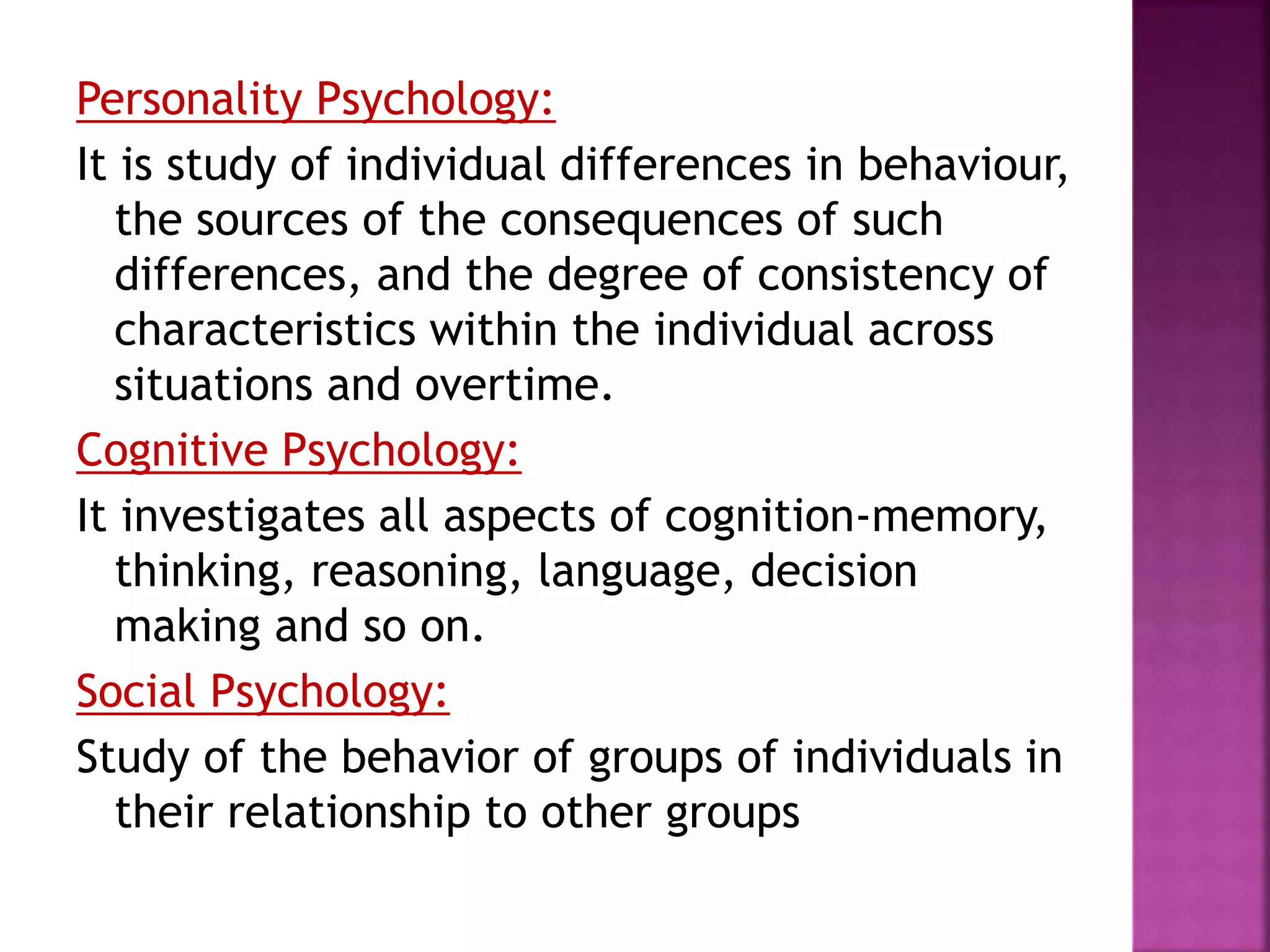
Personality Psychology:
It is study of individual differences in behaviour,
the sources of the consequences of such
differences, and the degree of consistency of
characteristics within the individual across
situations and overtime.
Cognitive Psychology:
It investigates all aspects of cognition-memory,
thinking, reasoning, language, decision
making and so on.
Social Psychology:
Study of the behavior of groups of individuals in
their relationship to other groups
Animal Psychology:
It is also called comparative psychology because
it compares human psychology and animal
psychology. Animals psychology is useful for
understanding the human behaviour also.
Psychometric Psychology:
It is concerned with the tests and inventories for
the measurement of human capacities and
abilities.
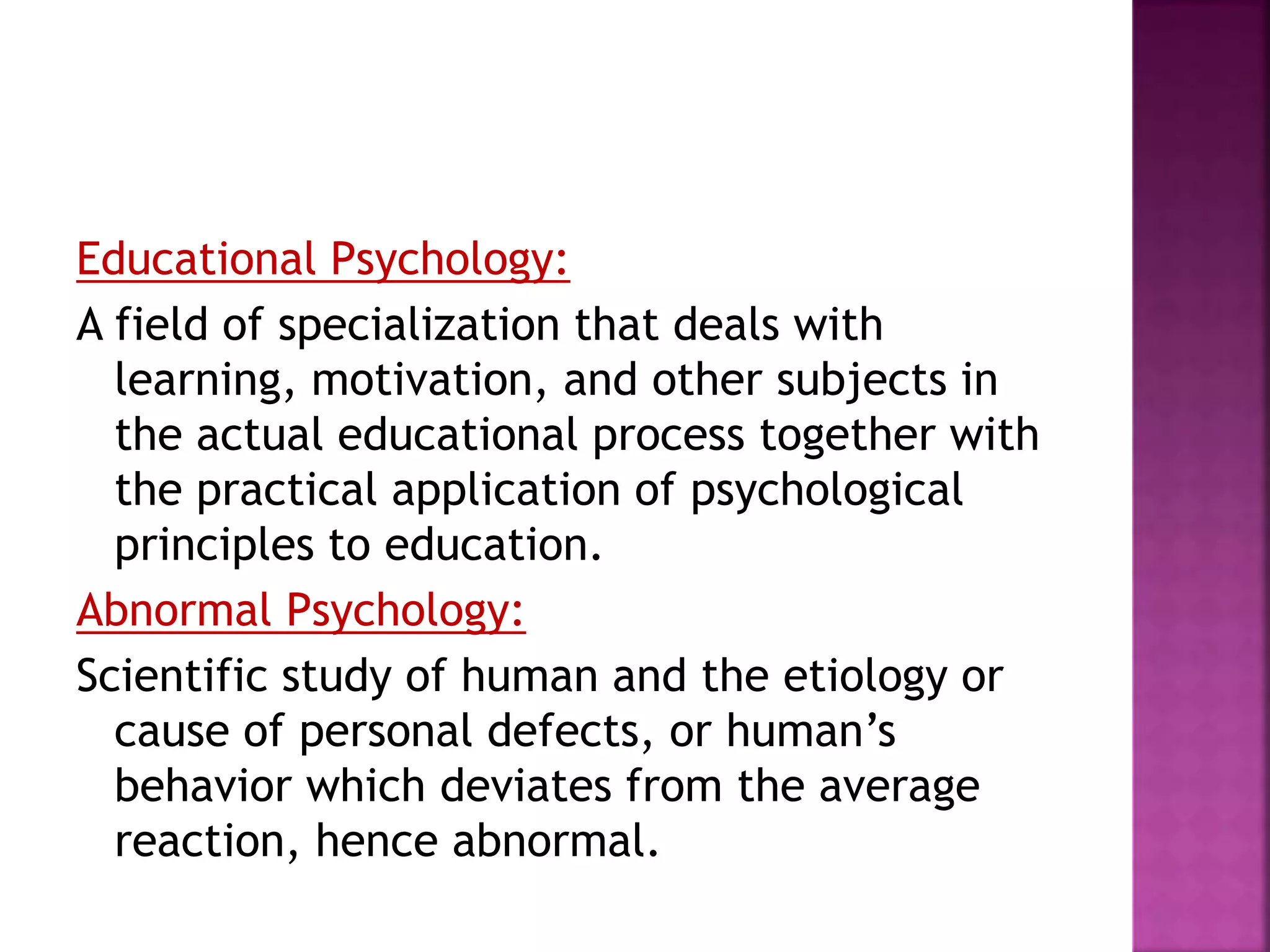
Educational Psychology:
A field of specialization that deals with
learning, motivation, and other subjects in
the actual educational process together with
the practical application of psychological
principles to education.
Abnormal Psychology:
Scientific study of human and the etiology or
cause of personal defects, or human’s
behavior which deviates from the average
reaction, hence abnormal.
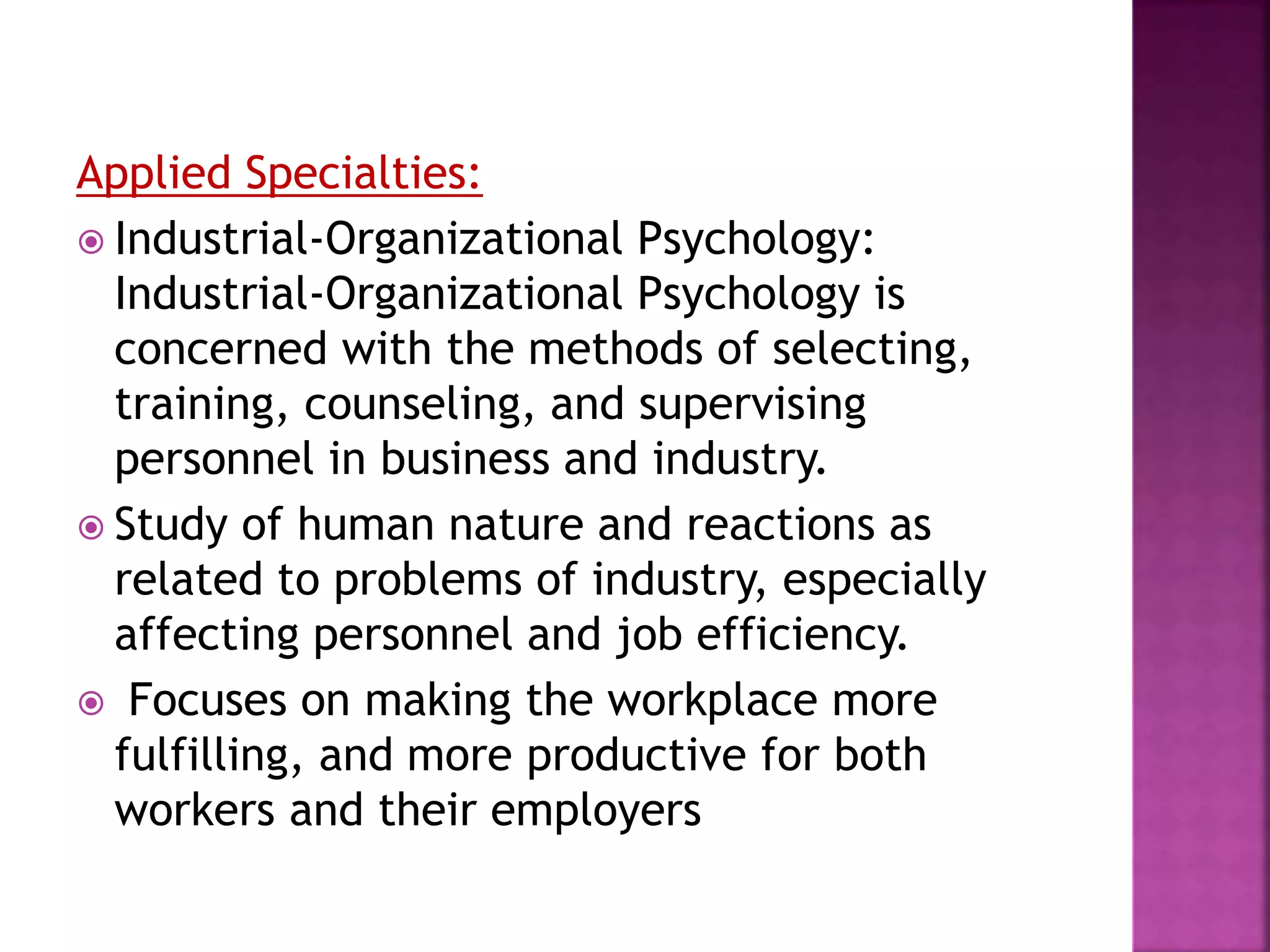
Applied Specialties:
 Industrial-Organizational Psychology:
Industrial-Organizational Psychology is
concerned with the methods of selecting,
training, counseling, and supervising
personnel in business and industry.
 Study of human nature and reactions as
related to problems of industry, especially
affecting personnel and job efficiency.
 Focuses on making the workplace more
fulfilling, and more productive for both
workers and their employers
 Guidance and Counseling Psychology:
Dedicated to helping people with
educational, job or career, and social
adjustments.
 Administration and interpretation of
psychological tests, such as intelligence,
achievement, and vocational tests.
 Mostly worked in schools as schools
counselors (more commonly known as
guidance counselors).
Military Psychology:
 It deals with war and other allied problems
School Psychology:
 Work with children to evaluate learning &
Emotional problems. Look to psychological
principles and techniques for help in
answering questions pertaining to how
children learn better with classmates of
about the same level of ability.
Clinical Psychology:
 Apply psychological principles to the
diagnosis and treatment of emotional &
behavioral problems
Forensic Psychology
 Forensic psychologists play a vital role in
identifying the psyche of the criminal, and
the purpose of crime, and also in
determining the quantum, and nature of
sentencing
 Identification of Sex-related differences in
brain function especially towards women
 The creation of biologically plausible
network models of human cognition
Criminal Psychology:
It deals with legal activities of Criminals and
witnesses.
It helps in deletion of crimes and in dealing
with criminals.
It helps criminals to understand their abnormal
behaviors and helps to change their behavior.
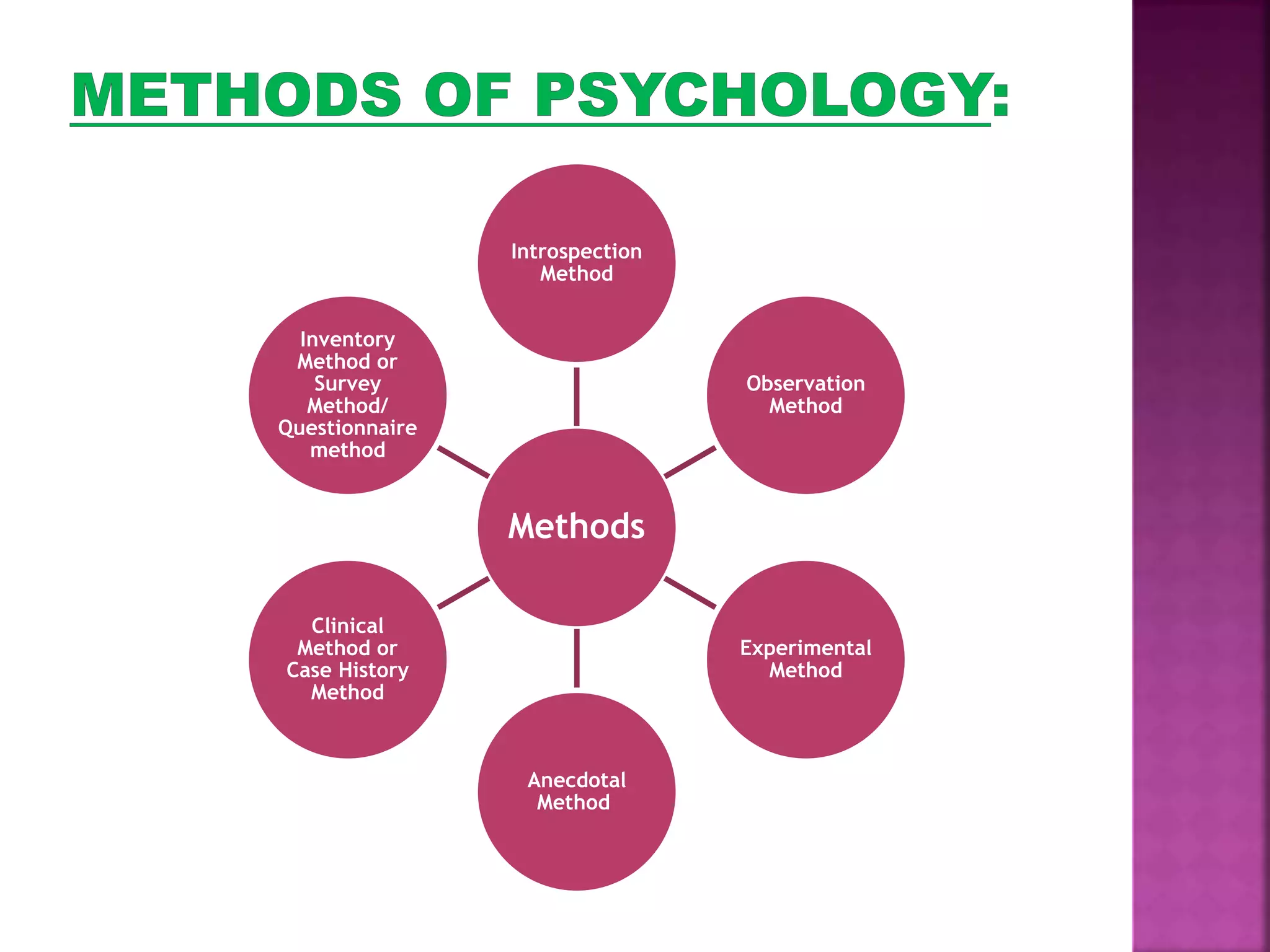
Methods
Introspection
Method
Observation
Method
Experimental
Method
Anecdotal
Method
Clinical
Method or
Case History
Method
Inventory
Method or
Survey
Method/
Questionnaire
method
1. Introspection Method :
 This is one of the methods of Psychology. This
method is also known as “Self- observation
method”.
 Introspection means to look within or “invalid
inspection of one’s own mind”, In this method,
an individual thinks, feels, observes and
experiences about his internal activities for
himself, others cannot be seems observes and
touched.
 For Eg: When a doctor ask a patient to detail
about his health problems, the patient tries to
recollect and explains about his difficulties and
current experience.
Merits:
 It is a cost effective method.
 It does not require any laboratory.
 We can get direct experiences about internal
activities.
 We can use this method at any time and any
place.
Demerits:
 This method cannot be used for small
children and animals.
2. Observation Method:
 This method is known as a Systematic
observation method.
 Observation means “Look at outside one’s self”.
 Observation method means observing behavior of
an individual by somebody.
 It is the collection of data by means of observing
behavior of an individual by more than two
persons.
 For Eg: A nurse is ask to make observational
report to a patient with undiagnosed illness. She
reports her observation on a patient such as
pulse rate, body temperature, B.P., facial
expression etc.
 This method can be used for small children and
animals.
Experimental Method
 This is one of the methods of Psychology. This method is
one of the most scientific and modern method of the
subject. The word experiment is derived from the Latin
word. ‘Experiments’ meaning ‘to try or put to test the
phenomenon or the subject. Hence, experiment is to try or
put to that the phenomenon on the subject.
 An experiment is defined as systematic observation under
controlled condition. It is an objective observation under
laboratory condition.
 Experimental method is a procedure based on
experimentation. It follows a set of rules and gives us
definite data.
 In Psychology, experimental method is used to study the
cause and effect relationship regarding the nature of
human beings. To study the cause and effect relationship,
the Psychologist used objective observations. Under
control conditions to observe behaviors shown by an
individual.
From this observations, certain conclusions or
drawn and establishes some principles.
Merits:
 This is one of the miost scientific method.
 It helps to find out cause and effect relationships
regarding the nature of human beings.
 Repetition is possible.
Demerits:
 Difficulties in controlling.
 We cannot perform experimental methods for all
the problems.
 It is costly method.
 Time consuming method.
Anecdotal Method
 a type of research method based on
personal recollections of a case, as opposed
to specific, empirically derived investigation.
Can provide ideas to fuel further research.
 A psychologist relying on the anecdotal
method reflects to his or her class on the
progress of the patients he or she is treating
makes.
4. Clinical Method or Case History Method:
 Clinical Psychologist and Psychiatrist are
using this method. The aim of the method is
used to study the services and causes of fears
of the people, anxieties, worries and social
maladjustment of the people.
 It consist of collecting all the information of
individuals past.
 It can be done by interviewing the individual
himself, his family members, his neighbors,
his relatives, his roommates, classmates,
teachers, who already known him.
 Documents like cumulative records, personal
diaries helps to know about his past life.
Merits:
 It can be a productive sources of ideas for
further investigations by other methods.
 It helps to solve the problems of the
individuals and suggest possible solutions.
Demerits:
 This method depends upon memory of
incidence which may have been observe in
accurately.
5. Inventory Method or Survey Method:
 This is one of the methods of Psychology. All
problems in Psychology cannot be solved by
experimental method or other methods. The
problems like the study of public opinion, the
study of public interest and attitudes etc. can be
studied by only survey method or inventory
method.
 Survey method values collecting a large numbers
of information from a large number of people by
using questionnaires and interviews.
 The result of survey method, a large number of
people have to be carefully analyzed before
conclusions are made.
 Psychology is a very diverse field, one that is expected to
see a tremendous career path in it.
the following characteristics of psychology can represents the
nature :
 A psychologist may offer treatment that focuses on
behavioural adaptations.
 Psychology uses scientific methods.
 A psychiatrist is a medical doctor who is more likely to
focus on medical management of mental health issues.
 There are different types of psychology, such as forensic,
cognitive, social, and developmental psychology.
 Psychology is the study of function and behaviour of the
mind.
 Psychology studies the facts of behaviour.
 A person with a condition that affects their mental health
may benefit from assessment and treatment with a
psychologist.
 Psychology discovers the cause – effect
relationship in human behavior.
 Psychology predicts human behavior.
 Psychology helps for re adjustment.
 The laws of psychology are universal.
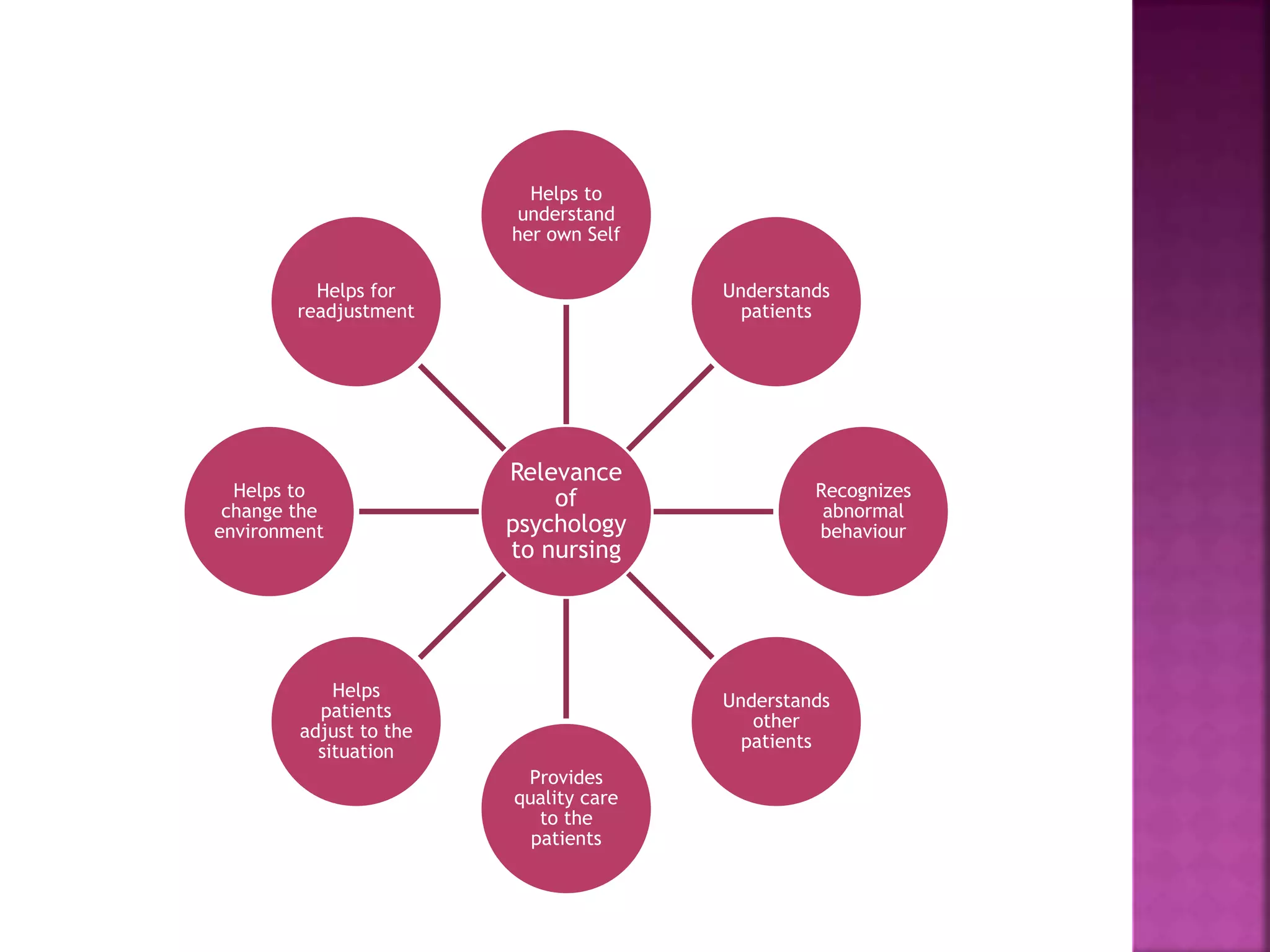
Relevance
of
psychology
to nursing
Helps to
understand
her own Self
Understands
patients
Recognizes
abnormal
behaviour
Understands
other
patients
Provides
quality care
to the
patients
Helps
patients
adjust to the
situation
Helps to
change the
environment
Helps for
readjustment
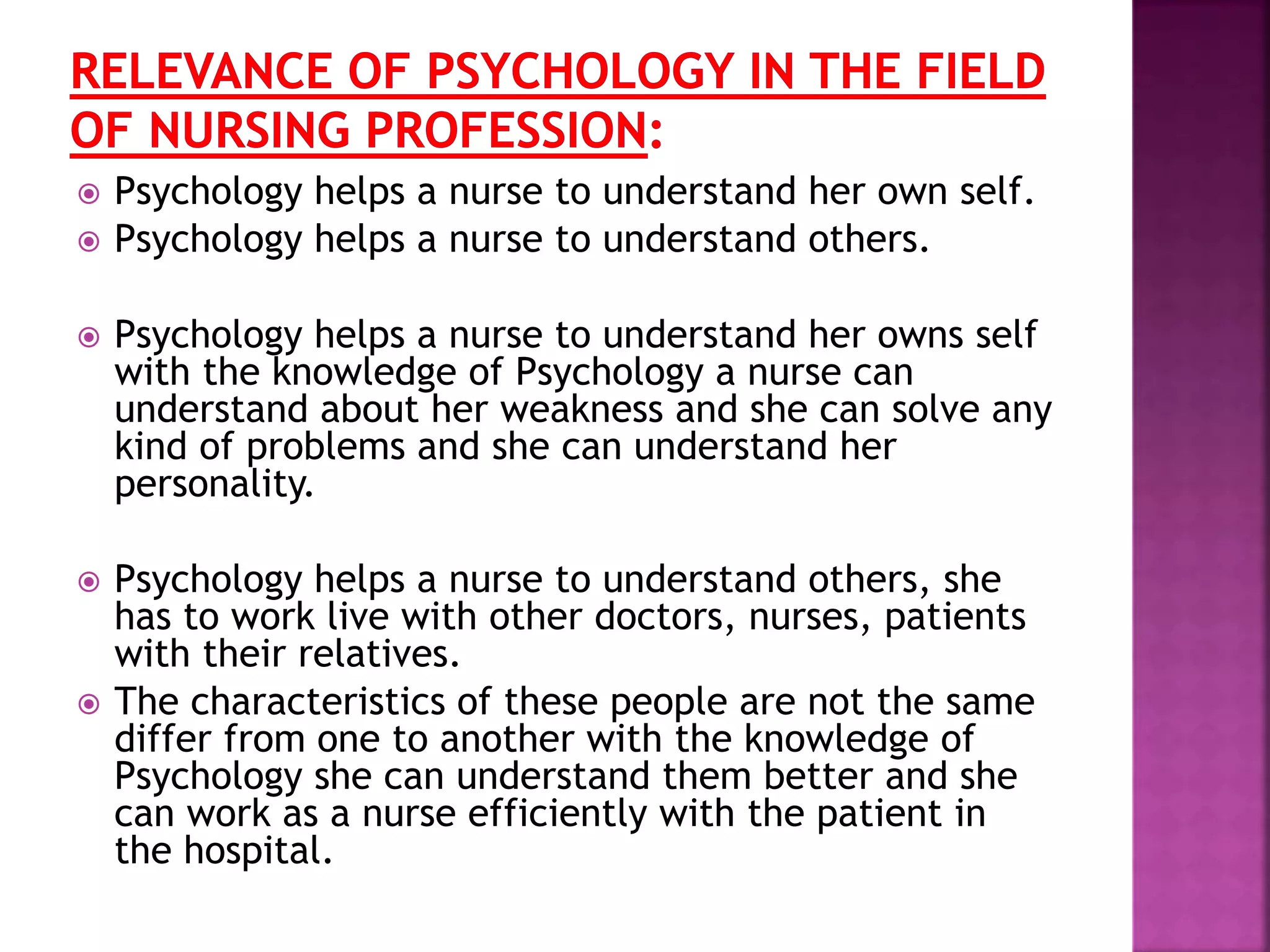
 Psychology helps a nurse to understand her own self.
 Psychology helps a nurse to understand others.
 Psychology helps a nurse to understand her owns self
with the knowledge of Psychology a nurse can
understand about her weakness and she can solve any
kind of problems and she can understand her
personality.
 Psychology helps a nurse to understand others, she
has to work live with other doctors, nurses, patients
with their relatives.
 The characteristics of these people are not the same
differ from one to another with the knowledge of
Psychology she can understand them better and she
can work as a nurse efficiently with the patient in
the hospital.
 Psychology helps a nurse to improve the situations by
helping others to solve the problems.
 Good understand of the patient by the nurse can
social supporter for the patients who are admitted to
hospitals.
 With the knowledge of Psychology she will become a
good health teacher to explain the causes of illness
and disease and suggest treatment for all patients
and the relatives.
 Psychology helps a nurse to understand the
relationships between body and mind.
 Psychology helps nurse have to behave as a common
man with the patient to known what are his feelings
or attitudes towards the life and his disease.
Long Essays;
1. Define Psychology and explain in detail about the methods of
Psychology.
2. Define Psychology. Explain its nature and Scope of Psychology.
Short Essays;
1. Explain any three branches of psychology.
2. Explain the nature of psychology.
3. Case study Method.
4. Relevance of psychology to Nursing.
5. Experimental method.
6. Discuss the scope of psychology.
7. Explain about different methods used in psychology.
Short Notes;
1. List branches of psychology
2. Case history method
3. Observation method
4. Define psychology
5. Experimental method
Thank You

Introduction to psychology

  • 1.
  • 2.
    At the endof this Chapter you should be able to:  Know the history and origin of Science of psychology  explain the nature of psychology and its definition;  describe the scope of psychology;  elaborate the basic psychological processes; and  explain the fields of psychology  Understand the relevance of Psychology to Nursing
  • 3.
     As humanbeings our curiosity drives us to know the reasons behind various events happening around us.  Whenever we meet somebody or see someone doing something we immediately try to understand as to why this person is doing this kind of activity.  Similarly we often try to understand our own experiences and behaviors in different situations.  The knowledge of psychology helps the health care professional to understand the situations and to react accordingly.
  • 4.
     In simplewords psychology is a systematic and scientific study of mental processes, experiences and behaviors - both overt and covert.  The word ‘psychology’ has its origin in two Greek words ‘psyche’ and ‘logos’.  The word ‘psyche’ in Greek language refers to ‘spirit’ or ‘soul’ and the word ‘logos’ refers to ‘discourse’ or ‘study’.  The term ‘psychology’, literally means the science of the soul.
  • 5.
     According tothe origin of the two Greek words Psychology is the study of Soul or Sprit. Soul is being Philosophical concept. it is an abstract cannot be seen observe and it is difficult to study even under microscopic condition. Hence this definition is rejected by the Psychologist.
  • 6.
     During earliertimes psychology was considered as a discipline which deals with the study of soul. It was called rational psychology.  But modern psychology is empirical, and does not deal with the problems relating to the soul.  It deals with mental process apart from the soul or mental substance.  It is the science of experience and behavior, which tells us how the mind works and behaves.  It can predict the behavior of an individual, and control it to a certain extent by putting him under proper conditions. It seeks to discover the laws of mind.
  • 7.
    Thus psychology dealswith the following: (1) Mental processes; (2) Their expressions in behavior, (3) Their concomitant to physiological processes; (4) Their external stimuli; (5) Animal behavior, human mind, normal behavior, and abnormal behavior; and (6) The peculiar traits and the objective products of collective behavior. These are the objects of psychological investigation.
  • 8.
     In theancient time, Psychology was considered to be a branch of Philosophy.  From hundred years onward Psychology has been separated from the subject of Philosophy because of increased number of experimental method by the Psychologists.  Now it is called as Independent science.
  • 9.
     Later, theAmerican Psychologist William James (1890)fused the word “mind” in the place of “Soul”. According to him Psychology is a study of mind, it has no definite body, shape, cannot be seen as observe and difficult to study the nature of Mind by the Psychologist. Hence this definition is also rejected by the Psychologist.
  • 10.
     Later, theGerman Psychologist William Wundt defined Psychology is the study of consciousness. It is a part of the mind and abstract. It is very difficult to study the nature of consciousness by the Psychologist. Hence, this definition is also rejected by the Psychologist.
  • 11.
     He hasstudied Human behaviour accurately through conducting his experiment on the object like patient and predicting his behaviour for all the Psychologist in his laboratory. Hence, all the Psychologist called him as a “Father of Psychology”.  Then, he defined his earlier definition as Psychology as the Science of the behaviour of Human beings.
  • 12.
     Later, theother Psychologist conducted an experiment on the object like cow and predicting behaviour of the cow. Then they defined Psychology as the science of behaviour of Human beings and Animals.
  • 13.
    Study of Soul Studyof Mind Study of Conscious experience Study of behaviour
  • 14.
     Psychology asthe ‘science of mental processes’. In his view, psychology may be defined in terms of conscious states. - 1892 William James  Psychology as the science of the ‘inner world’ as distinguished from physical science which study the physical phenomena. -1884 James Sully  Psychology as the science which studies the ‘internal experiences’. - 1892 Wilhelm Wundt
  • 15.
     In 1911W. B. Pillsbury also defined psychology as the ‘science of behaviour’. - 1905 William McDougall  Psychology as the “science of activities of the individual.” - R. S. Woodworth  Psychology may be defined as the science of experience and purposive behaviour of individuals who process the relevant information from the environment for satisfactory adjustment. The behaviour of an individual is not like that of a machine which is pre-set to react to incoming stimuli.
  • 16.
     Psychology isthe scientific study of mental processes and behaviour. It is study of mind and how it works. – Oxford Dictionary  Psychology is the science of human and animal behaviour which includes the application of this science to solve human behaviour. - W.Hamilton  Psyvhology is the scientific study of the human mind and its functions, especially those affecting behaviour in given context.
  • 17.
     As psychologyhas evolved as a science, its fields of specialization have multiplied and its educational and training requirements have become formalized.  Psychologists work in a variety of fields in academic and professional settings.  The scope of Psychology is very wide and vast.  It studies, describes and explains the behaviour of all living organisms which are created by Almighty (God).
  • 18.
     Behaviour isall activities of the human beings or organisms and all living organisms include Adolescents, adults, old aged people, students, teachers, parents, producers, consumers, official, clients, criminals, witnesses etc. are studied in Psychology.  When the Psychologist failed to study the behaviour of all these living organisms, for further convenience, they divided the scope of Psychology into two main branches such as Pure Psychology and Applied Psychology.
  • 19.
    (or subjects ofPsychology/ Branches of psychology) PURE PSYCHOLOGY APPLIED PSYCHOLOGY Abnormal Psychology Development Psychology Experimental Psychology General Psychology Geo Psychology Para Psychology Physiological Psychology Social Psychology Clinical Psychology Educational Psychology Industrial Psychology Legal Psychology Military Psychology Political Psychology
  • 20.
     Abnormal Psychology:It is branched under pure Psychology. It studies the behaviour of abnormal people and it also studies mental disorders, their causes and suggests treatment.  Development Psychology: It is a branch of pure Psychology. It studies growth and development and behaviour of an individual from the birth until his death. Further it is classified into three types such as –  Child Psychology  Adolescent Psychology  Adult and old aged Psychology
  • 21.
     Experimental Psychology:It studies the ways and means of carrying our Psychological experiments by using scientific methods. Experimental Psychologist do basic research in an effort to discover and understand the fundamental causes of human behaviour.  General Psychology: It is a branch of Pure Psychology. It deals with the fundamental rules, principles and theories of Psychology in relation to the study of behaviour of normal adult.
  • 22.
     Geo Psychology:It is a branch of Pure Psychology. It describes and explains the relation of Physical environment, particularly the weather, climate, soil with behaviour.  Para Psychology: It is a branch of Pure Psychology. It deals with extra sensory perceptions, causes of rebirth, telepathy and allied problems.
  • 23.
     Physiological Psychology:It describes and explains the biological and physiological basis of behavior of an individual. It also studies the structure and functions of sense organs, nervous system, muscle, glands and its underlying behavior.  Social Psychology: It is a branch of pure Psychology. It studies the behaviour of an individual in relation to the society.
  • 24.
     Clinical Psychology:It is a branch of applied Psychology, it studies the causes of mental illness, abnormal behaviour of the patient and suggests treatment and effective adjustment of affected person in the society.  Educational Psychology: It is a branch of applied Psychology, it tries to apply Psychological principles, theories and techniques for the behaviour of human being in the field of education.
  • 25.
     Industrial Psychology:It is a branch of applied Psychology, it studies Psychological principles, theories and techniques for the study of human behaviour in the field of Industry.  Legal Psychology: It is a branch of applied Psychology, it tries to apply Psychological principles, theories and techniques with the behaviour of person’s like clients, criminals, witnesses etc.
  • 26.
     Military Psychology:It is a branch of applied Psychology, it tries to apply Psychological principles, theories and techniques for study of human behavior in the field of Military science.  Political Psychology: It is a branch of applied Psychology, it tries to apply Psychological principles, theories and techniques for the study of human behavior in the field of political science.
  • 27.
    Psychologist can beclassified in one of the three categories:  Practitioners: Psychologists who use their knowledge of psychology to aid individuals or groups by providing certain services, often in the from of Psychotherapy or Counseling.  Academicians: The are employed in colleges and universities and typically engaged in teaching and research.  Researcher: The are employed in agencies and industries where they examine diverse such as effect of toxic environmental substances on process of learning and memory.
  • 28.
    Research Specialties: The ExperimentalPsychology: is a branch aims at understanding the fundamental causes of behaviour. Study basic psychological processes as sensation, perception, learning, memory, cognition, motivation, and emotion. Work mostly in the laboratory and may use animals as well as human beings in their research. Study how people learn everything from simple tasks such as sitting upright to more complex things such as emotions and language.
  • 29.
    Physiological Psychology: The branchof psychology that studies the connection between the nervous and endocrine system and behavior. Developmental Psychology: Concerns itself with the study of human behaviour in all its aspects of growth and development Also known as Genetic Psychology Involves the development of an individual in terms of stages.
  • 30.
    Personality Psychology: It isstudy of individual differences in behaviour, the sources of the consequences of such differences, and the degree of consistency of characteristics within the individual across situations and overtime. Cognitive Psychology: It investigates all aspects of cognition-memory, thinking, reasoning, language, decision making and so on. Social Psychology: Study of the behavior of groups of individuals in their relationship to other groups
  • 31.
    Animal Psychology: It isalso called comparative psychology because it compares human psychology and animal psychology. Animals psychology is useful for understanding the human behaviour also. Psychometric Psychology: It is concerned with the tests and inventories for the measurement of human capacities and abilities.
  • 32.
    Educational Psychology: A fieldof specialization that deals with learning, motivation, and other subjects in the actual educational process together with the practical application of psychological principles to education. Abnormal Psychology: Scientific study of human and the etiology or cause of personal defects, or human’s behavior which deviates from the average reaction, hence abnormal.
  • 33.
    Applied Specialties:  Industrial-OrganizationalPsychology: Industrial-Organizational Psychology is concerned with the methods of selecting, training, counseling, and supervising personnel in business and industry.  Study of human nature and reactions as related to problems of industry, especially affecting personnel and job efficiency.  Focuses on making the workplace more fulfilling, and more productive for both workers and their employers
  • 34.
     Guidance andCounseling Psychology: Dedicated to helping people with educational, job or career, and social adjustments.  Administration and interpretation of psychological tests, such as intelligence, achievement, and vocational tests.  Mostly worked in schools as schools counselors (more commonly known as guidance counselors). Military Psychology:  It deals with war and other allied problems
  • 35.
    School Psychology:  Workwith children to evaluate learning & Emotional problems. Look to psychological principles and techniques for help in answering questions pertaining to how children learn better with classmates of about the same level of ability. Clinical Psychology:  Apply psychological principles to the diagnosis and treatment of emotional & behavioral problems
  • 36.
    Forensic Psychology  Forensicpsychologists play a vital role in identifying the psyche of the criminal, and the purpose of crime, and also in determining the quantum, and nature of sentencing  Identification of Sex-related differences in brain function especially towards women  The creation of biologically plausible network models of human cognition
  • 37.
    Criminal Psychology: It dealswith legal activities of Criminals and witnesses. It helps in deletion of crimes and in dealing with criminals. It helps criminals to understand their abnormal behaviors and helps to change their behavior.
  • 38.
  • 39.
    1. Introspection Method:  This is one of the methods of Psychology. This method is also known as “Self- observation method”.  Introspection means to look within or “invalid inspection of one’s own mind”, In this method, an individual thinks, feels, observes and experiences about his internal activities for himself, others cannot be seems observes and touched.  For Eg: When a doctor ask a patient to detail about his health problems, the patient tries to recollect and explains about his difficulties and current experience.
  • 40.
    Merits:  It isa cost effective method.  It does not require any laboratory.  We can get direct experiences about internal activities.  We can use this method at any time and any place. Demerits:  This method cannot be used for small children and animals.
  • 41.
    2. Observation Method: This method is known as a Systematic observation method.  Observation means “Look at outside one’s self”.  Observation method means observing behavior of an individual by somebody.  It is the collection of data by means of observing behavior of an individual by more than two persons.  For Eg: A nurse is ask to make observational report to a patient with undiagnosed illness. She reports her observation on a patient such as pulse rate, body temperature, B.P., facial expression etc.  This method can be used for small children and animals.
  • 42.
    Experimental Method  Thisis one of the methods of Psychology. This method is one of the most scientific and modern method of the subject. The word experiment is derived from the Latin word. ‘Experiments’ meaning ‘to try or put to test the phenomenon or the subject. Hence, experiment is to try or put to that the phenomenon on the subject.  An experiment is defined as systematic observation under controlled condition. It is an objective observation under laboratory condition.  Experimental method is a procedure based on experimentation. It follows a set of rules and gives us definite data.  In Psychology, experimental method is used to study the cause and effect relationship regarding the nature of human beings. To study the cause and effect relationship, the Psychologist used objective observations. Under control conditions to observe behaviors shown by an individual.
  • 43.
    From this observations,certain conclusions or drawn and establishes some principles. Merits:  This is one of the miost scientific method.  It helps to find out cause and effect relationships regarding the nature of human beings.  Repetition is possible. Demerits:  Difficulties in controlling.  We cannot perform experimental methods for all the problems.  It is costly method.  Time consuming method.
  • 44.
    Anecdotal Method  atype of research method based on personal recollections of a case, as opposed to specific, empirically derived investigation. Can provide ideas to fuel further research.  A psychologist relying on the anecdotal method reflects to his or her class on the progress of the patients he or she is treating makes.
  • 45.
    4. Clinical Methodor Case History Method:  Clinical Psychologist and Psychiatrist are using this method. The aim of the method is used to study the services and causes of fears of the people, anxieties, worries and social maladjustment of the people.  It consist of collecting all the information of individuals past.  It can be done by interviewing the individual himself, his family members, his neighbors, his relatives, his roommates, classmates, teachers, who already known him.  Documents like cumulative records, personal diaries helps to know about his past life.
  • 46.
    Merits:  It canbe a productive sources of ideas for further investigations by other methods.  It helps to solve the problems of the individuals and suggest possible solutions. Demerits:  This method depends upon memory of incidence which may have been observe in accurately.
  • 47.
    5. Inventory Methodor Survey Method:  This is one of the methods of Psychology. All problems in Psychology cannot be solved by experimental method or other methods. The problems like the study of public opinion, the study of public interest and attitudes etc. can be studied by only survey method or inventory method.  Survey method values collecting a large numbers of information from a large number of people by using questionnaires and interviews.  The result of survey method, a large number of people have to be carefully analyzed before conclusions are made.
  • 48.
     Psychology isa very diverse field, one that is expected to see a tremendous career path in it. the following characteristics of psychology can represents the nature :  A psychologist may offer treatment that focuses on behavioural adaptations.  Psychology uses scientific methods.  A psychiatrist is a medical doctor who is more likely to focus on medical management of mental health issues.  There are different types of psychology, such as forensic, cognitive, social, and developmental psychology.  Psychology is the study of function and behaviour of the mind.  Psychology studies the facts of behaviour.  A person with a condition that affects their mental health may benefit from assessment and treatment with a psychologist.
  • 49.
     Psychology discoversthe cause – effect relationship in human behavior.  Psychology predicts human behavior.  Psychology helps for re adjustment.  The laws of psychology are universal.
  • 51.
    Relevance of psychology to nursing Helps to understand herown Self Understands patients Recognizes abnormal behaviour Understands other patients Provides quality care to the patients Helps patients adjust to the situation Helps to change the environment Helps for readjustment
  • 52.
     Psychology helpsa nurse to understand her own self.  Psychology helps a nurse to understand others.  Psychology helps a nurse to understand her owns self with the knowledge of Psychology a nurse can understand about her weakness and she can solve any kind of problems and she can understand her personality.  Psychology helps a nurse to understand others, she has to work live with other doctors, nurses, patients with their relatives.  The characteristics of these people are not the same differ from one to another with the knowledge of Psychology she can understand them better and she can work as a nurse efficiently with the patient in the hospital.
  • 53.
     Psychology helpsa nurse to improve the situations by helping others to solve the problems.  Good understand of the patient by the nurse can social supporter for the patients who are admitted to hospitals.  With the knowledge of Psychology she will become a good health teacher to explain the causes of illness and disease and suggest treatment for all patients and the relatives.  Psychology helps a nurse to understand the relationships between body and mind.  Psychology helps nurse have to behave as a common man with the patient to known what are his feelings or attitudes towards the life and his disease.
  • 54.
    Long Essays; 1. DefinePsychology and explain in detail about the methods of Psychology. 2. Define Psychology. Explain its nature and Scope of Psychology. Short Essays; 1. Explain any three branches of psychology. 2. Explain the nature of psychology. 3. Case study Method. 4. Relevance of psychology to Nursing. 5. Experimental method. 6. Discuss the scope of psychology. 7. Explain about different methods used in psychology. Short Notes; 1. List branches of psychology 2. Case history method 3. Observation method 4. Define psychology 5. Experimental method
  • 55.