
Nursing process
Implementation
Prof Nagamani.T
Introduction
 The fourth phase of the nursing process is the
implementation phase. This phase is when nurses
initiate the interventions established during the
planning phase.
 After the nursing assessment is performed, nursing
diagnoses are established, and a care plan is
developed, the plan must be initiated.
 All phases of the nursing process are essential.
 The implementation phase of the nursing process is
an ongoing process in patient care.
Meaning
 The implementation phase of the nursing process is
when the nurse puts the treatment plan into effect. It
involves action or doing and the actual carrying out of
nursing interventions outlined in the plan of care. This
typically begins with the medical staff conducting any
needed medical interventions.
 A taxonomy of nursing interventions referred to as
the Nursing Interventions Classification
(NIC) taxonomy, was developed by the Iowa
Intervention Project, in addition to the efforts of
NANDA-I to standardize the language for describing
problems. The nurse can look up a client’s nursing
diagnosis to see which nursing interventions are
recommended.
 Implementation involves a focus on accomplishing
predetermined goals and continuous progress
toward achieving desired outcomes.
 This phase of the nursing process involves
prioritizing nursing interventions, assessing patient
safety during nursing interventions, delegating
interventions when appropriate, and documenting all
interventions performed.
The following are three of the top reasons why the
implementation phase is so important.
 1. Implementation of the nursing process is significant
because it involves action on the nurse's part to
promote positive patient outcomes. Conversely, if the
care plan is not implemented, there is a lack of nursing
care, negatively impacting patient outcomes.
2. When the nursing care plan is implemented
(implementation phase), nurses can begin to gauge
patient responses to interventions.
3. Implementation supports continuity of care. Care
begins from the first patient encounter and continues
until discharge.
Objectives Of The Implementation Phase
 1. Ongoing Assessment: The nursing care plan is
developed based on data from the initial nursing
assessment.
 2. Establishing Priorities: Utilizing data from initial and
going assessments, the nurse then establishes priorities for
implementing care.
 3. Allocating Resources: Before implementing nursing
interventions, the nurse must review proposed interventions
and determine the skills and knowledge level required to
safely and effectively implement them.
 4. Initiating Nursing Interventions: After verifying priorities
and determining resources, the nurse can initiate nursing
interventions.
 5. Documenting Interventions and Patient Response:
 Nurses are legally obligated to document all interventions
and any observations concerning the patient's response to
those interventions.
Skills Required For The Implementation Phase
 Nurses must have psychomotor, interpersonal, and
cognitive skills as these serve as competencies
through which high-quality nursing care is delivered.
 Psychomotor skills are necessary to safely perform
nursing activities such as handling medical
equipment competently.
 Interpersonal skills help nurses establish therapeutic
nurse-patient relationships and promote
interdisciplinary collaboration.
 Cognitive skills are necessary to help the nurse
understand the rationale for proposed interventions
and make appropriate observations.
Process of Implementing
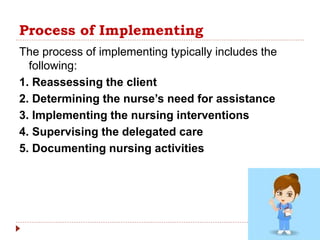
The process of implementing typically includes the
following:
1. Reassessing the client
2. Determining the nurse’s need for assistance
3. Implementing the nursing interventions
4. Supervising the delegated care
5. Documenting nursing activities
Process of Implementing
1. Reassessing the client
 Prior to implementing an intervention, the nurse must
reassess the client to make sure the intervention is still
needed. Even if an order is written on the care plan, the
client’s condition may have changed.
2. Determining the nurse’s need for assistance
 Other nursing tasks or activities may also be performed
by non-RN members of the healthcare team. The nurse
may need assistance when implementing some nursing
intervention, such as ambulating an unsteady obese
client, repositioning a client, or when a nurse is not
familiar with a particular model of traction equipment
needs assistance the first time it is applied.
3. Implementing the nursing interventions
 Nurses must not only have a substantial knowledge
base of the sciences, nursing theory, nursing
practice, and legal parameters of nursing
interventions but also must have the psychomotor
skills to implement procedures safely. It is necessary
for nurses to describe, explain, and clarify to the
client what interventions will be done, what
sensations to anticipate, what the client is expected
to do, and what the expected outcome is. When
implementing care, nurses perform activities that
may be independent, dependent, or interdependent.
Nursing Intervention Categories
 Nursing interventions are grouped into three
categories according to the role of the healthcare
professional involved in the patient’s care:
 Independent Nursing Interventions
 Dependent Nursing Interventions
 Interdependent Nursing Interventions
Independent Nursing Interventions
 A registered nurse can perform independent
interventions on their own without the help or
assistance from other medical personnel, such as:
 routine nursing tasks such as checking vital signs
 educating a patient on the importance of their
medication so they can administer it as prescribed
Dependent Nursing Interventions
 A nurse cannot initiate dependent interventions
alone. Some actions require guidance or supervision
from a physician or other medical professional, such
as:
 prescribing new medication
 inserting and removing a urinary catheter
 providing diet
 Implementing wound or bladder irrigations
Interdependent Nursing Interventions
 A nurse performs as part of collaborative or
interdependent interventions that involve team
members across disciplines.
 In some cases, such as post-surgery, the patient’s
recovery plan may require prescription medication
from a physician, feeding assistance from a nurse,
and treatment by a physical therapist or occupational
therapist.
 The physician may prescribe a specific diet to a
patient. The nurse includes diet counseling in the
patient care plan. To aid the patient, even more, the
nurse enlists the help of the dietician that is available
in the facility.
4. Supervising the delegated care
 Delegate specific nursing interventions to other
members of the nursing team as appropriate.
Consider the capabilities and limitations of the
members of the nursing team and supervise the
performance of the nursing interventions. Deciding
whether delegation is indicated is another activity
that arises during the nursing process.
 The American Nurses Association and the National
Council of State Boards of Nursing (2006) define
delegation as “the process for a nurse to direct
another person to perform nursing tasks and
activities.” It generally concerns the appointment of
the performance of activities or tasks associated with
patient care to unlicensed assistive personnel while
retaining accountability for the outcome.
5. Documenting nursing activities
 Record what has been done as well as the patient’s
responses to nursing interventions precisely and
concisely.
Keep Watching……

Implementation.pptx

  • 1.
  • 2.
    Introduction  The fourthphase of the nursing process is the implementation phase. This phase is when nurses initiate the interventions established during the planning phase.  After the nursing assessment is performed, nursing diagnoses are established, and a care plan is developed, the plan must be initiated.  All phases of the nursing process are essential.  The implementation phase of the nursing process is an ongoing process in patient care.
  • 3.
    Meaning  The implementationphase of the nursing process is when the nurse puts the treatment plan into effect. It involves action or doing and the actual carrying out of nursing interventions outlined in the plan of care. This typically begins with the medical staff conducting any needed medical interventions.  A taxonomy of nursing interventions referred to as the Nursing Interventions Classification (NIC) taxonomy, was developed by the Iowa Intervention Project, in addition to the efforts of NANDA-I to standardize the language for describing problems. The nurse can look up a client’s nursing diagnosis to see which nursing interventions are recommended.
  • 4.
     Implementation involvesa focus on accomplishing predetermined goals and continuous progress toward achieving desired outcomes.  This phase of the nursing process involves prioritizing nursing interventions, assessing patient safety during nursing interventions, delegating interventions when appropriate, and documenting all interventions performed.
  • 5.
    The following arethree of the top reasons why the implementation phase is so important.  1. Implementation of the nursing process is significant because it involves action on the nurse's part to promote positive patient outcomes. Conversely, if the care plan is not implemented, there is a lack of nursing care, negatively impacting patient outcomes. 2. When the nursing care plan is implemented (implementation phase), nurses can begin to gauge patient responses to interventions. 3. Implementation supports continuity of care. Care begins from the first patient encounter and continues until discharge.
  • 6.
    Objectives Of TheImplementation Phase  1. Ongoing Assessment: The nursing care plan is developed based on data from the initial nursing assessment.  2. Establishing Priorities: Utilizing data from initial and going assessments, the nurse then establishes priorities for implementing care.  3. Allocating Resources: Before implementing nursing interventions, the nurse must review proposed interventions and determine the skills and knowledge level required to safely and effectively implement them.  4. Initiating Nursing Interventions: After verifying priorities and determining resources, the nurse can initiate nursing interventions.  5. Documenting Interventions and Patient Response:  Nurses are legally obligated to document all interventions and any observations concerning the patient's response to those interventions.
  • 7.
    Skills Required ForThe Implementation Phase  Nurses must have psychomotor, interpersonal, and cognitive skills as these serve as competencies through which high-quality nursing care is delivered.  Psychomotor skills are necessary to safely perform nursing activities such as handling medical equipment competently.  Interpersonal skills help nurses establish therapeutic nurse-patient relationships and promote interdisciplinary collaboration.  Cognitive skills are necessary to help the nurse understand the rationale for proposed interventions and make appropriate observations.
  • 8.
    Process of Implementing Theprocess of implementing typically includes the following: 1. Reassessing the client 2. Determining the nurse’s need for assistance 3. Implementing the nursing interventions 4. Supervising the delegated care 5. Documenting nursing activities
  • 9.
    Process of Implementing 1.Reassessing the client  Prior to implementing an intervention, the nurse must reassess the client to make sure the intervention is still needed. Even if an order is written on the care plan, the client’s condition may have changed. 2. Determining the nurse’s need for assistance  Other nursing tasks or activities may also be performed by non-RN members of the healthcare team. The nurse may need assistance when implementing some nursing intervention, such as ambulating an unsteady obese client, repositioning a client, or when a nurse is not familiar with a particular model of traction equipment needs assistance the first time it is applied.
  • 10.
    3. Implementing thenursing interventions  Nurses must not only have a substantial knowledge base of the sciences, nursing theory, nursing practice, and legal parameters of nursing interventions but also must have the psychomotor skills to implement procedures safely. It is necessary for nurses to describe, explain, and clarify to the client what interventions will be done, what sensations to anticipate, what the client is expected to do, and what the expected outcome is. When implementing care, nurses perform activities that may be independent, dependent, or interdependent.
  • 11.
    Nursing Intervention Categories Nursing interventions are grouped into three categories according to the role of the healthcare professional involved in the patient’s care:  Independent Nursing Interventions  Dependent Nursing Interventions  Interdependent Nursing Interventions
  • 12.
    Independent Nursing Interventions A registered nurse can perform independent interventions on their own without the help or assistance from other medical personnel, such as:  routine nursing tasks such as checking vital signs  educating a patient on the importance of their medication so they can administer it as prescribed
  • 13.
    Dependent Nursing Interventions A nurse cannot initiate dependent interventions alone. Some actions require guidance or supervision from a physician or other medical professional, such as:  prescribing new medication  inserting and removing a urinary catheter  providing diet  Implementing wound or bladder irrigations
  • 14.
    Interdependent Nursing Interventions A nurse performs as part of collaborative or interdependent interventions that involve team members across disciplines.  In some cases, such as post-surgery, the patient’s recovery plan may require prescription medication from a physician, feeding assistance from a nurse, and treatment by a physical therapist or occupational therapist.  The physician may prescribe a specific diet to a patient. The nurse includes diet counseling in the patient care plan. To aid the patient, even more, the nurse enlists the help of the dietician that is available in the facility.
  • 15.
    4. Supervising thedelegated care  Delegate specific nursing interventions to other members of the nursing team as appropriate. Consider the capabilities and limitations of the members of the nursing team and supervise the performance of the nursing interventions. Deciding whether delegation is indicated is another activity that arises during the nursing process.  The American Nurses Association and the National Council of State Boards of Nursing (2006) define delegation as “the process for a nurse to direct another person to perform nursing tasks and activities.” It generally concerns the appointment of the performance of activities or tasks associated with patient care to unlicensed assistive personnel while retaining accountability for the outcome.
  • 16.
    5. Documenting nursingactivities  Record what has been done as well as the patient’s responses to nursing interventions precisely and concisely.
  • 17.