ADVANCE CONCEPTS IN
NURSING
INTRODUCTION TO
NURSING PROCESS
LEARNING OUTCOMES
 Discuss the concepts and theories that underpin the
process of nursing.
 Formulate nursing diagnosis on actual and potential
patient’s problems.
 Plan and document appropriate patient’s goals and
interventions with the collaboration of patient, family
and the multidisciplinary team.
 Implement the Nursing Care Plan.
 Evaluate and reassess each component of the Nursing
Care Plan appropriately.
 Educate patients and their families during their stay at
hospital and at the time of discharge.
 Demonstrate appropriate communication skills and
interaction skills with patients, families and colleagues.
THE NURSING PROCESS IS:
 A systematic, rational method of planning and providing
individualized nursing care.
 An organized, systematic method of giving individualized
nursing care that focuses on identifying and treating unique
responses of individuals or groups to actual-(Alfaro)
 Nursing is the protection, promotion, and
optimization of health and abilities, prevention of
illness and injury, alleviation of suffering through
the diagnosis and treatment of human responses,
and advocacy in the care of individuals, families,
communities, and populations. (ANA)
CHARACTERISTICS OF NP
• A problem-solving method
• Systematic, goal-directed, flexible, rational approach
• Ensures consistent, continuous, quality nursing care
• Provides a basis for professional accountability
• Utilizes critical thinking processes
CHARACTERISTICS:
a) Systematic
 The nursing process has an ordered sequence of activities and each
activity depends on the accuracy of the activity that precedes it and
influences the activity following it.
b) Dynamic
 The nursing process has great interaction and overlapping among the
activities and each activity is fluid and flows into the next activity
c) Interpersonal
 The nursing process ensures that nurses are client-centered rather than
task-centered and encourages them to work to enhance client’s
strengths and meet human needs
d) Goal-directed
 The nursing process is a means for nurses and clients to work together
to identify specific goals (wellness promotion, disease and illness
prevention, health restoration, coping and altered functioning) that are
most important to the client, and to match them with the appropriate
nursing actions
e) Universally applicable
 The nursing process allows nurses to practice nursing with well or ill
people, young or old, in any type of practice setting
BACK
GROUND
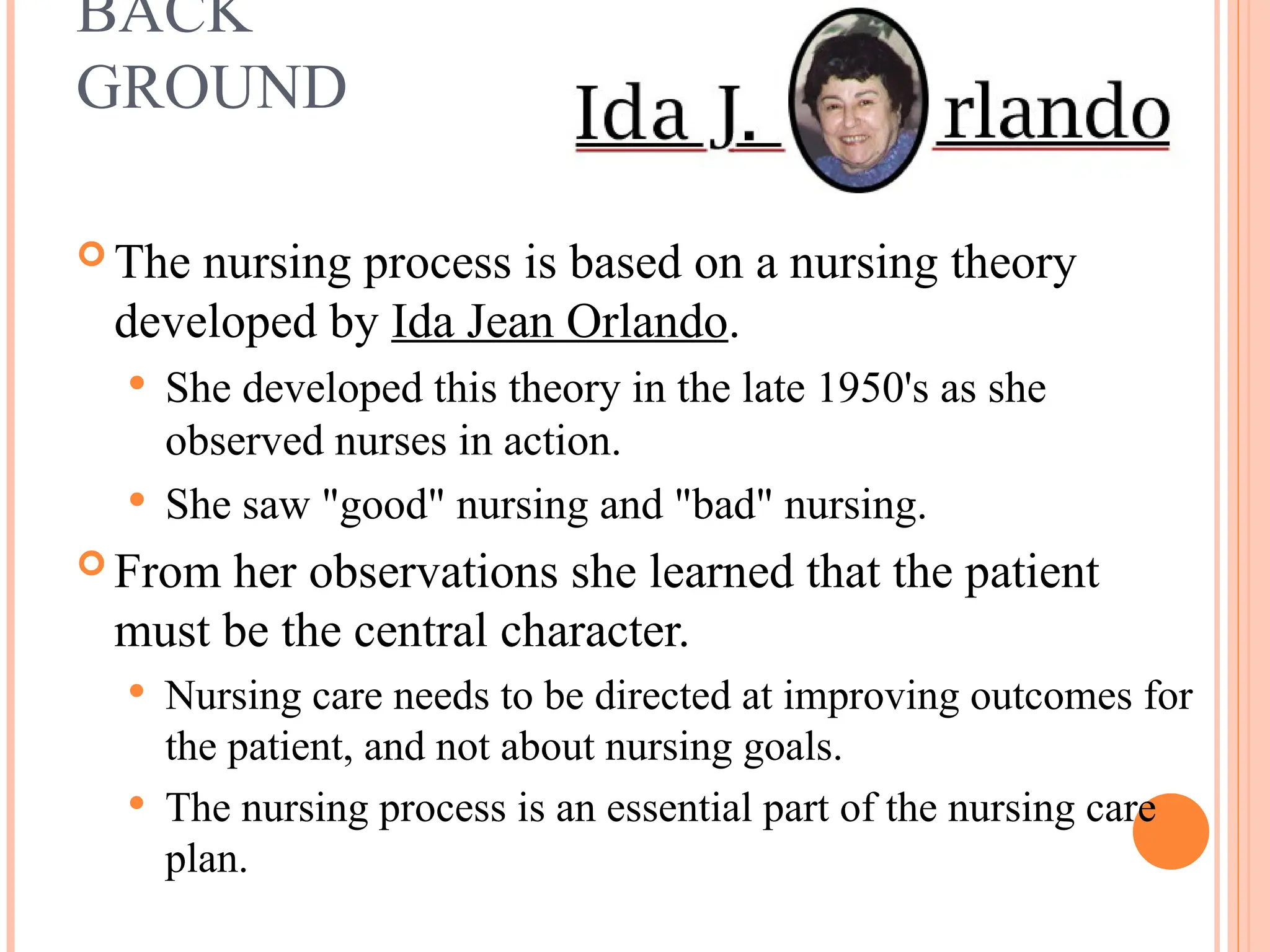
 The nursing process is based on a nursing theory
developed by Ida Jean Orlando.
 She developed this theory in the late 1950's as she
observed nurses in action.
 She saw "good" nursing and "bad" nursing.
 From her observations she learned that the patient
must be the central character.
 Nursing care needs to be directed at improving outcomes for
the patient, and not about nursing goals.
 The nursing process is an essential part of the nursing care
plan.
BACK GROUND OF NURSING
PROCESS
 The original concept of the nursing process was introduced in
the 1950s as a three-step process of
 Assessment, Planning, and Evaluation
 Based on the scientific method of
 Observing, Measuring, Gathering data, and Analyzing the
findings.
 Over time, became part of the;
 Conceptual framework of all nursing curricula and
 Included in the legal definition of nursing in the nurse
practice acts of most states.
 After years of study, use, and refinement, the three step
process was expanded into five steps.
ADVANTAGES OF NURSING
PROCESS
 Provides individualized
care
 Client is an active
participant
 Promotes continuity of
care
 Provides more effective
communication among
nurses and healthcare
professionals
 Develops a clear and
efficient plan of care
 Provides personal
satisfaction as you see
client achieve goals
 Professional growth as
you evaluate
effectiveness of your
interventions
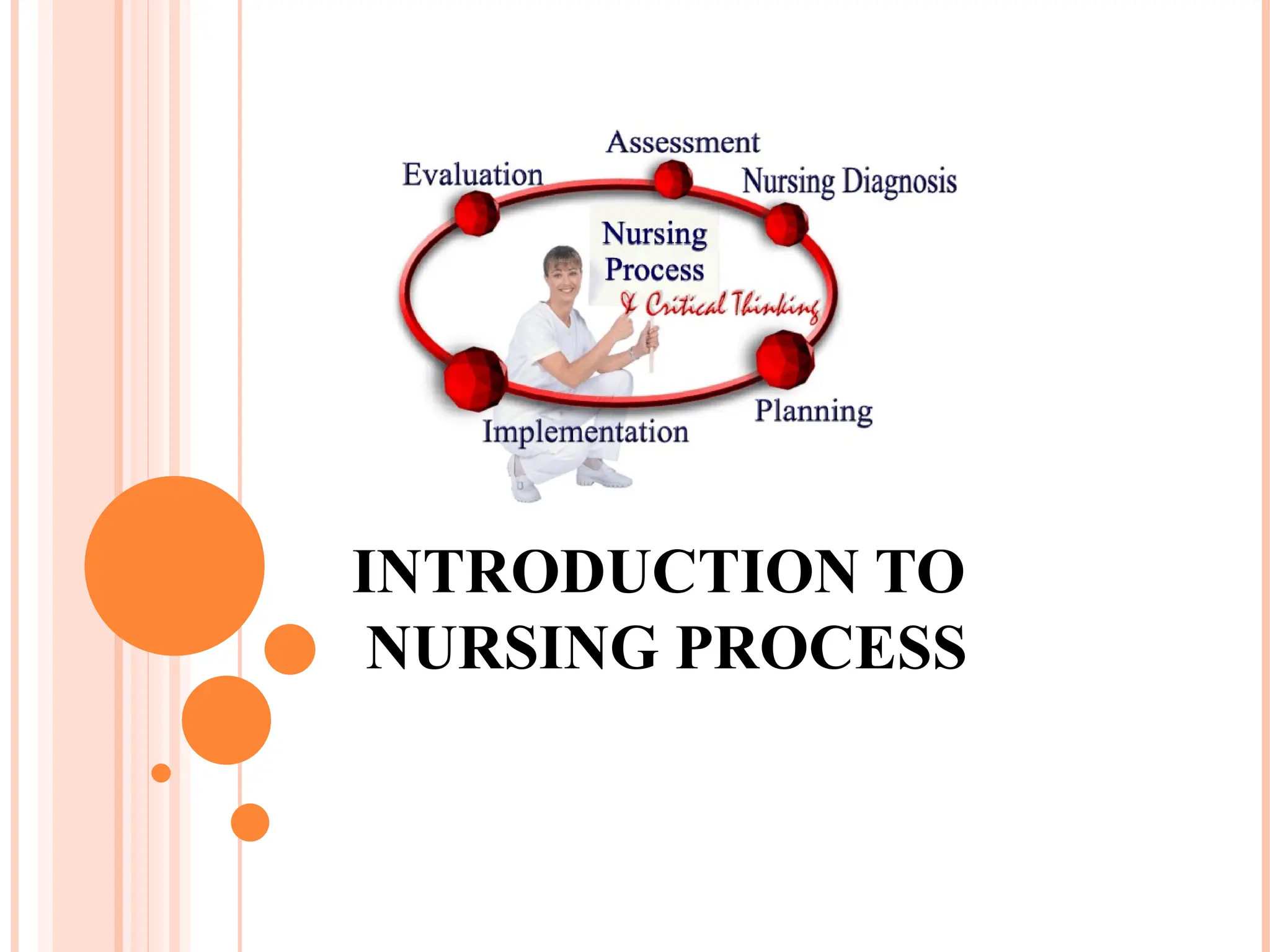
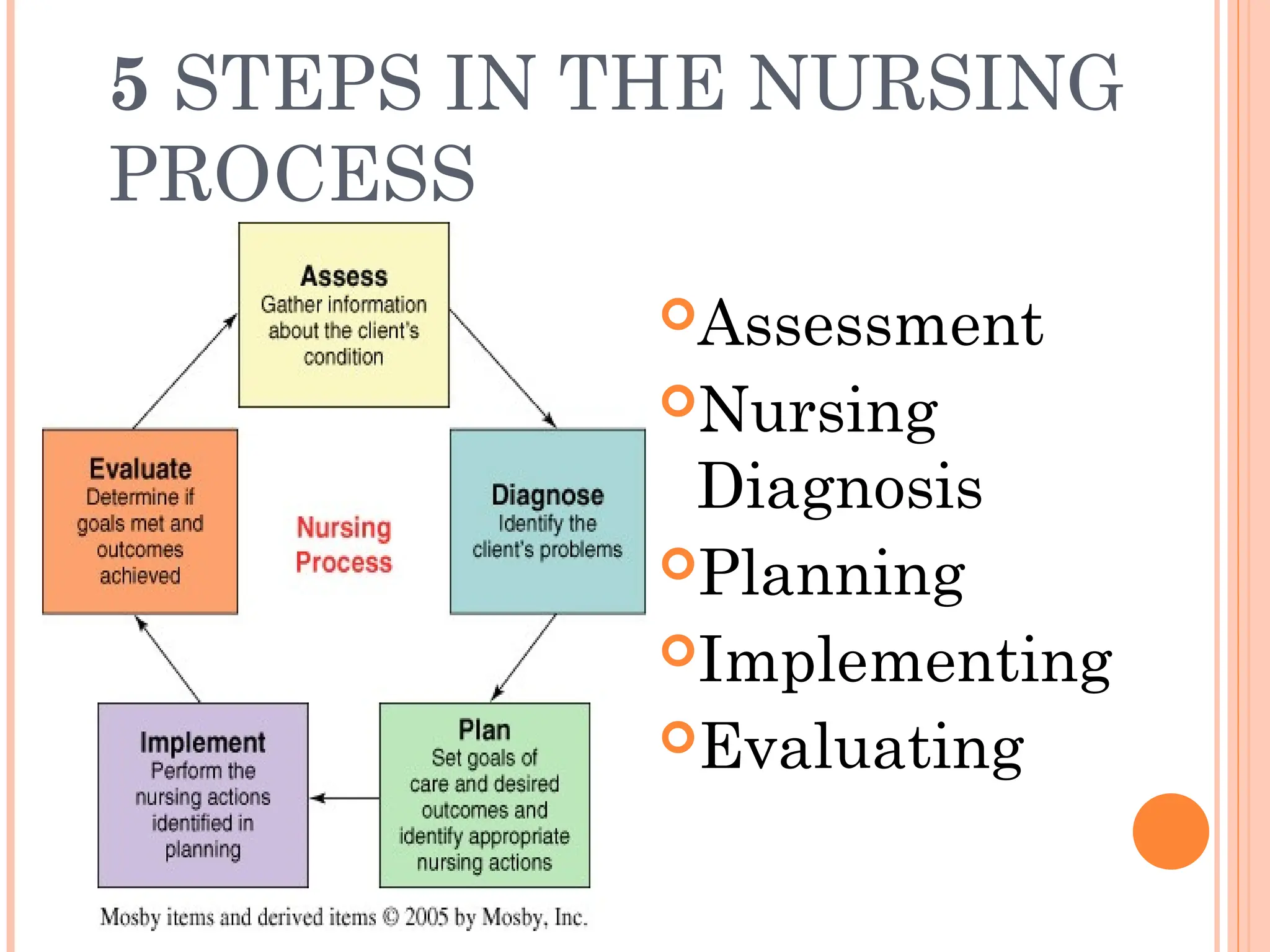
5 STEPS IN THE NURSING
PROCESS
Assessment
Nursing
Diagnosis
Planning
Implementing
Evaluating
1ST
COMPONENT OF THE NURSING
PROCESS- ASSESSMENT:
 The first step, or phase, of the nursing process is
assessment.
 During this phase, you are collecting data (factual
information) from several sources.
 The collection and organization of these data allow to:
 Determine the patient’s current health status.
 Determine the patient’s strengths and problem areas
(both actual and potential).
 Prepare for the second step of the process—diagnosis.
1ST
COMPONENT OF THE NURSING
PROCESS- ASSESSMENT:
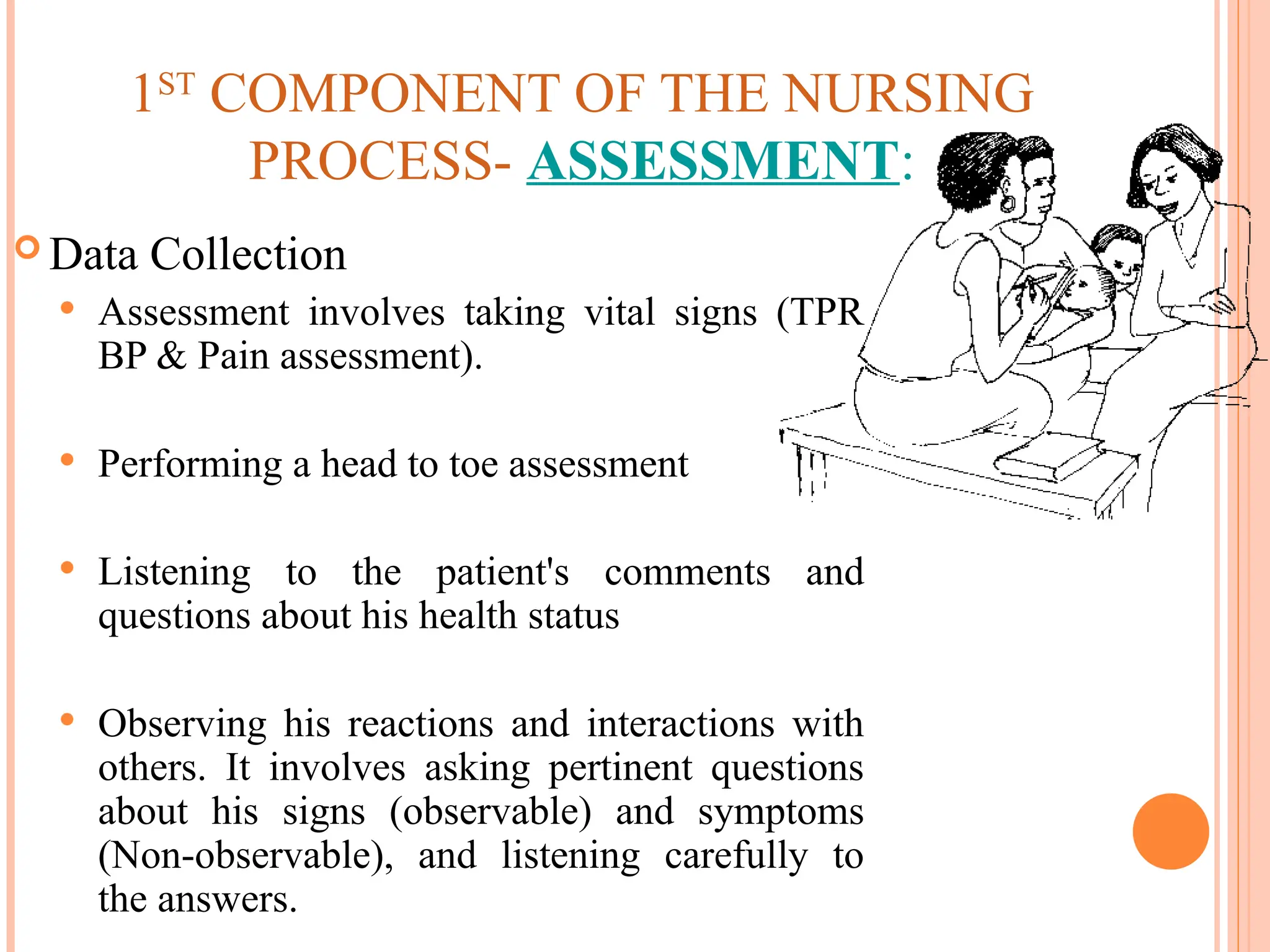
 Data Collection
 Assessment involves taking vital signs (TPR
BP & Pain assessment).
 Performing a head to toe assessment
 Listening to the patient's comments and
questions about his health status
 Observing his reactions and interactions with
others. It involves asking pertinent questions
about his signs (observable) and symptoms
(Non-observable), and listening carefully to
the answers.
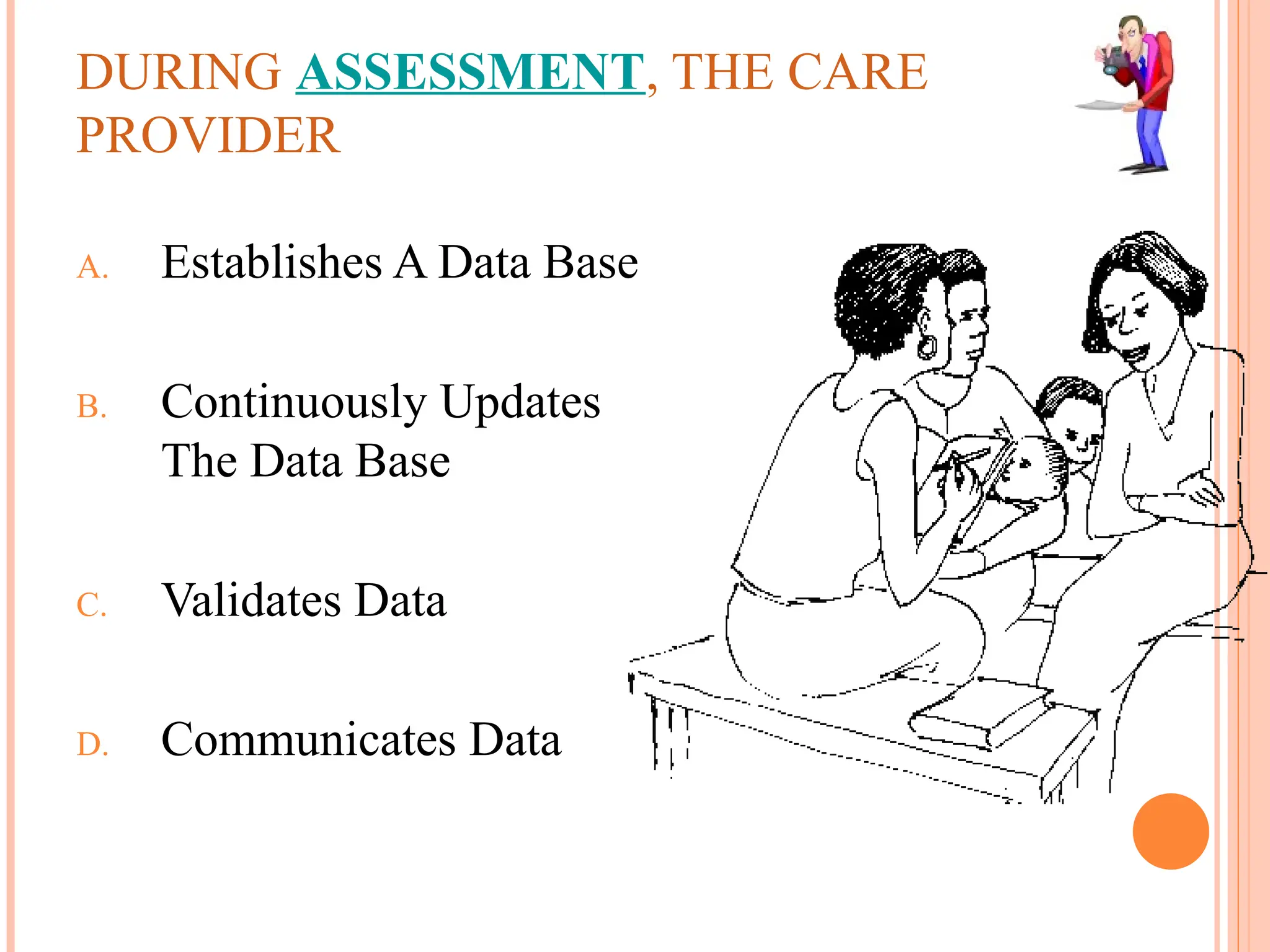
DURING ASSESSMENT, THE CARE
PROVIDER
A. Establishes A Data Base
B. Continuously Updates
The Data Base
C. Validates Data
D. Communicates Data
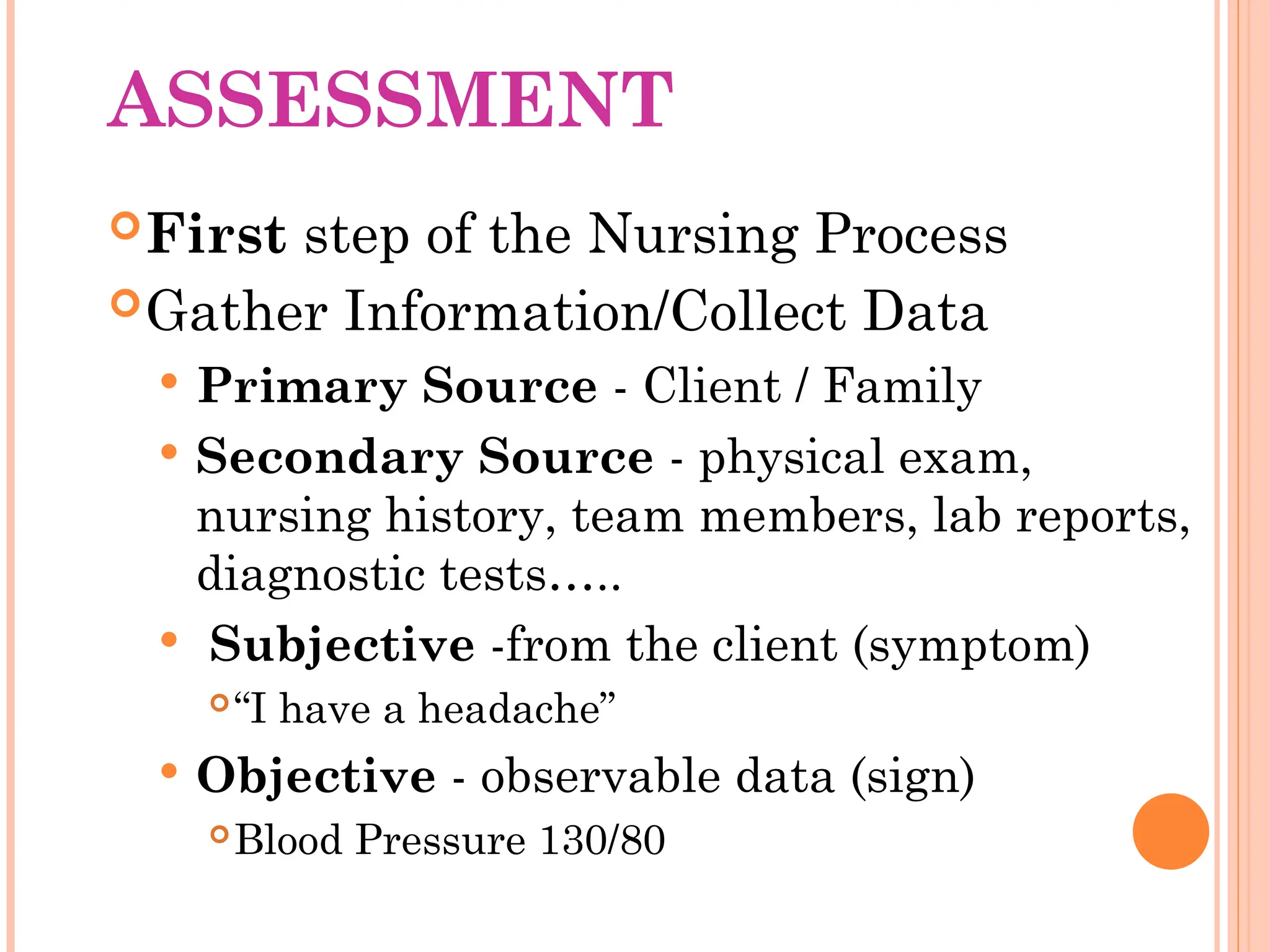
ASSESSMENT
First step of the Nursing Process
Gather Information/Collect Data
 Primary Source - Client / Family
 Secondary Source - physical exam,
nursing history, team members, lab reports,
diagnostic tests…..
 Subjective -from the client (symptom)
“I have a headache”
 Objective - observable data (sign)
Blood Pressure 130/80
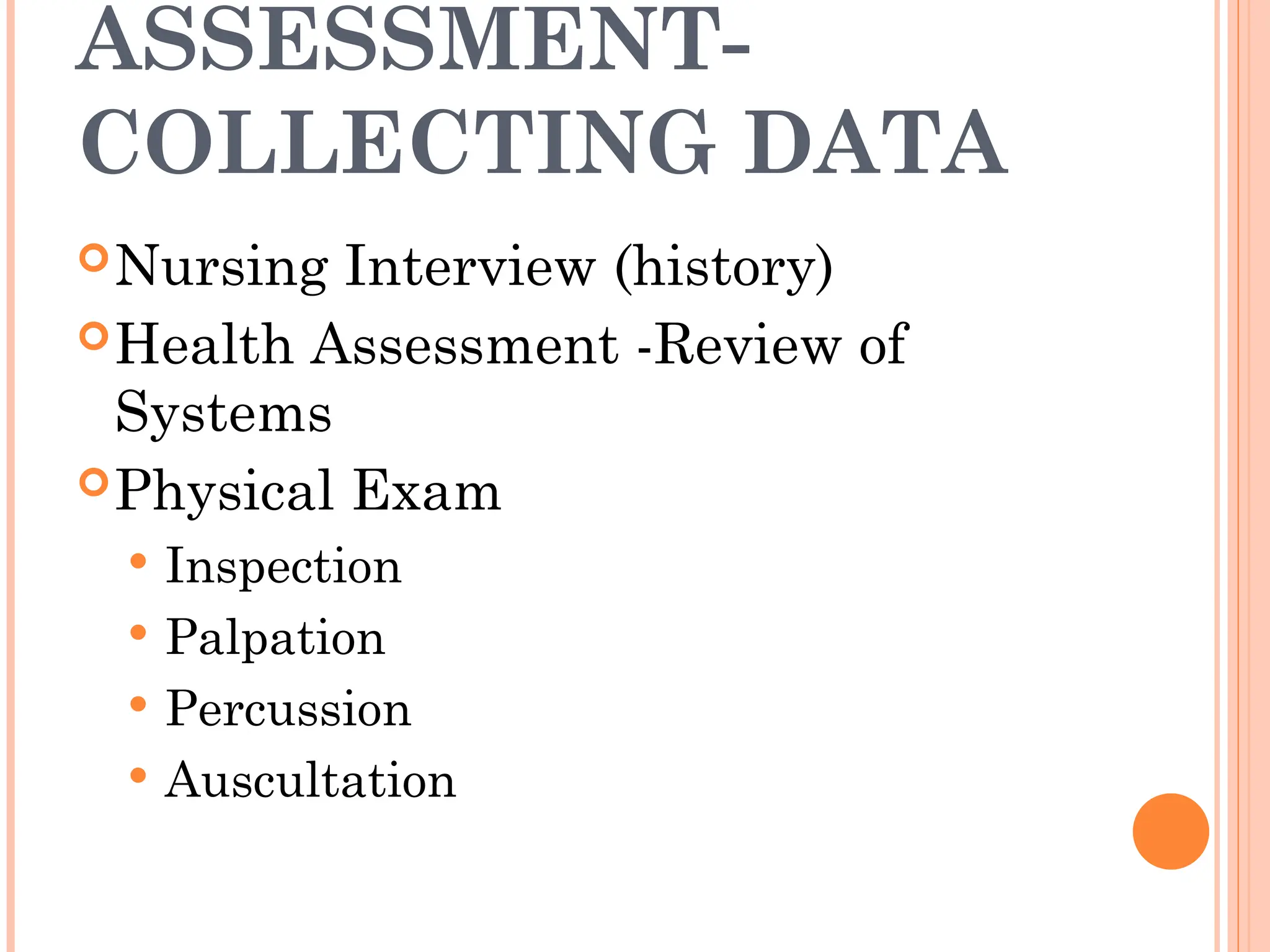
ASSESSMENT-
COLLECTING DATA
Nursing Interview (history)
Health Assessment -Review of
Systems
Physical Exam
 Inspection
 Palpation
 Percussion
 Auscultation
EXAMPLE OF
ASSESSMENT
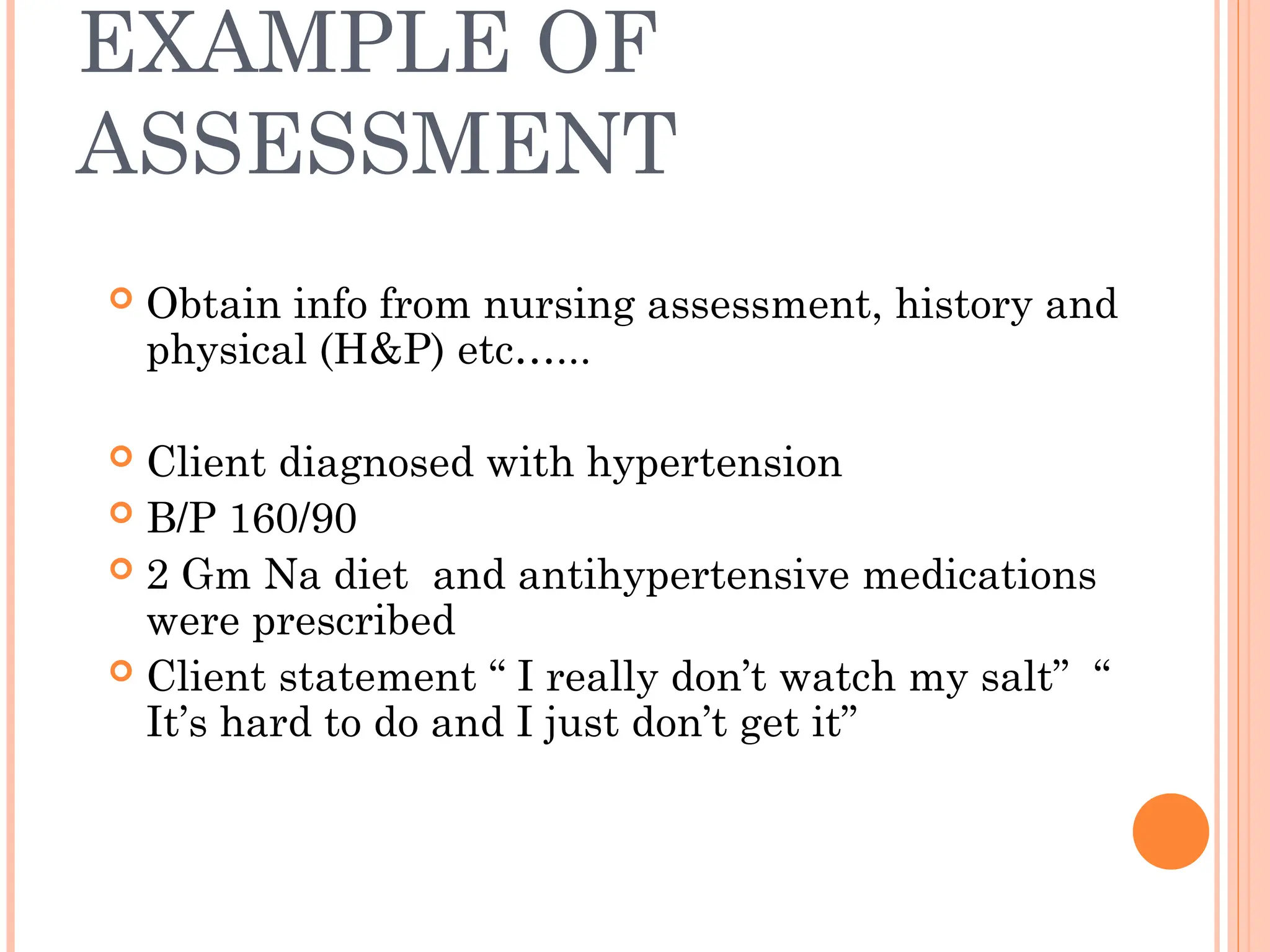
 Obtain info from nursing assessment, history and
physical (H&P) etc…...
 Client diagnosed with hypertension
 B/P 160/90
 2 Gm Na diet and antihypertensive medications
were prescribed
 Client statement “ I really don’t watch my salt” “
It’s hard to do and I just don’t get it”
2ND
COMPONENT OF THE NURSING
PROCESS- DIAGNOSIS:
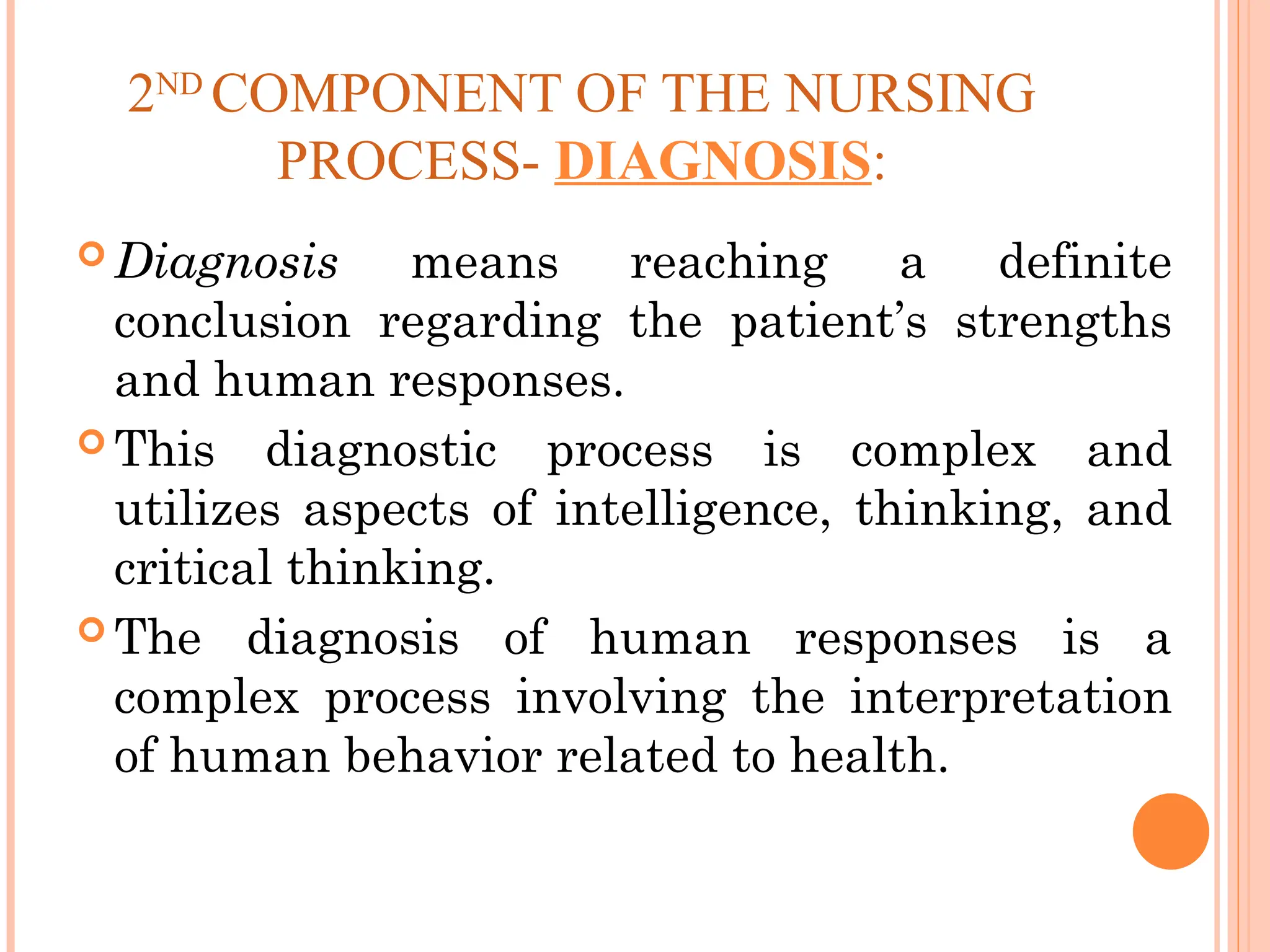
 Diagnosis means reaching a definite
conclusion regarding the patient’s strengths
and human responses.
 This diagnostic process is complex and
utilizes aspects of intelligence, thinking, and
critical thinking.
 The diagnosis of human responses is a
complex process involving the interpretation
of human behavior related to health.
NURSING DIAGNOSIS
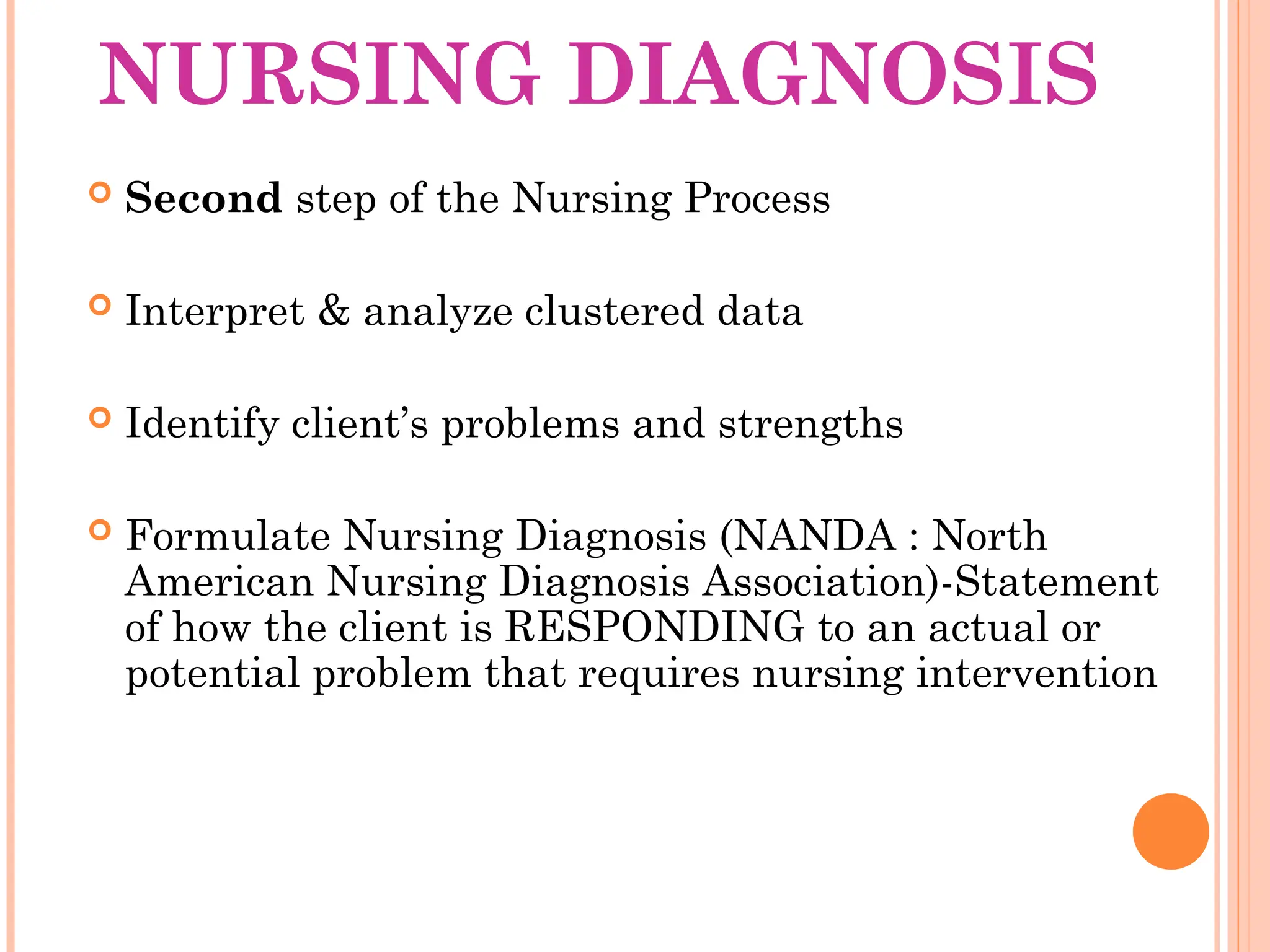
 Second step of the Nursing Process
 Interpret & analyze clustered data
 Identify client’s problems and strengths
 Formulate Nursing Diagnosis (NANDA : North
American Nursing Diagnosis Association)-Statement
of how the client is RESPONDING to an actual or
potential problem that requires nursing intervention
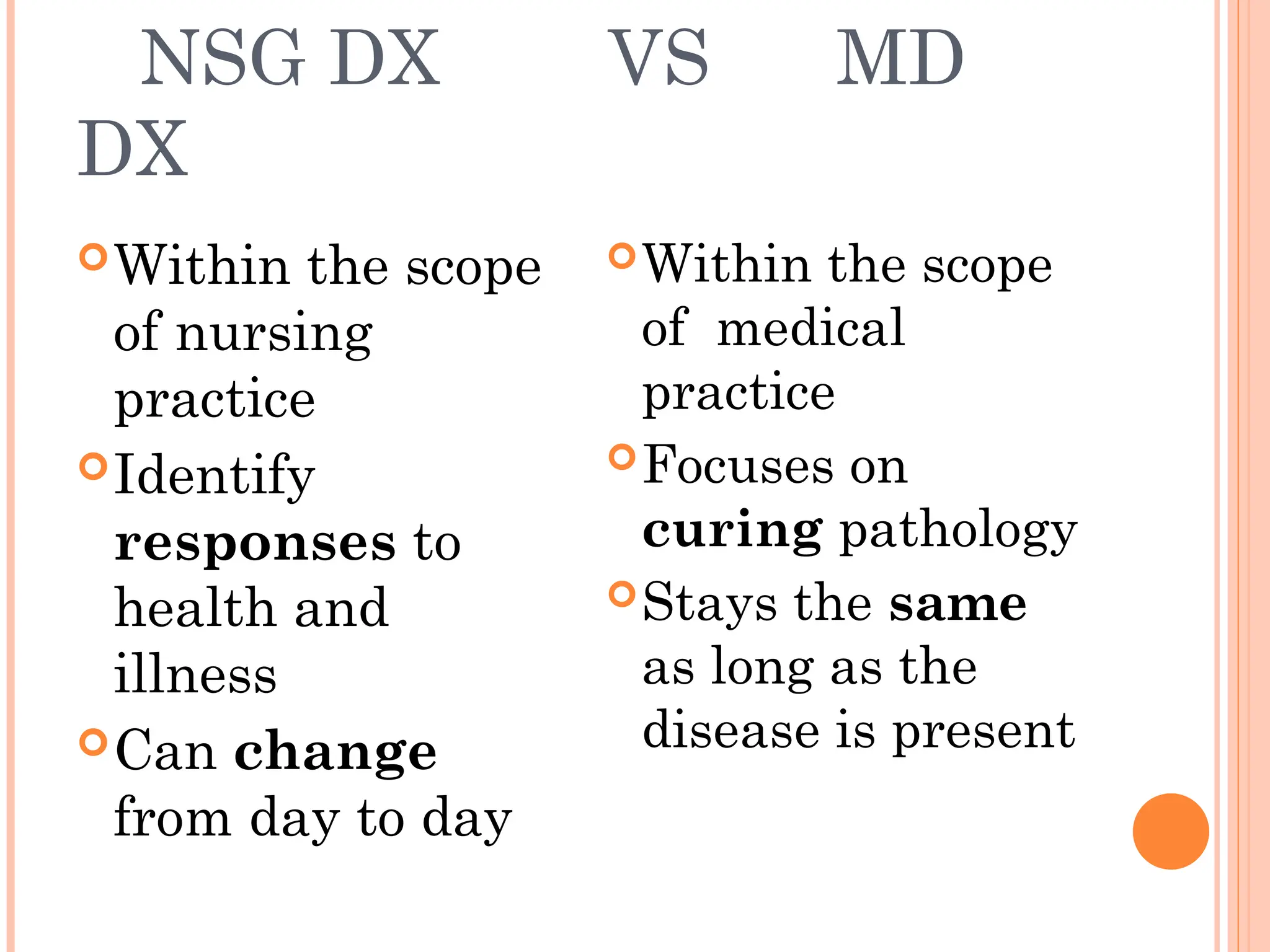
NSG DX VS MD
DX
Within the scope
of nursing
practice
Identify
responses to
health and
illness
Can change
from day to day
Within the scope
of medical
practice
Focuses on
curing pathology
Stays the same
as long as the
disease is present
FORMULATING A NURSING DIAGNOSIS
 Composed of 3 parts:
 Problem statement- the client’s response to a
problem
 Etiology- what’s causing/contributing to the
client’s problem
 Defining Characteristics- what’s the evidence of
the problem
NURSING DIAGNOSIS
 Problem( Diagnostic Label)-based on your
assessment of client…(gathered information), pick
a problem from the NANDA list...
 Etiology- determine what the problem is caused by
or related to (R/T)...
 Defining characteristics- then state as
evidenced by (AEB) the specific facts the problem is
based on...
EXAMPLE OF NURSING DX
 Ineffective therapeutic regimen
management
R/T difficulty maintaining lifestyle changes and
lack of knowledge
AEB B/P= 160/90, dietary sodium restrictions
not being observed, and client statements of “ I
don’t watch my salt” “It’s hard to do and I just
don’t get it”.
TYPES OF NURSING DIAGNOSES
 Actual
Imbalanced nutrition; less than body
requirements RT chronic diarrhea, nausea,
and pain AEB height 5’5” weight 105 lbs.
 Risk/Potential
Risk for falls RT altered gait and
generalized weakness
 Wellness
Family coping: potential for growth RT
unexpected birth of twins.
COLLABORATIVE PROBLEMS
 Require both nursing interventions and medical
interventions
EXAMPLE: Client admitted with medical dx of
pneumonia
Collaborative problem = respiratory insufficiency
Nsg interventions: Raise HOB, Encourage C&DB
MD interventions: Antibiotics IV, O2 therapy
3RD
COMPONENT OF THE NURSING
PROCESS- PLANNING:
The establishment of client goals/outcomes
 Working with the client, to prevent, reduce, or
resolve problems
 To determine related nursing interventions (actions)
that are most likely to assist client in achieving goals
 This is about improving the quality of life for your
patient.
 This is about what your patient needs to do to
improve his health status or better cope with his
illness.
DURING PLANNING, THE PROVIDER:
 A. Establishes Priorities
 B. Writes Client Goals/Outcomes And
Develops An Evaluative Strategy
 C. Selects Nursing Interventions
 D. Communicates The Plan
PLANNING
Third step of the Nursing Process
 This is when the nurse organizes a nursing care plan
based on the nursing diagnoses.
 Nurse and client formulate goals to help the client with
their problems
 Expected outcomes are identified
 Interventions (nursing orders) are selected to aid the
client reach these goals.
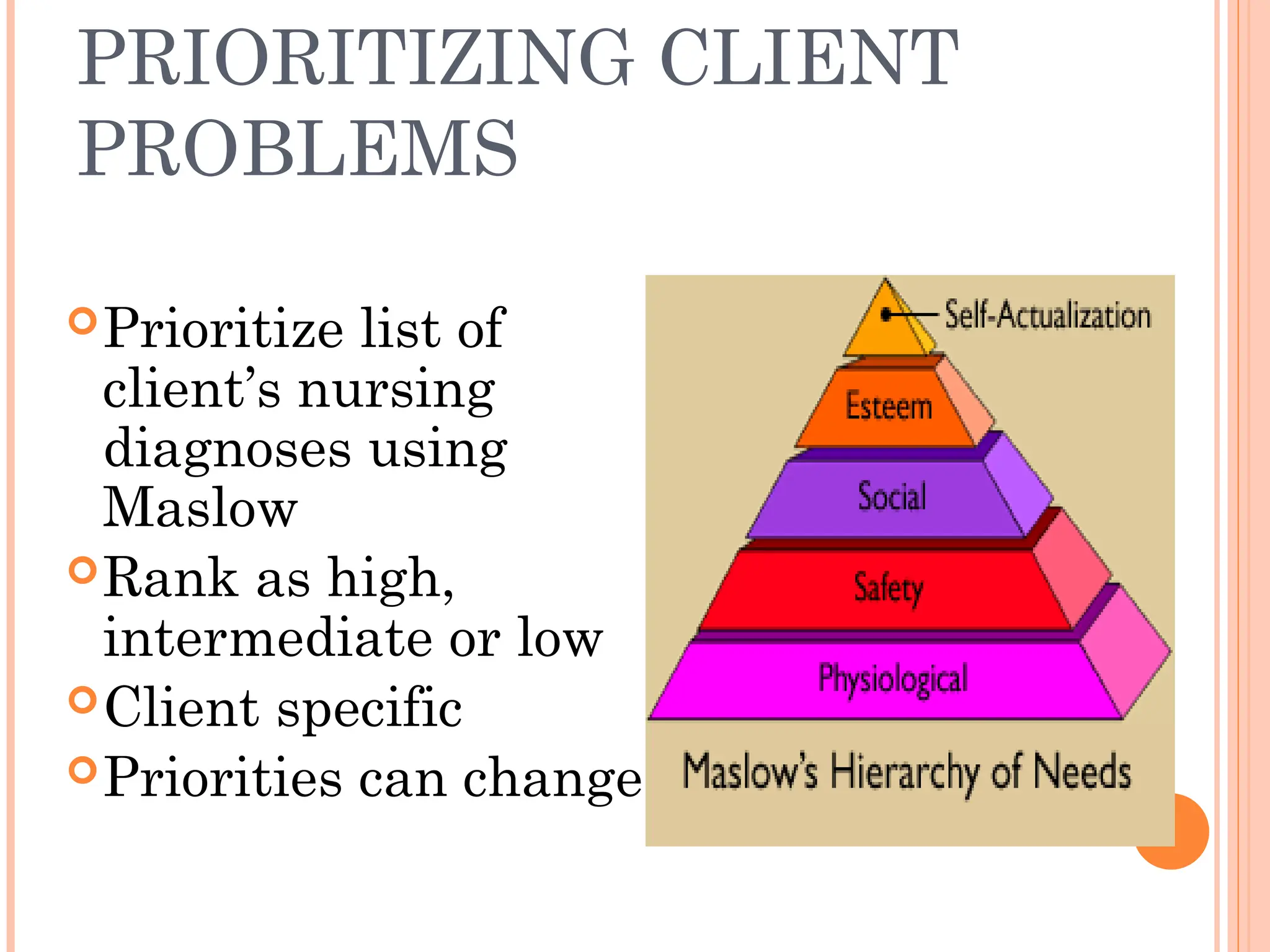
PRIORITIZING CLIENT
PROBLEMS
Prioritize list of
client’s nursing
diagnoses using
Maslow
Rank as high,
intermediate or low
Client specific
Priorities can change
PLANNING- TYPES OF
GOALS
Short term goals
Long term goals
Cognitive goals
Psychomotor goals
Affective goals
GOALS ARE PATIENT-
CENTERED AND
SMART
Specific
Measurable
Attainable
Relevant
Time Bound
Pt)
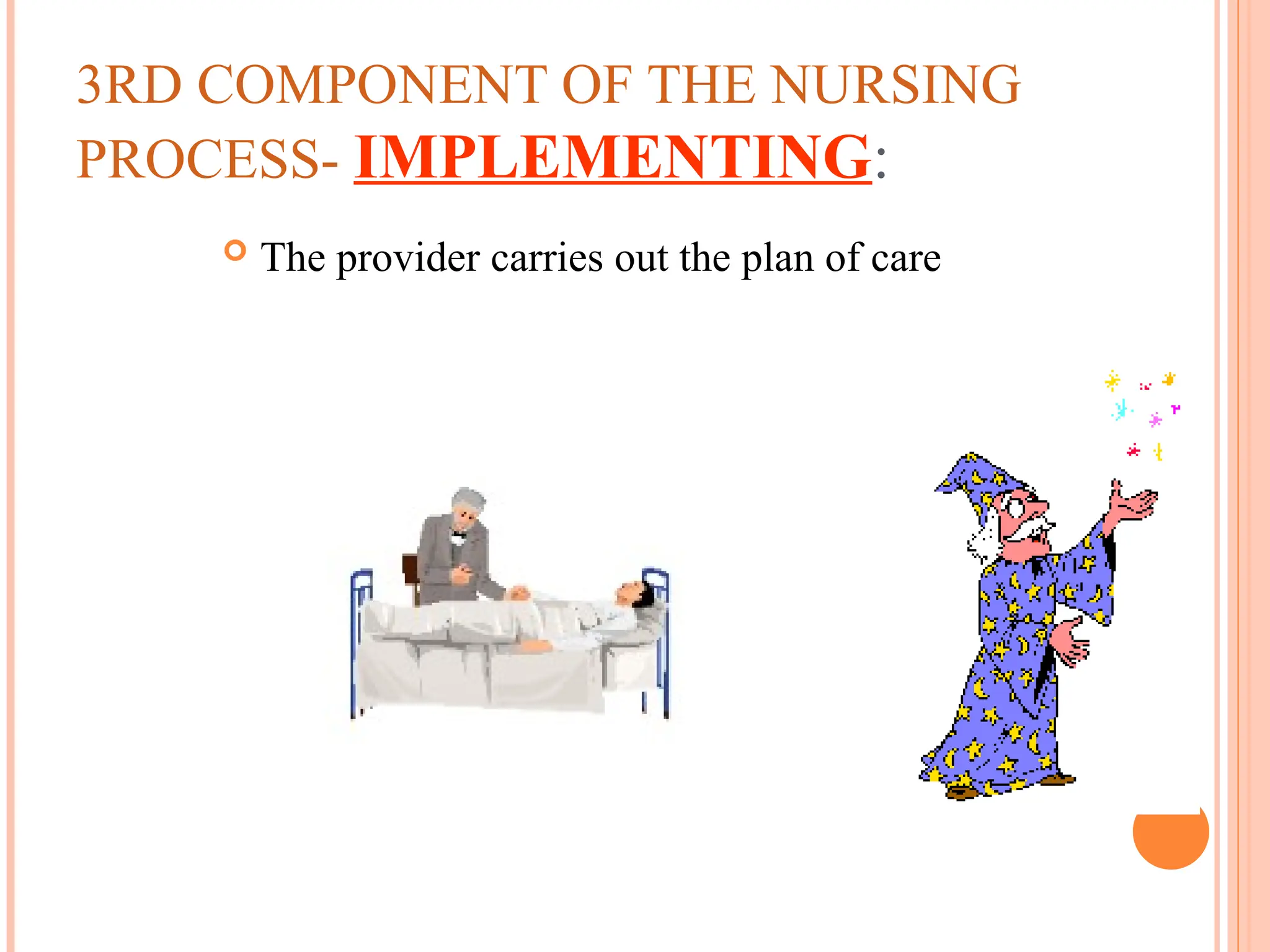
3RD COMPONENT OF THE NURSING
PROCESS- IMPLEMENTING:
 The provider carries out the plan of care
DURING IMPLEMENTING, THE CARE
PROVIDER:
 Carries Out The Plan Of Nursing Care or Setting your
plans in motion and delegating responsibilities for
each step.
 Continues Data Collection And Modifies The Plan Of
Care As Needed
 Documents Care
IMPLEMENTION
“Doing” step
 Carrying out nursing intervention
 s
 This includes monitoring, teaching, further
assessing, reviewing NCP, incorporating physicians
orders and monitoring cost effectiveness of
interventions
PLANNING-SELECT
INTERVENTIONS
 Interventions are selected and written.
 The nurse uses clinical judgment and professional
knowledge to select appropriate interventions that
will aid the client in reaching their goal.
 Interventions should be examined for feasibility
and acceptability to the client
 Interventions should be written clearly and
specifically.
INTERVENTIONS –
 Independent ( Nurse initiated )- any action the
nurse can initiate without direct supervision
 Dependent ( Physician initiated )-nursing
actions requiring MD orders
 Collaborative- nursing actions performed jointly
with other health care team members
4TH COMPONENT OF THE NURSING
PROCESS- EVALUATING:
 The measuring of the extent to which
client goals have been met
 Evaluation involves not only analyzing
the success of the goals and
interventions, but examining the need
for adjustments and changes as well.
 The evaluation incorporates all input
from the entire health care team,
including the patient.
DURING EVALUATING, THE CARE
PROVIDER:
 Measures The Clients Achievement
Of Desired Goals/Outcomes
 Identifies Factors That Contribute To
The Client’s Success Or Failure
 Modifies The Plan Of Care, If
Indicated
EVALUATION-
 A comparison of client behavior and/or
response to the established outcome criteria
 Continuous review of the nursing care plan
 Examines if nursing interventions are
working
EVALUATION ERRORS
Factors that impede goal attainment:
 Incomplete database
 Unrealistic client outcomes
 Nonspecific nsg interventions
 Inadequate time for clients to achieve outcomes.
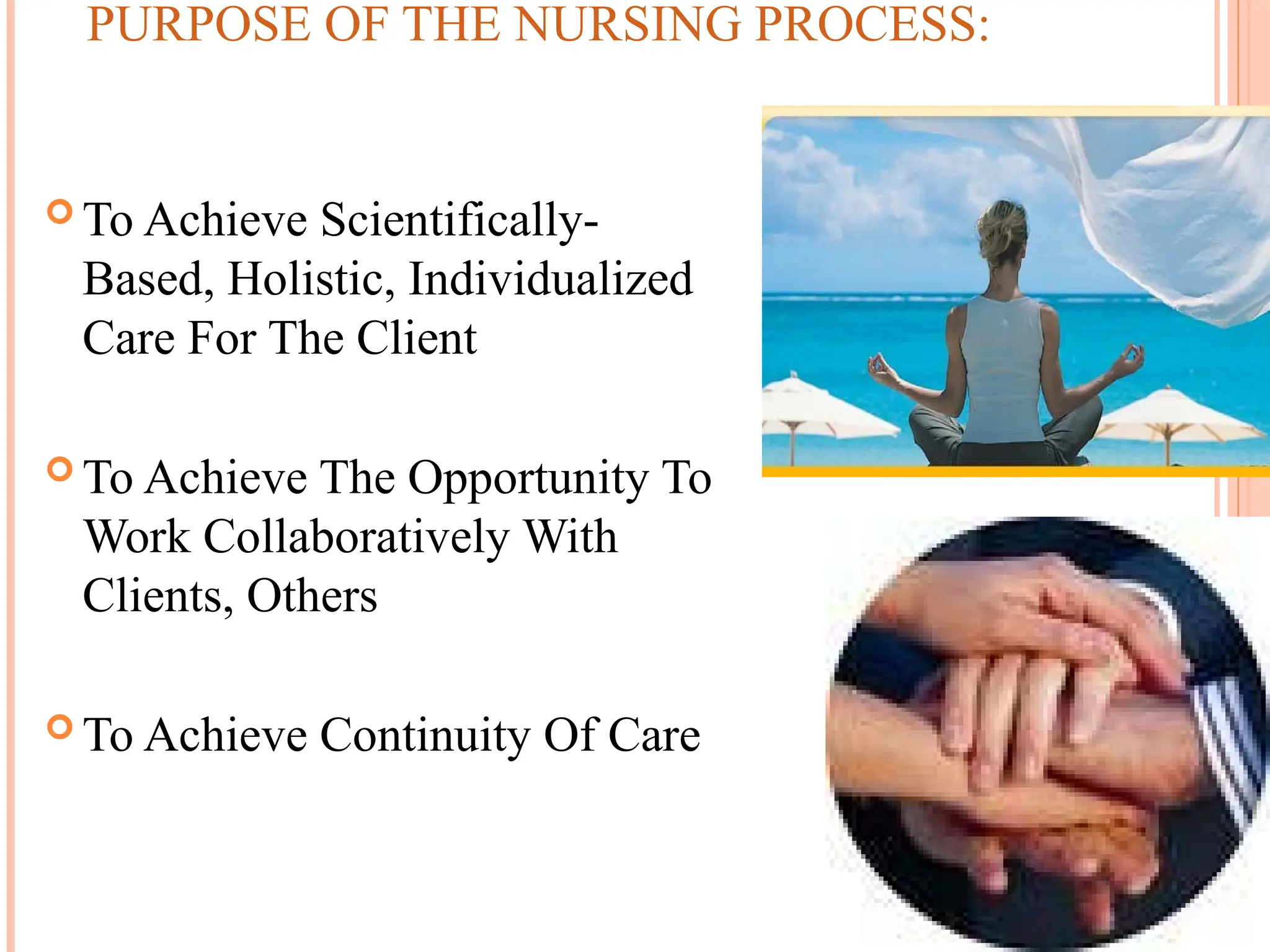
PURPOSE OF THE NURSING PROCESS:
 To Achieve Scientifically-
Based, Holistic, Individualized
Care For The Client
 To Achieve The Opportunity To
Work Collaboratively With
Clients, Others
 To Achieve Continuity Of Care
THE WHOLE PATIENT
 The nursing process involves looking at the whole
patient at all times. It personalizes the patient. He is
not "the CVA in 214B."
 It also forces the health care team to observe and
interact with the patient, and not just the task they are
performing such as a dressing change, or a bed bath.
The process provides a roadmap that ensures good
nursing care and improves patient outcomes.
HOLISTIC
 Physical-
 Emotional-
 Psychosocial-
 Developmental-
 Spiritual Being
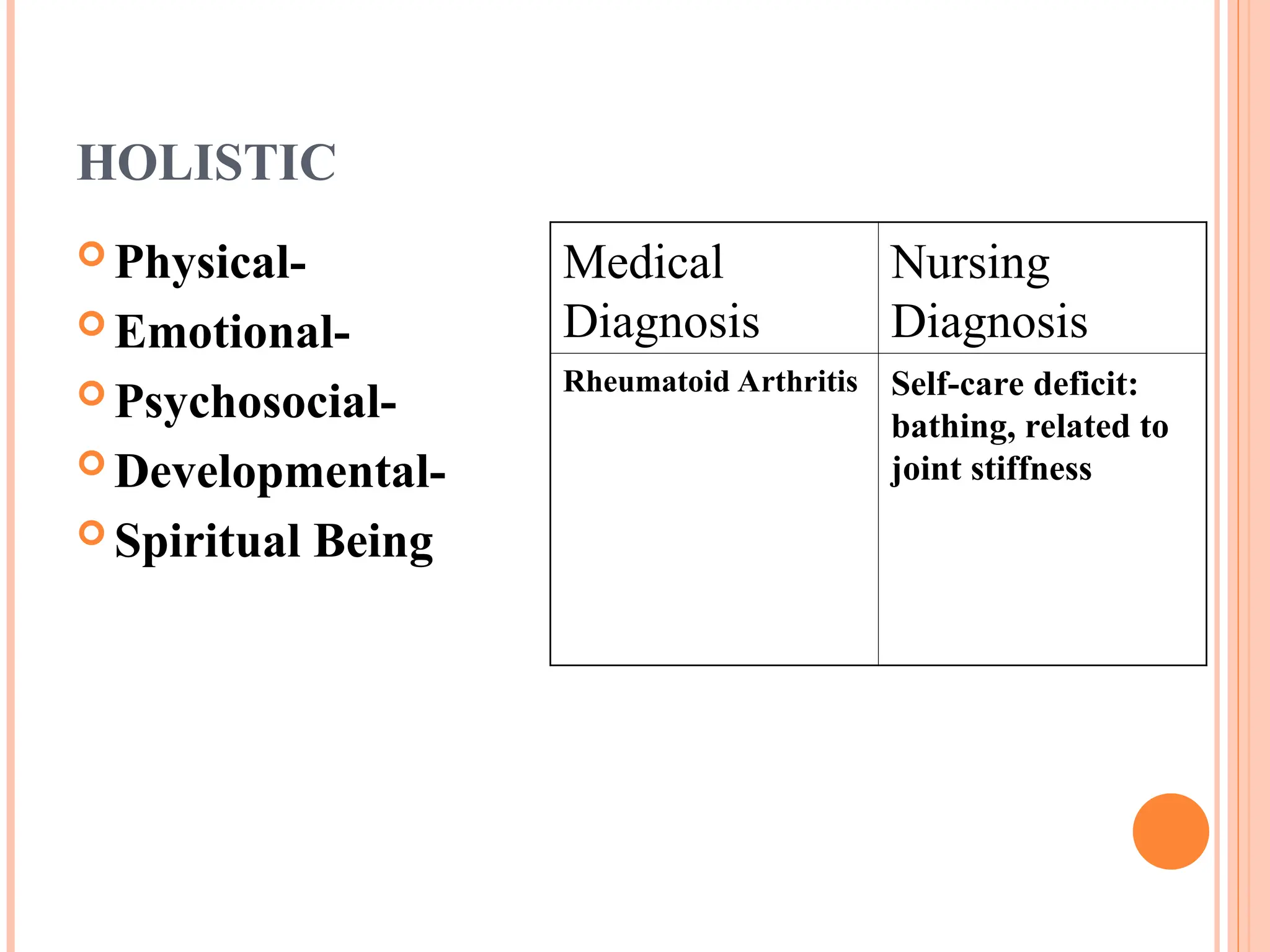
Medical
Diagnosis
Nursing
Diagnosis
Rheumatoid Arthritis Self-care deficit:
bathing, related to
joint stiffness

Unit 1 (c) Nursing Process.ppt..........

  • 1.
  • 2.
  • 3.
    LEARNING OUTCOMES  Discussthe concepts and theories that underpin the process of nursing.  Formulate nursing diagnosis on actual and potential patient’s problems.  Plan and document appropriate patient’s goals and interventions with the collaboration of patient, family and the multidisciplinary team.  Implement the Nursing Care Plan.  Evaluate and reassess each component of the Nursing Care Plan appropriately.  Educate patients and their families during their stay at hospital and at the time of discharge.  Demonstrate appropriate communication skills and interaction skills with patients, families and colleagues.
  • 4.
    THE NURSING PROCESSIS:  A systematic, rational method of planning and providing individualized nursing care.  An organized, systematic method of giving individualized nursing care that focuses on identifying and treating unique responses of individuals or groups to actual-(Alfaro)  Nursing is the protection, promotion, and optimization of health and abilities, prevention of illness and injury, alleviation of suffering through the diagnosis and treatment of human responses, and advocacy in the care of individuals, families, communities, and populations. (ANA)
  • 5.
    CHARACTERISTICS OF NP •A problem-solving method • Systematic, goal-directed, flexible, rational approach • Ensures consistent, continuous, quality nursing care • Provides a basis for professional accountability • Utilizes critical thinking processes
  • 6.
    CHARACTERISTICS: a) Systematic  Thenursing process has an ordered sequence of activities and each activity depends on the accuracy of the activity that precedes it and influences the activity following it. b) Dynamic  The nursing process has great interaction and overlapping among the activities and each activity is fluid and flows into the next activity c) Interpersonal  The nursing process ensures that nurses are client-centered rather than task-centered and encourages them to work to enhance client’s strengths and meet human needs d) Goal-directed  The nursing process is a means for nurses and clients to work together to identify specific goals (wellness promotion, disease and illness prevention, health restoration, coping and altered functioning) that are most important to the client, and to match them with the appropriate nursing actions e) Universally applicable  The nursing process allows nurses to practice nursing with well or ill people, young or old, in any type of practice setting
  • 7.
    BACK GROUND  The nursingprocess is based on a nursing theory developed by Ida Jean Orlando.  She developed this theory in the late 1950's as she observed nurses in action.  She saw "good" nursing and "bad" nursing.  From her observations she learned that the patient must be the central character.  Nursing care needs to be directed at improving outcomes for the patient, and not about nursing goals.  The nursing process is an essential part of the nursing care plan.
  • 8.
    BACK GROUND OFNURSING PROCESS  The original concept of the nursing process was introduced in the 1950s as a three-step process of  Assessment, Planning, and Evaluation  Based on the scientific method of  Observing, Measuring, Gathering data, and Analyzing the findings.  Over time, became part of the;  Conceptual framework of all nursing curricula and  Included in the legal definition of nursing in the nurse practice acts of most states.  After years of study, use, and refinement, the three step process was expanded into five steps.
  • 9.
    ADVANTAGES OF NURSING PROCESS Provides individualized care  Client is an active participant  Promotes continuity of care  Provides more effective communication among nurses and healthcare professionals  Develops a clear and efficient plan of care  Provides personal satisfaction as you see client achieve goals  Professional growth as you evaluate effectiveness of your interventions
  • 10.
    5 STEPS INTHE NURSING PROCESS Assessment Nursing Diagnosis Planning Implementing Evaluating
  • 11.
    1ST COMPONENT OF THENURSING PROCESS- ASSESSMENT:  The first step, or phase, of the nursing process is assessment.  During this phase, you are collecting data (factual information) from several sources.  The collection and organization of these data allow to:  Determine the patient’s current health status.  Determine the patient’s strengths and problem areas (both actual and potential).  Prepare for the second step of the process—diagnosis.
  • 12.
    1ST COMPONENT OF THENURSING PROCESS- ASSESSMENT:  Data Collection  Assessment involves taking vital signs (TPR BP & Pain assessment).  Performing a head to toe assessment  Listening to the patient's comments and questions about his health status  Observing his reactions and interactions with others. It involves asking pertinent questions about his signs (observable) and symptoms (Non-observable), and listening carefully to the answers.
  • 13.
    DURING ASSESSMENT, THECARE PROVIDER A. Establishes A Data Base B. Continuously Updates The Data Base C. Validates Data D. Communicates Data
  • 14.
    ASSESSMENT First step ofthe Nursing Process Gather Information/Collect Data  Primary Source - Client / Family  Secondary Source - physical exam, nursing history, team members, lab reports, diagnostic tests…..  Subjective -from the client (symptom) “I have a headache”  Objective - observable data (sign) Blood Pressure 130/80
  • 15.
    ASSESSMENT- COLLECTING DATA Nursing Interview(history) Health Assessment -Review of Systems Physical Exam  Inspection  Palpation  Percussion  Auscultation
  • 17.
    EXAMPLE OF ASSESSMENT  Obtaininfo from nursing assessment, history and physical (H&P) etc…...  Client diagnosed with hypertension  B/P 160/90  2 Gm Na diet and antihypertensive medications were prescribed  Client statement “ I really don’t watch my salt” “ It’s hard to do and I just don’t get it”
  • 18.
    2ND COMPONENT OF THENURSING PROCESS- DIAGNOSIS:  Diagnosis means reaching a definite conclusion regarding the patient’s strengths and human responses.  This diagnostic process is complex and utilizes aspects of intelligence, thinking, and critical thinking.  The diagnosis of human responses is a complex process involving the interpretation of human behavior related to health.
  • 19.
    NURSING DIAGNOSIS  Secondstep of the Nursing Process  Interpret & analyze clustered data  Identify client’s problems and strengths  Formulate Nursing Diagnosis (NANDA : North American Nursing Diagnosis Association)-Statement of how the client is RESPONDING to an actual or potential problem that requires nursing intervention
  • 20.
    NSG DX VSMD DX Within the scope of nursing practice Identify responses to health and illness Can change from day to day Within the scope of medical practice Focuses on curing pathology Stays the same as long as the disease is present
  • 21.
    FORMULATING A NURSINGDIAGNOSIS  Composed of 3 parts:  Problem statement- the client’s response to a problem  Etiology- what’s causing/contributing to the client’s problem  Defining Characteristics- what’s the evidence of the problem
  • 22.
    NURSING DIAGNOSIS  Problem(Diagnostic Label)-based on your assessment of client…(gathered information), pick a problem from the NANDA list...  Etiology- determine what the problem is caused by or related to (R/T)...  Defining characteristics- then state as evidenced by (AEB) the specific facts the problem is based on...
  • 23.
    EXAMPLE OF NURSINGDX  Ineffective therapeutic regimen management R/T difficulty maintaining lifestyle changes and lack of knowledge AEB B/P= 160/90, dietary sodium restrictions not being observed, and client statements of “ I don’t watch my salt” “It’s hard to do and I just don’t get it”.
  • 24.
    TYPES OF NURSINGDIAGNOSES  Actual Imbalanced nutrition; less than body requirements RT chronic diarrhea, nausea, and pain AEB height 5’5” weight 105 lbs.  Risk/Potential Risk for falls RT altered gait and generalized weakness  Wellness Family coping: potential for growth RT unexpected birth of twins.
  • 25.
    COLLABORATIVE PROBLEMS  Requireboth nursing interventions and medical interventions EXAMPLE: Client admitted with medical dx of pneumonia Collaborative problem = respiratory insufficiency Nsg interventions: Raise HOB, Encourage C&DB MD interventions: Antibiotics IV, O2 therapy
  • 26.
    3RD COMPONENT OF THENURSING PROCESS- PLANNING: The establishment of client goals/outcomes  Working with the client, to prevent, reduce, or resolve problems  To determine related nursing interventions (actions) that are most likely to assist client in achieving goals  This is about improving the quality of life for your patient.  This is about what your patient needs to do to improve his health status or better cope with his illness.
  • 27.
    DURING PLANNING, THEPROVIDER:  A. Establishes Priorities  B. Writes Client Goals/Outcomes And Develops An Evaluative Strategy  C. Selects Nursing Interventions  D. Communicates The Plan
  • 28.
    PLANNING Third step ofthe Nursing Process  This is when the nurse organizes a nursing care plan based on the nursing diagnoses.  Nurse and client formulate goals to help the client with their problems  Expected outcomes are identified  Interventions (nursing orders) are selected to aid the client reach these goals.
  • 29.
    PRIORITIZING CLIENT PROBLEMS Prioritize listof client’s nursing diagnoses using Maslow Rank as high, intermediate or low Client specific Priorities can change
  • 30.
    PLANNING- TYPES OF GOALS Shortterm goals Long term goals Cognitive goals Psychomotor goals Affective goals
  • 31.
    GOALS ARE PATIENT- CENTEREDAND SMART Specific Measurable Attainable Relevant Time Bound Pt)
  • 32.
    3RD COMPONENT OFTHE NURSING PROCESS- IMPLEMENTING:  The provider carries out the plan of care
  • 33.
    DURING IMPLEMENTING, THECARE PROVIDER:  Carries Out The Plan Of Nursing Care or Setting your plans in motion and delegating responsibilities for each step.  Continues Data Collection And Modifies The Plan Of Care As Needed  Documents Care
  • 34.
    IMPLEMENTION “Doing” step  Carryingout nursing intervention  s  This includes monitoring, teaching, further assessing, reviewing NCP, incorporating physicians orders and monitoring cost effectiveness of interventions
  • 35.
    PLANNING-SELECT INTERVENTIONS  Interventions areselected and written.  The nurse uses clinical judgment and professional knowledge to select appropriate interventions that will aid the client in reaching their goal.  Interventions should be examined for feasibility and acceptability to the client  Interventions should be written clearly and specifically.
  • 36.
    INTERVENTIONS –  Independent( Nurse initiated )- any action the nurse can initiate without direct supervision  Dependent ( Physician initiated )-nursing actions requiring MD orders  Collaborative- nursing actions performed jointly with other health care team members
  • 37.
    4TH COMPONENT OFTHE NURSING PROCESS- EVALUATING:  The measuring of the extent to which client goals have been met  Evaluation involves not only analyzing the success of the goals and interventions, but examining the need for adjustments and changes as well.  The evaluation incorporates all input from the entire health care team, including the patient.
  • 38.
    DURING EVALUATING, THECARE PROVIDER:  Measures The Clients Achievement Of Desired Goals/Outcomes  Identifies Factors That Contribute To The Client’s Success Or Failure  Modifies The Plan Of Care, If Indicated
  • 39.
    EVALUATION-  A comparisonof client behavior and/or response to the established outcome criteria  Continuous review of the nursing care plan  Examines if nursing interventions are working
  • 40.
    EVALUATION ERRORS Factors thatimpede goal attainment:  Incomplete database  Unrealistic client outcomes  Nonspecific nsg interventions  Inadequate time for clients to achieve outcomes.
  • 41.
    PURPOSE OF THENURSING PROCESS:  To Achieve Scientifically- Based, Holistic, Individualized Care For The Client  To Achieve The Opportunity To Work Collaboratively With Clients, Others  To Achieve Continuity Of Care
  • 42.
    THE WHOLE PATIENT The nursing process involves looking at the whole patient at all times. It personalizes the patient. He is not "the CVA in 214B."  It also forces the health care team to observe and interact with the patient, and not just the task they are performing such as a dressing change, or a bed bath. The process provides a roadmap that ensures good nursing care and improves patient outcomes.
  • 43.
    HOLISTIC  Physical-  Emotional- Psychosocial-  Developmental-  Spiritual Being Medical Diagnosis Nursing Diagnosis Rheumatoid Arthritis Self-care deficit: bathing, related to joint stiffness

Editor's Notes

  • #5 A systematic problem-solving approach used to identify, prevent and treat actual or potential health problems and promote wellness. A systematic way to plan, implement and evaluate care for individuals, families, groups and communities.
  • #10 Each step needs to be completed before we can progress further in the process
  • #14 Form a data base on information collected about the client
  • #15 Methods of data collection Nurse client interview-health history Physical exam inspection Palpation Percussion ausculation
  • #17 Based on this assessment we can see one factor effecting the client’s uncontrolled hypertension is lack of maintaining sodium intake restrictions.
  • #19 Nursing Dx is a problem statement of how the client is RESPONDING to a problem…it may be an actual or potential problem Interpreted data is clustered inaccording to body systems, risk factors, family factors,emotional fectors etc.
  • #23 Based on our assessment of the client with hypertension who wasn’t following the prescribed low salt diet this is an example of a nsg dx. First part is the clients problem taken from the NANDA list Second part is a reason why the client has the problem Third part is the evidence of the problem
  • #28 Now that we have a nsg dx we need a plan to help this client Goals allow us to determine the specific outcome desired by the client Short term- goal in which a specific time frame with date ie Able to identify 20 foods which are low in sodium within 2 days Long term goal in which desired outcome is expected in a broader time frame ie Client be able to develop a daily meal plan based on 2 Gm Na restrictions by the end of the monthl Cognitive goal - goal in which client gains new knowledge ie able to correctly identify foods high and low in sodium Pyschomotor goal- goal in which client’s acquire a new skill ie client able to correctly monitor B/P using stethoscope and sphygmomanometer Affective goal - goal in which the client’s values or attitudes change ie client able to accept the need for maintaining life time dietary changes to control B/P Interventions are nursing orders that you are empowered to select based on your judgement of the client’s needs Prioritize most important goals first
  • #29 Pt. Have many dx…..need to prioritize
  • #34 NIC = nursing intervention classification
  • #35 Be specific clearly state what teaching is needed, materials to be used etc Utilize research and evidence based practice protocols
  • #39 Is the goal met and problem resolved? Is goal not yet reached but progress being made and care ongoing? Is goal not met and revisions needed to the care plan?