Nursing Information
System
BY
MRS.SHANTHI.P
ASSOCIATE PROFESSOR
SRMTCON
INTRODUCTION:
• Nursing informatics specialists are the translators that have evolved
into health tech innovators who establish businesses,manage medical
economics,create technology and amplify the voice of end-user
clinicians
DEFINITION
Nursing informatics is a specialty that integrate nursing,science,computer science, and
information science to manage &communicate data,information,and knowledge in nursing practice
-ANA
Nursing informatics is the use of technology and /or computer system to collect,
store,process,display,retrieve and communicate timely data and information in and across health care
facilities that administer nursing services and resources ,manage the delivery of patient and nursing
care, link research resources and findings to nursing practice, and apply educational resources to
nursing education - Saba McCormick
PURPOSE
• Create pertinent patient data available in a usable form
• To process information to support managerial function
• To make policy decision
• To assist in taking the operating decisions
• To provide a framework to take patient care decisions
• To make available an intergrated automized information processing system
for all phases of the nursing process
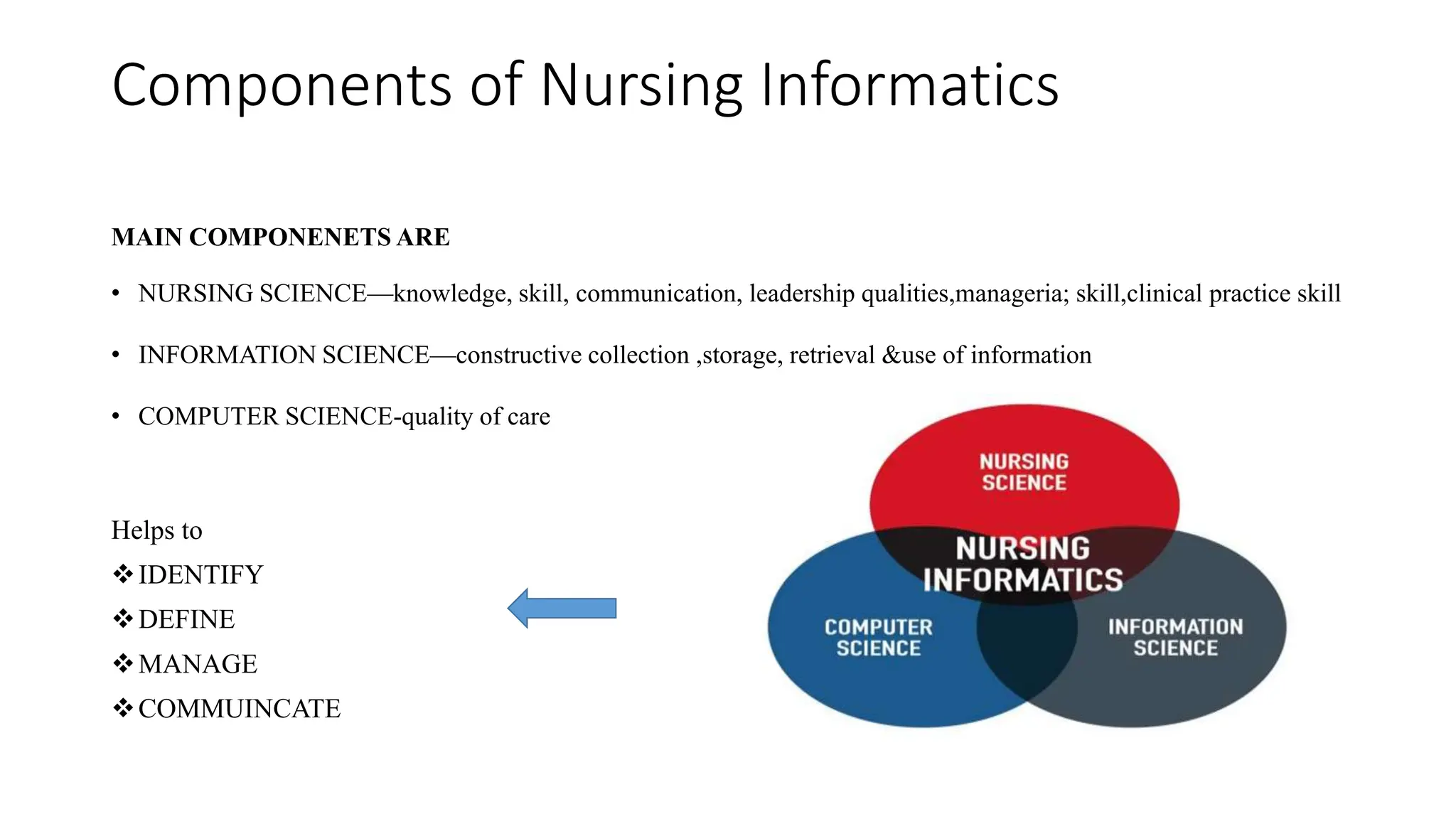
Components of Nursing Informatics
MAIN COMPONENETS ARE
• NURSING SCIENCE—knowledge, skill, communication, leadership qualities,manageria; skill,clinical practice skill
• INFORMATION SCIENCE—constructive collection ,storage, retrieval &use of information
• COMPUTER SCIENCE-quality of care
Helps to
IDENTIFY
DEFINE
MANAGE
COMMUINCATE
Sub-Component : Forms The Informatics Pyramid
data
information
knowledge
wisdom
Nursing
practice
• NISs, are computer systems that manage clinical data, through retrieving,
viewing and analyzing data by the nursing staff and then integrated into a
patient's care plan
• NIS provides features include patient charting, staff schedules, and decision
support, such as disease linkage between signs and symptoms. The
intended benefits of NIS include better
• drug administration,
• improved workload functionality and
• better care planning
• Improved Workload Functionality Staffing levels and appropriate skill
mix per shift can be determined easily by using the shift modules,
which can later be used in distribution of labor among the nurses.
This leads to less time spent in designing and altering duty rosters.
• Scheduling and Personnel Management Patient care becomes more
effective and economical using shift modules designed to handle
absences, overtime, staffing levels and cost-effective staffing
• Enhanced Decision Making Right clinical decisions need right information,
through accessing medical resources and identifying the critical
information in decision making. Decision support modules provide prompts
and reminders, and guides to disease linkages between signs or symptoms,
etiologies or related factors and patient populations
• Improved Drug Administration Iss enable electronically prescribed
drugs to become more understandable, to decrease probability of
administering wrong drugs to patients. Patient-charting modules, the
patient’s VS, admission and nursing assessments, and nursing notes
can be stored and retrieve when needed for drug administration
Advantages of nursing information system
Advantages
Disadvantages
• Threat to data
• Over dependency on technology
• Cost consuming
• Needs to update time to time
• Special skill required to operate
• Separate IT team required for handling issues
• Accidental loss of data
• Problems of adjustability
Nursing Information System IN HEALTH CARE INFORMATION SYSYTEM  PPT.pptx

Nursing Information System IN HEALTH CARE INFORMATION SYSYTEM PPT.pptx

  • 1.
  • 2.
    INTRODUCTION: • Nursing informaticsspecialists are the translators that have evolved into health tech innovators who establish businesses,manage medical economics,create technology and amplify the voice of end-user clinicians
  • 3.
    DEFINITION Nursing informatics isa specialty that integrate nursing,science,computer science, and information science to manage &communicate data,information,and knowledge in nursing practice -ANA Nursing informatics is the use of technology and /or computer system to collect, store,process,display,retrieve and communicate timely data and information in and across health care facilities that administer nursing services and resources ,manage the delivery of patient and nursing care, link research resources and findings to nursing practice, and apply educational resources to nursing education - Saba McCormick
  • 4.
    PURPOSE • Create pertinentpatient data available in a usable form • To process information to support managerial function • To make policy decision • To assist in taking the operating decisions • To provide a framework to take patient care decisions • To make available an intergrated automized information processing system for all phases of the nursing process
  • 5.
    Components of NursingInformatics MAIN COMPONENETS ARE • NURSING SCIENCE—knowledge, skill, communication, leadership qualities,manageria; skill,clinical practice skill • INFORMATION SCIENCE—constructive collection ,storage, retrieval &use of information • COMPUTER SCIENCE-quality of care Helps to IDENTIFY DEFINE MANAGE COMMUINCATE
  • 6.
    Sub-Component : FormsThe Informatics Pyramid data information knowledge wisdom Nursing practice
  • 7.
    • NISs, arecomputer systems that manage clinical data, through retrieving, viewing and analyzing data by the nursing staff and then integrated into a patient's care plan • NIS provides features include patient charting, staff schedules, and decision support, such as disease linkage between signs and symptoms. The intended benefits of NIS include better • drug administration, • improved workload functionality and • better care planning
  • 8.
    • Improved WorkloadFunctionality Staffing levels and appropriate skill mix per shift can be determined easily by using the shift modules, which can later be used in distribution of labor among the nurses. This leads to less time spent in designing and altering duty rosters.
  • 9.
    • Scheduling andPersonnel Management Patient care becomes more effective and economical using shift modules designed to handle absences, overtime, staffing levels and cost-effective staffing
  • 10.
    • Enhanced DecisionMaking Right clinical decisions need right information, through accessing medical resources and identifying the critical information in decision making. Decision support modules provide prompts and reminders, and guides to disease linkages between signs or symptoms, etiologies or related factors and patient populations
  • 11.
    • Improved DrugAdministration Iss enable electronically prescribed drugs to become more understandable, to decrease probability of administering wrong drugs to patients. Patient-charting modules, the patient’s VS, admission and nursing assessments, and nursing notes can be stored and retrieve when needed for drug administration
  • 12.
    Advantages of nursinginformation system
  • 13.
  • 15.
    Disadvantages • Threat todata • Over dependency on technology • Cost consuming • Needs to update time to time • Special skill required to operate • Separate IT team required for handling issues • Accidental loss of data • Problems of adjustability