Thyroid Function Tests
Introduction
Thyroid hormones:
tetra iodothyronine / thyroxine (T4)
tri iodothyronine (T3)
Binds to:
thyroxine binding globulin (TBG)
thyroxine binding pre albumin (TBPA)
albumin
apolipoproteins
Free fractions are metabolically active
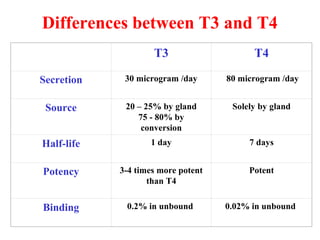
Differences between T3 and T4
T3 T4
Secretion 30 microgram /day 80 microgram /day
Source 20 – 25% by gland
75 - 80% by
conversion
Solely by gland
Half-life 1 day 7 days
Potency 3-4 times more potent
than T4
Potent
Binding 0.2% in unbound 0.02% in unbound
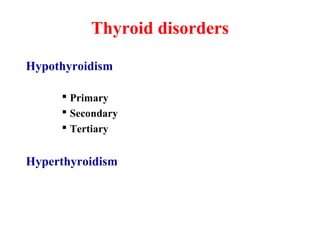
Thyroid disorders
Hypothyroidism
 Primary
 Secondary
 Tertiary
Hyperthyroidism
Thyroid disorders
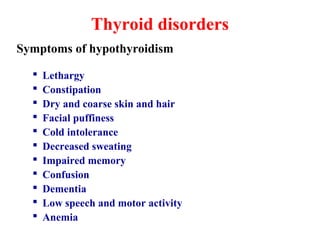
Symptoms of hypothyroidism
 Lethargy
 Constipation
 Dry and coarse skin and hair
 Facial puffiness
 Cold intolerance
 Decreased sweating
 Impaired memory
 Confusion
 Dementia
 Low speech and motor activity
 Anemia
Thyroid disorders
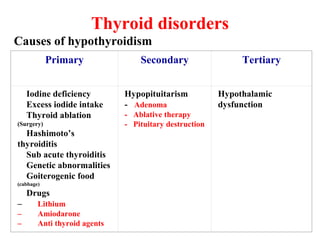
Causes of hypothyroidism
Primary Secondary Tertiary
Iodine deficiency
Excess iodide intake
Thyroid ablation
(Surgery)
Hashimoto’s
thyroiditis
Sub acute thyroiditis
Genetic abnormalities
Goiterogenic food
(cabbage)
Drugs
– Lithium
– Amiodarone
– Anti thyroid agents
Hypopituitarism
- Adenoma
- Ablative therapy
- Pituitary destruction
Hypothalamic
dysfunction
Thyroid disorders
Symptoms of hyperthyroidism
 Nervousness
 Fatigue
 Weight loss
 Heat intolerance
 Increased sweating
 Tachycardia
 Atrial fibrillation
 Warm and moist skin
 Exophthalmos
Thyroid disorders
Causes of hyperthyroidism
a) Overproduction of thyroid hormones
a) Grave’s disease
b) TSH secreting pituitary adenomas
c) Multi nodular goiter
b) Leaking thyroid hormone due to thyroid destruction
a) Lymphocytic thyroiditis
b) Sub acute thyroiditis
c) Radiation
c) Drugs
a) Thyroid replacement drugs
b) Amiodarone
c) Iodinated radio contrast agents
d) Metastatic thyroid carcinoma
Thyroid tests
Tests specific to thyroid status:
 Measure the concentration of products secreted
by the thyroid gland
 Evaluate the integrity of the hypothalamic–
pituitary- thyroid axis
 Assess inherent thyroid gland function
 Detect antibodies to thyroid tissue
Thyroid tests
Measure the concentration of products secreted by the
thyroid gland
 Free T4
 Total serum T4
 Serum T3 resin uptake
 Free T4 index
 Total serum T3
Thyroid tests
Free T4:
Reference range: 0.8 - 2.7 nanogram/dl
Measures unbound fraction of T4
Decreased direct equilibrium dialysis (method) T4
and increase TSH is suggestive of primary
hypothyroidism
Increase DED free T4 and TSH of less than 0.01
milliunits/L is suggestive of non-pituitary
hyperthyroidism
Thyroid tests
Total serum T4:
Reference range: 4 - 12 microgram/dl
Measures both bound and free T4
Increased total serum T4 – hyperthyroidism/
increase concentration of thyroid binding proteins
Decreased total serum T4 –
hypothyroidism/decrease concentration of thyroid
binding proteins/ non thyroid illness [DM, liver disease,
renal failure, prolonged infection and CV diseases]
Thyroid tests
Serum T3 resin uptake (thyroid hormone binding ratio):
Reference range: 25 – 35%
Indirectly estimates the number of binding sites on
thyroid binding proteins occupied by T3
The T3 resin uptake is high when thyroid –binding
protein is low and vice versa
Thyroid tests
Increase in T3 resin uptake - consistent with
hyperthyroidism
Decrease in T3 resin uptake - consistent with
hypothyroidism
This test is never used alone for diagnosis. In practice, the T3 resin
uptake test is used only to calculate the free T4 index
Thyroid tests
Free thyroxine (T4) index:
Reference range: 1.2 – 4.2
Free T4 index = Total serum T4 (mg/dl) X T3 resin uptake (%)
The index is high in hyperthyroidism
The index is low in hypothyroidism
Thyroid tests
Total serum T3:
Reference range: 78 - 195 nanogram/dl
Used to detect T3 toxicosis (increase T3 and normal T4)
Thyroid tests
Evaluate the integrity of the hypothalamic – pituitary -
thyroid axis:
Assessed by measuring TSH and TRH
Thyroid tests
TSH:
Ref range: 0.3 - 5 microunits /ml or milliunits /L
Symptomatic primary hypothyroidism: >20 mu/L
Mild symptomatic hypothyroidism: 10 to 20 mu/L
Primary hyperthyroidism: <0.05 mu/L
Thyroid tests
TRH:
Regulates the TSH secretion from pituitary
TRH test measure the ability of TRH to stimulate the
pituitary to secrete TSH
TSH rise of 5 micro units/ml over baseline - euthyroid state
A significant increase rules out – hyperthyroidism
Is performed by drawing baseline serum TSH concentration and then
administer approximately 200-400 microgram of TRH by iv over 30 – 60
seconds. Then TSH concentration drawn at 30 – 60 minutes
Thyroid tests
Assess inherent thyroid gland function
Radioactive iodine uptake test is used to assess
intrinsic function of the thyroid gland
This test is not specific and the reference range
should be adjusted based on local population
This test is indirect measure of thyroid activity
Thyroid tests
Subject with normal thyroid gland
 12 – 20% of radio active iodine is absorbed after 6
hours
 5 - 25% of radio active iodine is absorbed after 24
hours
Thyroid tests
Increased radio active iodine uptake noted in:
 Thyrotoxicosis
 Iodine deficiency
 Post thyroiditis
 Withdrawal rebound after thyroid hormone/ anti
thyroid drug therapy
Decreased radio active iodine uptake noted in:
 Acute thyroiditis
 Euthyroid patients
 Patients on exogenous thyroid hormone therapy
 Patients taking anti-thyroid drugs
 hypothyroidism
Thyroid tests
Detect antibodies to thyroid tissue (Anti thyroid antibodies)
Found in Hashimoto’s thyroiditis (95% of patients) and
Grave’s disease (55% of patients)
Adults without thyroid disease (10% of adults)
In Grave’s disease, hyperthyroidism is caused by
antibodies activating TSH receptors
In thyroiditis, hypothyroidism is caused by antibodies
competitively binding to TSH receptors thus blocking the
TSH from eliciting the response
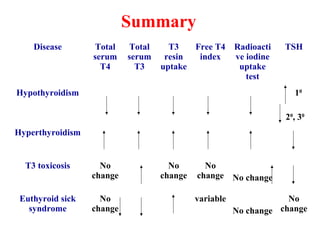
Summary
Disease Total
serum
T4
Total
serum
T3
T3
resin
uptake
Free T4
index
Radioacti
ve iodine
uptake
test
TSH
Hypothyroidism 10
20
, 30
Hyperthyroidism
T3 toxicosis No
change
No
change
No
change No change
Euthyroid sick
syndrome
No
change
variable
No change
No
change
Thank you

Thyroid function tests

  • 1.
  • 2.
    Introduction Thyroid hormones: tetra iodothyronine/ thyroxine (T4) tri iodothyronine (T3) Binds to: thyroxine binding globulin (TBG) thyroxine binding pre albumin (TBPA) albumin apolipoproteins Free fractions are metabolically active
  • 3.
    Differences between T3and T4 T3 T4 Secretion 30 microgram /day 80 microgram /day Source 20 – 25% by gland 75 - 80% by conversion Solely by gland Half-life 1 day 7 days Potency 3-4 times more potent than T4 Potent Binding 0.2% in unbound 0.02% in unbound
  • 4.
    Thyroid disorders Hypothyroidism  Primary Secondary  Tertiary Hyperthyroidism
  • 5.
    Thyroid disorders Symptoms ofhypothyroidism  Lethargy  Constipation  Dry and coarse skin and hair  Facial puffiness  Cold intolerance  Decreased sweating  Impaired memory  Confusion  Dementia  Low speech and motor activity  Anemia
  • 6.
    Thyroid disorders Causes ofhypothyroidism Primary Secondary Tertiary Iodine deficiency Excess iodide intake Thyroid ablation (Surgery) Hashimoto’s thyroiditis Sub acute thyroiditis Genetic abnormalities Goiterogenic food (cabbage) Drugs – Lithium – Amiodarone – Anti thyroid agents Hypopituitarism - Adenoma - Ablative therapy - Pituitary destruction Hypothalamic dysfunction
  • 7.
    Thyroid disorders Symptoms ofhyperthyroidism  Nervousness  Fatigue  Weight loss  Heat intolerance  Increased sweating  Tachycardia  Atrial fibrillation  Warm and moist skin  Exophthalmos
  • 8.
    Thyroid disorders Causes ofhyperthyroidism a) Overproduction of thyroid hormones a) Grave’s disease b) TSH secreting pituitary adenomas c) Multi nodular goiter b) Leaking thyroid hormone due to thyroid destruction a) Lymphocytic thyroiditis b) Sub acute thyroiditis c) Radiation c) Drugs a) Thyroid replacement drugs b) Amiodarone c) Iodinated radio contrast agents d) Metastatic thyroid carcinoma
  • 9.
    Thyroid tests Tests specificto thyroid status:  Measure the concentration of products secreted by the thyroid gland  Evaluate the integrity of the hypothalamic– pituitary- thyroid axis  Assess inherent thyroid gland function  Detect antibodies to thyroid tissue
  • 10.
    Thyroid tests Measure theconcentration of products secreted by the thyroid gland  Free T4  Total serum T4  Serum T3 resin uptake  Free T4 index  Total serum T3
  • 11.
    Thyroid tests Free T4: Referencerange: 0.8 - 2.7 nanogram/dl Measures unbound fraction of T4 Decreased direct equilibrium dialysis (method) T4 and increase TSH is suggestive of primary hypothyroidism Increase DED free T4 and TSH of less than 0.01 milliunits/L is suggestive of non-pituitary hyperthyroidism
  • 12.
    Thyroid tests Total serumT4: Reference range: 4 - 12 microgram/dl Measures both bound and free T4 Increased total serum T4 – hyperthyroidism/ increase concentration of thyroid binding proteins Decreased total serum T4 – hypothyroidism/decrease concentration of thyroid binding proteins/ non thyroid illness [DM, liver disease, renal failure, prolonged infection and CV diseases]
  • 13.
    Thyroid tests Serum T3resin uptake (thyroid hormone binding ratio): Reference range: 25 – 35% Indirectly estimates the number of binding sites on thyroid binding proteins occupied by T3 The T3 resin uptake is high when thyroid –binding protein is low and vice versa
  • 14.
    Thyroid tests Increase inT3 resin uptake - consistent with hyperthyroidism Decrease in T3 resin uptake - consistent with hypothyroidism This test is never used alone for diagnosis. In practice, the T3 resin uptake test is used only to calculate the free T4 index
  • 15.
    Thyroid tests Free thyroxine(T4) index: Reference range: 1.2 – 4.2 Free T4 index = Total serum T4 (mg/dl) X T3 resin uptake (%) The index is high in hyperthyroidism The index is low in hypothyroidism
  • 16.
    Thyroid tests Total serumT3: Reference range: 78 - 195 nanogram/dl Used to detect T3 toxicosis (increase T3 and normal T4)
  • 17.
    Thyroid tests Evaluate theintegrity of the hypothalamic – pituitary - thyroid axis: Assessed by measuring TSH and TRH
  • 18.
    Thyroid tests TSH: Ref range:0.3 - 5 microunits /ml or milliunits /L Symptomatic primary hypothyroidism: >20 mu/L Mild symptomatic hypothyroidism: 10 to 20 mu/L Primary hyperthyroidism: <0.05 mu/L
  • 19.
    Thyroid tests TRH: Regulates theTSH secretion from pituitary TRH test measure the ability of TRH to stimulate the pituitary to secrete TSH TSH rise of 5 micro units/ml over baseline - euthyroid state A significant increase rules out – hyperthyroidism Is performed by drawing baseline serum TSH concentration and then administer approximately 200-400 microgram of TRH by iv over 30 – 60 seconds. Then TSH concentration drawn at 30 – 60 minutes
  • 20.
    Thyroid tests Assess inherentthyroid gland function Radioactive iodine uptake test is used to assess intrinsic function of the thyroid gland This test is not specific and the reference range should be adjusted based on local population This test is indirect measure of thyroid activity
  • 21.
    Thyroid tests Subject withnormal thyroid gland  12 – 20% of radio active iodine is absorbed after 6 hours  5 - 25% of radio active iodine is absorbed after 24 hours
  • 22.
    Thyroid tests Increased radioactive iodine uptake noted in:  Thyrotoxicosis  Iodine deficiency  Post thyroiditis  Withdrawal rebound after thyroid hormone/ anti thyroid drug therapy Decreased radio active iodine uptake noted in:  Acute thyroiditis  Euthyroid patients  Patients on exogenous thyroid hormone therapy  Patients taking anti-thyroid drugs  hypothyroidism
  • 23.
    Thyroid tests Detect antibodiesto thyroid tissue (Anti thyroid antibodies) Found in Hashimoto’s thyroiditis (95% of patients) and Grave’s disease (55% of patients) Adults without thyroid disease (10% of adults) In Grave’s disease, hyperthyroidism is caused by antibodies activating TSH receptors In thyroiditis, hypothyroidism is caused by antibodies competitively binding to TSH receptors thus blocking the TSH from eliciting the response
  • 24.
    Summary Disease Total serum T4 Total serum T3 T3 resin uptake Free T4 index Radioacti veiodine uptake test TSH Hypothyroidism 10 20 , 30 Hyperthyroidism T3 toxicosis No change No change No change No change Euthyroid sick syndrome No change variable No change No change
  • 25.