VALIDATION OF ANALYTICAL PROCEDURES:
TEXT AND METHODOLOGY
Q2(R1)
Niha Sultana
Drug Regulatory Affairs
Evolet Healthcare
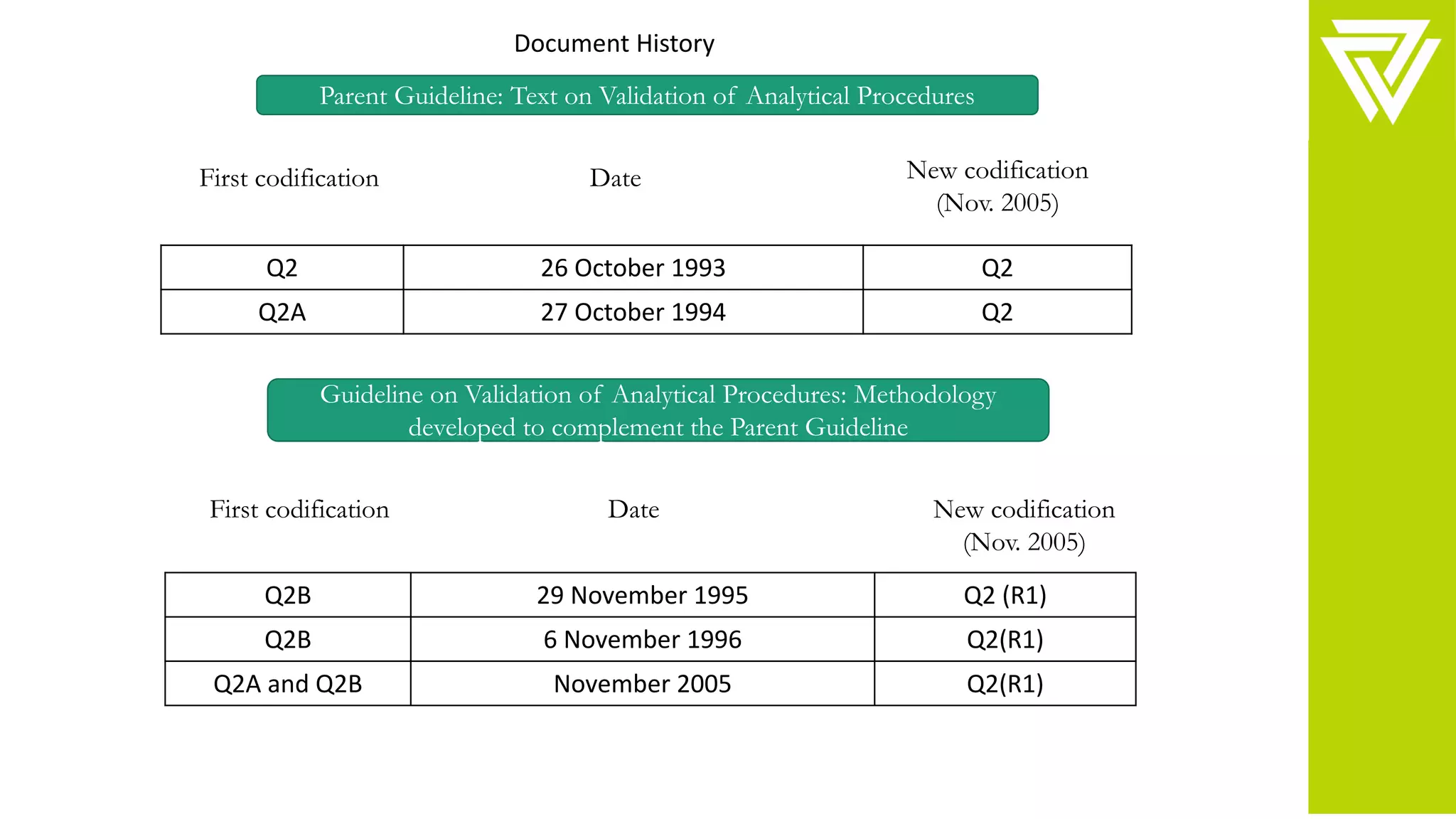
Parent Guideline: Text on Validation of Analytical Procedures
Guideline on Validation of Analytical Procedures: Methodology
developed to complement the Parent Guideline
First codification Date New codification
(Nov. 2005)
First codification Date New codification
(Nov. 2005)
Q2 26 October 1993 Q2
Q2A 27 October 1994 Q2
Q2B 29 November 1995 Q2 (R1)
Q2B 6 November 1996 Q2(R1)
Q2A and Q2B November 2005 Q2(R1)
Document History
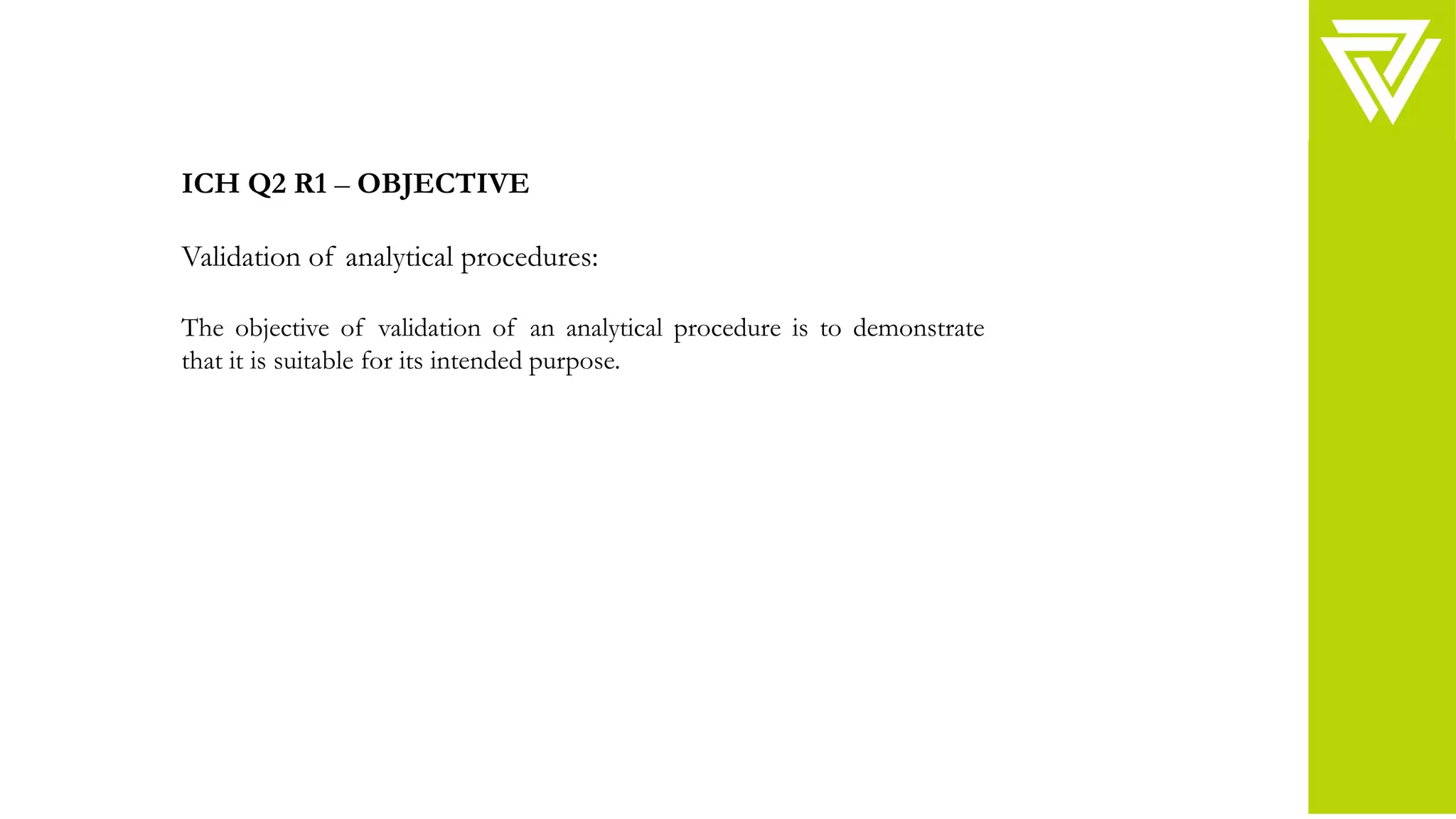
ICH Q2 R1 – OBJECTIVE
Validation of analytical procedures:
The objective of validation of an analytical procedure is to demonstrate
that it is suitable for its intended purpose.
Q2 (R1)PART I PART II
TEXT ON VALIDATION OF
ANALYTICAL
PROCEDURES
VALIDATION OF
ANALYTICAL
PROCEDURES:
METHODOLOGY
• Represents a discussion of
characteristics.
• Does not necessarily seek
testing.
• Collection of terms and
definition.
• complementary to the parent document
• Provides guidance and recommendations
• provides an indication of the data which
should be presented in a registration
application .
• various validation characteristics in distinct
sections.
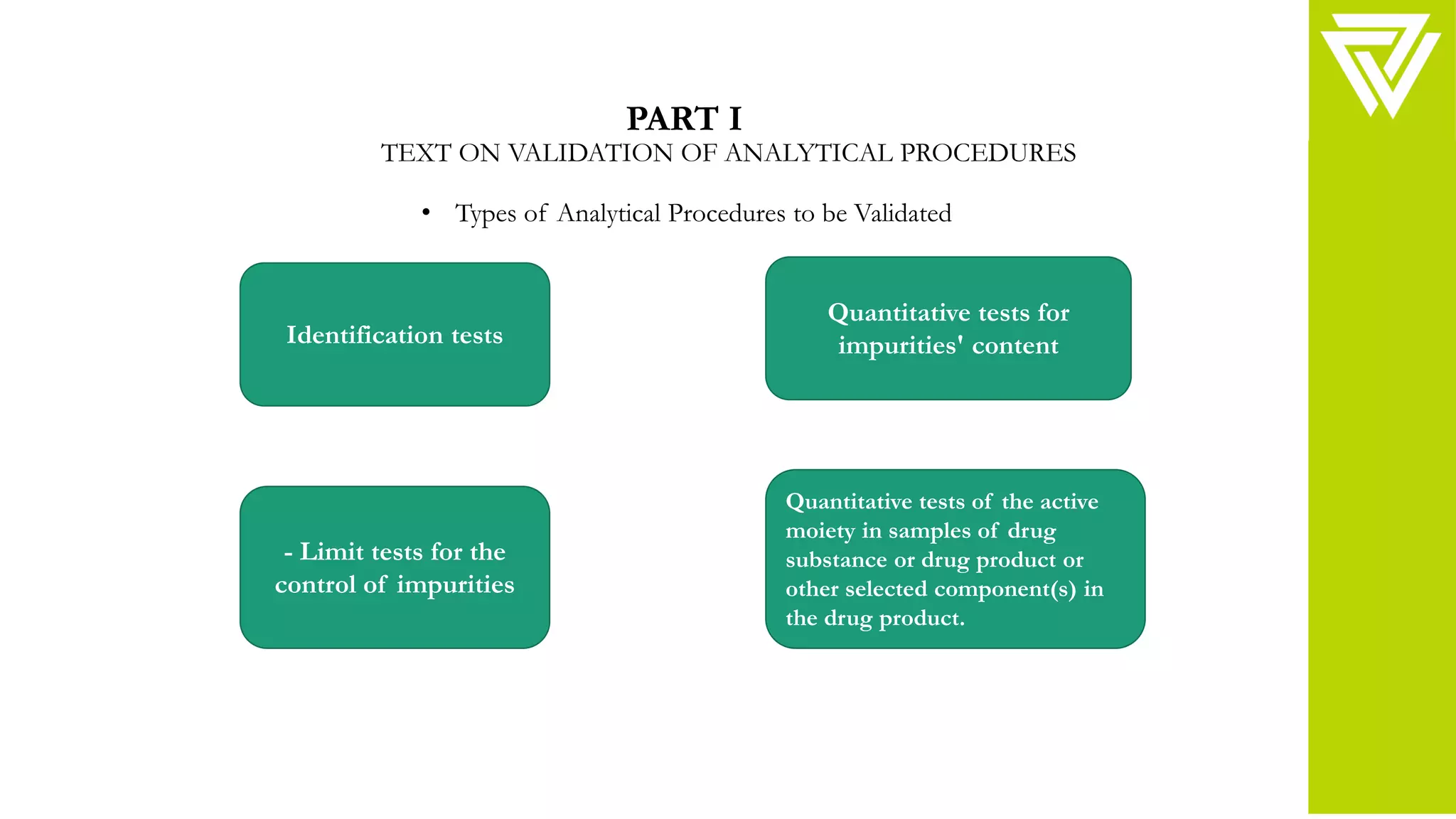
• Types of Analytical Procedures to be Validated
PART I
Identification tests
- Limit tests for the
control of impurities
Quantitative tests of the active
moiety in samples of drug
substance or drug product or
other selected component(s) in
the drug product.
Quantitative tests for
impurities' content
TEXT ON VALIDATION OF ANALYTICAL PROCEDURES
Typical validation characteristics which should be considered
Accuracy
Precision
-repeatability
-intermediate precision
Specificity
Detection limit
Quantitation
limit
Linearity limit
Range
Types of analytical
procedures
characteristics
Identification Testing of
impurities
Quantitation limit
Assay
-dissolution
-content/potency
Accuracy - + - +
Precision
-Repeatability
- int. presicision
-
-
+ -
+(1) -
+
+(1)
Specificity + + + +
Detection limit - -(3) + -
Quantitation limit - + - -
Linearity - + - +
Range - + - +
• - signifies that this characteristic is not normally evaluated.
• + signifies that this characteristic is normally evaluated.
• (1)in cases where reproducibility (see glossary) has been performed, intermediate precision is
not needed
• (2) lack of specificity of one analytical procedure could be compensated by other supporting
analytical procedure(s)
• (3) may be needed in some cases
TABLE
PART II
VALIDATION OF ANALYTICAL PROCEDURES: METHODOLOGY
1. SPECIFICITY
Specificity is the ability to assess unequivocally the analyte in the presence of
components which may be expected to be present.
This definition has the following implications:
 Identification: to ensure the identity of an analyte.
 Purity Tests: to ensure that all the analytical procedures performed allow an accurate
statement of the content of impurities of an analyte.
 Assay (content or potency): To provide an exact result which allows an accurate
statement on the content or potency of the analyte in a sample.
2. ACCURACY
The accuracy of an analytical procedure expresses the closeness of agreement between the
value which is accepted either as a conventional true value or an accepted reference value and
the value found.
This is sometimes termed trueness.
 Assay
-drug substance
-drug product
 Impurities (quantitation)
 Recommended data
-min. of 9 determinations over min of 3 conc. level (3 conc./3 replicates)
3. PRECISION
The precision of an analytical procedure expresses the closeness of agreement (degree of
scatter) between a series of measurements obtained from multiple sampling of the same
homogeneous sample under the prescribed conditions.
Precision may be considered at three levels:
 Repeatability
Repeatability expresses the precision under the same operating conditions over a short interval
of time.
Repeatability is also termed intra-assay precision .
 Intermediate precision
Intermediate precision expresses within-laboratories variations: different days, different analysts,
different equipment, etc.
 Reproducibility
Reproducibility expresses the precision between laboratories (collaborative studies, usually
applied to standardization of methodology).
4. DETECTION LIMIT
The detection limit of an individual analytical procedure is the lowest amount of analyte in a
sample which can be detected but not necessarily quantitated as an exact value.
 Based on Visual Evaluation
 Based on Signal-to-Noise
 Based on the Standard Deviation of the Response and the Slope
DL= 3.3 σ/S σ- standard deviation
S- slope
5. QUANTITATION LIMIT
The quantitation limit of an individual analytical procedure is the lowest amount of analyte
in a sample which can be quantitatively determined with suitable precision and accuracy. The
quantitation limit is a parameter of quantitative assays for low levels of compounds in
sample matrices, and is used particularly for the determination of impurities and/or
degradation products
 Based on Visual Evaluation
 Based on Signal-to-Noise
 Based on the Standard Deviation of the Response and the Slope
QL= 3.3 σ/S σ- standard deviation
S- slope
6. LINEARITY
The linearity of an analytical procedure is its ability (within a given range) to obtain test results
which are directly proportional to the concentration (amount) of analyte in the sample.
A linear relationship should be evaluated across the range (see section 3) of the analytical
procedure.
Linearity should be evaluated by visual inspection of a plot of signals as a function of analyte
concentration or content.
For the establishment of linearity, a minimum of 5 concentrations is recommended
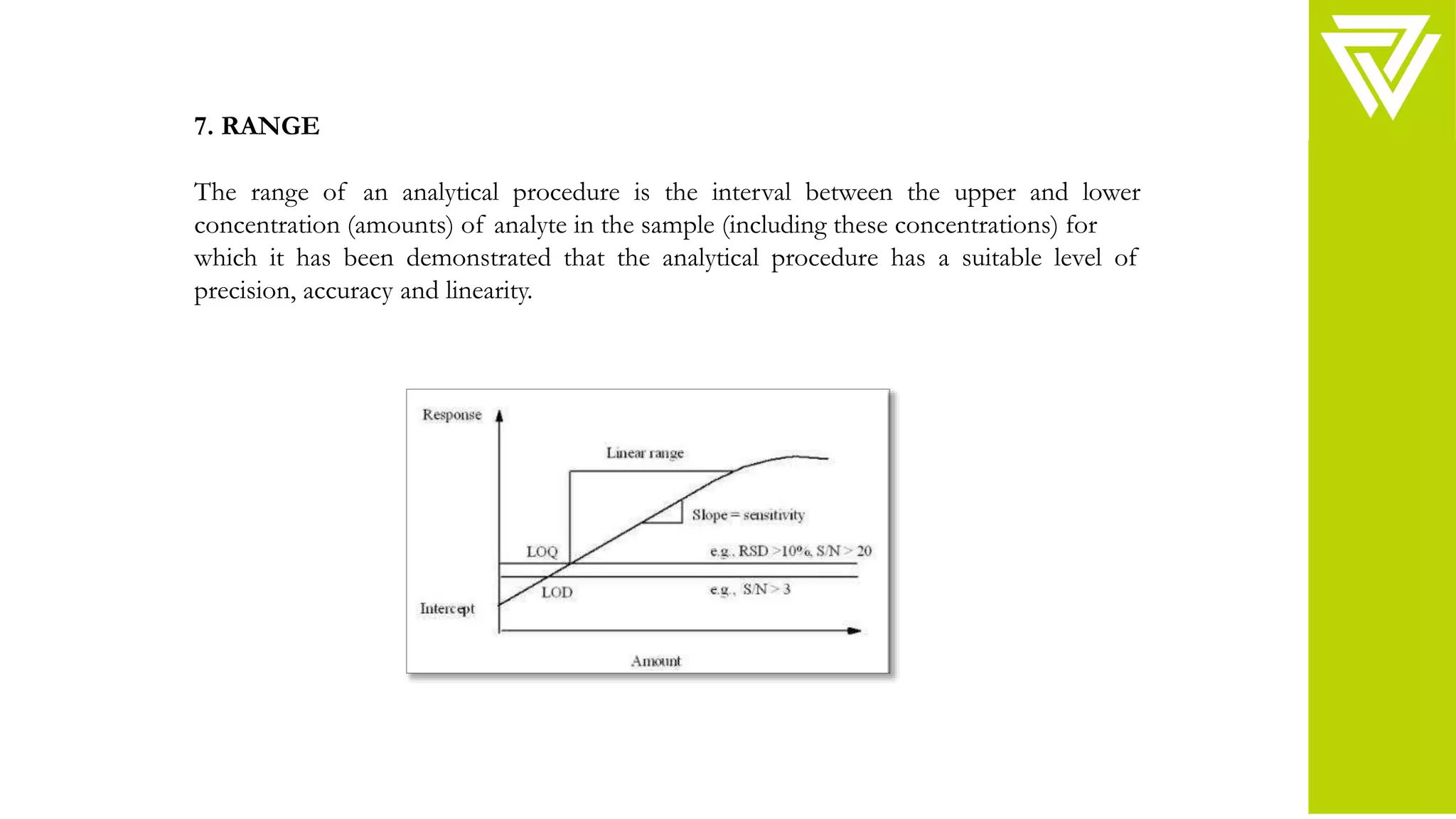
7. RANGE
The range of an analytical procedure is the interval between the upper and lower
concentration (amounts) of analyte in the sample (including these concentrations) for
which it has been demonstrated that the analytical procedure has a suitable level of
precision, accuracy and linearity.
8. ROBUSTNESS
The robustness of an analytical procedure is a measure of its capacity to remain unaffected by
small, but deliberate variations in method parameters and provides an indication of its reliability
during normal usage.
Examples of typical variations are:
- stability of analytical solutions;
- extraction time.
In the case of liquid chromatography, examples of typical variations are:
- influence of variations of pH in a mobile phase;
- influence of variations in mobile phase composition;
- different columns (different lots and/or suppliers);
- temperature;
- flow rate.
In the case of gas-chromatography, examples of typical variations are:
- different columns (different lots and/or suppliers);
- temperature;
- flow rate.
ICH-Q2 AMV

ICH-Q2 AMV

  • 1.
    VALIDATION OF ANALYTICALPROCEDURES: TEXT AND METHODOLOGY Q2(R1) Niha Sultana Drug Regulatory Affairs Evolet Healthcare
  • 2.
    Parent Guideline: Texton Validation of Analytical Procedures Guideline on Validation of Analytical Procedures: Methodology developed to complement the Parent Guideline First codification Date New codification (Nov. 2005) First codification Date New codification (Nov. 2005) Q2 26 October 1993 Q2 Q2A 27 October 1994 Q2 Q2B 29 November 1995 Q2 (R1) Q2B 6 November 1996 Q2(R1) Q2A and Q2B November 2005 Q2(R1) Document History
  • 3.
    ICH Q2 R1– OBJECTIVE Validation of analytical procedures: The objective of validation of an analytical procedure is to demonstrate that it is suitable for its intended purpose.
  • 4.
    Q2 (R1)PART IPART II TEXT ON VALIDATION OF ANALYTICAL PROCEDURES VALIDATION OF ANALYTICAL PROCEDURES: METHODOLOGY • Represents a discussion of characteristics. • Does not necessarily seek testing. • Collection of terms and definition. • complementary to the parent document • Provides guidance and recommendations • provides an indication of the data which should be presented in a registration application . • various validation characteristics in distinct sections.
  • 5.
    • Types ofAnalytical Procedures to be Validated PART I Identification tests - Limit tests for the control of impurities Quantitative tests of the active moiety in samples of drug substance or drug product or other selected component(s) in the drug product. Quantitative tests for impurities' content TEXT ON VALIDATION OF ANALYTICAL PROCEDURES
  • 6.
    Typical validation characteristicswhich should be considered Accuracy Precision -repeatability -intermediate precision Specificity Detection limit Quantitation limit Linearity limit Range
  • 7.
    Types of analytical procedures characteristics IdentificationTesting of impurities Quantitation limit Assay -dissolution -content/potency Accuracy - + - + Precision -Repeatability - int. presicision - - + - +(1) - + +(1) Specificity + + + + Detection limit - -(3) + - Quantitation limit - + - - Linearity - + - + Range - + - + • - signifies that this characteristic is not normally evaluated. • + signifies that this characteristic is normally evaluated. • (1)in cases where reproducibility (see glossary) has been performed, intermediate precision is not needed • (2) lack of specificity of one analytical procedure could be compensated by other supporting analytical procedure(s) • (3) may be needed in some cases TABLE
  • 8.
    PART II VALIDATION OFANALYTICAL PROCEDURES: METHODOLOGY 1. SPECIFICITY Specificity is the ability to assess unequivocally the analyte in the presence of components which may be expected to be present. This definition has the following implications:  Identification: to ensure the identity of an analyte.  Purity Tests: to ensure that all the analytical procedures performed allow an accurate statement of the content of impurities of an analyte.  Assay (content or potency): To provide an exact result which allows an accurate statement on the content or potency of the analyte in a sample.
  • 9.
    2. ACCURACY The accuracyof an analytical procedure expresses the closeness of agreement between the value which is accepted either as a conventional true value or an accepted reference value and the value found. This is sometimes termed trueness.  Assay -drug substance -drug product  Impurities (quantitation)  Recommended data -min. of 9 determinations over min of 3 conc. level (3 conc./3 replicates)
  • 10.
    3. PRECISION The precisionof an analytical procedure expresses the closeness of agreement (degree of scatter) between a series of measurements obtained from multiple sampling of the same homogeneous sample under the prescribed conditions. Precision may be considered at three levels:  Repeatability Repeatability expresses the precision under the same operating conditions over a short interval of time. Repeatability is also termed intra-assay precision .  Intermediate precision Intermediate precision expresses within-laboratories variations: different days, different analysts, different equipment, etc.  Reproducibility Reproducibility expresses the precision between laboratories (collaborative studies, usually applied to standardization of methodology).
  • 12.
    4. DETECTION LIMIT Thedetection limit of an individual analytical procedure is the lowest amount of analyte in a sample which can be detected but not necessarily quantitated as an exact value.  Based on Visual Evaluation  Based on Signal-to-Noise  Based on the Standard Deviation of the Response and the Slope DL= 3.3 σ/S σ- standard deviation S- slope
  • 13.
    5. QUANTITATION LIMIT Thequantitation limit of an individual analytical procedure is the lowest amount of analyte in a sample which can be quantitatively determined with suitable precision and accuracy. The quantitation limit is a parameter of quantitative assays for low levels of compounds in sample matrices, and is used particularly for the determination of impurities and/or degradation products  Based on Visual Evaluation  Based on Signal-to-Noise  Based on the Standard Deviation of the Response and the Slope QL= 3.3 σ/S σ- standard deviation S- slope
  • 14.
    6. LINEARITY The linearityof an analytical procedure is its ability (within a given range) to obtain test results which are directly proportional to the concentration (amount) of analyte in the sample. A linear relationship should be evaluated across the range (see section 3) of the analytical procedure. Linearity should be evaluated by visual inspection of a plot of signals as a function of analyte concentration or content. For the establishment of linearity, a minimum of 5 concentrations is recommended
  • 15.
    7. RANGE The rangeof an analytical procedure is the interval between the upper and lower concentration (amounts) of analyte in the sample (including these concentrations) for which it has been demonstrated that the analytical procedure has a suitable level of precision, accuracy and linearity.
  • 16.
    8. ROBUSTNESS The robustnessof an analytical procedure is a measure of its capacity to remain unaffected by small, but deliberate variations in method parameters and provides an indication of its reliability during normal usage. Examples of typical variations are: - stability of analytical solutions; - extraction time. In the case of liquid chromatography, examples of typical variations are: - influence of variations of pH in a mobile phase; - influence of variations in mobile phase composition; - different columns (different lots and/or suppliers); - temperature; - flow rate. In the case of gas-chromatography, examples of typical variations are: - different columns (different lots and/or suppliers); - temperature; - flow rate.