FORMING PROCESS
OPEN DIE FORGING AND
CLOSED DIE FORGING
N PRAKASAN
ME METALLURGY
FORGING PROCESSESFORGING PROCESSES
The two broad categories of Forging
processes are,
1) Open Die Forging
2) Closed Die Forging
(or Impression die forging)
1) Open Die Forging1) Open Die Forging
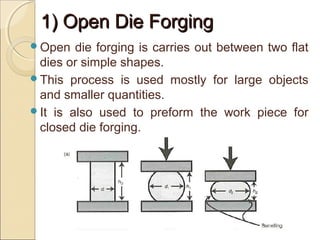
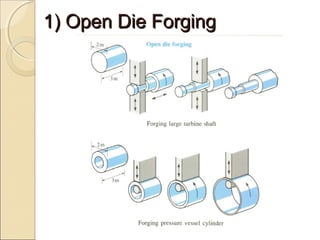
Open die forging is carries out between two flat
dies or simple shapes.
This process is used mostly for large objects
and smaller quantities.
It is also used to preform the work piece for
closed die forging.
1) Open Die Forging1) Open Die Forging
Advantages
Simple, inexpensive dies; wide
range of sizes; good strength
Limitations
Simple shapes only; difficult to
hold close tolerances;
machining necessary; low
production rate; poor utilization
of material; high skill required
2) Closed Die Forging2) Closed Die Forging
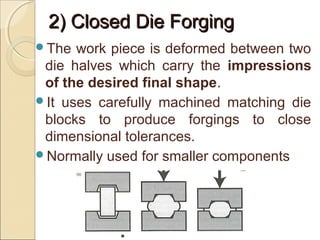
The work piece is deformed between two
die halves which carry the impressions
of the desired final shape.
It uses carefully machined matching die
blocks to produce forgings to close
dimensional tolerances.
Normally used for smaller components
2) Closed Die Forging2) Closed Die Forging
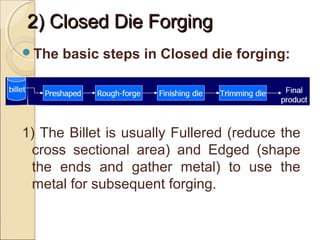
The basic steps in Closed die forging:
1) The Billet is usually Fullered (reduce the
cross sectional area) and Edged (shape
the ends and gather metal) to use the
metal for subsequent forging.
2) Closed Die Forging2) Closed Die Forging
2) The pre-shaped billet is placed in the cavity of
the blocking die and rough – forged to the final
shape. The greatest change in the shape of the
metal occurs in this step.
3) The part is transferred to the finishing die to
forge to get final shape and dimensions.
4) Removal of Flash with a trimming die.
Forging dies must be tapered to facilitate removal of
the finished part. This draft allowance is approximately 5O
for steel forgings.
2) Closed Die Forging2) Closed Die Forging
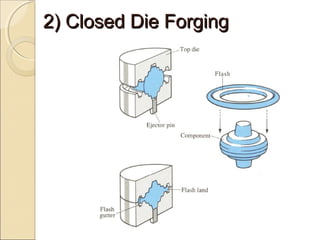
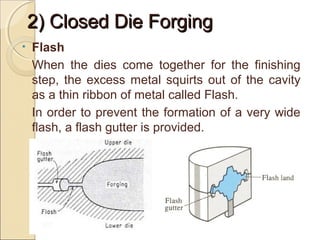
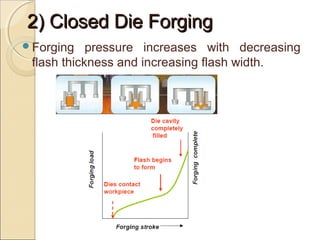
• Flash
When the dies come together for the finishing
step, the excess metal squirts out of the cavity
as a thin ribbon of metal called Flash.
In order to prevent the formation of a very wide
flash, a flash gutter is provided.
2) Closed Die Forging2) Closed Die Forging
Purposes of Flash
• Flash regulates the escape of metal and thus
thin flash increases the flow resistance of the
system so that the pressure builds up to high
values to ensure that metal fills all recesses of
the die cavity.
• Flash acts as a ‘safety valve’ for excess metal
in the closed die cavity.
2) Closed Die Forging2) Closed Die Forging
Forging pressure increases with decreasing
flash thickness and increasing flash width.
2) Closed Die Forging2) Closed Die Forging
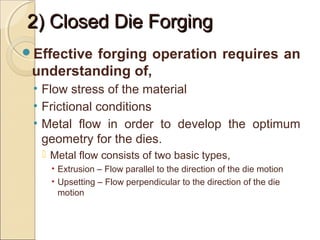
Effective forging operation requires an
understanding of,
• Flow stress of the material
• Frictional conditions
• Metal flow in order to develop the optimum
geometry for the dies.
 Metal flow consists of two basic types,
• Extrusion – Flow parallel to the direction of the die motion
• Upsetting – Flow perpendicular to the direction of the die
motion
2) Closed Die Forging2) Closed Die Forging
• Closed die design:
The design of a part for production by closed die
forging involves the prediction of,
• Work piece volume and weight
• Number of preforming steps and their
configuration
• Flash dimensions in preforming and finishing
dies
• The load and energy requirement for each
forging operation
2) Closed Die Forging2) Closed Die Forging
Advantages
Good utilization of material; better
properties than open die forging;
good dimensional accuracy; high
production rate; good
reproducibility
Limitations
High die cost for small quantities;
machining often necessary
2) Closed Die Forging2) Closed Die Forging
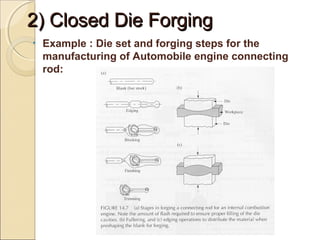
• Example : Die set and forging steps for the
manufacturing of Automobile engine connecting
rod:
References:References:
Mechanical Metallurgy by Dieter, G.E.
Lecture Notes, Suranaree university of
technology

Forming process forging

  • 1.
    FORMING PROCESS OPEN DIEFORGING AND CLOSED DIE FORGING N PRAKASAN ME METALLURGY
  • 2.
    FORGING PROCESSESFORGING PROCESSES Thetwo broad categories of Forging processes are, 1) Open Die Forging 2) Closed Die Forging (or Impression die forging)
  • 3.
    1) Open DieForging1) Open Die Forging Open die forging is carries out between two flat dies or simple shapes. This process is used mostly for large objects and smaller quantities. It is also used to preform the work piece for closed die forging.
  • 4.
    1) Open DieForging1) Open Die Forging
  • 5.
    1) Open DieForging1) Open Die Forging Advantages Simple, inexpensive dies; wide range of sizes; good strength Limitations Simple shapes only; difficult to hold close tolerances; machining necessary; low production rate; poor utilization of material; high skill required
  • 6.
    2) Closed DieForging2) Closed Die Forging The work piece is deformed between two die halves which carry the impressions of the desired final shape. It uses carefully machined matching die blocks to produce forgings to close dimensional tolerances. Normally used for smaller components
  • 7.
    2) Closed DieForging2) Closed Die Forging
  • 8.
    2) Closed DieForging2) Closed Die Forging The basic steps in Closed die forging: 1) The Billet is usually Fullered (reduce the cross sectional area) and Edged (shape the ends and gather metal) to use the metal for subsequent forging.
  • 9.
    2) Closed DieForging2) Closed Die Forging 2) The pre-shaped billet is placed in the cavity of the blocking die and rough – forged to the final shape. The greatest change in the shape of the metal occurs in this step. 3) The part is transferred to the finishing die to forge to get final shape and dimensions. 4) Removal of Flash with a trimming die. Forging dies must be tapered to facilitate removal of the finished part. This draft allowance is approximately 5O for steel forgings.
  • 10.
    2) Closed DieForging2) Closed Die Forging • Flash When the dies come together for the finishing step, the excess metal squirts out of the cavity as a thin ribbon of metal called Flash. In order to prevent the formation of a very wide flash, a flash gutter is provided.
  • 11.
    2) Closed DieForging2) Closed Die Forging Purposes of Flash • Flash regulates the escape of metal and thus thin flash increases the flow resistance of the system so that the pressure builds up to high values to ensure that metal fills all recesses of the die cavity. • Flash acts as a ‘safety valve’ for excess metal in the closed die cavity.
  • 12.
    2) Closed DieForging2) Closed Die Forging Forging pressure increases with decreasing flash thickness and increasing flash width.
  • 13.
    2) Closed DieForging2) Closed Die Forging Effective forging operation requires an understanding of, • Flow stress of the material • Frictional conditions • Metal flow in order to develop the optimum geometry for the dies.  Metal flow consists of two basic types, • Extrusion – Flow parallel to the direction of the die motion • Upsetting – Flow perpendicular to the direction of the die motion
  • 14.
    2) Closed DieForging2) Closed Die Forging • Closed die design: The design of a part for production by closed die forging involves the prediction of, • Work piece volume and weight • Number of preforming steps and their configuration • Flash dimensions in preforming and finishing dies • The load and energy requirement for each forging operation
  • 15.
    2) Closed DieForging2) Closed Die Forging Advantages Good utilization of material; better properties than open die forging; good dimensional accuracy; high production rate; good reproducibility Limitations High die cost for small quantities; machining often necessary
  • 16.
    2) Closed DieForging2) Closed Die Forging • Example : Die set and forging steps for the manufacturing of Automobile engine connecting rod:
  • 17.
    References:References: Mechanical Metallurgy byDieter, G.E. Lecture Notes, Suranaree university of technology