Addition and Subtraction
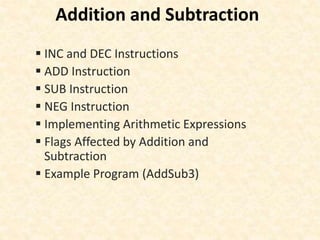
 INC and DEC Instructions
 ADD Instruction
 SUB Instruction
 NEG Instruction
 Implementing Arithmetic Expressions
 Flags Affected by Addition and
Subtraction
 Example Program (AddSub3)
INC and DEC Instructions
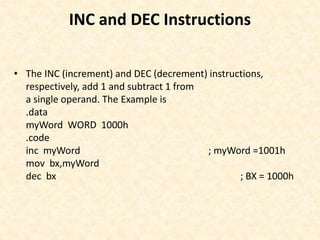
• The INC (increment) and DEC (decrement) instructions,
respectively, add 1 and subtract 1 from
a single operand. The Example is
.data
myWord WORD 1000h
.code
inc myWord ; myWord =1001h
mov bx,myWord
dec bx ; BX = 1000h
ADD Instruction
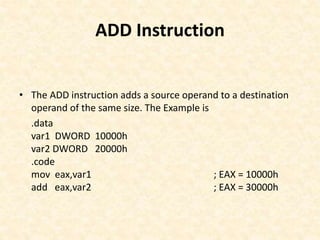
• The ADD instruction adds a source operand to a destination
operand of the same size. The Example is
.data
var1 DWORD 10000h
var2 DWORD 20000h
.code
mov eax,var1 ; EAX = 10000h
add eax,var2 ; EAX = 30000h
SUB Instruction
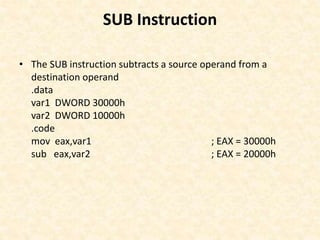
• The SUB instruction subtracts a source operand from a
destination operand
.data
var1 DWORD 30000h
var2 DWORD 10000h
.code
mov eax,var1 ; EAX = 30000h
sub eax,var2 ; EAX = 20000h
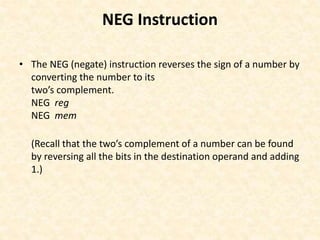
NEG Instruction
• The NEG (negate) instruction reverses the sign of a number by
converting the number to its
two’s complement.
NEG reg
NEG mem
(Recall that the two’s complement of a number can be found
by reversing all the bits in the destination operand and adding
1.)
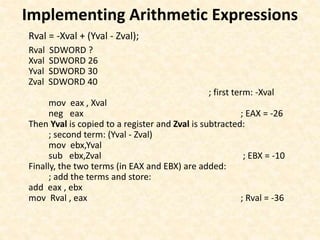
Implementing Arithmetic Expressions
Rval = -Xval + (Yval - Zval);
Rval SDWORD ?
Xval SDWORD 26
Yval SDWORD 30
Zval SDWORD 40
; first term: -Xval
mov eax , Xval
neg eax ; EAX = -26
Then Yval is copied to a register and Zval is subtracted:
; second term: (Yval - Zval)
mov ebx,Yval
sub ebx,Zval ; EBX = -10
Finally, the two terms (in EAX and EBX) are added:
; add the terms and store:
add eax , ebx
mov Rval , eax ; Rval = -36
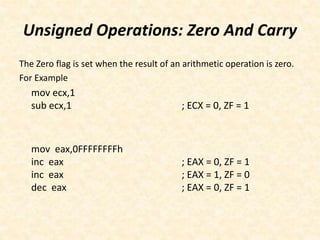
Unsigned Operations: Zero And Carry
The Zero flag is set when the result of an arithmetic operation is zero.
For Example
mov ecx,1
sub ecx,1 ; ECX = 0, ZF = 1
mov eax,0FFFFFFFFh
inc eax ; EAX = 0, ZF = 1
inc eax ; EAX = 1, ZF = 0
dec eax ; EAX = 0, ZF = 1
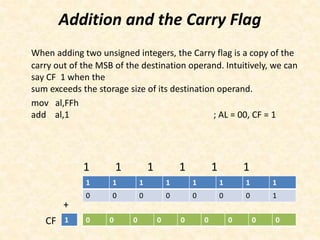
Addition and the Carry Flag
When adding two unsigned integers, the Carry flag is a copy of the
carry out of the MSB of the destination operand. Intuitively, we can
say CF 1 when the
sum exceeds the storage size of its destination operand.
mov al,FFh
add al,1 ; AL = 00, CF = 1
1 1 1 1 1 1
+
CF
1 1 1 1 1 1 1 1
0 0 0 0 0 0 0 1
0 0 0 0 0 0 0 0 01
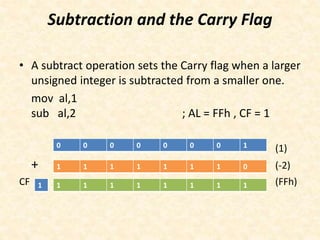
Subtraction and the Carry Flag
• A subtract operation sets the Carry flag when a larger
unsigned integer is subtracted from a smaller one.
mov al,1
sub al,2 ; AL = FFh , CF = 1
(1)
+ (-2)
CF (FFh)
0 0 0 0 0 0 0 1
1 1 1 1 1 1 1 0
1 1 1 1 1 1 1 11
Signed Operations: Sign and Overflow
Flags
The Sign flag is set when the result of a signed arithmetic operation
is negative.
mov eax,4
sub eax,5 ; EAX = -1, SF = 1
Overflow Flag
largest possible integer signed byte value is +127 ; adding 1 to it
causes overflow:
mov al,+127
add al,1 ; OF = 1
the smallest possible negative integer byte value is 128. Subtracting
1 from it causes
underflow.
mov al,-128
sub al,1 ; OF = 1

Assembly language (addition and subtraction)

  • 1.
    Addition and Subtraction INC and DEC Instructions  ADD Instruction  SUB Instruction  NEG Instruction  Implementing Arithmetic Expressions  Flags Affected by Addition and Subtraction  Example Program (AddSub3)
  • 2.
    INC and DECInstructions • The INC (increment) and DEC (decrement) instructions, respectively, add 1 and subtract 1 from a single operand. The Example is .data myWord WORD 1000h .code inc myWord ; myWord =1001h mov bx,myWord dec bx ; BX = 1000h
  • 3.
    ADD Instruction • TheADD instruction adds a source operand to a destination operand of the same size. The Example is .data var1 DWORD 10000h var2 DWORD 20000h .code mov eax,var1 ; EAX = 10000h add eax,var2 ; EAX = 30000h
  • 4.
    SUB Instruction • TheSUB instruction subtracts a source operand from a destination operand .data var1 DWORD 30000h var2 DWORD 10000h .code mov eax,var1 ; EAX = 30000h sub eax,var2 ; EAX = 20000h
  • 5.
    NEG Instruction • TheNEG (negate) instruction reverses the sign of a number by converting the number to its two’s complement. NEG reg NEG mem (Recall that the two’s complement of a number can be found by reversing all the bits in the destination operand and adding 1.)
  • 6.
    Implementing Arithmetic Expressions Rval= -Xval + (Yval - Zval); Rval SDWORD ? Xval SDWORD 26 Yval SDWORD 30 Zval SDWORD 40 ; first term: -Xval mov eax , Xval neg eax ; EAX = -26 Then Yval is copied to a register and Zval is subtracted: ; second term: (Yval - Zval) mov ebx,Yval sub ebx,Zval ; EBX = -10 Finally, the two terms (in EAX and EBX) are added: ; add the terms and store: add eax , ebx mov Rval , eax ; Rval = -36
  • 7.
    Unsigned Operations: ZeroAnd Carry The Zero flag is set when the result of an arithmetic operation is zero. For Example mov ecx,1 sub ecx,1 ; ECX = 0, ZF = 1 mov eax,0FFFFFFFFh inc eax ; EAX = 0, ZF = 1 inc eax ; EAX = 1, ZF = 0 dec eax ; EAX = 0, ZF = 1
  • 8.
    Addition and theCarry Flag When adding two unsigned integers, the Carry flag is a copy of the carry out of the MSB of the destination operand. Intuitively, we can say CF 1 when the sum exceeds the storage size of its destination operand. mov al,FFh add al,1 ; AL = 00, CF = 1 1 1 1 1 1 1 + CF 1 1 1 1 1 1 1 1 0 0 0 0 0 0 0 1 0 0 0 0 0 0 0 0 01
  • 9.
    Subtraction and theCarry Flag • A subtract operation sets the Carry flag when a larger unsigned integer is subtracted from a smaller one. mov al,1 sub al,2 ; AL = FFh , CF = 1 (1) + (-2) CF (FFh) 0 0 0 0 0 0 0 1 1 1 1 1 1 1 1 0 1 1 1 1 1 1 1 11
  • 10.
    Signed Operations: Signand Overflow Flags The Sign flag is set when the result of a signed arithmetic operation is negative. mov eax,4 sub eax,5 ; EAX = -1, SF = 1 Overflow Flag largest possible integer signed byte value is +127 ; adding 1 to it causes overflow: mov al,+127 add al,1 ; OF = 1 the smallest possible negative integer byte value is 128. Subtracting 1 from it causes underflow. mov al,-128 sub al,1 ; OF = 1