Quotient Ring
Let I be an ideal of a ring R then the set R/I = { a + I : aϵ R } is called cosets of I in R is
A ring called Quotient ring where addition and multiplication are defined as
(a + I ) + (b + I) = (a + b) + I a , b ϵ R
(a + I ) + (b + I) = ab + I a , b ϵ R
Note
(i) If R is a commutative ring with unity then R/I is also a commutative ring with
unity
(ii) 1 + I is the multiplicative identity of R/I and 0 + I = I is the additive identity of R/I
Theorem
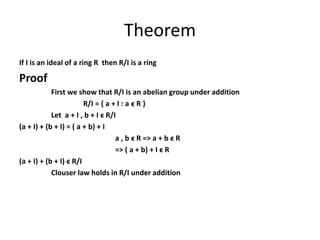
If I is an ideal of a ring R then R/I is a ring
Proof
First we show that R/I is an abelian group under addition
R/I = { a + I : a ϵ R }
Let a + I , b + I ϵ R/I
(a + I) + (b + I) = ( a + b) + I
a , b ϵ R => a + b ϵ R
=> ( a + b) + I ϵ R
(a + I) + (b + I) ϵ R/I
Clouser law holds in R/I under addition
Now
let ( a + I) , (b + I) , (c + I) ϵ R/I ; a , b , c ϵ R
( a + I) , (b + I) , (c + I) = ( a + I) , (b + I) + I
= [ a + (b + c )] + I
= [ ( a + b ) + c ] + I
= ( a + b) + I + (c + I)
= [ (a + I ) + (b + I )] + ( c + I)
Thus associative law holds in R/I under addition
Since 0 ϵ R thus 0 + I ϵ R/I
a + I ϵ R/I
(0 + I) + ( a + I) = ( 0 + a ) + I = a + I
and
(a + I) + ( 0 + I ) = ( a + I ) + I = a + I
a ϵ R ; - a ϵ R (R is ring)
Thus a + I ϵ R/I and ( - a) + I ϵ R/I
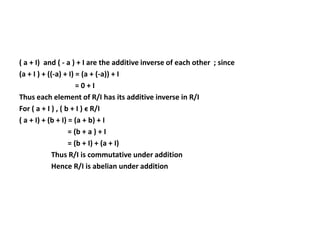
( a + I) and ( - a ) + I are the additive inverse of each other ; since
(a + I ) + ((-a) + I) = (a + (-a)) + I
= 0 + I
Thus each element of R/I has its additive inverse in R/I
For ( a + I ) , ( b + I ) ϵ R/I
( a + I) + (b + I) = (a + b) + I
= (b + a ) + I
= (b + I) + (a + I)
Thus R/I is commutative under addition
Hence R/I is abelian under addition
now we show that R/I is semi group under multiplication
Let
(a + I) , (b + I) ϵ R/I a , b ϵ R
(a + I)(b + I ) = ab + I
since a , b ϵ R => ab ϵ R
Thus ab + I ϵ R/I
I . e (a + I ) (b + I) ϵ R/I
Clouser law holds in R/I under multiplication
For (a + I) , (b + I) , (c + I) ϵ R/I a,b,c ϵ R
(a + I) [ (b + I)(c + I)] = (a + I) (bc + I)
= a (bc) + I
= (ab) c + I
= (ab +I) (c + I)
Thus associative law holds in R/I under multiplication
Hence R/I is semi group under multiplication
Now we show that both left and right distributive laws holds in R/I
Let
(a + I) , (b + I) , (c + I) ϵ R/I for a,b,c ϵ R
and
(a + I) [ (b + I) + (c + I)] = (a + I) [ (b + c) + I ]
= a ( b + c ) + I
= (ab + I ) + (ac + I )
=(a + I ) ( b + I ) + ( a + I )( c + I )
Left distributive law holds in R/I
Also
[ (b + I) + (c + I)] (a + I) = [ (b + c ) + I ] (a + I)
= (b + c)a + I
= (ba + ca) + I
= (ba + I ) + (ca + I)
= (b + I)(a + I) + (c + I) (a + I)
Right distributive law holds in R/I
Hence R/I is a ring
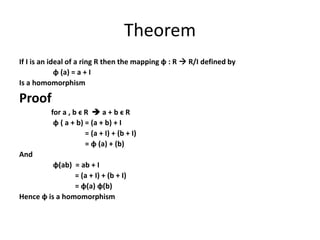
Theorem
If I is an ideal of a ring R then the mapping ɸ : R  R/I defined by
ɸ (a) = a + I
Is a homomorphism
Proof
for a , b ϵ R  a + b ϵ R
ɸ ( a + b) = (a + b) + I
= (a + I) + (b + I)
= ɸ (a) + (b)
And
ɸ(ab) = ab + I
= (a + I) + (b + I)
= ɸ(a) ɸ(b)
Hence ɸ is a homomorphism
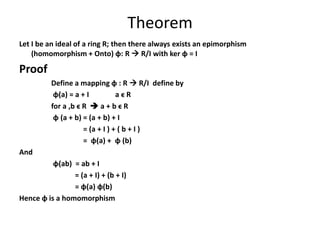
Theorem
Let I be an ideal of a ring R; then there always exists an epimorphism
(homomorphism + Onto) ɸ: R  R/I with ker ɸ = I
Proof
Define a mapping ɸ : R  R/I define by
ɸ(a) = a + I a ϵ R
for a ,b ϵ R  a + b ϵ R
ɸ (a + b) = (a + b) + I
= (a + I ) + ( b + I )
= ɸ(a) + ɸ (b)
And
ɸ(ab) = ab + I
= (a + I) + (b + I)
= ɸ(a) ɸ(b)
Hence ɸ is a homomorphism
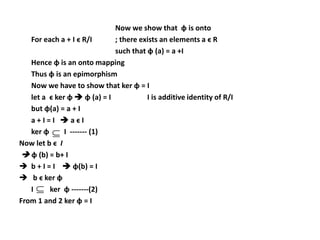
Now we show that ɸ is onto
For each a + I ϵ R/I ; there exists an elements a ϵ R
such that ɸ (a) = a +I
Hence ɸ is an onto mapping
Thus ɸ is an epimorphism
Now we have to show that ker ɸ = I
let a ϵ ker ɸ  ɸ (a) = I I is additive identity of R/I
but ɸ(a) = a + I
a + I = I  a ϵ I
ker ɸ I ------- (1)
Now let b ϵ I
 ɸ (b) = b+ I
 b + I = I  ɸ(b) = I
 b ϵ ker ɸ
I ker ɸ -------(2)
From 1 and 2 ker ɸ = I


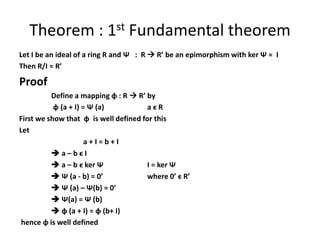
Theorem : 1st Fundamental theorem
Let I be an ideal of a ring R and Ѱ : R  R’ be an epimorphism with ker Ѱ = I
Then R/I ≈ R’
Proof
Define a mapping ɸ : R  R’ by
ɸ (a + I) = Ѱ (a) a ϵ R
First we show that ɸ is well defined for this
Let
a + I = b + I
 a – b ϵ I
 a – b ϵ ker Ѱ I = ker Ѱ
 Ѱ (a - b) = 0’ where 0’ ϵ R’
 Ѱ (a) – Ѱ(b) = 0’
 Ѱ(a) = Ѱ (b)
 ɸ (a + I) = ɸ (b+ I)
hence ɸ is well defined
To show that ɸ is homomorphism let
ɸ [(a + I ) + ( b + I ) ] = ɸ [ (a + b) + I ]
= Ѱ (a + b )
= Ѱ(a) + Ѱ (b)
= ɸ(a + I ) + ɸ ( b + I )
Also
ɸ[(a + I)(b + I)] = ɸ [ab + I]
= Ѱ (ab)
= Ѱ(a) + Ѱ(b)
= ɸ(a + I) ɸ(b + I)
Thus ɸ is a homomorphism
To show that ɸ is onto
Let r’ ϵ R’ be any element of R
Since Ѱ is onto (epimorphism) there exists an elements r ϵ R such that Ѱ (r) = r’
 ɸ (r + I) = r’
Thus there will be exists an element r + I ϵ R/I
Such that ɸ (r + I) = r’
ɸ is onto
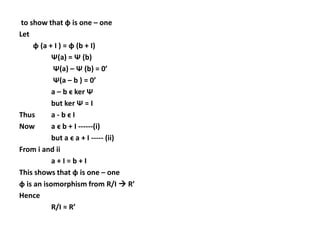
to show that ɸ is one – one
Let
ɸ (a + I ) = ɸ (b + I)
Ѱ(a) = Ѱ (b)
Ѱ(a) – Ѱ (b) = 0’
Ѱ(a – b ) = 0’
a – b ϵ ker Ѱ
but ker Ѱ = I
Thus a - b ϵ I
Now a ϵ b + I ------(i)
but a ϵ a + I ----- (ii)
From i and ii
a + I = b + I
This shows that ɸ is one – one
ɸ is an isomorphism from R/I  R’
Hence
R/I ≈ R’

Quotient ring

  • 1.
    Quotient Ring Let Ibe an ideal of a ring R then the set R/I = { a + I : aϵ R } is called cosets of I in R is A ring called Quotient ring where addition and multiplication are defined as (a + I ) + (b + I) = (a + b) + I a , b ϵ R (a + I ) + (b + I) = ab + I a , b ϵ R Note (i) If R is a commutative ring with unity then R/I is also a commutative ring with unity (ii) 1 + I is the multiplicative identity of R/I and 0 + I = I is the additive identity of R/I
  • 2.
    Theorem If I isan ideal of a ring R then R/I is a ring Proof First we show that R/I is an abelian group under addition R/I = { a + I : a ϵ R } Let a + I , b + I ϵ R/I (a + I) + (b + I) = ( a + b) + I a , b ϵ R => a + b ϵ R => ( a + b) + I ϵ R (a + I) + (b + I) ϵ R/I Clouser law holds in R/I under addition
  • 3.
    Now let ( a+ I) , (b + I) , (c + I) ϵ R/I ; a , b , c ϵ R ( a + I) , (b + I) , (c + I) = ( a + I) , (b + I) + I = [ a + (b + c )] + I = [ ( a + b ) + c ] + I = ( a + b) + I + (c + I) = [ (a + I ) + (b + I )] + ( c + I) Thus associative law holds in R/I under addition Since 0 ϵ R thus 0 + I ϵ R/I a + I ϵ R/I (0 + I) + ( a + I) = ( 0 + a ) + I = a + I and (a + I) + ( 0 + I ) = ( a + I ) + I = a + I a ϵ R ; - a ϵ R (R is ring) Thus a + I ϵ R/I and ( - a) + I ϵ R/I
  • 4.
    ( a +I) and ( - a ) + I are the additive inverse of each other ; since (a + I ) + ((-a) + I) = (a + (-a)) + I = 0 + I Thus each element of R/I has its additive inverse in R/I For ( a + I ) , ( b + I ) ϵ R/I ( a + I) + (b + I) = (a + b) + I = (b + a ) + I = (b + I) + (a + I) Thus R/I is commutative under addition Hence R/I is abelian under addition
  • 5.
    now we showthat R/I is semi group under multiplication Let (a + I) , (b + I) ϵ R/I a , b ϵ R (a + I)(b + I ) = ab + I since a , b ϵ R => ab ϵ R Thus ab + I ϵ R/I I . e (a + I ) (b + I) ϵ R/I Clouser law holds in R/I under multiplication For (a + I) , (b + I) , (c + I) ϵ R/I a,b,c ϵ R (a + I) [ (b + I)(c + I)] = (a + I) (bc + I) = a (bc) + I = (ab) c + I = (ab +I) (c + I) Thus associative law holds in R/I under multiplication Hence R/I is semi group under multiplication
  • 6.
    Now we showthat both left and right distributive laws holds in R/I Let (a + I) , (b + I) , (c + I) ϵ R/I for a,b,c ϵ R and (a + I) [ (b + I) + (c + I)] = (a + I) [ (b + c) + I ] = a ( b + c ) + I = (ab + I ) + (ac + I ) =(a + I ) ( b + I ) + ( a + I )( c + I ) Left distributive law holds in R/I Also [ (b + I) + (c + I)] (a + I) = [ (b + c ) + I ] (a + I) = (b + c)a + I = (ba + ca) + I = (ba + I ) + (ca + I) = (b + I)(a + I) + (c + I) (a + I) Right distributive law holds in R/I Hence R/I is a ring
  • 7.
    Theorem If I isan ideal of a ring R then the mapping ɸ : R  R/I defined by ɸ (a) = a + I Is a homomorphism Proof for a , b ϵ R  a + b ϵ R ɸ ( a + b) = (a + b) + I = (a + I) + (b + I) = ɸ (a) + (b) And ɸ(ab) = ab + I = (a + I) + (b + I) = ɸ(a) ɸ(b) Hence ɸ is a homomorphism
  • 8.
    Theorem Let I bean ideal of a ring R; then there always exists an epimorphism (homomorphism + Onto) ɸ: R  R/I with ker ɸ = I Proof Define a mapping ɸ : R  R/I define by ɸ(a) = a + I a ϵ R for a ,b ϵ R  a + b ϵ R ɸ (a + b) = (a + b) + I = (a + I ) + ( b + I ) = ɸ(a) + ɸ (b) And ɸ(ab) = ab + I = (a + I) + (b + I) = ɸ(a) ɸ(b) Hence ɸ is a homomorphism
  • 9.
    Now we showthat ɸ is onto For each a + I ϵ R/I ; there exists an elements a ϵ R such that ɸ (a) = a +I Hence ɸ is an onto mapping Thus ɸ is an epimorphism Now we have to show that ker ɸ = I let a ϵ ker ɸ  ɸ (a) = I I is additive identity of R/I but ɸ(a) = a + I a + I = I  a ϵ I ker ɸ I ------- (1) Now let b ϵ I  ɸ (b) = b+ I  b + I = I  ɸ(b) = I  b ϵ ker ɸ I ker ɸ -------(2) From 1 and 2 ker ɸ = I  
  • 10.
    Theorem : 1stFundamental theorem Let I be an ideal of a ring R and Ѱ : R  R’ be an epimorphism with ker Ѱ = I Then R/I ≈ R’ Proof Define a mapping ɸ : R  R’ by ɸ (a + I) = Ѱ (a) a ϵ R First we show that ɸ is well defined for this Let a + I = b + I  a – b ϵ I  a – b ϵ ker Ѱ I = ker Ѱ  Ѱ (a - b) = 0’ where 0’ ϵ R’  Ѱ (a) – Ѱ(b) = 0’  Ѱ(a) = Ѱ (b)  ɸ (a + I) = ɸ (b+ I) hence ɸ is well defined
  • 11.
    To show thatɸ is homomorphism let ɸ [(a + I ) + ( b + I ) ] = ɸ [ (a + b) + I ] = Ѱ (a + b ) = Ѱ(a) + Ѱ (b) = ɸ(a + I ) + ɸ ( b + I ) Also ɸ[(a + I)(b + I)] = ɸ [ab + I] = Ѱ (ab) = Ѱ(a) + Ѱ(b) = ɸ(a + I) ɸ(b + I) Thus ɸ is a homomorphism To show that ɸ is onto Let r’ ϵ R’ be any element of R Since Ѱ is onto (epimorphism) there exists an elements r ϵ R such that Ѱ (r) = r’  ɸ (r + I) = r’ Thus there will be exists an element r + I ϵ R/I Such that ɸ (r + I) = r’ ɸ is onto
  • 12.
    to show thatɸ is one – one Let ɸ (a + I ) = ɸ (b + I) Ѱ(a) = Ѱ (b) Ѱ(a) – Ѱ (b) = 0’ Ѱ(a – b ) = 0’ a – b ϵ ker Ѱ but ker Ѱ = I Thus a - b ϵ I Now a ϵ b + I ------(i) but a ϵ a + I ----- (ii) From i and ii a + I = b + I This shows that ɸ is one – one ɸ is an isomorphism from R/I  R’ Hence R/I ≈ R’