Recursion
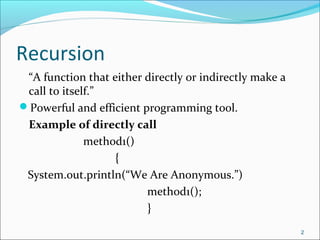
“A function that either directly or indirectly make a
call to itself.”
Powerful and efficient programming tool.
Example of directly call
method1()
{
System.out.println(“We Are Anonymous.”)
method1();
}
2
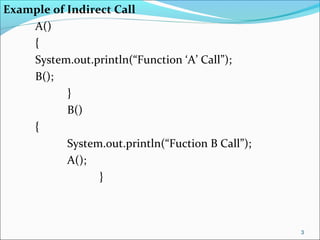
Example of Indirect Call
A()
{
System.out.println(“Function ‘A’ Call”);
B();
}
B()
{
System.out.println(“Fuction B Call”);
A();
}
3
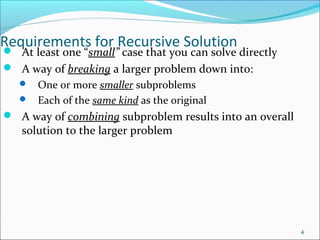
Requirements for Recursive Solution
 At least one “small” case that you can solve directly
 A way of breaking a larger problem down into:
 One or more smaller subproblems
 Each of the same kind as the original
 A way of combining subproblem results into an overall
solution to the larger problem
4
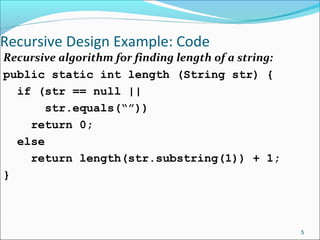
Recursive Design Example: Code
Recursive algorithm for finding length of a string:
public static int length (String str) {
if (str == null ||
str.equals(“”))
return 0;
else
return length(str.substring(1)) + 1;
}
5
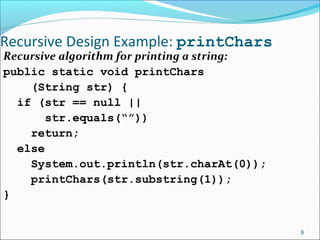
Recursive Design Example: printChars
Recursive algorithm for printing a string:
public static void printChars
(String str) {
if (str == null ||
str.equals(“”))
return;
else
System.out.println(str.charAt(0));
printChars(str.substring(1));
}
6
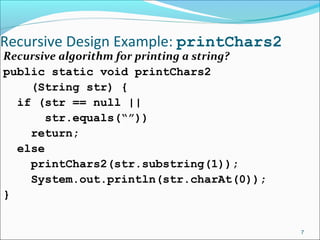
Recursive Design Example: printChars2
Recursive algorithm for printing a string?
public static void printChars2
(String str) {
if (str == null ||
str.equals(“”))
return;
else
printChars2(str.substring(1));
System.out.println(str.charAt(0));
}
7
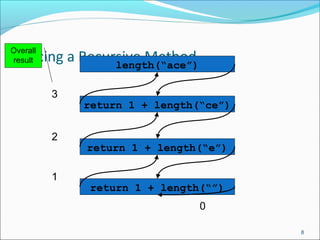
Tracing a Recursive Method
8
length(“ace”)
return 1 + length(“ce”)
return 1 + length(“e”)
return 1 + length(“”)
0
1
2
3
Overall
result
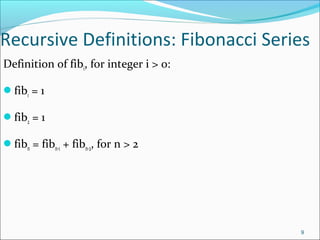
Recursive Definitions: Fibonacci Series
Definition of fibi, for integer i > 0:
fib1 = 1
fib2 = 1
fibn = fibn-1 + fibn-2, for n > 2
9
Fibonacci Series Code
public static int fib (int n) {
if (n <= 2)
return 1;
else
return fib(n-1) + fib(n-2);
}
This is straightforward, but an inefficient recursion ...
10
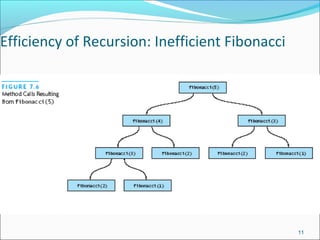
Efficiency of Recursion: Inefficient Fibonacci
11

Recursion

  • 2.
    Recursion “A function thateither directly or indirectly make a call to itself.” Powerful and efficient programming tool. Example of directly call method1() { System.out.println(“We Are Anonymous.”) method1(); } 2
  • 3.
    Example of IndirectCall A() { System.out.println(“Function ‘A’ Call”); B(); } B() { System.out.println(“Fuction B Call”); A(); } 3
  • 4.
    Requirements for RecursiveSolution  At least one “small” case that you can solve directly  A way of breaking a larger problem down into:  One or more smaller subproblems  Each of the same kind as the original  A way of combining subproblem results into an overall solution to the larger problem 4
  • 5.
    Recursive Design Example:Code Recursive algorithm for finding length of a string: public static int length (String str) { if (str == null || str.equals(“”)) return 0; else return length(str.substring(1)) + 1; } 5
  • 6.
    Recursive Design Example:printChars Recursive algorithm for printing a string: public static void printChars (String str) { if (str == null || str.equals(“”)) return; else System.out.println(str.charAt(0)); printChars(str.substring(1)); } 6
  • 7.
    Recursive Design Example:printChars2 Recursive algorithm for printing a string? public static void printChars2 (String str) { if (str == null || str.equals(“”)) return; else printChars2(str.substring(1)); System.out.println(str.charAt(0)); } 7
  • 8.
    Tracing a RecursiveMethod 8 length(“ace”) return 1 + length(“ce”) return 1 + length(“e”) return 1 + length(“”) 0 1 2 3 Overall result
  • 9.
    Recursive Definitions: FibonacciSeries Definition of fibi, for integer i > 0: fib1 = 1 fib2 = 1 fibn = fibn-1 + fibn-2, for n > 2 9
  • 10.
    Fibonacci Series Code publicstatic int fib (int n) { if (n <= 2) return 1; else return fib(n-1) + fib(n-2); } This is straightforward, but an inefficient recursion ... 10
  • 11.
    Efficiency of Recursion:Inefficient Fibonacci 11