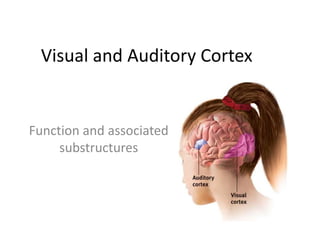
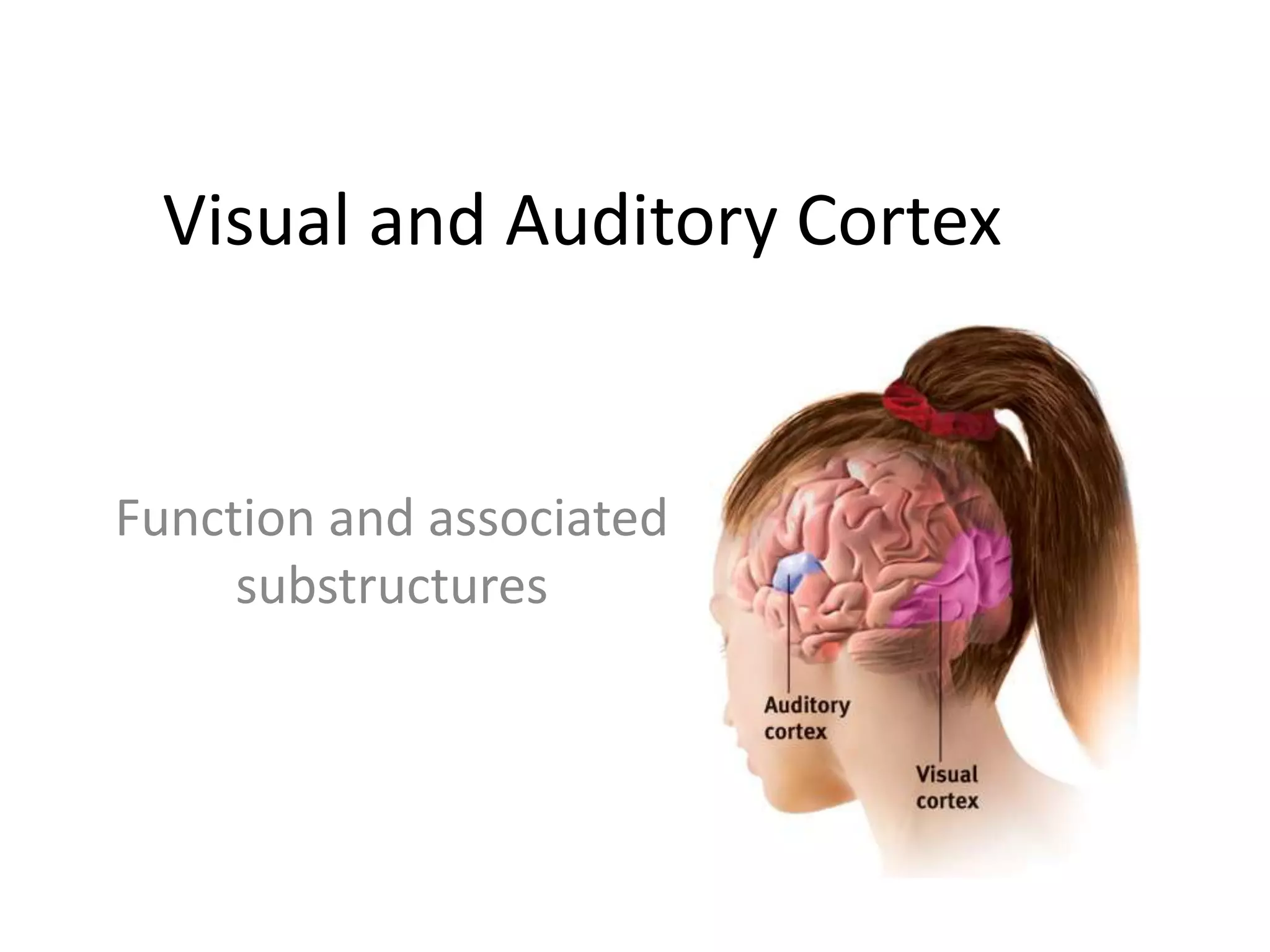
Visual and Auditory CortexFunction and associated substructures
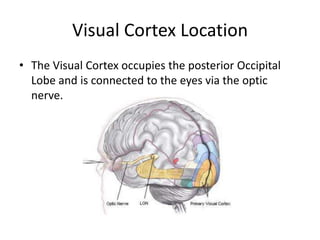
Visual Cortex LocationThe Visual Cortex occupies the posterior Occipital Lobe and is connected to the eyes via the optic nerve.
FunctionThe Primary Visual Cortex (PVC) is highly specialized for processing information about static and moving objects and is excellent in pattern recognition.The PVC contains a number of specialized regions that process such things as color, spatial information, depth, texture, and motion.We will cover this region in greater depth in our Sensation and Perception Unit.
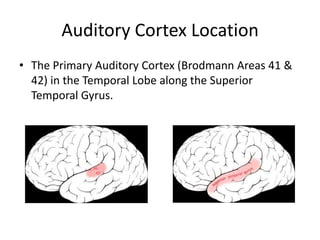
Auditory Cortex LocationThe Primary Auditory Cortex (Brodmann Areas 41 & 42) in the Temporal Lobe along the Superior Temporal Gyrus.
FunctionThe Primary Auditory Cortex (PAC) performs the basics of hearing; pitch and volume.It is important to remember that the perception of sound, as something that carries meaning (ie. Speech, music, car horn), does not take place in the PAC but through the processes of PAC in conjunction with other association areas.
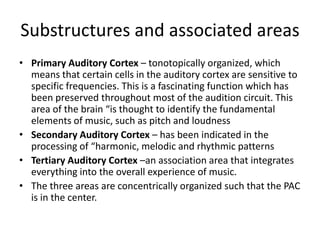
Substructures and associated areasPrimary Auditory Cortex – tonotopically organized, which means that certain cells in the auditory cortex are sensitive to specific frequencies. This is a fascinating function which has been preserved throughout most of the audition circuit. This area of the brain “is thought to identify the fundamental elements of music, such as pitch and loudnessSecondary Auditory Cortex – has been indicated in the processing of “harmonic, melodic and rhythmic patternsTertiary Auditory Cortex –an association area that integrates everything into the overall experience of music.The three areas are concentrically organized such that the PAC is in the center.
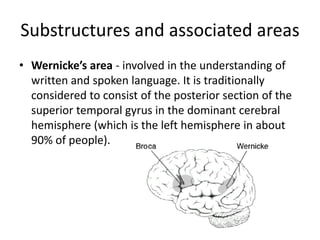
Substructures and associated areasWernicke’s area - involved in the understanding of written and spoken language. It is traditionally considered to consist of the posterior section of the superior temporal gyrus in the dominant cerebral hemisphere (which is the left hemisphere in about 90% of people).
Substructures and associated areasMiddle Temporal Gyrus - located between the superior temporal gyrus and inferior temporal gyrus. Its exact function is unknown, but it has been connected with processes as different as contemplating distance, recognition of known faces, and accessing word meaning while reading.FusiformGyrus - Some researchers believe that the fusiformgyrus may be related to the disorder known as prosopagnosia, or face blindness
Follow-up QuestionThe FusiformGyrus, located within the medial/inferior temporal lobe, is adjacent to both the Tertiary Auditory Cortex and areas of the Third Visual Complex (V3) and seems to play a large role in face recognition. Explain the relationship between the location of the FusiformGyrusand its function.Would a rose by any other name really smell as sweet?

Visual and auditory cortex

  • 1.
    Visual and AuditoryCortexFunction and associated substructures
  • 2.
    Visual Cortex LocationTheVisual Cortex occupies the posterior Occipital Lobe and is connected to the eyes via the optic nerve.
  • 3.
    FunctionThe Primary VisualCortex (PVC) is highly specialized for processing information about static and moving objects and is excellent in pattern recognition.The PVC contains a number of specialized regions that process such things as color, spatial information, depth, texture, and motion.We will cover this region in greater depth in our Sensation and Perception Unit.
  • 4.
    Auditory Cortex LocationThePrimary Auditory Cortex (Brodmann Areas 41 & 42) in the Temporal Lobe along the Superior Temporal Gyrus.
  • 5.
    FunctionThe Primary AuditoryCortex (PAC) performs the basics of hearing; pitch and volume.It is important to remember that the perception of sound, as something that carries meaning (ie. Speech, music, car horn), does not take place in the PAC but through the processes of PAC in conjunction with other association areas.
  • 6.
    Substructures and associatedareasPrimary Auditory Cortex – tonotopically organized, which means that certain cells in the auditory cortex are sensitive to specific frequencies. This is a fascinating function which has been preserved throughout most of the audition circuit. This area of the brain “is thought to identify the fundamental elements of music, such as pitch and loudnessSecondary Auditory Cortex – has been indicated in the processing of “harmonic, melodic and rhythmic patternsTertiary Auditory Cortex –an association area that integrates everything into the overall experience of music.The three areas are concentrically organized such that the PAC is in the center.
  • 7.
    Substructures and associatedareasWernicke’s area - involved in the understanding of written and spoken language. It is traditionally considered to consist of the posterior section of the superior temporal gyrus in the dominant cerebral hemisphere (which is the left hemisphere in about 90% of people).
  • 8.
    Substructures and associatedareasMiddle Temporal Gyrus - located between the superior temporal gyrus and inferior temporal gyrus. Its exact function is unknown, but it has been connected with processes as different as contemplating distance, recognition of known faces, and accessing word meaning while reading.FusiformGyrus - Some researchers believe that the fusiformgyrus may be related to the disorder known as prosopagnosia, or face blindness
  • 9.
    Follow-up QuestionThe FusiformGyrus,located within the medial/inferior temporal lobe, is adjacent to both the Tertiary Auditory Cortex and areas of the Third Visual Complex (V3) and seems to play a large role in face recognition. Explain the relationship between the location of the FusiformGyrusand its function.Would a rose by any other name really smell as sweet?