Function of cerebral cortex
in
hearing
General information
• The cerebral cortex is the outer covering of
gray matter over the hemispheres.
• Certain cortical regions have somewhat
simpler functions, termed the primary
cortices.
• These include areas directly receiving sensory
input (vision, hearing, somatic sensation) or
directly involved in production of limb or eye
movements
FUNCTION OF THE AUDITORY CORTEX
• Primary auditory cortex (AI)
• Secondary auditory cortex (AII)
• The belt region
 Primary auditory cortex:
• composed of neurons involved in decoding the cochleotopic and tonotopic
spatial representation of a stimulus.
• the part of the temporal lobe that processes auditory information in humans.
 Secondary auditory cortex:
• which doesn't have clear tonotopic organization but has an important role in
sound localization and analysis of complex sounds: in particular for specific
animal vocalizations and human language.
• It also has a role in auditory memory.
 The belt region:
• surrounding AI and AII, which helps to integrate hearing with other sensory
systems
Functions Primary auditory area
• Primary auditory area is concerned with perception of auditory
impulses, analysis of pitch and determination of intensity and source of
sound.
• Area 41 and 42 are concerned only with the perception of auditory
sensation (sound).
• Wernicke area is responsible for the interpretation of auditory
sensation.
• It carries out this function with the help of secondary auditory area 22.
• Wernicke area is also responsible for understanding the auditory
information about any word and sending the information to Broca
area.
MAIN FUNCTION OF PRIMARY AUDITORY CORTEX
• The neurons in the primary auditory cortex are
organized tonotopically, meaning that the
neurons in the auditory cortex react best to
specific frequencies.
• At one end of the auditory cortex, neurons react
best to low frequencies.
• the other end, they react to high frequencies.
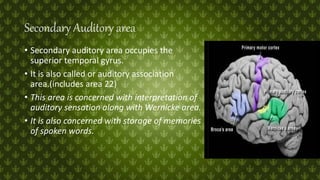
Secondary Auditory area
• Secondary auditory area occupies the
superior temporal gyrus.
• It is also called or auditory association
area.(includes area 22)
• This area is concerned with interpretation of
auditory sensation along with Wernicke area.
• It is also concerned with storage of memories
of spoken words.
Auditory Brain
• Auditory messages are conveyed to the brain via two types of pathway:
1. PRIMARY AUDITORY PATHWAYS
2. NON-PRIMARY PATHWAYS
• primary auditory pathway which exclusively carries messages from the
cochlea.
• non-primary pathway (also called the reticular sensory pathway) which
carries all types of sensory messages.
PRIMARY AUDITORY PATHWAYS
COCHLEA
COCHLEAR NUCLEI
SUPERIOR OLIVE
INFERIOR COLLICULUS
THALAMUS
AUDITORY CORTEX
NON-PRIMARY PATHWAYS
COCHLEA
COCHLEAR NUCLEI
RETICULAR FORMATION
THALAMUS (NON SPECIFIC)
CORTEX LIMBIC CORTEX HYPOTHALAMUS
WAKE EMOTIONAL MOTIVATION
Area for equilibrium
• Area for equilibrium is in the posterior part of superior
temporal gyrus.
• It is concerned with the maintenance of equilibrium of
the body.
• Stimulation of the area causes dizziness, swaying,
falling and feeling of rotation.
Damage to the Primary Auditory Cortex
• If the whole primary auditory area is damaged, a
person will not be aware of what he hears.
• Yet, an ability to react reflexively to sounds
remains. There are extensive connections from
both ears to both the left and right primary
auditory cortexes.
• person who has had a lesion on one side of the
auditory cortex only, is able to discriminate sound
frequencies quite well.
• Because each primary auditory cortex is mainly
responsible for localizing sounds on the opposite
side.
Teja robba pcc

Teja robba pcc

  • 1.
    Function of cerebralcortex in hearing
  • 2.
    General information • Thecerebral cortex is the outer covering of gray matter over the hemispheres. • Certain cortical regions have somewhat simpler functions, termed the primary cortices. • These include areas directly receiving sensory input (vision, hearing, somatic sensation) or directly involved in production of limb or eye movements
  • 3.
    FUNCTION OF THEAUDITORY CORTEX • Primary auditory cortex (AI) • Secondary auditory cortex (AII) • The belt region
  • 4.
     Primary auditorycortex: • composed of neurons involved in decoding the cochleotopic and tonotopic spatial representation of a stimulus. • the part of the temporal lobe that processes auditory information in humans.  Secondary auditory cortex: • which doesn't have clear tonotopic organization but has an important role in sound localization and analysis of complex sounds: in particular for specific animal vocalizations and human language. • It also has a role in auditory memory.  The belt region: • surrounding AI and AII, which helps to integrate hearing with other sensory systems
  • 5.
    Functions Primary auditoryarea • Primary auditory area is concerned with perception of auditory impulses, analysis of pitch and determination of intensity and source of sound. • Area 41 and 42 are concerned only with the perception of auditory sensation (sound). • Wernicke area is responsible for the interpretation of auditory sensation. • It carries out this function with the help of secondary auditory area 22. • Wernicke area is also responsible for understanding the auditory information about any word and sending the information to Broca area.
  • 6.
    MAIN FUNCTION OFPRIMARY AUDITORY CORTEX • The neurons in the primary auditory cortex are organized tonotopically, meaning that the neurons in the auditory cortex react best to specific frequencies. • At one end of the auditory cortex, neurons react best to low frequencies. • the other end, they react to high frequencies.
  • 7.
    Secondary Auditory area •Secondary auditory area occupies the superior temporal gyrus. • It is also called or auditory association area.(includes area 22) • This area is concerned with interpretation of auditory sensation along with Wernicke area. • It is also concerned with storage of memories of spoken words.
  • 8.
    Auditory Brain • Auditorymessages are conveyed to the brain via two types of pathway: 1. PRIMARY AUDITORY PATHWAYS 2. NON-PRIMARY PATHWAYS • primary auditory pathway which exclusively carries messages from the cochlea. • non-primary pathway (also called the reticular sensory pathway) which carries all types of sensory messages.
  • 9.
    PRIMARY AUDITORY PATHWAYS COCHLEA COCHLEARNUCLEI SUPERIOR OLIVE INFERIOR COLLICULUS THALAMUS AUDITORY CORTEX
  • 10.
    NON-PRIMARY PATHWAYS COCHLEA COCHLEAR NUCLEI RETICULARFORMATION THALAMUS (NON SPECIFIC) CORTEX LIMBIC CORTEX HYPOTHALAMUS WAKE EMOTIONAL MOTIVATION
  • 11.
    Area for equilibrium •Area for equilibrium is in the posterior part of superior temporal gyrus. • It is concerned with the maintenance of equilibrium of the body. • Stimulation of the area causes dizziness, swaying, falling and feeling of rotation.
  • 12.
    Damage to thePrimary Auditory Cortex • If the whole primary auditory area is damaged, a person will not be aware of what he hears. • Yet, an ability to react reflexively to sounds remains. There are extensive connections from both ears to both the left and right primary auditory cortexes. • person who has had a lesion on one side of the auditory cortex only, is able to discriminate sound frequencies quite well. • Because each primary auditory cortex is mainly responsible for localizing sounds on the opposite side.