





















B. Isogloss, Dialect, Idiolect &
Vernacular
Presented by:
Robbie Liza E. Caytiles
University of Antique
College of Teacher Education
Graduate Studies
Sibalom, Antique
Lit.216 SOCIOLINGUISTICS (Current Trends and Principles of Teaching English
III. Language Variation and Change or Language Attrition
Thank you, Lord, for another successful class.
We thank you for our teachers who have shared their time and expertise with us.
We thank you for our classmates who were our partners in this learning sessions.
We are blessed that in spite of the pandemic, we are able to learn and meet one
another online.
Thank you for providing a means for us to study through the use of technology.
All of these things are not possible without you.
May you continue blessing us with your Divine Wisdom,
so we could continue to learn while healing.
Grant all those who are sick to get well again, and those who are well to stay that
way.
Grant that we could be able to continue learning successfully.
May you bless all those who had made this class possible; the admins, the teachers,
and everyone who have contributed to the success of our learning process.
We ask all these, in your mighty name.
Isogloss, Dialect,
Idiolect & Vernacular
Presented by:
Robbie Liza E. Caytiles
University of Antique
College of Teacher Education
Graduate Studies
Sibalom, Antique
Lit.216 SOCIOLINGUISTICS (Current Trends and Principles of Teaching English
III. Language Variation and Change or Language Attrition
a. Pidgin/Creole
b. Isogloss, Dialect, Idiolect & Vernacular
c. Standard Language
d. Language and Social Variables
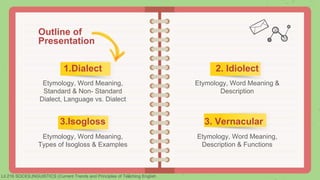
Outline of
Presentation
1.Dialect
Etymology, Word Meaning,
Standard & Non- Standard
Dialect, Language vs. Dialect
2. Idiolect
Etymology, Word Meaning &
Description
3.Isogloss
Etymology, Word Meaning,
Types of Isogloss & Examples
3. Vernacular
Etymology, Word Meaning,
Description & Functions
Lit.216 SOCIOLINGUISTICS (Current Trends and Principles of Teaching English
-RALPH WALDO EMERSON,
“Language is a city to
the building of which
every human being
brought a stone.”
01
DIALECT
All you need to know…
1.Go to www.menti.com
2. Input the code: 2223 2052
3. Answer the question above by placing
your answers on the box.
4. You are given 5 chances to answer.
5. Duplication of answer is fine 
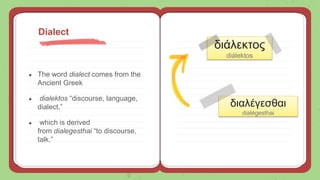
● The word dialect comes from the
Ancient Greek
● dialektos “discourse, language,
dialect,”
● which is derived
from dialegesthai “to discourse,
talk.”
Dialect
διαλέγεσθαι
dialégesthai
διάλεκτος
diálektos
Dialect
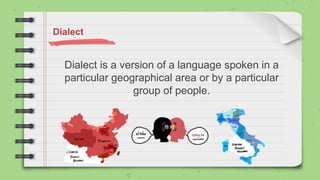
Dialect is a version of a language spoken in a
particular geographical area or by a particular
group of people.
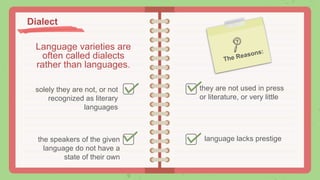
Language varieties are
often called dialects
rather than languages.
solely they are not, or not
recognized as literary
languages
they are not used in press
or literature, or very little
the speakers of the given
language do not have a
state of their own
language lacks prestige
Dialect
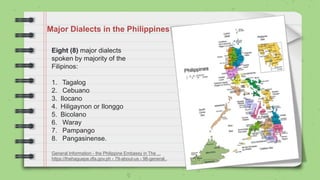
Major Dialects in the Philippines
General Information - the Philippine Embassy in The ...
https://thehaguepe.dfa.gov.ph › 79-about-us › 98-general..
Eight (8) major dialects
spoken by majority of the
Filipinos:
1. Tagalog
2. Cebuano
3. Ilocano
4. Hiligaynon or Ilonggo
5. Bicolano
6. Waray
7. Pampango
8. Pangasinense.
Why is mother
tongue called
“mother
tongue”?
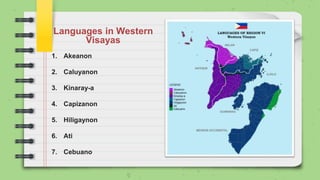
Languages in Western
Visayas
1. Akeanon
2. Caluyanon
3. Kinaray-a
4. Capizanon
5. Hiligaynon
6. Ati
7. Cebuano
Dialect
Dialect
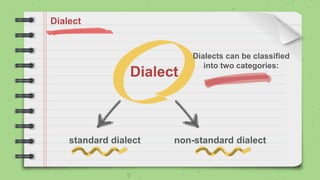
Dialects can be classified
into two categories:
standard dialect non-standard dialect
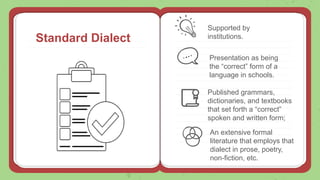
Standard Dialect
Supported by
institutions.
Presentation as being
the “correct” form of a
language in schools.
Published grammars,
dictionaries, and textbooks
that set forth a “correct”
spoken and written form;
An extensive formal
literature that employs that
dialect in prose, poetry,
non-fiction, etc.
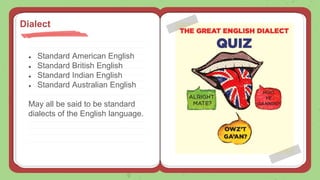
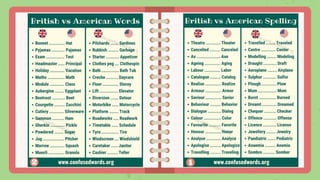
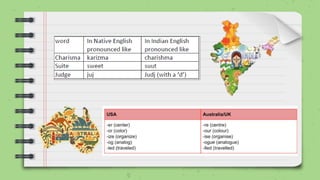
● Standard American English
● Standard British English
● Standard Indian English
● Standard Australian English
May all be said to be standard
dialects of the English language.
Dialect
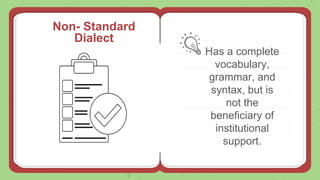
Non- Standard
Dialect
Has a complete
vocabulary,
grammar, and
syntax, but is
not the
beneficiary of
institutional
support.
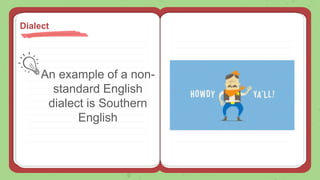
An example of a non-
standard English
dialect is Southern
English
Dialect
Language Vs. Dialect
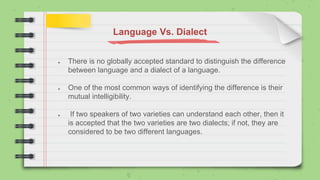
● There is no globally accepted standard to distinguish the difference
between language and a dialect of a language.
● One of the most common ways of identifying the difference is their
mutual intelligibility.
● If two speakers of two varieties can understand each other, then it
is accepted that the two varieties are two dialects; if not, they are
considered to be two different languages.
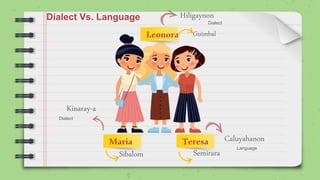
Dialect Vs. Language
Maria
Leonora
Teresa
Guimbal
Sibalom Semirara
Kinaray-a
Hiligaynon
Caluyahanon
Dialect
Dialect
Language
02
IDIOLECT
All you need to know…
● This meaning is reflected in the
etymology of the word: the two
morphemes
● Idio- is of Greek origin, and means
“own, personal, private, peculiar,
separate and distinct,”
● -lect refers to a “social variety of a
language.”
Idiolect
a variety of a
language unique to an
individual
manifested by patterns of word
selection and grammar , or
words, phrases, idioms , or
pronunciations that are unique to
that individual
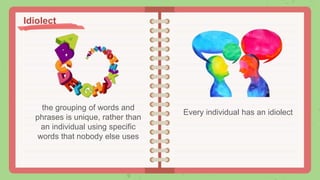
Idiolect
the grouping of words and
phrases is unique, rather than
an individual using specific
words that nobody else uses
Every individual has an idiolect
Idiolect
Idiolects change through contact with other idiolects,
and change throughout their lifetime as well as from
generation to generation.
Idiolect
03
ISOGLOSS
All you need to know…
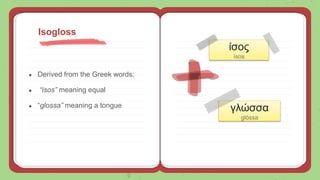
● Derived from the Greek words:
● “isos” meaning equal
● “glossa” meaning a tongue
Isogloss
ίσος
ísos
γλώσσα
glóssa
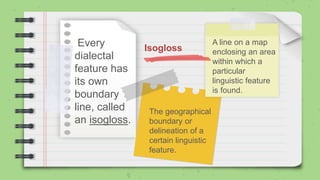
Every
dialectal
feature has
its own
boundary
line, called
an isogloss.
The geographical
boundary or
delineation of a
certain linguistic
feature.
A line on a map
enclosing an area
within which a
particular
linguistic feature
is found.
Isogloss
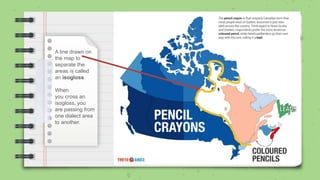
A line drawn on
the map to
separate the
areas is called
an isogloss.
When
you cross an
isogloss, you
are passing from
one dialect area
to another.
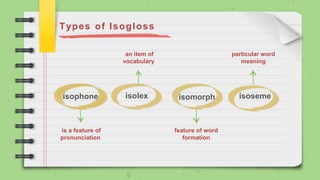
Types of Isogloss
isophone isomorph isoseme
isolex
is a feature of
pronunciation
particular word
meaning
an item of
vocabulary
feature of word
formation
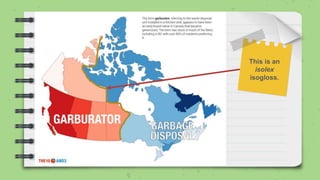
This is an
isolex
isogloss.
04
VERNACULAR
All you need to know…
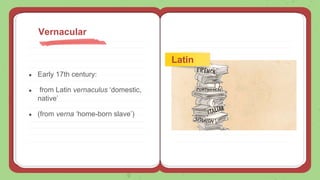
● Early 17th century:
● from Latin vernaculus ‘domestic,
native’
● (from verna ‘home-born slave’)
Vernacular
Latin
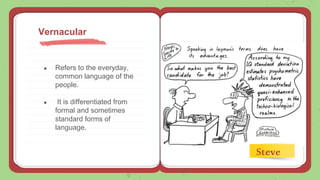
● Refers to the everyday,
common language of the
people.
● It is differentiated from
formal and sometimes
standard forms of
language.
Vernacular
Steve
Activity: Laymen's Term!
Felis catus
Activity: Laymen's Term!
Acacia
Confusa
Activity: Laymen's Term!
Serpentes
Activity: Laymen's Term!
Cocos
Nucifera
`
Activity: Laymen's Term!
`
Vernacular is the local
language of common
speech.
By using vernacular, the
writer has the ability to
connect to a larger
audience.
Vernacular
• The purpose of using
vernacular is to allow readers
to understand the language of
a work.
• It is important to connect to
readers, and if the language
being used isn’t understood,
this will not be possible.
Function of Vernacular
Resources
https://pediaa.com/difference-between-
language-and-dialect/
https://www.britannica.com/topic/dialect#r
ef393717’
https://www.oxfordbibliographies.com/vie
w/document/obo-9780199772810/obo-
9780199772810-0225.xml
https://www.slideshare.net/cupidlucid/lan
guage-variation-presentation
https://writingexplained.org/grammar-
dictionary/vernacular
ADDITIONAL ACTIVITIES
Language Vs. Dialect
by Prof. Bot Jocano
https://www.youtube.c
om/watch?v=a_L8-
BGf5wk
Accents & Idiolects
https://www.youtube.c
om/watch?v=FQkF4Y
YSx6A
Open Forum
Questions? Clarifications? Please
feel free to ask 
Thank you so much
for listening and
participating!
ISOGLOSS, DIALECT,
IDIOLECT AND
VERNACULAR
Presented by:
Robbbie Liza E. Caytiles

Isogloss, Dialect, Idiolect, Vernacular.pptx

  • 1.
    B. Isogloss, Dialect,Idiolect & Vernacular Presented by: Robbie Liza E. Caytiles University of Antique College of Teacher Education Graduate Studies Sibalom, Antique Lit.216 SOCIOLINGUISTICS (Current Trends and Principles of Teaching English III. Language Variation and Change or Language Attrition
  • 2.
    Thank you, Lord,for another successful class. We thank you for our teachers who have shared their time and expertise with us. We thank you for our classmates who were our partners in this learning sessions. We are blessed that in spite of the pandemic, we are able to learn and meet one another online. Thank you for providing a means for us to study through the use of technology. All of these things are not possible without you.
  • 3.
    May you continueblessing us with your Divine Wisdom, so we could continue to learn while healing. Grant all those who are sick to get well again, and those who are well to stay that way. Grant that we could be able to continue learning successfully. May you bless all those who had made this class possible; the admins, the teachers, and everyone who have contributed to the success of our learning process. We ask all these, in your mighty name.
  • 4.
    Isogloss, Dialect, Idiolect &Vernacular Presented by: Robbie Liza E. Caytiles University of Antique College of Teacher Education Graduate Studies Sibalom, Antique Lit.216 SOCIOLINGUISTICS (Current Trends and Principles of Teaching English III. Language Variation and Change or Language Attrition a. Pidgin/Creole b. Isogloss, Dialect, Idiolect & Vernacular c. Standard Language d. Language and Social Variables
  • 5.
    Outline of Presentation 1.Dialect Etymology, WordMeaning, Standard & Non- Standard Dialect, Language vs. Dialect 2. Idiolect Etymology, Word Meaning & Description 3.Isogloss Etymology, Word Meaning, Types of Isogloss & Examples 3. Vernacular Etymology, Word Meaning, Description & Functions Lit.216 SOCIOLINGUISTICS (Current Trends and Principles of Teaching English
  • 6.
    -RALPH WALDO EMERSON, “Languageis a city to the building of which every human being brought a stone.”
  • 7.
  • 8.
    1.Go to www.menti.com 2.Input the code: 2223 2052 3. Answer the question above by placing your answers on the box. 4. You are given 5 chances to answer. 5. Duplication of answer is fine 
  • 10.
    ● The worddialect comes from the Ancient Greek ● dialektos “discourse, language, dialect,” ● which is derived from dialegesthai “to discourse, talk.” Dialect διαλέγεσθαι dialégesthai διάλεκτος diálektos
  • 11.
    Dialect Dialect is aversion of a language spoken in a particular geographical area or by a particular group of people.
  • 12.
    Language varieties are oftencalled dialects rather than languages. solely they are not, or not recognized as literary languages they are not used in press or literature, or very little the speakers of the given language do not have a state of their own language lacks prestige Dialect
  • 13.
    Major Dialects inthe Philippines General Information - the Philippine Embassy in The ... https://thehaguepe.dfa.gov.ph › 79-about-us › 98-general.. Eight (8) major dialects spoken by majority of the Filipinos: 1. Tagalog 2. Cebuano 3. Ilocano 4. Hiligaynon or Ilonggo 5. Bicolano 6. Waray 7. Pampango 8. Pangasinense.
  • 14.
    Why is mother tonguecalled “mother tongue”?
  • 15.
    Languages in Western Visayas 1.Akeanon 2. Caluyanon 3. Kinaray-a 4. Capizanon 5. Hiligaynon 6. Ati 7. Cebuano
  • 16.
    Dialect Dialect Dialects can beclassified into two categories: standard dialect non-standard dialect
  • 17.
    Standard Dialect Supported by institutions. Presentationas being the “correct” form of a language in schools. Published grammars, dictionaries, and textbooks that set forth a “correct” spoken and written form; An extensive formal literature that employs that dialect in prose, poetry, non-fiction, etc.
  • 18.
    ● Standard AmericanEnglish ● Standard British English ● Standard Indian English ● Standard Australian English May all be said to be standard dialects of the English language. Dialect
  • 21.
    Non- Standard Dialect Has acomplete vocabulary, grammar, and syntax, but is not the beneficiary of institutional support.
  • 22.
    An example ofa non- standard English dialect is Southern English Dialect
  • 23.
    Language Vs. Dialect ●There is no globally accepted standard to distinguish the difference between language and a dialect of a language. ● One of the most common ways of identifying the difference is their mutual intelligibility. ● If two speakers of two varieties can understand each other, then it is accepted that the two varieties are two dialects; if not, they are considered to be two different languages.
  • 24.
    Dialect Vs. Language Maria Leonora Teresa Guimbal SibalomSemirara Kinaray-a Hiligaynon Caluyahanon Dialect Dialect Language
  • 25.
  • 26.
    ● This meaningis reflected in the etymology of the word: the two morphemes ● Idio- is of Greek origin, and means “own, personal, private, peculiar, separate and distinct,” ● -lect refers to a “social variety of a language.” Idiolect
  • 27.
    a variety ofa language unique to an individual manifested by patterns of word selection and grammar , or words, phrases, idioms , or pronunciations that are unique to that individual Idiolect
  • 28.
    the grouping ofwords and phrases is unique, rather than an individual using specific words that nobody else uses Every individual has an idiolect Idiolect
  • 29.
    Idiolects change throughcontact with other idiolects, and change throughout their lifetime as well as from generation to generation. Idiolect
  • 30.
  • 31.
    ● Derived fromthe Greek words: ● “isos” meaning equal ● “glossa” meaning a tongue Isogloss ίσος ísos γλώσσα glóssa
  • 32.
    Every dialectal feature has its own boundary line,called an isogloss. The geographical boundary or delineation of a certain linguistic feature. A line on a map enclosing an area within which a particular linguistic feature is found. Isogloss
  • 33.
    A line drawnon the map to separate the areas is called an isogloss. When you cross an isogloss, you are passing from one dialect area to another.
  • 34.
    Types of Isogloss isophoneisomorph isoseme isolex is a feature of pronunciation particular word meaning an item of vocabulary feature of word formation
  • 35.
  • 36.
  • 37.
    ● Early 17thcentury: ● from Latin vernaculus ‘domestic, native’ ● (from verna ‘home-born slave’) Vernacular Latin
  • 38.
    ● Refers tothe everyday, common language of the people. ● It is differentiated from formal and sometimes standard forms of language. Vernacular Steve
  • 39.
  • 40.
  • 41.
  • 42.
  • 43.
  • 44.
    Vernacular is thelocal language of common speech. By using vernacular, the writer has the ability to connect to a larger audience. Vernacular
  • 45.
    • The purposeof using vernacular is to allow readers to understand the language of a work. • It is important to connect to readers, and if the language being used isn’t understood, this will not be possible. Function of Vernacular
  • 46.
  • 47.
    ADDITIONAL ACTIVITIES Language Vs.Dialect by Prof. Bot Jocano https://www.youtube.c om/watch?v=a_L8- BGf5wk Accents & Idiolects https://www.youtube.c om/watch?v=FQkF4Y YSx6A
  • 48.
    Open Forum Questions? Clarifications?Please feel free to ask 
  • 49.
    Thank you somuch for listening and participating! ISOGLOSS, DIALECT, IDIOLECT AND VERNACULAR Presented by: Robbbie Liza E. Caytiles

Editor's Notes

  • #12 This could also be explained as a social or regional variety of a language distinguished by grammar, pronunciation, or vocabulary; this is especially a way of speaking that differs from the standard variety of the language.
  • #14  Filipino is that native language which is used nationally as the language of communication among ethnic groups.
  • #16 What is the most spoken language in Western Visayas?
  • #18 Supported by instuitutions: Such institutional support may include government recognition or designation
  • #22 no backup from institutions
  • #23 no backup from institutions
  • #29 ex. marites always says “kwan” si “kwan” nga bata ni “kwan” etc….
  • #33 >Ex: the pronunciation of a vowel , the meaning of a word, or use of some syntactic feature 
  • #36 Isolex is an item of vocabulary.
  • #40 In science, it is important to be precise and exact, and there are many formalized terms to indicate species and classification. Where an everyday speaker might simply say house cat, a scientist would say Felis Domesticus.
  • #41 In science, it is important to be precise and exact, and there are many formalized terms to indicate species and classification. Where an everyday speaker might simply say house cat, a scientist would say Felis Domesticus.
  • #42 In science, it is important to be precise and exact, and there are many formalized terms to indicate species and classification. Where an everyday speaker might simply say house cat, a scientist would say Felis Domesticus.
  • #43 In science, it is important to be precise and exact, and there are many formalized terms to indicate species and classification. Where an everyday speaker might simply say house cat, a scientist would say Felis Domesticus.
  • #44 In science, it is important to be precise and exact, and there are many formalized terms to indicate species and classification. Where an everyday speaker might simply say house cat, a scientist would say Felis Domesticus.