COMPOSTING
A
Part Solution of MSW
LOKESH SAINI
Mtech I’st Semester
2015PCE5271
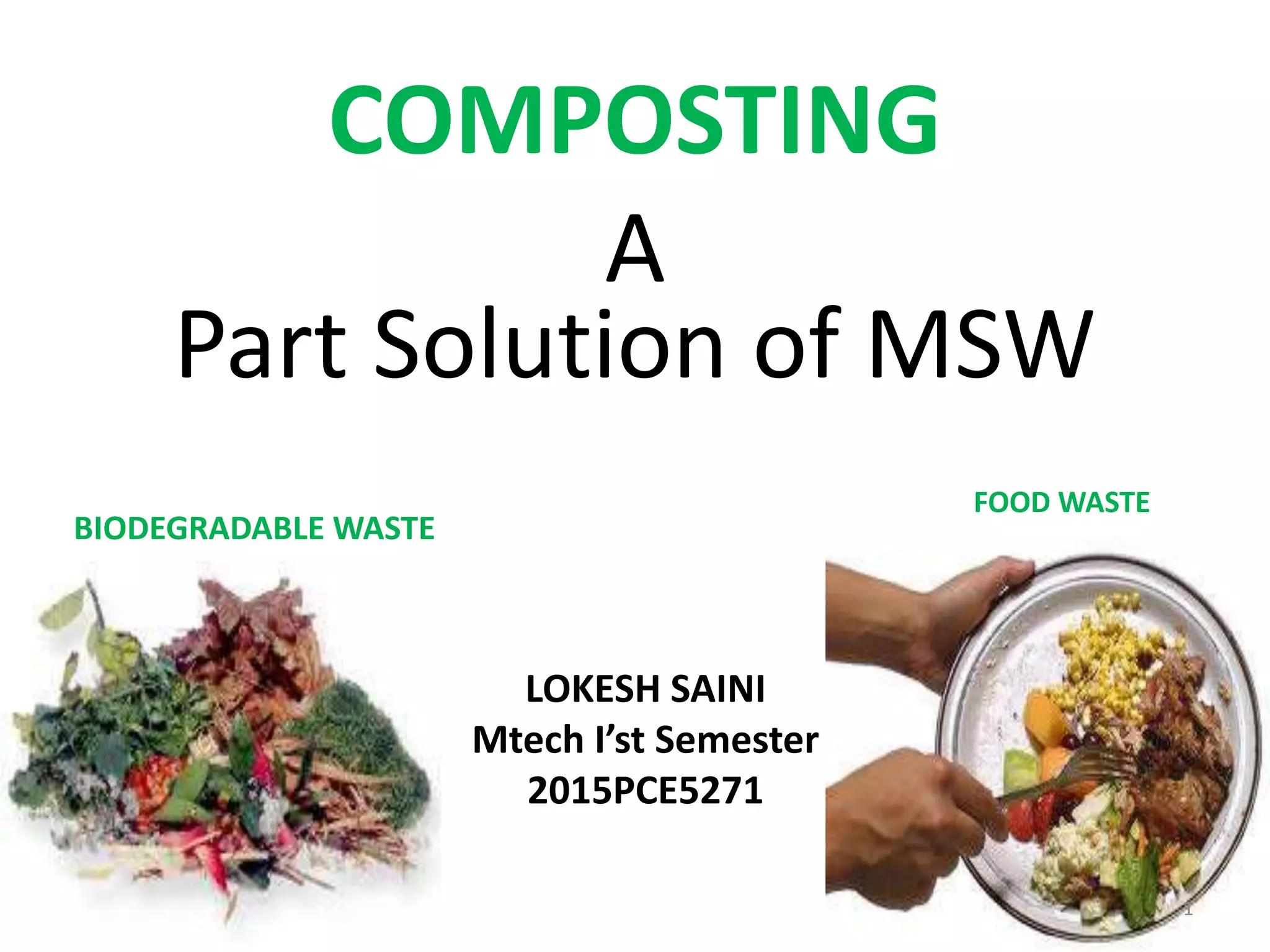
BIODEGRADABLE WASTE
FOOD WASTE
1
Annepu Kharvel Ranjith
2
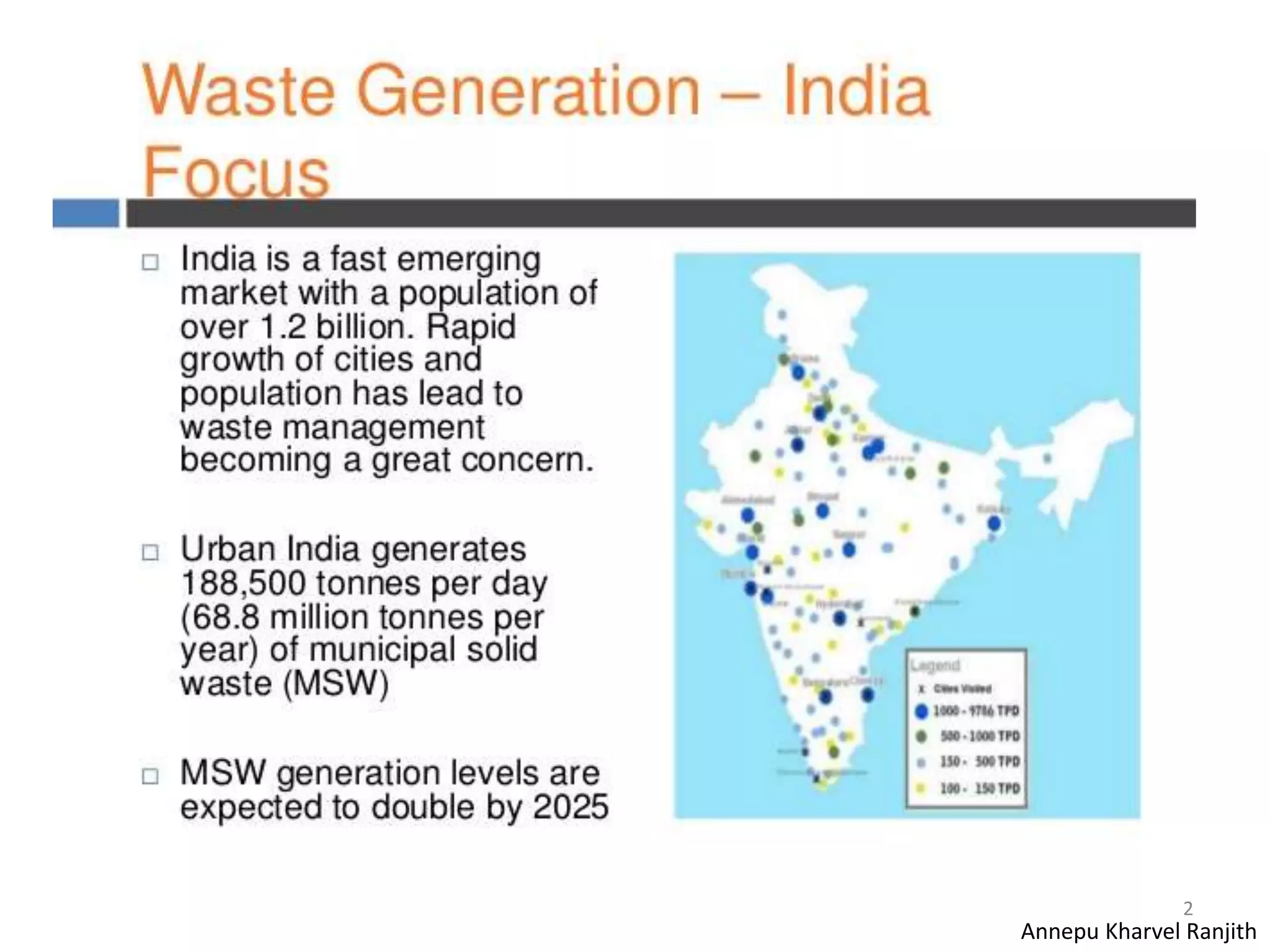
MSW generation in India
CPHEEO Manual on MSW, 2005
• Total Municipal Waste Generation 1,88,500 TPD (Annepu Kharvel Ranjith)
3
Sources of ORGANIC Waste
GARDEN TRIMMINGS KITCHEN
HOTELS/RETRAURENT FRUIT/VEGITABLE MARKET
4
FIRST STEP TOWARDS COMPOSTING
5
RESOURCE RECOVERY THROUGH WASTE PROCESSING
Biological
Method
(COMPOSTING)
In India, Aerobic composting plants have been
used to process upto 500 tons per day of waste
Aerobic Process:- Windrow
Composting, Aerated static pile
composting and in-vessel
composting, vermi-culture etc
Anaerobic Process:- Low-solids
anaerobic digestion(wet process),
high-solids aerobic digestion(Dry
Process)
CPHEEO, Manual MSW
???IS COMPOSTING
7
Composting is an organized method of
producing compost manure by adopting the
natural Phenomenon. Compost is
particularly useful as an organic manure
which contains Plant Nutrients (Nitrogen,
Phosphorus and Potassium).
CPHEEO, Manual MSW
AEROBIC COMPOSTING
8
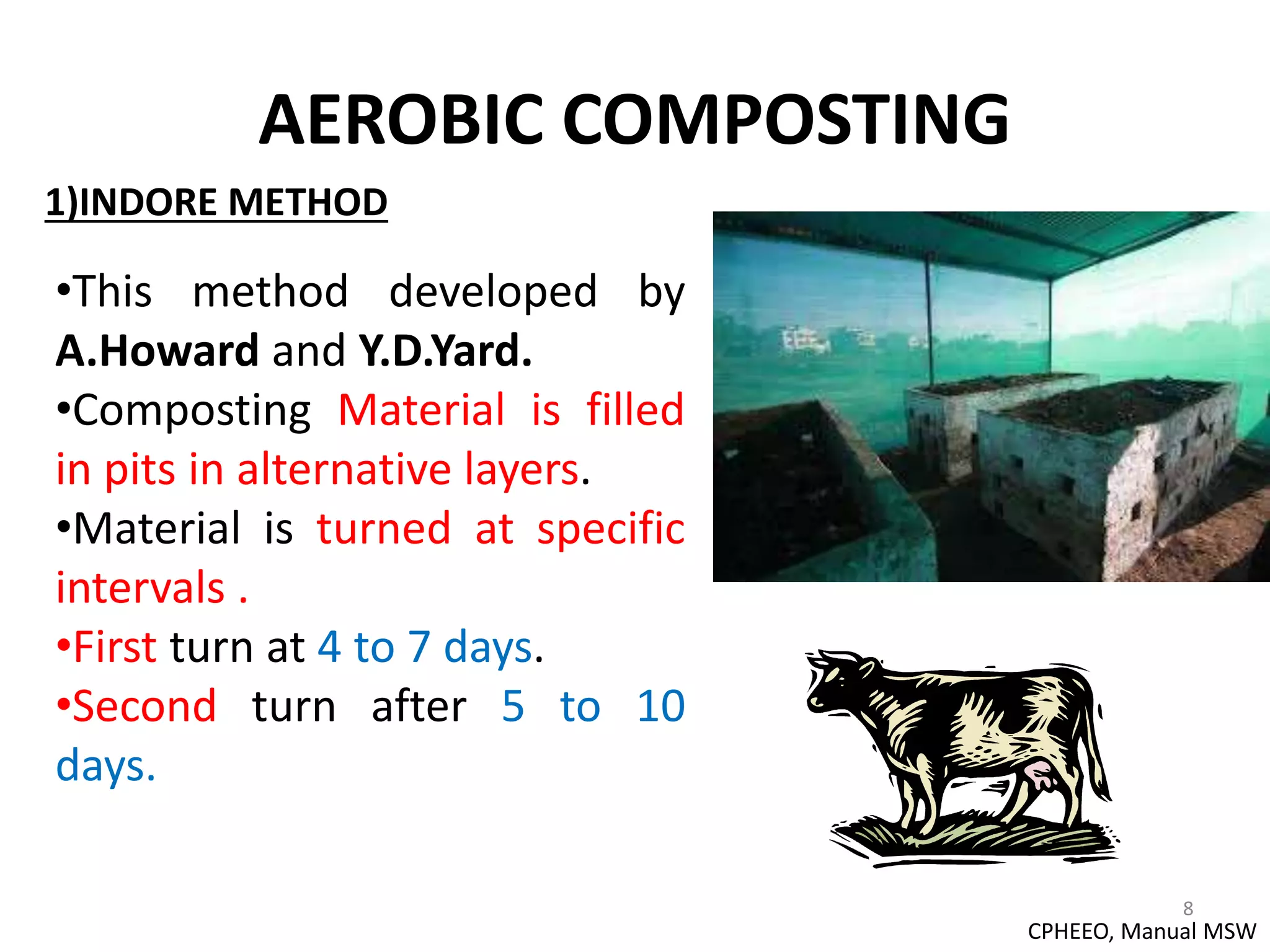
1)INDORE METHOD
•This method developed by
A.Howard and Y.D.Yard.
•Composting Material is filled
in pits in alternative layers.
•Material is turned at specific
intervals .
•First turn at 4 to 7 days.
•Second turn after 5 to 10
days.
CPHEEO, Manual MSW
9
2)WINDROW COMPOSTING
•Used, where higher ambient temperatures are available.
•Refuse is kept in 20 Windrows(piles) size 3mX2mX1.5m.
•Moisture content maintained at 60%.
•Temp. increases in side pile.
•After pile for turned for cooling and aeration to avoid
anaerobic decomposition.
•Each windrow is turned on 6th & 11th days to centre to
destroy insects larvae and to provide aeration.
•On 16th day windrows are broken and passed through
screens of 25mm.
CPHEEO, Manual MSW
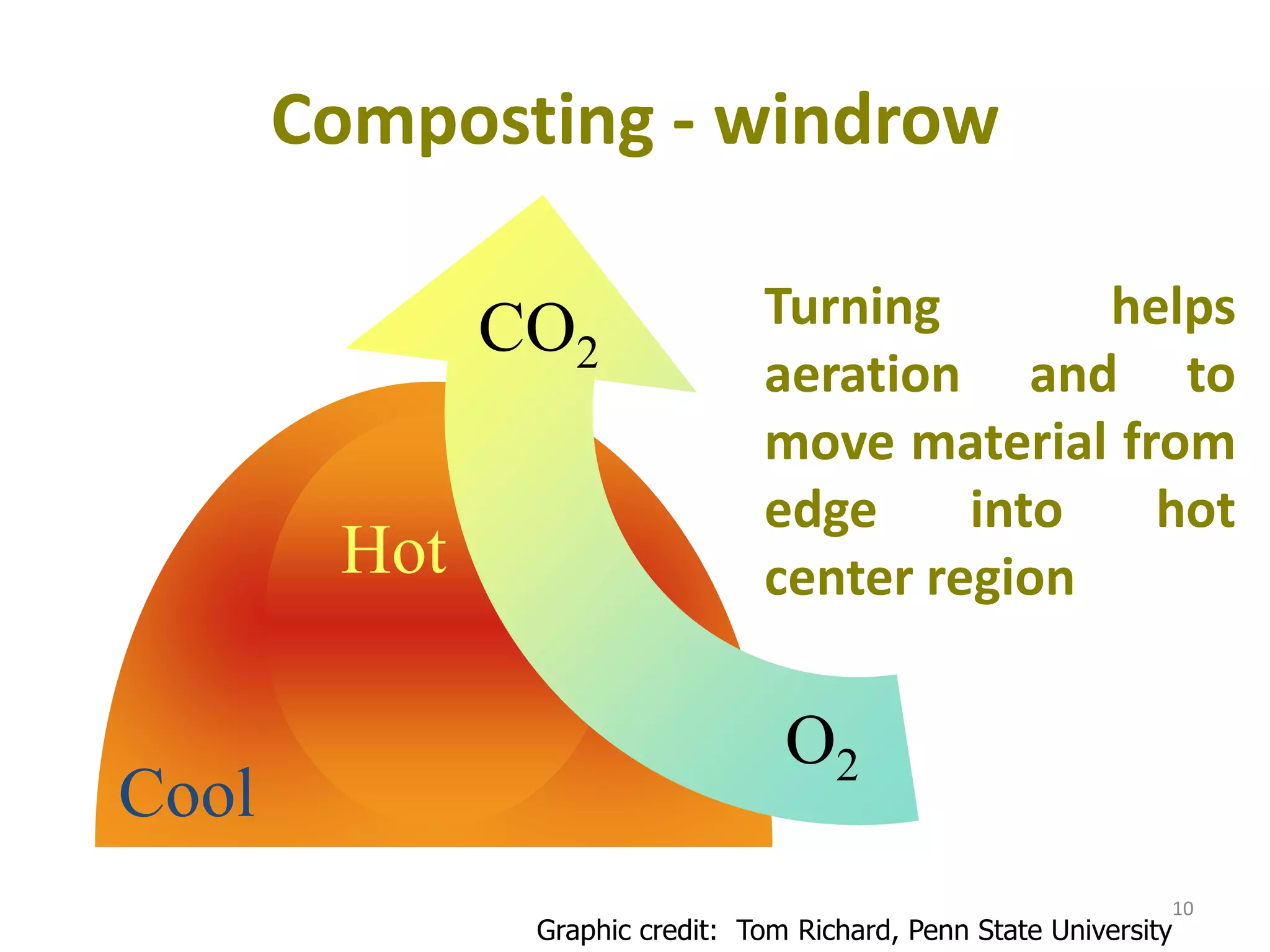
Composting - windrow
CO2
O2
Cool
Hot
Graphic credit: Tom Richard, Penn State University
Turning helps
aeration and to
move material from
edge into hot
center region
10
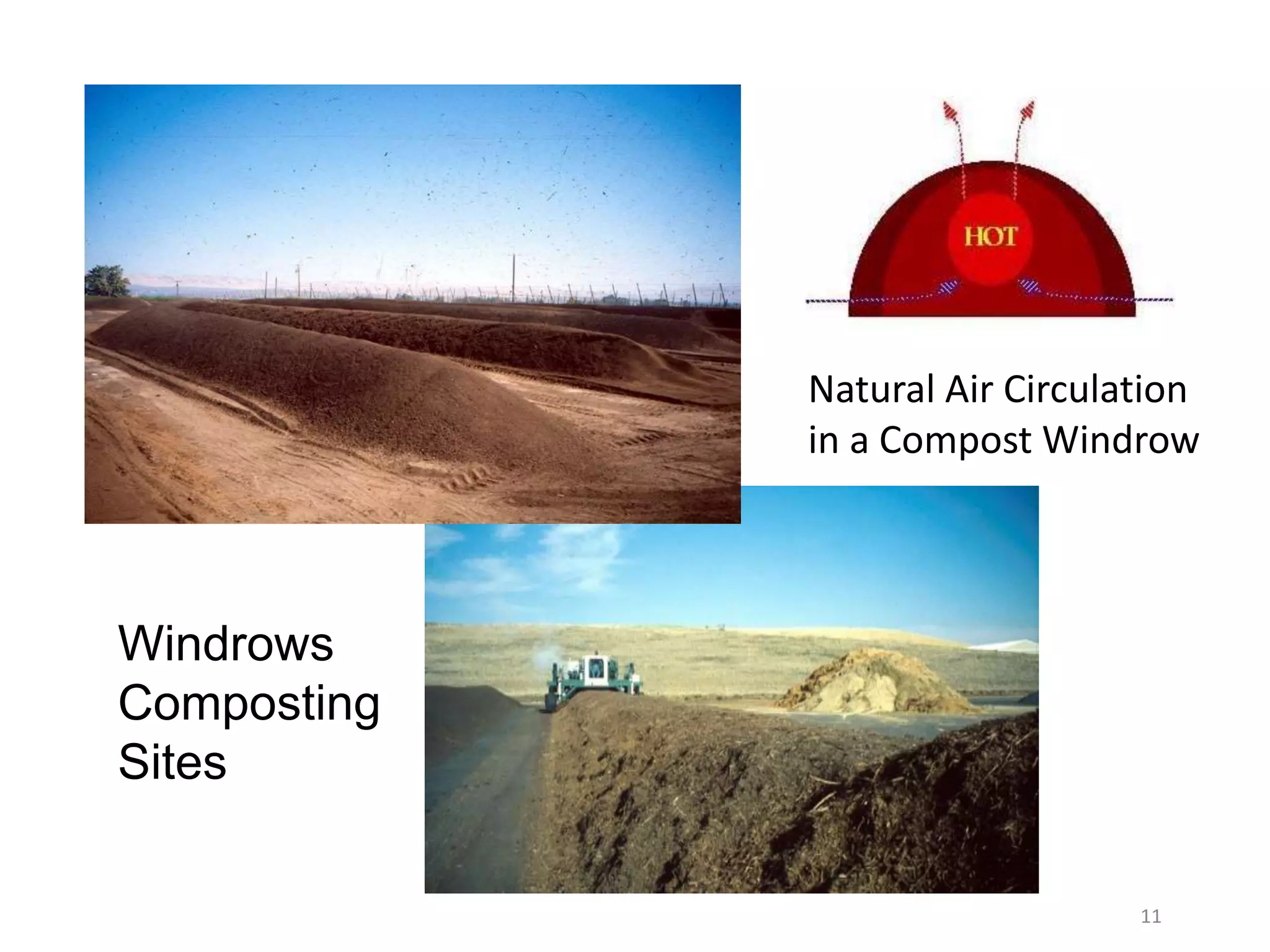
Windrows
Composting
Sites
Natural Air Circulation
in a Compost Windrow
11
Processing – turned windrows
12
ANAEROBIC METHOD
13
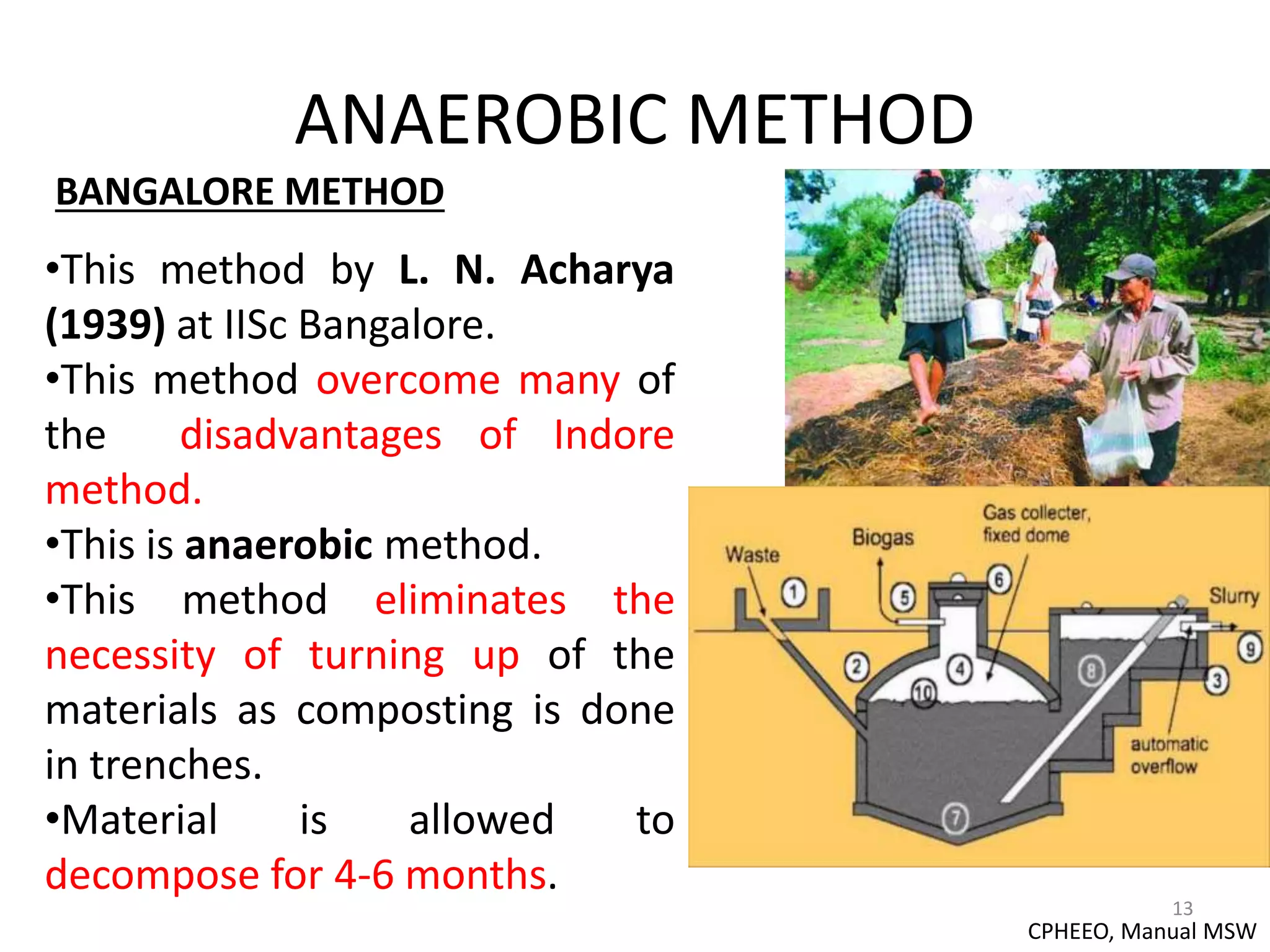
BANGALORE METHOD
•This method by L. N. Acharya
(1939) at IISc Bangalore.
•This method overcome many of
the disadvantages of Indore
method.
•This is anaerobic method.
•This method eliminates the
necessity of turning up of the
materials as composting is done
in trenches.
•Material is allowed to
decompose for 4-6 months.
CPHEEO, Manual MSW
14
AEROBIC
(HOT COMPOSTING)
ANAEROBIC
(COLD COMPOSTING)
FUELED BY OXYGEN &
MOISTURE
FUELED BY BACTERIA &
MOISTURE
TURNED WEEKLY NOT TURNED
LARGE
(At least 1 cubic meter)
SMALL
(Less than 1 cubic meter)
QUICK
Ready in 6 weeks
SLOW
Ready after 6 months
NEEDS SMALLER SPACE NEEDS LARGER SPACE
NO ODOUROUS GASES ODOUROUS GASES
CPHEEO, Manual MSW
FACTORS AFFECTING BIOLOGICAL COMPOSTING
15
•ORGANISM:- Mesofilic or Thermofilic.
•USE OF CULTURES:- Improves the Speed of
Decomposing.
•MOISTURES:- 50-60% for Aerobic and >60% for
Anaerobic Composting.
•TEMPERATURE:- 50-60 °C .
•CARBON/NITROGEN(C/N) RATIO:- 26-31.
•AERATION:- 1-2 cum/day/Kg of Volatile solids.
•ADDITION OF SEWAGE AND SEWAGE SLUDGE:-To
control the C/N Ratio.
CPHEEO, Manual MSW
MECHANICAL COMPOSTING
16
Preferred where labour cost is high
and limitation of space
The stabilization of waste takes 3- 6 days.
The operation involved are
reception of refuse
segregation
shredding
stabilization
marketing the humus
17
Some other methods
18
VERMICOMPOSTING HEAP METHOD
•Slow Process
•Used for small scale
•Can be Used Domestically
SOME FACTS ABOUT COMPOSTING IN INDIA
19
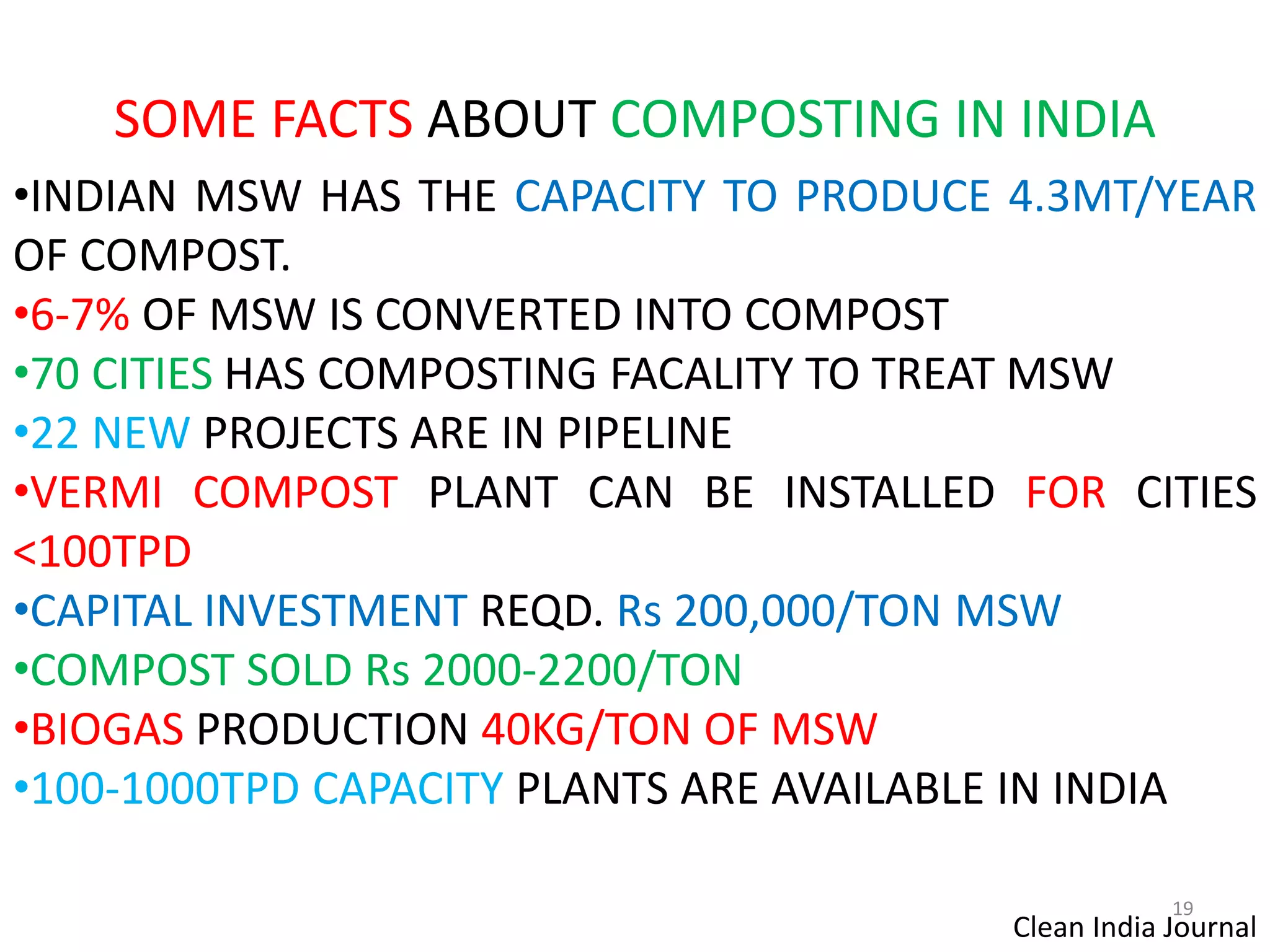
•INDIAN MSW HAS THE CAPACITY TO PRODUCE 4.3MT/YEAR
OF COMPOST.
•6-7% OF MSW IS CONVERTED INTO COMPOST
•70 CITIES HAS COMPOSTING FACALITY TO TREAT MSW
•22 NEW PROJECTS ARE IN PIPELINE
•VERMI COMPOST PLANT CAN BE INSTALLED FOR CITIES
<100TPD
•CAPITAL INVESTMENT REQD. Rs 200,000/TON MSW
•COMPOST SOLD Rs 2000-2200/TON
•BIOGAS PRODUCTION 40KG/TON OF MSW
•100-1000TPD CAPACITY PLANTS ARE AVAILABLE IN INDIA
Clean India Journal
REFERENCES
20
1. Manual on Solid Waste Management, CPHEEO, MOUD,
New Delhi.
2. Annepu Kharvel Ranjith; Sustainable Solid Waste
Management in India, Columbia University.
3. http://www.cleanindiajournal.com/composting_in_swm%e
2%80%93a_report/
4. PPT from www.islide.org.
21

Ls composting swhm

  • 1.
    COMPOSTING A Part Solution ofMSW LOKESH SAINI Mtech I’st Semester 2015PCE5271 BIODEGRADABLE WASTE FOOD WASTE 1
  • 2.
  • 3.
    MSW generation inIndia CPHEEO Manual on MSW, 2005 • Total Municipal Waste Generation 1,88,500 TPD (Annepu Kharvel Ranjith) 3
  • 4.
    Sources of ORGANICWaste GARDEN TRIMMINGS KITCHEN HOTELS/RETRAURENT FRUIT/VEGITABLE MARKET 4
  • 5.
    FIRST STEP TOWARDSCOMPOSTING 5
  • 6.
    RESOURCE RECOVERY THROUGHWASTE PROCESSING Biological Method (COMPOSTING) In India, Aerobic composting plants have been used to process upto 500 tons per day of waste Aerobic Process:- Windrow Composting, Aerated static pile composting and in-vessel composting, vermi-culture etc Anaerobic Process:- Low-solids anaerobic digestion(wet process), high-solids aerobic digestion(Dry Process) CPHEEO, Manual MSW
  • 7.
    ???IS COMPOSTING 7 Composting isan organized method of producing compost manure by adopting the natural Phenomenon. Compost is particularly useful as an organic manure which contains Plant Nutrients (Nitrogen, Phosphorus and Potassium). CPHEEO, Manual MSW
  • 8.
    AEROBIC COMPOSTING 8 1)INDORE METHOD •Thismethod developed by A.Howard and Y.D.Yard. •Composting Material is filled in pits in alternative layers. •Material is turned at specific intervals . •First turn at 4 to 7 days. •Second turn after 5 to 10 days. CPHEEO, Manual MSW
  • 9.
    9 2)WINDROW COMPOSTING •Used, wherehigher ambient temperatures are available. •Refuse is kept in 20 Windrows(piles) size 3mX2mX1.5m. •Moisture content maintained at 60%. •Temp. increases in side pile. •After pile for turned for cooling and aeration to avoid anaerobic decomposition. •Each windrow is turned on 6th & 11th days to centre to destroy insects larvae and to provide aeration. •On 16th day windrows are broken and passed through screens of 25mm. CPHEEO, Manual MSW
  • 10.
    Composting - windrow CO2 O2 Cool Hot Graphiccredit: Tom Richard, Penn State University Turning helps aeration and to move material from edge into hot center region 10
  • 11.
  • 12.
  • 13.
    ANAEROBIC METHOD 13 BANGALORE METHOD •Thismethod by L. N. Acharya (1939) at IISc Bangalore. •This method overcome many of the disadvantages of Indore method. •This is anaerobic method. •This method eliminates the necessity of turning up of the materials as composting is done in trenches. •Material is allowed to decompose for 4-6 months. CPHEEO, Manual MSW
  • 14.
    14 AEROBIC (HOT COMPOSTING) ANAEROBIC (COLD COMPOSTING) FUELEDBY OXYGEN & MOISTURE FUELED BY BACTERIA & MOISTURE TURNED WEEKLY NOT TURNED LARGE (At least 1 cubic meter) SMALL (Less than 1 cubic meter) QUICK Ready in 6 weeks SLOW Ready after 6 months NEEDS SMALLER SPACE NEEDS LARGER SPACE NO ODOUROUS GASES ODOUROUS GASES CPHEEO, Manual MSW
  • 15.
    FACTORS AFFECTING BIOLOGICALCOMPOSTING 15 •ORGANISM:- Mesofilic or Thermofilic. •USE OF CULTURES:- Improves the Speed of Decomposing. •MOISTURES:- 50-60% for Aerobic and >60% for Anaerobic Composting. •TEMPERATURE:- 50-60 °C . •CARBON/NITROGEN(C/N) RATIO:- 26-31. •AERATION:- 1-2 cum/day/Kg of Volatile solids. •ADDITION OF SEWAGE AND SEWAGE SLUDGE:-To control the C/N Ratio. CPHEEO, Manual MSW
  • 16.
    MECHANICAL COMPOSTING 16 Preferred wherelabour cost is high and limitation of space The stabilization of waste takes 3- 6 days. The operation involved are reception of refuse segregation shredding stabilization marketing the humus
  • 17.
  • 18.
    Some other methods 18 VERMICOMPOSTINGHEAP METHOD •Slow Process •Used for small scale •Can be Used Domestically
  • 19.
    SOME FACTS ABOUTCOMPOSTING IN INDIA 19 •INDIAN MSW HAS THE CAPACITY TO PRODUCE 4.3MT/YEAR OF COMPOST. •6-7% OF MSW IS CONVERTED INTO COMPOST •70 CITIES HAS COMPOSTING FACALITY TO TREAT MSW •22 NEW PROJECTS ARE IN PIPELINE •VERMI COMPOST PLANT CAN BE INSTALLED FOR CITIES <100TPD •CAPITAL INVESTMENT REQD. Rs 200,000/TON MSW •COMPOST SOLD Rs 2000-2200/TON •BIOGAS PRODUCTION 40KG/TON OF MSW •100-1000TPD CAPACITY PLANTS ARE AVAILABLE IN INDIA Clean India Journal
  • 20.
    REFERENCES 20 1. Manual onSolid Waste Management, CPHEEO, MOUD, New Delhi. 2. Annepu Kharvel Ranjith; Sustainable Solid Waste Management in India, Columbia University. 3. http://www.cleanindiajournal.com/composting_in_swm%e 2%80%93a_report/ 4. PPT from www.islide.org.
  • 21.