Soil Quality and
Health
SSAC 4th Semester Project
Kishlay Ranjan
Soil Quality
Soil Quality mainly encompasses two distinct but
related parts
1. Innate Qualities (Soil Formation & Characteristics)
2. Dynamic Qualities (Soil Erosion & Management)
The integration of growth-enhancing factors
that makes a soil productive has often been
referred to as "soil quality“ or How well soil
does what we want it to do.
As per USDA(1994) Soil quality can be defined as
The capacity of a specific kind of soil to
function, within its natural or managed
ecosystem boundaries, to sustain animal and
plant productivity, maintain or enhance air and
water quality and support human health and
habitats.
2
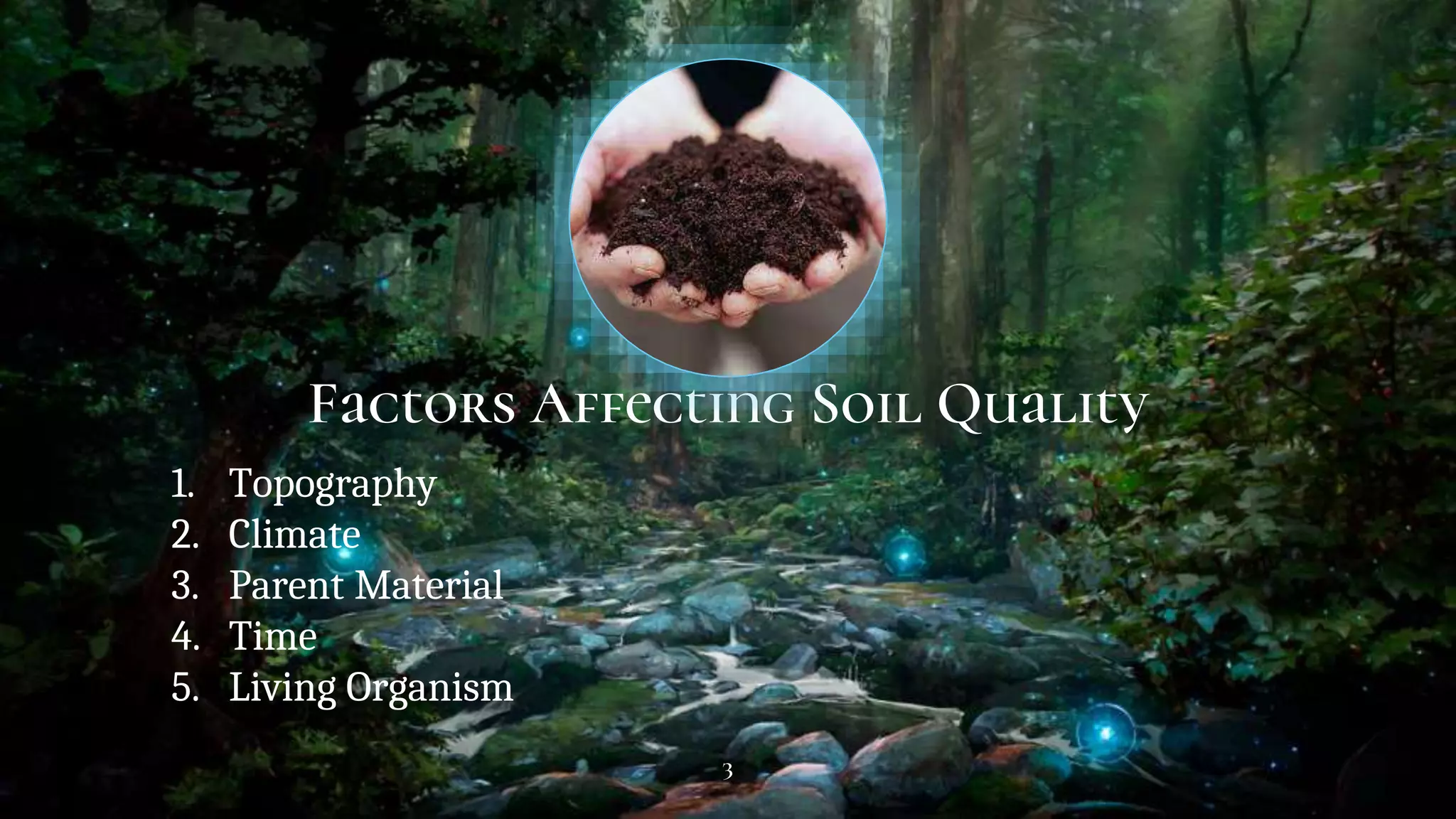
Factors Affecting Soil Quality
1. Topography
2. Climate
3. Parent Material
4. Time
5. Living Organism
3
“
Soil Quality
Capacity of a soil to function
within its ecosystem boundary to
sustain biological productivity,
maintain environmental quality
and promote plant and animal
health
-Doran & Parkin, 1994
5
IMPORTANCE OF SOIL QUALITY
❧ Soils are the storehouses for water and nutrients. Plants draw on these
stores as needed to produce roots, stems, leaves, and, eventually, food
and fiber for human consumption.
❧ The soil matrix is the major incubation chamber for the decomposition
of organic wastes, for example, pesticides, sewage, and solid wastes.
❧ The reason that soil quality matters is that healthy soil can store and
process more water. Poor quality, depleted soil, won't hold water and
will make it impossible for your plants to thrive and survive.
6
Big concept
The soil quality concept recognises the concern for the sustainability of
current arable land use practices. It integrates soil chemical, physical
and biological properties, and takes account of the interaction of soil
with water and air.
8
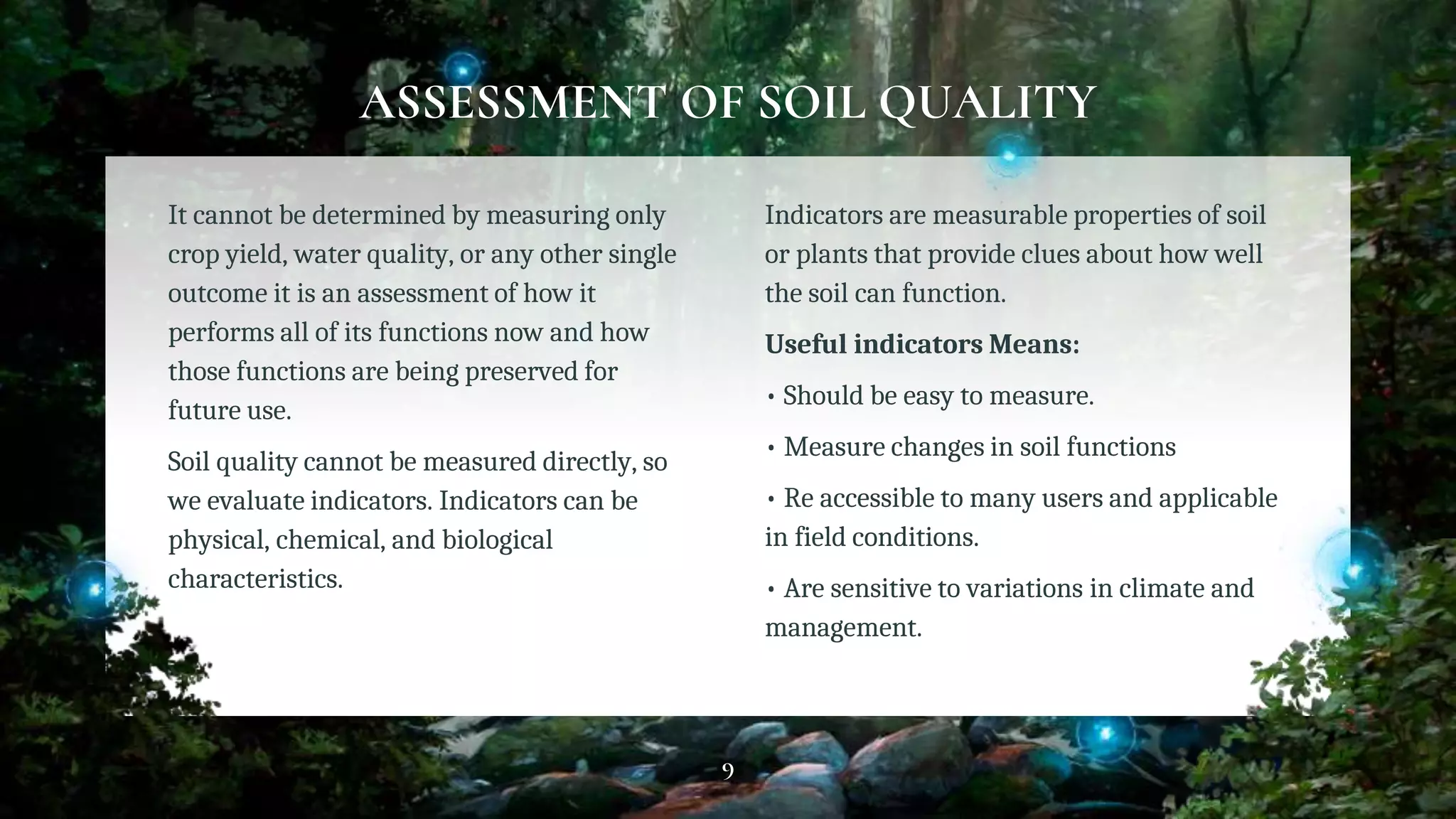
It cannot be determined by measuring only
crop yield, water quality, or any other single
outcome it is an assessment of how it
performs all of its functions now and how
those functions are being preserved for
future use.
Soil quality cannot be measured directly, so
we evaluate indicators. Indicators can be
physical, chemical, and biological
characteristics.
ASSESSMENT OF SOIL QUALITY
Indicators are measurable properties of soil
or plants that provide clues about how well
the soil can function.
Useful indicators Means:
• Should be easy to measure.
• Measure changes in soil functions
• Re accessible to many users and applicable
in field conditions.
• Are sensitive to variations in climate and
management.
9
Soil Quality parameters
Physical Factor
• Soil depth & Water
Holding Capacity
• Physical environment-
Structure, Aeration,
Drainage, Texture, Density
• Soil Erosion- Water and
Wind Erosion
Chemical Factors
Nutrient Availability-
Capacity & Intensity Factor
• Soil Reaction- Acidic,
Saline, Sodic Soil
• Presence of toxic elements
• Ion Exchange
Phenomena(CEC & AEC)
Biological Factors
Microorganisms present
and their interaction among
themselves
• Earth worms activities
• Soil Enzyme Activity
• Organic Matter content
10
Soil Health
Soil health has been defined as the "the continued
capacity of soil to function as a vital living system,
within ecosystem and land-use boundaries, to
sustain biological productivity, promote the
quality of air and water environments, and
maintain plant, animal, and human health"
(Pankhurst et al., 1997).
11
12
Soil Physical Indicators Selected for Assessing the Soil Quality
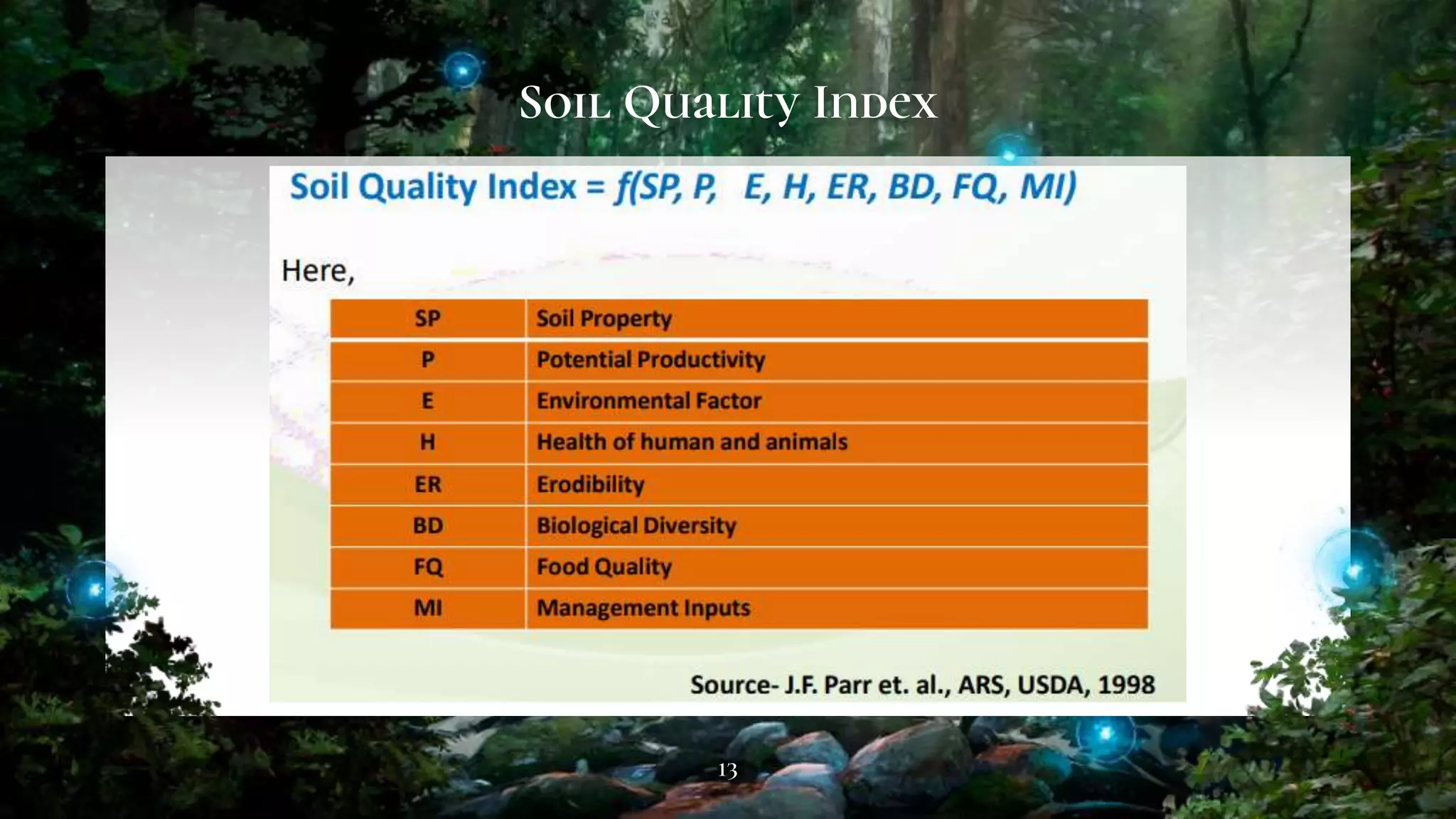
Soil Quality Index
13
Methods Of Assessment
14
Farmers Method
15
1. Farmer who work daily with soils usually note that
some of their fields perform better than others .
2. They tend to judge the quality or condition of their soils
by such observable factors as the performance of the crop
plants, the colors associated with accumulation of organic
matter, the ease of tillage ,the presence of standing water
after rain storms.
Thanks!
16

Soil quality and health soil science (ssac)

  • 1.
    Soil Quality and Health SSAC4th Semester Project Kishlay Ranjan
  • 2.
    Soil Quality Soil Qualitymainly encompasses two distinct but related parts 1. Innate Qualities (Soil Formation & Characteristics) 2. Dynamic Qualities (Soil Erosion & Management) The integration of growth-enhancing factors that makes a soil productive has often been referred to as "soil quality“ or How well soil does what we want it to do. As per USDA(1994) Soil quality can be defined as The capacity of a specific kind of soil to function, within its natural or managed ecosystem boundaries, to sustain animal and plant productivity, maintain or enhance air and water quality and support human health and habitats. 2
  • 3.
    Factors Affecting SoilQuality 1. Topography 2. Climate 3. Parent Material 4. Time 5. Living Organism 3
  • 5.
    “ Soil Quality Capacity ofa soil to function within its ecosystem boundary to sustain biological productivity, maintain environmental quality and promote plant and animal health -Doran & Parkin, 1994 5
  • 6.
    IMPORTANCE OF SOILQUALITY ❧ Soils are the storehouses for water and nutrients. Plants draw on these stores as needed to produce roots, stems, leaves, and, eventually, food and fiber for human consumption. ❧ The soil matrix is the major incubation chamber for the decomposition of organic wastes, for example, pesticides, sewage, and solid wastes. ❧ The reason that soil quality matters is that healthy soil can store and process more water. Poor quality, depleted soil, won't hold water and will make it impossible for your plants to thrive and survive. 6
  • 8.
    Big concept The soilquality concept recognises the concern for the sustainability of current arable land use practices. It integrates soil chemical, physical and biological properties, and takes account of the interaction of soil with water and air. 8
  • 9.
    It cannot bedetermined by measuring only crop yield, water quality, or any other single outcome it is an assessment of how it performs all of its functions now and how those functions are being preserved for future use. Soil quality cannot be measured directly, so we evaluate indicators. Indicators can be physical, chemical, and biological characteristics. ASSESSMENT OF SOIL QUALITY Indicators are measurable properties of soil or plants that provide clues about how well the soil can function. Useful indicators Means: • Should be easy to measure. • Measure changes in soil functions • Re accessible to many users and applicable in field conditions. • Are sensitive to variations in climate and management. 9
  • 10.
    Soil Quality parameters PhysicalFactor • Soil depth & Water Holding Capacity • Physical environment- Structure, Aeration, Drainage, Texture, Density • Soil Erosion- Water and Wind Erosion Chemical Factors Nutrient Availability- Capacity & Intensity Factor • Soil Reaction- Acidic, Saline, Sodic Soil • Presence of toxic elements • Ion Exchange Phenomena(CEC & AEC) Biological Factors Microorganisms present and their interaction among themselves • Earth worms activities • Soil Enzyme Activity • Organic Matter content 10
  • 11.
    Soil Health Soil healthhas been defined as the "the continued capacity of soil to function as a vital living system, within ecosystem and land-use boundaries, to sustain biological productivity, promote the quality of air and water environments, and maintain plant, animal, and human health" (Pankhurst et al., 1997). 11
  • 12.
    12 Soil Physical IndicatorsSelected for Assessing the Soil Quality
  • 13.
  • 14.
  • 15.
    Farmers Method 15 1. Farmerwho work daily with soils usually note that some of their fields perform better than others . 2. They tend to judge the quality or condition of their soils by such observable factors as the performance of the crop plants, the colors associated with accumulation of organic matter, the ease of tillage ,the presence of standing water after rain storms.
  • 16.