Technology Propagation Supported
By,
NABARDNABARD
Swachh Bharat Mission
ROUTINE SCENE OF EVERY CITY of INDIA !
Bio Degradable Waste
70%
Plastic/Paper Waste 15%
Glass, Ceramics 5%
Metal 6%
Miscelleneous 9%
SEGREGATION AT SOURCE
DRY GARBAGE
Plastics
Metal
Thermocol, Foam
Glass
WET GARBAGE
Vegetable waste
Food waste
Garden waste
Coconut shellGlass
Rexene
Battery cells
Paper
Cloth
Rubber, bulb, tubes etc.
Coconut shell
Small pieces of wood
Egg shells
Meat bones/residual
Used cotton
Nirmalya, used
flower
 Organic waste generated should be
managed at source only.
 Segregation of waste is mandatory for Segregation of waste is mandatory for
citizens, residential complexes and
other properties.
(schedule II , no. 6)
1) At Source Segregation
2) Decentralized Organic waste processing.
3) Recycling of plastic, paper and other non- degradable
wastes.
4) Last but not the least……
To Create a Mass Awareness among citizens….
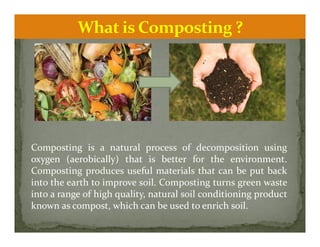
Composting is a natural process of decomposition using
oxygen (aerobically) that is better for the environment.
Composting produces useful materials that can be put back
into the earth to improve soil. Composting turns green waste
into a range of high quality, natural soil conditioning product
known as compost, which can be used to enrich soil.
From Nature, To Nature,,,
 SPINTEX COMPOST TUMBLER !
First time in India ! Specially designed for 2 separate compost cycles..
Looks aesthetic, user friendly and easy to operate, Portable!
Gives compost within 3-4 weeks days! Easy discharge of compost.
No odor, no rats or cats problem! And saves space.
Mrs. Vani Murthy
From Bangalore
A renowned Compost
Expert.
 All in one compost
culture
 Balanced C:N ratio.
 Highly supplemented
with cellulolyticwith cellulolytic
microbes.
 No need to add any
other raw material.
 Provides aeration
 Odor generated by
kitchen waste restricted.
 *Patent Awaited
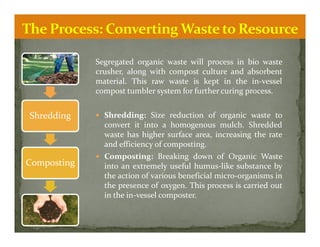
Segregated organic waste will process in bio waste
crusher, along with compost culture and absorbent
material. This raw waste is kept in the in-vessel
compost tumbler system for further curing process.
 Shredding: Size reduction of organic waste to
convert it into a homogenous mulch. Shredded
Shredding
convert it into a homogenous mulch. Shredded
waste has higher surface area, increasing the rate
and efficiency of composting.
 Composting: Breaking down of Organic Waste
into an extremely useful humus-like substance by
the action of various beneficial micro-organisms in
the presence of oxygen. This process is carried out
in the in-vessel composter.
Composting
ORGANIC WASTE
Mesophilic
Stage
Thermophilic
Stage
Cooling
Stage
Specially Designed
three layer insulated vessels
Curing
Stage
Internal Features to
break up clumps
Baffle Walls
for slow and steady flow
COMPOST
for slow and steady flow
• Specifically designed Composter to ensure optimum
temperature, moisture and oxygen is available for an environment
conducive to rapid composting
• Rotation can be manual with gear assembly or automated with a geared
motor
• Specially designed plastic vessels which are UV resistant and corrosion
resistant
• Stand and Gear System fabricated from good quality metal
• Ideal for Residential Societies, Hotels, Commercial
Buildings, Hospitals, etc.
Add Daily waste +
Carbon + Culture
Finished Compost
After 4 weeks
Give 2-3 Rotations
once every day
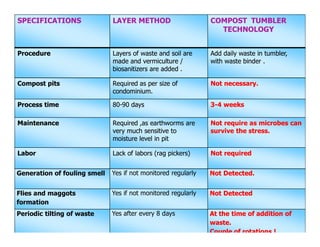
SPECIFICATIONSSPECIFICATIONS LAYER METHODLAYER METHOD COMPOST TUMBLERCOMPOST TUMBLER
TECHNOLOGYTECHNOLOGY
ProcedureProcedure Layers of waste and soil areLayers of waste and soil are
made and vermiculture /made and vermiculture /
biosanitizers are added .biosanitizers are added .
Add daily waste in tumbler,Add daily waste in tumbler,
with waste binder .with waste binder .
Compost pitsCompost pits Required as per size ofRequired as per size of
condominium.condominium.
Not necessary.Not necessary.
Process timeProcess time 8080--90 days90 days 33--4 weeks4 weeks
MaintenanceMaintenance Required ,as earthworms areRequired ,as earthworms are Not require as microbes canNot require as microbes canMaintenanceMaintenance Required ,as earthworms areRequired ,as earthworms are
very much sensitive tovery much sensitive to
moisture level in pitmoisture level in pit
Not require as microbes canNot require as microbes can
survive the stress.survive the stress.
LaborLabor Lack of labors (rag pickers)Lack of labors (rag pickers) Not requiredNot required
Generation of fouling smellGeneration of fouling smell Yes if not monitored regularly Not Detected.Not Detected.
Flies and maggotsFlies and maggots
formationformation
Yes if not monitored regularly Not DetectedNot Detected
Periodic tilting of wastePeriodic tilting of waste Yes after every 8 days At the time of addition ofAt the time of addition of
waste.waste.
Couple of rotations !Couple of rotations !
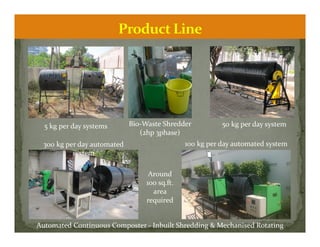
5 kg per day systems 50 kg per day systemBio-Waste Shredder
Automated Continuous Composter - Inbuilt Shredding & Mechanised Rotating
5 kg per day systems 50 kg per day system
100 kg per day automated system300 kg per day automated
system
Bio-Waste Shredder
(2hp 3phase)
Around
100 sq.ft.
area
required
Bio Waste Shredder +
Continuous Composting
Tumbler
Area Required: 100 sqft
16 ft x 5 ft & 3 ft x 5 ft
 Segregated organic waste is processed in bio waste crusher, then manually
transferred to the in-vessel composting tumbler for further curing process which
takes 8-10 days. The tumbler is rotated manually using geared assembly for 5-10 min
after waste input.
 Dried Leaves, Sawdust or Matured Compost may have to be added from time to
time to maintain the moisture level. A small amount of Bio-culture will be added
for composting.
 A Waste Segregation Awareness camp will be held for Housing Society Members
and the Safaiwala of the building will be trained to operate the easy to use
Composting System.
Automated Continuous Composting
Tumbler
 Platform mounted Bio Waste Shredder
 Geared motor for rotation
Area Required: 100 sq ft (17 ft x 6t)
• Segregated organic waste is processed in bio waste crusher, which is transferred to
the in-vessel composting tumbler for further curing process which takes 8-10 days.
The tumbler is rotated using geared motor assembly for 5-10 min after waste input.
• Dried Leaves, Sawdust or Matured Compost may have to be added from time to
time to maintain the moisture level. A small amount of Bio-culture will be added
for composting.
• A Waste Segregation Awareness camp will be held for Housing Society Members
and the Safaiwala of the building will be trained to operate the easy to use
Composting System.
•Capacity = 150 kg
farm waste /hour
•Type of waste = Dry
leaves, pruning's, branleaves, pruning's, bran
ches up to 10 mm
diameter.
• Power = 2 Hp Single
phase
 Leisure Frontier, Maldives
 VJF Prescision and Toolings, Philippines
 SD Corp Ltd.(Shapoorji Group) (Imperial Tower, Tardev Mumbai)
 Bhumi realty Mumbai
 NABARD (National Bank for Agriculture and Rural Development)
 MMRDA (Mumbai Metropolitan Redevelopment Authority)
 State Horticulture Board, Meghalaya
 Indian Institute of Tropical Meteorology IITM , Pune, Maharashtra Indian Institute of Tropical Meteorology IITM , Pune, Maharashtra
 Indian Institute of Management IIM, Trichy, Tamilnadu
 Indian Institute of Hotel Management , Silvasa
 Kundan Developers, Pune, Maharashtra
 Nirwana Country Township, Gurgao, Haryana
 Rajah Group, Kerala
 Delhi Technological Institute, Delhi
 Radisson Hotel , Ludhiyana, Punjab
 Gera Builders, Pune
 Triveni Earthmovers, Orissa
OUR PROUD CUSTOMERS…
ACHEIVEMENTS
Global Maharashtra
Trade Fair 2011
Aurangabad
Installation and Demonstration
of Compost Tumbler at
Krishi- Bhavan, Pune
Clean and Green India
We believe in a consultative process to arrive at the right solutions needed by
Housing Societies and Communities that we work with. This is an introductory
document about continuous composting tumbler. Do reach out to us for more!
Koustubh Yadre
+91 9604 046 983
koustubhyadre@yahoo.com
www.mycocompost.org

Mycocompost ppt 2018

  • 1.
  • 2.
  • 3.
    ROUTINE SCENE OFEVERY CITY of INDIA !
  • 5.
    Bio Degradable Waste 70% Plastic/PaperWaste 15% Glass, Ceramics 5% Metal 6% Miscelleneous 9%
  • 6.
  • 7.
    DRY GARBAGE Plastics Metal Thermocol, Foam Glass WETGARBAGE Vegetable waste Food waste Garden waste Coconut shellGlass Rexene Battery cells Paper Cloth Rubber, bulb, tubes etc. Coconut shell Small pieces of wood Egg shells Meat bones/residual Used cotton Nirmalya, used flower
  • 8.
     Organic wastegenerated should be managed at source only.  Segregation of waste is mandatory for Segregation of waste is mandatory for citizens, residential complexes and other properties. (schedule II , no. 6)
  • 9.
    1) At SourceSegregation 2) Decentralized Organic waste processing. 3) Recycling of plastic, paper and other non- degradable wastes. 4) Last but not the least…… To Create a Mass Awareness among citizens….
  • 11.
    Composting is anatural process of decomposition using oxygen (aerobically) that is better for the environment. Composting produces useful materials that can be put back into the earth to improve soil. Composting turns green waste into a range of high quality, natural soil conditioning product known as compost, which can be used to enrich soil.
  • 12.
    From Nature, ToNature,,,
  • 13.
     SPINTEX COMPOSTTUMBLER ! First time in India ! Specially designed for 2 separate compost cycles.. Looks aesthetic, user friendly and easy to operate, Portable! Gives compost within 3-4 weeks days! Easy discharge of compost. No odor, no rats or cats problem! And saves space.
  • 14.
    Mrs. Vani Murthy FromBangalore A renowned Compost Expert.
  • 15.
     All inone compost culture  Balanced C:N ratio.  Highly supplemented with cellulolyticwith cellulolytic microbes.  No need to add any other raw material.  Provides aeration  Odor generated by kitchen waste restricted.  *Patent Awaited
  • 16.
    Segregated organic wastewill process in bio waste crusher, along with compost culture and absorbent material. This raw waste is kept in the in-vessel compost tumbler system for further curing process.  Shredding: Size reduction of organic waste to convert it into a homogenous mulch. Shredded Shredding convert it into a homogenous mulch. Shredded waste has higher surface area, increasing the rate and efficiency of composting.  Composting: Breaking down of Organic Waste into an extremely useful humus-like substance by the action of various beneficial micro-organisms in the presence of oxygen. This process is carried out in the in-vessel composter. Composting
  • 17.
    ORGANIC WASTE Mesophilic Stage Thermophilic Stage Cooling Stage Specially Designed threelayer insulated vessels Curing Stage Internal Features to break up clumps Baffle Walls for slow and steady flow COMPOST for slow and steady flow • Specifically designed Composter to ensure optimum temperature, moisture and oxygen is available for an environment conducive to rapid composting • Rotation can be manual with gear assembly or automated with a geared motor • Specially designed plastic vessels which are UV resistant and corrosion resistant • Stand and Gear System fabricated from good quality metal • Ideal for Residential Societies, Hotels, Commercial Buildings, Hospitals, etc.
  • 18.
    Add Daily waste+ Carbon + Culture Finished Compost After 4 weeks Give 2-3 Rotations once every day
  • 19.
    SPECIFICATIONSSPECIFICATIONS LAYER METHODLAYERMETHOD COMPOST TUMBLERCOMPOST TUMBLER TECHNOLOGYTECHNOLOGY ProcedureProcedure Layers of waste and soil areLayers of waste and soil are made and vermiculture /made and vermiculture / biosanitizers are added .biosanitizers are added . Add daily waste in tumbler,Add daily waste in tumbler, with waste binder .with waste binder . Compost pitsCompost pits Required as per size ofRequired as per size of condominium.condominium. Not necessary.Not necessary. Process timeProcess time 8080--90 days90 days 33--4 weeks4 weeks MaintenanceMaintenance Required ,as earthworms areRequired ,as earthworms are Not require as microbes canNot require as microbes canMaintenanceMaintenance Required ,as earthworms areRequired ,as earthworms are very much sensitive tovery much sensitive to moisture level in pitmoisture level in pit Not require as microbes canNot require as microbes can survive the stress.survive the stress. LaborLabor Lack of labors (rag pickers)Lack of labors (rag pickers) Not requiredNot required Generation of fouling smellGeneration of fouling smell Yes if not monitored regularly Not Detected.Not Detected. Flies and maggotsFlies and maggots formationformation Yes if not monitored regularly Not DetectedNot Detected Periodic tilting of wastePeriodic tilting of waste Yes after every 8 days At the time of addition ofAt the time of addition of waste.waste. Couple of rotations !Couple of rotations !
  • 20.
    5 kg perday systems 50 kg per day systemBio-Waste Shredder Automated Continuous Composter - Inbuilt Shredding & Mechanised Rotating 5 kg per day systems 50 kg per day system 100 kg per day automated system300 kg per day automated system Bio-Waste Shredder (2hp 3phase) Around 100 sq.ft. area required
  • 22.
    Bio Waste Shredder+ Continuous Composting Tumbler Area Required: 100 sqft 16 ft x 5 ft & 3 ft x 5 ft  Segregated organic waste is processed in bio waste crusher, then manually transferred to the in-vessel composting tumbler for further curing process which takes 8-10 days. The tumbler is rotated manually using geared assembly for 5-10 min after waste input.  Dried Leaves, Sawdust or Matured Compost may have to be added from time to time to maintain the moisture level. A small amount of Bio-culture will be added for composting.  A Waste Segregation Awareness camp will be held for Housing Society Members and the Safaiwala of the building will be trained to operate the easy to use Composting System.
  • 23.
    Automated Continuous Composting Tumbler Platform mounted Bio Waste Shredder  Geared motor for rotation Area Required: 100 sq ft (17 ft x 6t) • Segregated organic waste is processed in bio waste crusher, which is transferred to the in-vessel composting tumbler for further curing process which takes 8-10 days. The tumbler is rotated using geared motor assembly for 5-10 min after waste input. • Dried Leaves, Sawdust or Matured Compost may have to be added from time to time to maintain the moisture level. A small amount of Bio-culture will be added for composting. • A Waste Segregation Awareness camp will be held for Housing Society Members and the Safaiwala of the building will be trained to operate the easy to use Composting System.
  • 25.
    •Capacity = 150kg farm waste /hour •Type of waste = Dry leaves, pruning's, branleaves, pruning's, bran ches up to 10 mm diameter. • Power = 2 Hp Single phase
  • 26.
     Leisure Frontier,Maldives  VJF Prescision and Toolings, Philippines  SD Corp Ltd.(Shapoorji Group) (Imperial Tower, Tardev Mumbai)  Bhumi realty Mumbai  NABARD (National Bank for Agriculture and Rural Development)  MMRDA (Mumbai Metropolitan Redevelopment Authority)  State Horticulture Board, Meghalaya  Indian Institute of Tropical Meteorology IITM , Pune, Maharashtra Indian Institute of Tropical Meteorology IITM , Pune, Maharashtra  Indian Institute of Management IIM, Trichy, Tamilnadu  Indian Institute of Hotel Management , Silvasa  Kundan Developers, Pune, Maharashtra  Nirwana Country Township, Gurgao, Haryana  Rajah Group, Kerala  Delhi Technological Institute, Delhi  Radisson Hotel , Ludhiyana, Punjab  Gera Builders, Pune  Triveni Earthmovers, Orissa
  • 27.
  • 28.
  • 29.
  • 31.
    Installation and Demonstration ofCompost Tumbler at Krishi- Bhavan, Pune
  • 32.
  • 34.
    We believe ina consultative process to arrive at the right solutions needed by Housing Societies and Communities that we work with. This is an introductory document about continuous composting tumbler. Do reach out to us for more! Koustubh Yadre +91 9604 046 983 koustubhyadre@yahoo.com www.mycocompost.org