PERSENTED BY:
LOKESH SAINI
Guided By:
Prof. A. B. Gupta
Deptt. Of Civil Engg.
MNIT, Jaipur
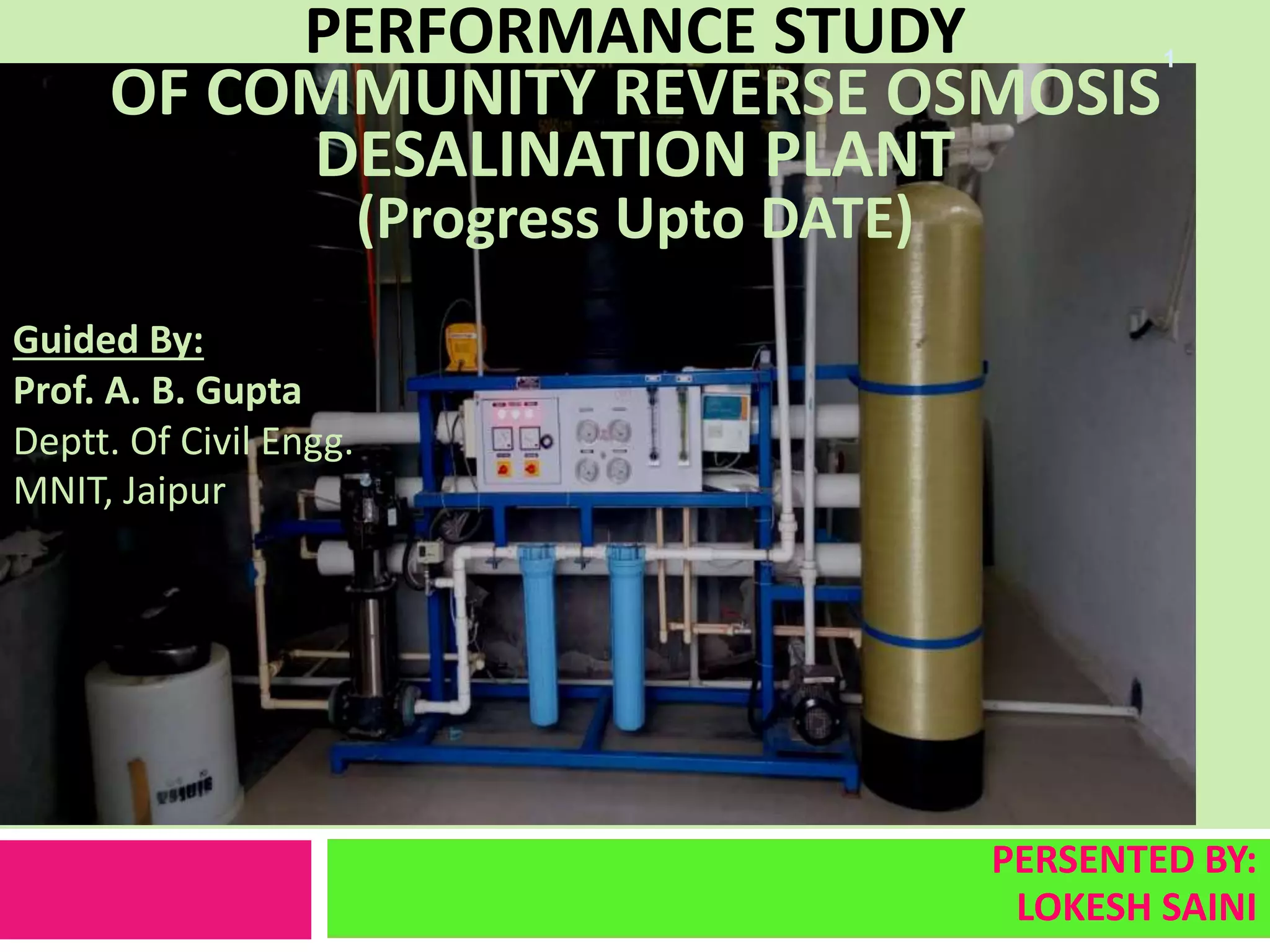
PERFORMANCE STUDY
OF COMMUNITY REVERSE OSMOSIS
DESALINATION PLANT
(Progress Upto DATE)
1
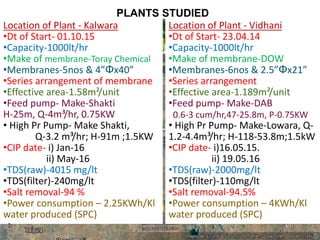
PLANTS STUDIED
Location of Plant - Vidhani
•Dt of Start- 23.04.14
•Capacity-1000lt/hr
•Make of membrane-DOW
•Membranes-6nos & 2.5”Φx21”
•Series arrangement
•Effective area-1.189m²/unit
•Feed pump- Make-DAB
0.6-3 cum/hr,47-25.8m, P-0.75KW
• High Pr Pump- Make-Lowara, Q-
1.2-4.4m³/hr; H-118-53.8m;1.5kW
•CIP date- i)16.05.15.
ii) 19.05.16
•TDS(raw)-2000mg/lt
•TDS(filter)-110mg/lt
•Salt removal-94.5%
•Power consumption – 4KWh/Kl
water produced (SPC)
Location of Plant - Kalwara
•Dt of Start- 01.10.15
•Capacity-1000lt/hr
•Make of membrane-Toray Chemical
•Membranes-5nos & 4”Φx40”
•Series arrangement of membrane
•Effective area-1.58m²/unit
•Feed pump- Make-Shakti
H-25m, Q-4m³/hr, 0.75KW
• High Pr Pump- Make Shakti,
Q-3.2 m³/hr; H-91m ;1.5KW
•CIP date- i) Jan-16
ii) May-16
•TDS(raw)-4015 mg/lt
•TDS(filter)-240mg/lt
•Salt removal-94 %
•Power consumption – 2.25KWh/Kl
water produced (SPC)
2
Raw
Waste0
1000
2000
3000
4000
5000
6000
Raw
Filter
Waste
Avg. Parameters at Kalwara
Raw
Waste0
500
1000
1500
2000
2500
3000
3500
4000
Raw
Filter
Waste
Avg. Parameters at Vidhani
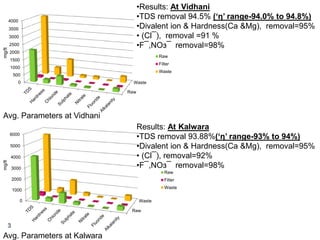
•Results: At Vidhani
•TDS removal 94.5% (‘η’ range-94.0% to 94.8%)
•Divalent ion & Hardness(Ca &Mg), removal=95%
• (Cl¯), removal =91 %
•F¯,NOз¯ removal=98%
Results: At Kalwara
•TDS removal 93.88%(‘η’ range-93% to 94%)
•Divalent ion & Hardness(Ca &Mg), removal=95%
• (Cl¯), removal=92%
•F¯,NOз¯ removal=98%
mg/ltmg/lt
3
0
1000
2000
3000
4000
5000
Jun-16
Jul-16
Aug-16
Sep-16
Oct-16
Vidhani Raw
Vidhani Filter
Vidhani ROC
0
1000
2000
3000
4000
5000
6000
7000
Jun-16
Jul-16
Aug-16
Sep-16
Oct-16
Kalwara Raw
Kalwara Filter
Kalwara ROC
Results: At Vidhani
•There is effect of monsoon on G.W quality.
•Avg. Salt Rejection=94.5%
•ROC salt is higher by 90.7% to feed water
TDS vs time at Vidhani
TDS vs time at Kalwara
Results: At Kalwara
•There is effect of monsoon on G.W. quality
•Avg. Salt Rejection=92.2%
•ROC salt is higher by 36.6% to feed water
** Salt concentration in GW increased
because operator discharged ROC into an
abandoned tube well in the campus itself.
*
*
mg/ltmg/lt
Drawl
Disposal
TDSTDS
4
2
2.2
2.4
2.6
2.8
3
3.2
3.4
Jul-16 Aug-16 Sep-16 Oct-16 Feb-17 Mar-17 Apr-17 May-17
Jul-15 Aug-15 Sep-15 Oct-15 Feb-16 Mar-16 Apr-16 May-16
P1
P2
D1
D2
Trend line for CIP* cycle
16.05.15 to
19.05.16
19.05.16 to
contd….
Results
•In consequent CIP
cycle KWh/Kl reduced
by 12%(approx.)
•Due to fouling SPC
increase by 12.9%.
•P1 and P2 are due to
weather effect (rainy
and winter season).
•D1 & D2 are due to
high weather
temperature.
Fig- Trend of KWh/Kl (SPC) with time at Vidhani
Secondary Data for CIP Cycle-1
Primary Data for CIP Cycle-2
CIP*=clean in place
μ1 = 2.52
σ1 = 0.339
‘SPC’ min-2.03
max-3.18
μ2 = 2.19
σ2 = 0.113
‘SPC’ min-2.0
max-2.35
5
Conclusions of work
•Membranes at both the plants are working satisfactorily.
•Plant operation power KWh/kl and G.W. extraction power charges/kl are
roughly same i.e 1:1.
•SPC depends on TDS of feed water. It increases with TDS.
•SPC also depends on temperature of atmosphere. It reduces with temperature.
•SPC increases with fouling.
•In consecutive CIP cycle SPC is reduced because in CIP, the active layer of
TFC PA membrane is removed and pore size of membrane is increased. Salt
rejection is reduced after each CIP.
•Results of filtered water are still in limits of IS:10500(2012). Hence, membrane
can be chemically washed for next operation.
•There is effect of monsoon on feed water quality. It improves during monsoon.
•Divalent ions and Hardness producing substances(like Ca & mg) are bigger in
size. Hence, removal is more at both plants.
•F¯ is attached with divalent cations Ca†² & Mg†². Hence, removal is good at
both sites.
•Major operation power utilized in High Pr & feed pumps.
--------THANKS--------6

Ppt2 lokesh saini abg

  • 1.
    PERSENTED BY: LOKESH SAINI GuidedBy: Prof. A. B. Gupta Deptt. Of Civil Engg. MNIT, Jaipur PERFORMANCE STUDY OF COMMUNITY REVERSE OSMOSIS DESALINATION PLANT (Progress Upto DATE) 1
  • 2.
    PLANTS STUDIED Location ofPlant - Vidhani •Dt of Start- 23.04.14 •Capacity-1000lt/hr •Make of membrane-DOW •Membranes-6nos & 2.5”Φx21” •Series arrangement •Effective area-1.189m²/unit •Feed pump- Make-DAB 0.6-3 cum/hr,47-25.8m, P-0.75KW • High Pr Pump- Make-Lowara, Q- 1.2-4.4m³/hr; H-118-53.8m;1.5kW •CIP date- i)16.05.15. ii) 19.05.16 •TDS(raw)-2000mg/lt •TDS(filter)-110mg/lt •Salt removal-94.5% •Power consumption – 4KWh/Kl water produced (SPC) Location of Plant - Kalwara •Dt of Start- 01.10.15 •Capacity-1000lt/hr •Make of membrane-Toray Chemical •Membranes-5nos & 4”Φx40” •Series arrangement of membrane •Effective area-1.58m²/unit •Feed pump- Make-Shakti H-25m, Q-4m³/hr, 0.75KW • High Pr Pump- Make Shakti, Q-3.2 m³/hr; H-91m ;1.5KW •CIP date- i) Jan-16 ii) May-16 •TDS(raw)-4015 mg/lt •TDS(filter)-240mg/lt •Salt removal-94 % •Power consumption – 2.25KWh/Kl water produced (SPC) 2
  • 3.
    Raw Waste0 1000 2000 3000 4000 5000 6000 Raw Filter Waste Avg. Parameters atKalwara Raw Waste0 500 1000 1500 2000 2500 3000 3500 4000 Raw Filter Waste Avg. Parameters at Vidhani •Results: At Vidhani •TDS removal 94.5% (‘η’ range-94.0% to 94.8%) •Divalent ion & Hardness(Ca &Mg), removal=95% • (Cl¯), removal =91 % •F¯,NOз¯ removal=98% Results: At Kalwara •TDS removal 93.88%(‘η’ range-93% to 94%) •Divalent ion & Hardness(Ca &Mg), removal=95% • (Cl¯), removal=92% •F¯,NOз¯ removal=98% mg/ltmg/lt 3
  • 4.
    0 1000 2000 3000 4000 5000 Jun-16 Jul-16 Aug-16 Sep-16 Oct-16 Vidhani Raw Vidhani Filter VidhaniROC 0 1000 2000 3000 4000 5000 6000 7000 Jun-16 Jul-16 Aug-16 Sep-16 Oct-16 Kalwara Raw Kalwara Filter Kalwara ROC Results: At Vidhani •There is effect of monsoon on G.W quality. •Avg. Salt Rejection=94.5% •ROC salt is higher by 90.7% to feed water TDS vs time at Vidhani TDS vs time at Kalwara Results: At Kalwara •There is effect of monsoon on G.W. quality •Avg. Salt Rejection=92.2% •ROC salt is higher by 36.6% to feed water ** Salt concentration in GW increased because operator discharged ROC into an abandoned tube well in the campus itself. * * mg/ltmg/lt Drawl Disposal TDSTDS 4
  • 5.
    2 2.2 2.4 2.6 2.8 3 3.2 3.4 Jul-16 Aug-16 Sep-16Oct-16 Feb-17 Mar-17 Apr-17 May-17 Jul-15 Aug-15 Sep-15 Oct-15 Feb-16 Mar-16 Apr-16 May-16 P1 P2 D1 D2 Trend line for CIP* cycle 16.05.15 to 19.05.16 19.05.16 to contd…. Results •In consequent CIP cycle KWh/Kl reduced by 12%(approx.) •Due to fouling SPC increase by 12.9%. •P1 and P2 are due to weather effect (rainy and winter season). •D1 & D2 are due to high weather temperature. Fig- Trend of KWh/Kl (SPC) with time at Vidhani Secondary Data for CIP Cycle-1 Primary Data for CIP Cycle-2 CIP*=clean in place μ1 = 2.52 σ1 = 0.339 ‘SPC’ min-2.03 max-3.18 μ2 = 2.19 σ2 = 0.113 ‘SPC’ min-2.0 max-2.35 5
  • 6.
    Conclusions of work •Membranesat both the plants are working satisfactorily. •Plant operation power KWh/kl and G.W. extraction power charges/kl are roughly same i.e 1:1. •SPC depends on TDS of feed water. It increases with TDS. •SPC also depends on temperature of atmosphere. It reduces with temperature. •SPC increases with fouling. •In consecutive CIP cycle SPC is reduced because in CIP, the active layer of TFC PA membrane is removed and pore size of membrane is increased. Salt rejection is reduced after each CIP. •Results of filtered water are still in limits of IS:10500(2012). Hence, membrane can be chemically washed for next operation. •There is effect of monsoon on feed water quality. It improves during monsoon. •Divalent ions and Hardness producing substances(like Ca & mg) are bigger in size. Hence, removal is more at both plants. •F¯ is attached with divalent cations Ca†² & Mg†². Hence, removal is good at both sites. •Major operation power utilized in High Pr & feed pumps. --------THANKS--------6